
Last Updated: March 2026 • 12–15 min read • Cornerstone Buyer’s Guide + Comparison + Affiliate Picks
✍️ Editorial note: This guide is researched and written by the editors at CoffeeGearHub.com using published grinder specifications, hands-on community knowledge, and established specialty-coffee sources. All product links are affiliate links — we may earn a commission at no cost to you. See our full disclosure policy.
The 30-Second Answer
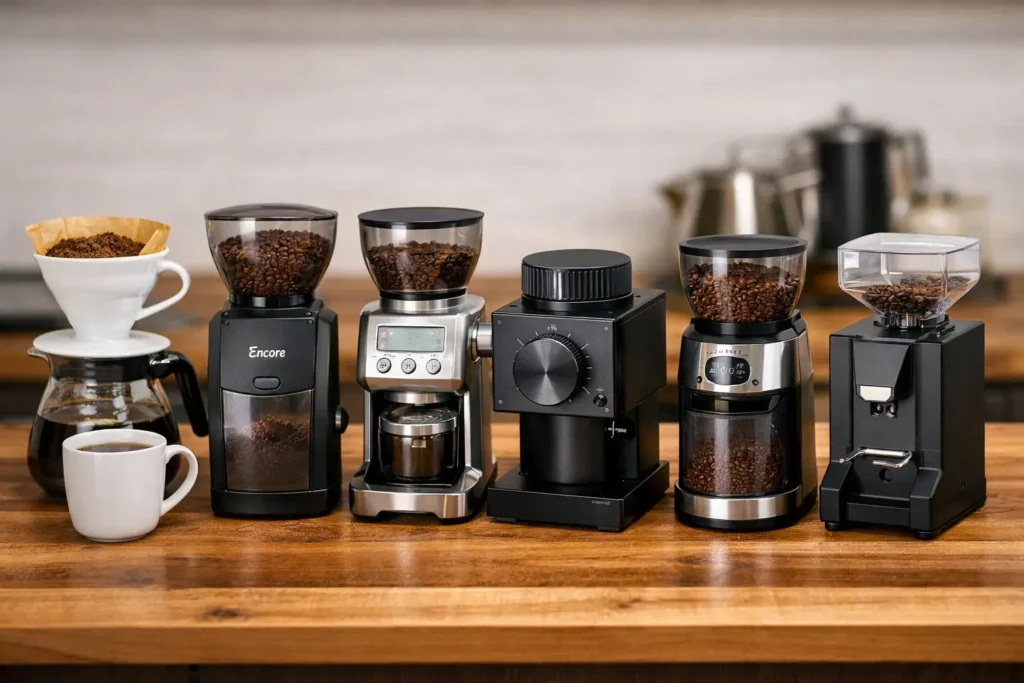
What are the best burr grinders for pour-over coffee? If you brew pour-over coffee, the grinder is the most important piece of equipment you own. You can control water temperature, pouring speed, and brew ratio precisely — but if your grind is uneven, the cup will still taste sour, bitter, or flat. Burr grinders solve this by producing consistent, uniform particles. The question is which one is right for your budget, brewing style, and kitchen.
- Best overall: Fellow Ode Gen 2 — 64mm flat burrs, filter-only design, near-zero retention
- Best value electric: Baratza Encore ESP — proven, repairable, excellent pour-over range
- Best budget: OXO Brew Conical Burr Grinder — best consistency at the lowest entry price
- Best manual: KINGrinder K6 — 48mm burrs, 120+ click range, near-zero retention
- Best premium manual: Comandante C40 MK4 — German nitro blade burrs, gold standard for hand grinding
Who This Guide Is For — Jump to What You Need
☕ Upgrading from a blade grinder
Start at Best Budget or Best Value Electric — both are transformative upgrades at accessible prices.
🤲 Prefer hand grinding
Jump to KINGrinder K6 or Comandante C40 — both outperform budget electric grinders per dollar.
🔬 Care deeply about grind quality
Read Fellow Ode Gen 2 and Grind Science — flat burr geometry explained.
💰 Comparing value across all picks
See Comparison Table + Who Should Buy What side by side.
Table of Contents
Quick Verdict: Choose in 30 Seconds
Pick the Fellow Ode Gen 2 if…
- You brew pour-over daily and want the best electric result
- You want a grinder designed exclusively for filter coffee
- You care about near-zero retention and repeatable results
- You want micro-adjustable precision to dial in any dripper
- Budget is not the primary constraint and you will not grind espresso
Pick a different grinder if…
- Budget-conscious electric pick → Baratza Encore ESP
- Entry-level budget → OXO Brew Conical Burr
- You prefer hand grinding → KINGrinder K6
- You want best-possible manual quality → Comandante C40
- You also pull espresso shots → KINGrinder K6 (wide range) or Baratza Vario+
Full Burr Grinder Comparison Table (2026)
| Grinder | Type | Burr Size | Burr Shape | Adjustment Steps | Retention | Best For | |
|---|---|---|---|---|---|---|---|
| Fellow Ode Gen 2 | Electric | 64mm | Flat | 31 micro-steps | ~0.1g (very low) | Filter coffee only | See Amazon |
| Baratza Encore ESP | Electric | 40mm | Conical | 40 | ~0.5g (low) | Drip + pour over | See Amazon |
| OXO Brew Conical Burr | Electric | 40mm | Conical | 15 + micro-adj. | ~1–2g (moderate) | Drip + pour over | See Amazon |
| KINGrinder K6 | Manual | 48mm | Conical | 120+ | Near zero | Pour over + espresso | See Amazon |
| Comandante C40 MK4 | Manual | 39mm | Conical (nitro) | 120+ (1/3 click) | Near zero | Pour over specialty | See Amazon |
💡 The key distinction: The Fellow Ode Gen 2 and Baratza Encore ESP are both strong electric picks, but they serve different buyers. The Ode Gen 2 is a filter-coffee specialist with flat burrs, micro-adjustability, and near-zero retention. The Encore ESP is a proven all-rounder at a lower price — and it is repairable, which matters for long-term ownership. One important note: the Fellow Ode Gen 2 does not grind fine enough for espresso. If you need a dual-purpose grinder, the KINGrinder K6 covers both methods at a fraction of the price.
Our Method: What We Actually Look for in a Pour-Over Grinder
Most grinder guides rank by price tier or brand reputation. For CoffeeGearHub, every recommendation is evaluated against the specific demands of pour-over brewing — which is more sensitive to grind quality than almost any other brew method:
What matters in a pour-over grinder
- Grind consistency: Does the grinder produce uniform particles — or a wide scatter of sizes?
- Adjustment range: Is the medium to medium-fine range finely adjustable, not jumping between settings?
- Retention: How much stale coffee stays in the grinder and mixes into fresh grounds?
- Repeatability: Can you return to the same setting reliably day after day?
- Value: Is the grind improvement proportional to the price difference?
What a pour-over grinder cannot do
The Fellow Ode Gen 2 — the top pick in this guide — is a filter-coffee-only grinder. It does not grind fine enough for espresso. If you need one grinder for both pour-over and espresso, the KINGrinder K6 covers both methods, or the Baratza Vario+ is the electric option. This guide focuses entirely on pour-over performance. If you also pull espresso shots, see our espresso grinder guide before deciding.
Best Overall Burr Grinder for Pour Over: Fellow Ode Gen 2
Affiliate link — commission earned at no cost to you.
🏆 Fellow Ode Gen 2 — Best for Serious Pour-Over Brewers
CoffeeGearHub Rating: 4.7 / 5
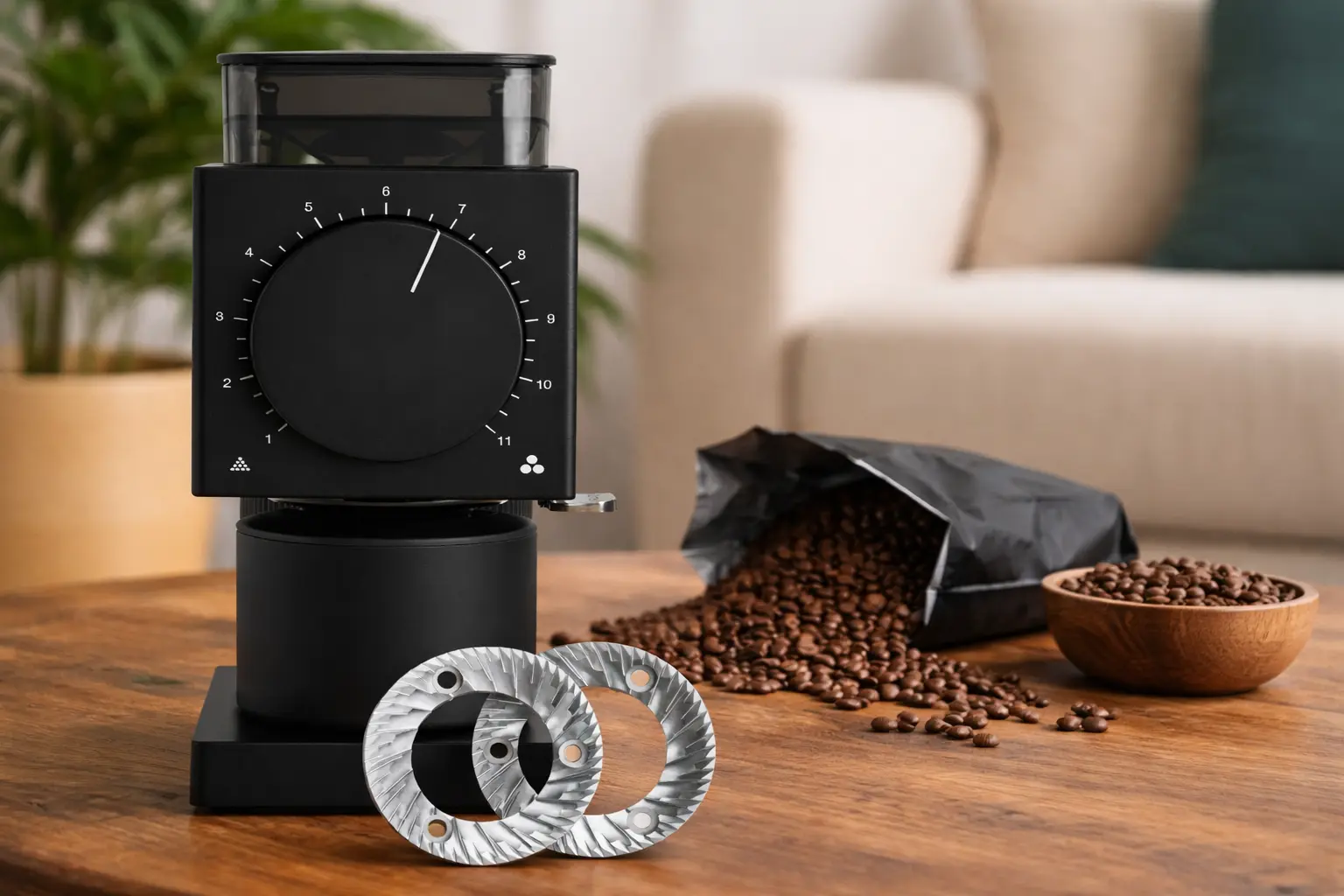
The Fellow Ode Gen 2 is the best burr grinder for pour-over because it was engineered with filter coffee as the only priority. Its 64mm flat stainless steel burrs produce a narrow, uniform grind distribution that is noticeably cleaner than conical entry-level grinders — especially for light-roast single-origin coffees where clarity and sweetness are the goal. The Gen 2 redesign improved burr geometry to reduce fines compared to the original Ode, and added a single-dosing catch cup that makes the workflow cleaner. Grind retention is near-zero at roughly 0.1g — what you grind is exactly what hits your V60, not a mix of today’s and yesterday’s coffee.
The one honest limitation: the Ode Gen 2 does not grind fine enough for espresso. If you need a dual-purpose grinder, this is not it. But for V60, Chemex, Kalita Wave, and batch brew, it is the clearest electric upgrade available for pour-over.
✅ Pros
64mm flat burrs — exceptional consistency
Near-zero retention (~0.1g)
31 micro-step adjustments
Single-dose catch cup (Gen 2 upgrade)
Filter-coffee-only focus
Low-noise motor
❌ Cons
Does not grind for espresso
Higher price than value picks
Single-dose design — no bulk hopper
Larger footprint than entry grinders
Best for: daily pour-over brewers who want the best possible grind quality for V60, Chemex, Kalita Wave, or batch brew — and will not be grinding espresso from the same machine.
Best Value Electric Grinder for Pour Over: Baratza Encore ESP
Affiliate link — commission earned at no cost to you.
Baratza Encore ESP — Best Value Electric for Daily Pour Over
CoffeeGearHub Rating: 4.4 / 5
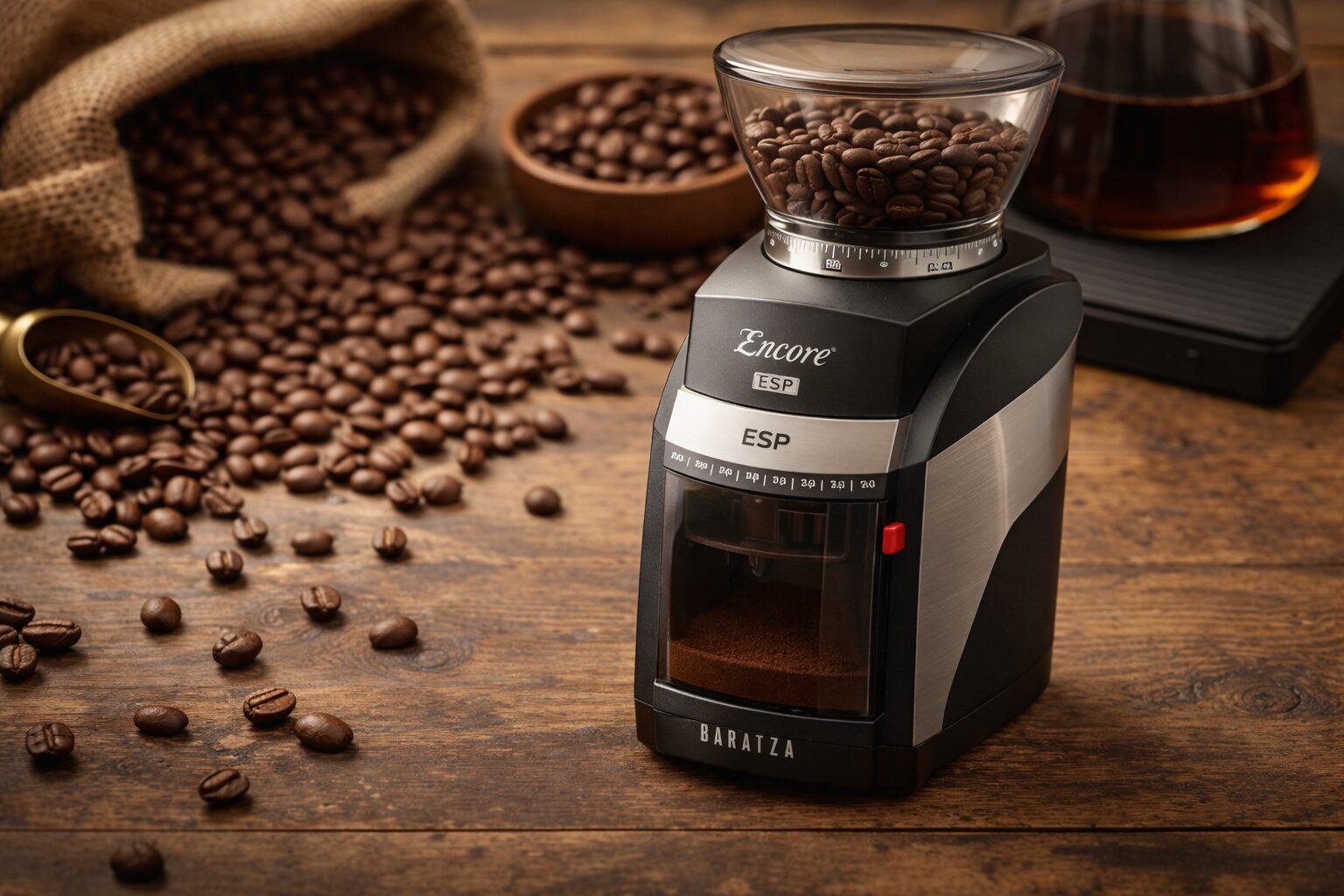
The Baratza Encore ESP is the most recommended first electric burr grinder for pour-over — and that reputation is well-earned. Its 40 grind settings cover the full filter coffee range cleanly, from coarse French press through medium-fine V60 and Chemex. The 40mm conical burrs deliver consistent results that represent a massive improvement over any blade grinder, and the improvement is immediately obvious in the cup. Baratza’s repair-first philosophy sets the Encore ESP apart from most competitors at this price: replacement burrs, motors, and parts are all available directly from Baratza, making this one of the most sustainable grinder investments on the market.
The trade-off versus the Fellow Ode Gen 2 is grind distribution: the Encore ESP’s conical burrs produce a slightly wider particle spread, most noticeable when brewing very light single-origin roasts. For medium roasts and everyday specialty coffee, that gap is not a practical issue.
✅ Pros
40 settings — full filter coffee range
Proven, consistent conical burrs
Repair-friendly — parts from Baratza directly
Compact, reliable daily driver
Strong community of support resources
❌ Cons
Wider distribution than flat-burr grinders
Moderate retention (~0.5g)
Adjustment steps coarser than Ode Gen 2
Limited espresso capability
Best for: first-time burr grinder buyers who want a proven, repairable, daily-driver electric grinder for pour-over, drip, and French press at an accessible price point.
Best Budget Burr Grinder for Pour Over: OXO Brew Conical Burr Grinder
Affiliate link — commission earned at no cost to you.
OXO Brew Conical Burr Grinder — Best Budget Option
CoffeeGearHub Rating: 4.0 / 5
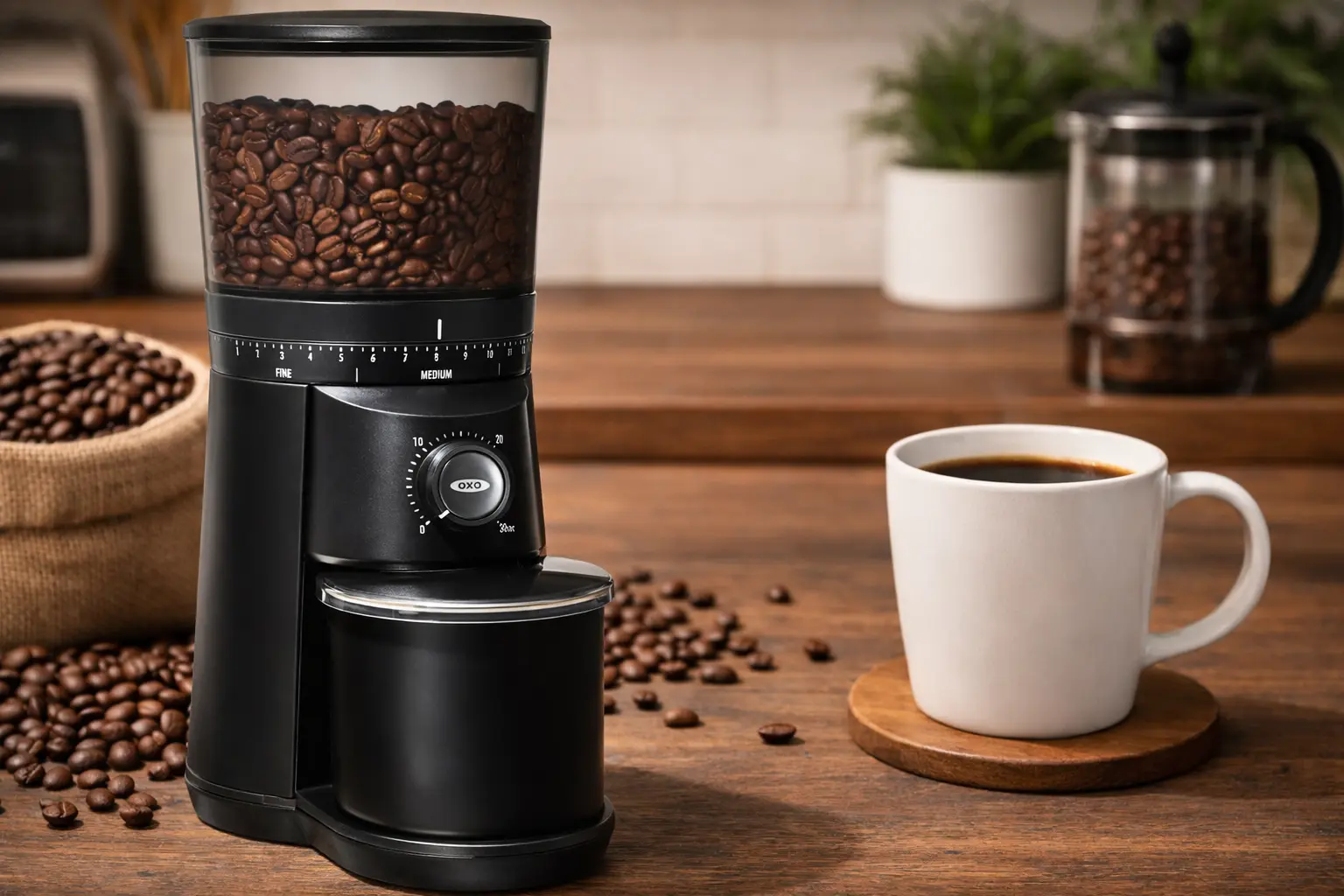
The OXO Brew is the best entry into burr grinding for pour-over at an accessible price point. It delivers a genuine conical burr grind that is dramatically more consistent than any blade grinder — and for anyone coming from a blade grinder, the improvement in cup quality is immediate. Its 15 main settings with micro-adjustments provide enough range to dial in a V60 or flat-bottom dripper, and the controls are simple enough that setup takes minutes. Retention is moderate at 1–2g, which is acceptable for most daily brewing but worth noting if you single-dose specialty beans and care about maximum freshness.
✅ Pros
Most affordable option in this guide
Genuine conical burr consistency
Simple, intuitive controls
Covers full drip and pour-over range
Good hopper capacity for daily use
❌ Cons
Moderate retention (1–2g)
Fewer micro-steps than Encore ESP
Louder than higher-end grinders
Less precise for specialty light roasts
Best for: anyone upgrading from a blade grinder for the first time who wants immediate, noticeable improvement in pour-over quality at the lowest possible entry price.
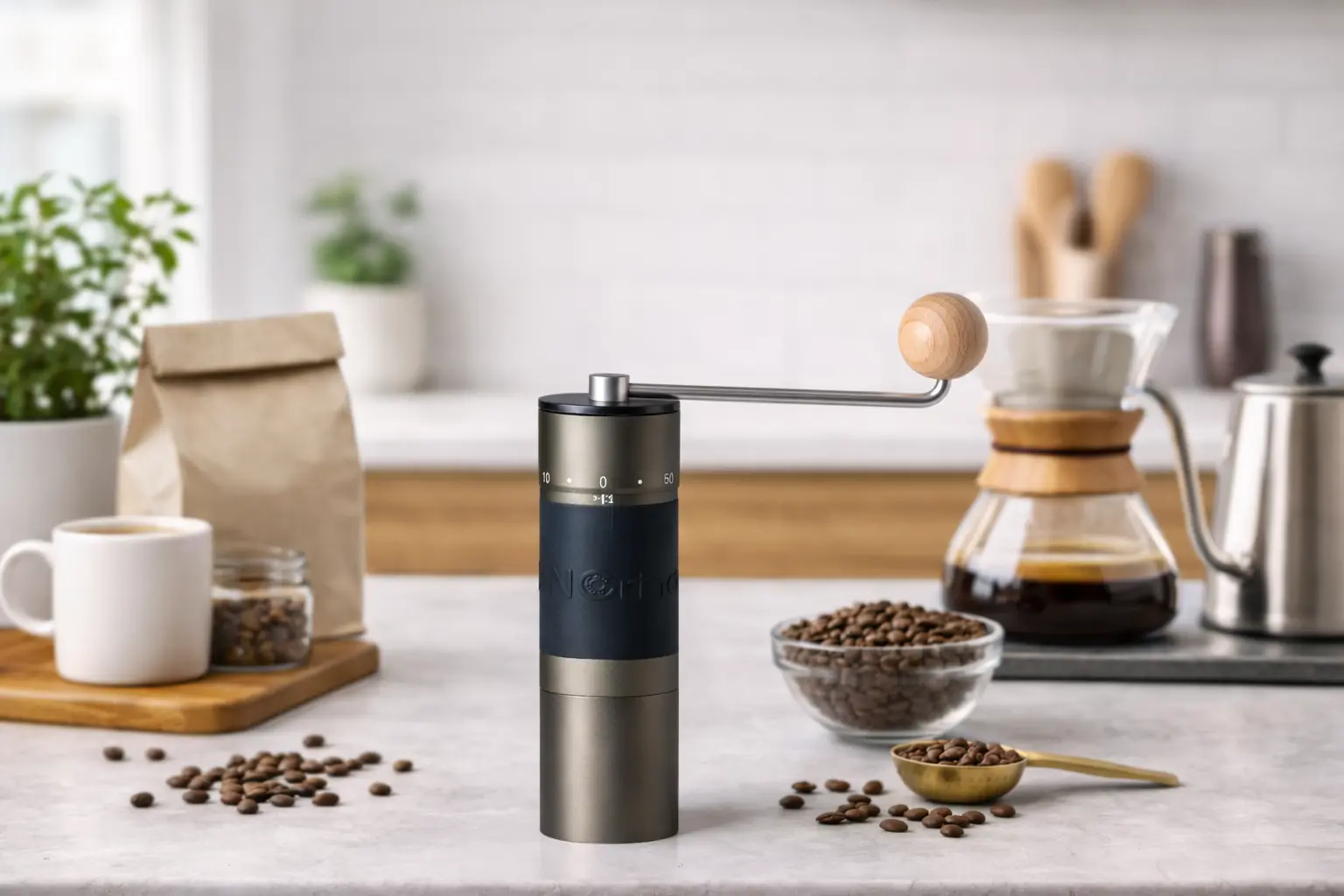
Best Manual Burr Grinder for Pour Over: KINGrinder K6
Affiliate link — commission earned at no cost to you.
KINGrinder K6 — Best Manual Grinder for Pour Over
CoffeeGearHub Rating: 4.5 / 5
The KINGrinder K6 is the best manual grinder for pour-over at its price point — and one of the strongest options in the entire manual grinder category. Its 48mm conical steel burrs produce excellent grind uniformity, and the 120+ click adjustment range gives more dialing-in precision than most electric grinders at twice the price. Near-zero retention means every gram ground goes into your cup, not the grinder body. It is genuinely quiet, portable, and requires no electricity — making it ideal for home brewing, travel, and anyone who values silence in the morning.
Pour-over grind settings: Start at 25–26 clicks for a standard V60. Move finer (22–24 clicks) if the brew runs too fast and tastes sour. Move coarser (27–30 clicks) for flat-bottom drippers like the Kalita Wave or Chemex. Target a total brew time of 3:00–3:30 and adjust in 2-click increments.
✅ Pros
48mm burrs — exceptional for the price
120+ click range — precise dialing
Near-zero retention
Quiet, portable, travel-friendly
No motor to fail
Wide range covers pour over + espresso
❌ Cons
Manual effort — 3–4 min per cup
Not practical for multiple cups quickly
Requires consistent handle technique
No motor = no speed advantage over time
Best for: single-cup pour-over brewers who value grind quality, silence, portability, and maximum value per dollar — and anyone who wants an excellent hand grinder for travel.
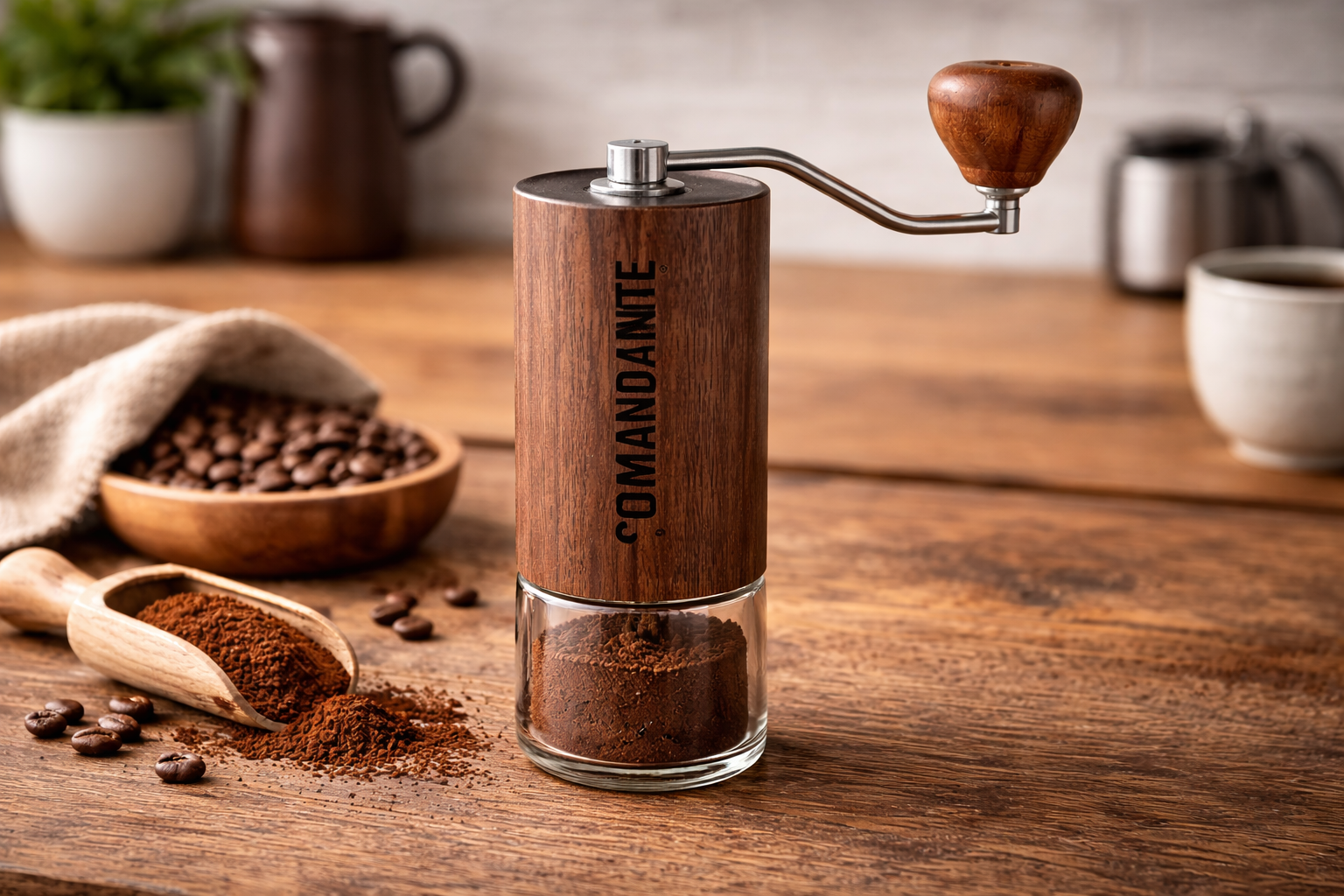
Best Premium Manual Grinder for Pour Over: Comandante C40 MK4
Affiliate link — commission earned at no cost to you.
Comandante C40 MK4 — Best Premium Manual Grinder
CoffeeGearHub Rating: 4.8 / 5
The Comandante C40 MK4 is the gold standard for manual pour-over grinding. Built in Germany from aerospace-grade stainless and high-nitrogen nitro blade steel burrs, it produces a grind distribution that competes with electric flat-burr grinders costing two to three times more. The MK4 generation refined the burr geometry and precision bearing system from earlier versions, resulting in smoother grinding action and tighter particle distribution. Specialty coffee competitions have been won on beans ground with a Comandante — and that performance is available to any home brewer willing to invest at the premium tier.
This is a grinder you buy once. It is also the right choice for serious pour-over brewers who travel frequently and will not compromise on grind quality away from home.
✅ Pros
Exceptional grind uniformity
Nitro blade steel burrs — competition-grade
Silky-smooth grinding action
Ultra-precise 1/3-click adjustments
Built to last decades
Gold standard at specialty cafés worldwide
❌ Cons
Highest price in this guide
Manual effort — not for multiple cups
Overkill for casual or medium-roast brewers
Shipping lead times can vary
Best for: serious pour-over enthusiasts who brew light-roast single-origin coffees, want the absolute ceiling of manual grind quality, or travel frequently and refuse to compromise on their cup.
🔬 KINGrinder K6 vs Comandante C40: The K6 delivers roughly 80% of the Comandante’s grind quality at about 35% of the price. For most pour-over brewers — especially those working with medium-roast specialty coffee — that gap is not noticeable in the cup. The Comandante pulls ahead when you are brewing very light, complex single-origin coffees where fine particle uniformity makes a perceptible difference in clarity and sweetness. If you are newer to specialty coffee or brewing medium roasts, the K6 is the smarter buy. If you are chasing the ceiling of manual pour-over quality, the Comandante delivers it.
How to Choose the Best Burr Grinder for Pour-Over Coffee
Pour-over grinder selection comes down to five questions. Work through them in order and the right pick becomes clear.
| Factor | What to ask yourself | What to buy |
|---|---|---|
| Grind consistency priority | How important is cup-to-cup repeatability vs. ease of use? | Upgrade order by consistency: OXO Brew → Encore ESP → Fellow Ode Gen 2 (electric); K6 → Comandante (manual) |
| Electric vs manual | Do you value speed and convenience, or silence and portability? | Electric for daily multi-cup convenience; manual for single-cup brewing, silence, or travel |
| Budget | What is your ceiling? | Entry-level → OXO Brew; mid-range → Encore ESP or Fellow Ode Gen 2; manual value → K6; manual premium → Comandante. Check Amazon for current pricing on each. |
| Espresso too? | Do you also pull espresso shots from this same grinder? | Fellow Ode Gen 2 cannot grind for espresso. For dual use: KINGrinder K6 covers both; Baratza Vario+ is the electric option. |
| Roast level | Do you mostly brew light roasts, or medium to dark? | Light roasts benefit most from flat burrs (Fellow Ode Gen 2) and low fines. Medium-dark roasts are more forgiving of conical grinders. |
🔬 The grinder-first rule: In pour-over brewing, grinder quality has a larger impact on cup quality than any other variable — including the dripper itself. An entry-level burr grinder paired with a basic plastic V60 will produce noticeably better coffee than a premium ceramic Chemex paired with a blade grinder. If you can upgrade only one thing in your setup, always make it the grinder.
Who Should Buy Which Burr Grinder?
| Your situation | Buy this | Why |
|---|---|---|
| You want the best pour-over grinder, full stop | Fellow Ode Gen 2 | 64mm flat burrs, filter-only design, near-zero retention — the clearest electric upgrade for pour-over |
| You want a reliable first electric burr grinder | Baratza Encore ESP | Proven, repairable, 40 settings — best all-around value for daily electric pour-over grinding |
| You are upgrading from a blade grinder on a budget | OXO Brew Conical Burr | Best entry price for genuine burr consistency — a transformative improvement in every cup |
| You prefer hand grinding for single cups | KINGrinder K6 | 48mm burrs, 120+ clicks, near-zero retention — best manual grinder value for pour over |
| You want the highest possible manual grind quality | Comandante C40 MK4 | German nitro blade burrs, competition-grade uniformity, designed to last decades |
| You grind for both pour-over and espresso | KINGrinder K6 or Baratza Vario+ | The K6’s wide click range covers both methods; the Vario+ adds electric speed for dual use |
| You travel and will not compromise on grind quality | Comandante C40 MK4 or KINGrinder K6 | Both pack easily — Comandante for maximum quality, K6 for best travel value |
| You brew light-roast single-origin pour over seriously | Fellow Ode Gen 2 or Comandante C40 | Flat burrs and premium nitro conical burrs reveal more clarity and sweetness in light roasts |
Electric vs Manual Burr Grinders for Pour Over
| Feature | Electric Burr Grinder | Manual Burr Grinder | Winner |
|---|---|---|---|
| Grinding speed | 20–30 seconds per dose | 2–4 minutes per cup | 🏆 Electric |
| Grind quality per dollar | Good — top-tier flat burrs cost more | Excellent — manual grinders punch above their price | 🏆 Manual |
| Noise | Loud — motor and grinding both audible | Near-silent — ideal for early mornings | 🏆 Manual |
| Portability | Requires counter space and power outlet | Compact, no power needed — ideal for travel | 🏆 Manual |
| Multiple cups back to back | Efficient for 2–4 cups quickly | Tiring — each cup requires full manual effort | 🏆 Electric |
| Retention | Varies — OXO ~1–2g; Encore ESP ~0.5g; Ode Gen 2 ~0.1g | Near-zero — no motor cavity to trap grounds | 🏆 Manual |
| Long-term reliability | Motor can fail; parts may be discontinued | No motor to fail — simpler mechanism lasts decades | 🏆 Manual |
| Best for | Daily multi-cup brewers, shared households | Single-cup specialists, travelers, quiet brewers | Depends |
For most daily pour-over brewers, electric is more practical. For single-cup specialists, travelers, or anyone who brews before others are awake, a high-quality manual grinder is the better tool — and often produces better results per dollar spent than budget electric grinders.
If you want to understand how grinder choice affects every pour-over variable, our complete setup guide connects all the dots: Pour-Over Coffee Brewing Setup: The Complete Guide.
Grind Science: Why Burr Geometry Matters for Pour Over
Pour-over brewing is gravity-driven extraction. Water flows through the coffee bed at a rate determined almost entirely by particle size and bed density. When your grind distribution is uneven, two things happen at the same time: fine particles over-extract and contribute bitterness, while coarse particles under-extract and contribute sourness. The result is a cup that tastes both harsh and sour simultaneously — a problem no amount of pouring technique can fix. The solution is not more skill. It is a better grinder.
Flat burrs vs conical burrs
Flat burrs cut beans between two horizontal rings rotating in opposite directions. This produces a unimodal (single-peak) particle distribution — meaning most particles land close to the target size with fewer outliers on either end. The result is a cleaner, brighter cup with greater clarity and separation of flavor notes. The Fellow Ode Gen 2 uses 64mm flat burrs specifically to maximize this effect for filter coffee.
Conical burrs use a cone-shaped inner burr inside a ring. They produce a bimodal distribution with a secondary peak of fine particles, creating a fuller body and sweeter finish — which many brewers prefer for medium to dark roasts. All manual grinders in this guide use conical burrs, as do the Encore ESP and OXO Brew.
What retention actually costs you
Every gram of coffee retained inside a grinder was ground in a previous session. When your next dose pushes it out, stale grounds mix into your fresh batch. For a grinder retaining 2g, a 15g dose effectively contains 2g of stale coffee. Over days and weeks, the stale-to-fresh ratio shifts, and cups taste different even when technique is identical.
This is why low-retention grinders like the Fellow Ode Gen 2 (~0.1g) and all manual grinders (near-zero) produce more consistent results day to day — and why high-retention grinders require flushing before dialing in a new bag of beans.
Troubleshooting: Grind Problems and How to Fix Them
Most pour-over problems trace directly back to the grind. Here is a diagnostic matrix covering the most common issues:
| Problem | Likely cause | Fix |
|---|---|---|
| Coffee tastes sour or sharp | Grind too coarse — water flows too fast, underextraction | Move 2–3 steps finer; target 3:00–3:30 total brew time |
| Coffee tastes bitter or harsh | Grind too fine — water stalls, overextraction | Move 2–3 steps coarser; check that bloom is even |
| Both sour and bitter at once | Uneven grind distribution — likely blade grinder or worn burrs | Upgrade to a burr grinder; check for burr wear or alignment drift |
| Drawdown too fast (under 2 min) | Grind too coarse or uneven coffee bed distribution | Grind finer; swirl or tap brewer before pouring to level the bed |
| Drawdown too slow (over 5 min) | Grind too fine or fines clogging filter | Grind coarser; try rinsing filter before adding coffee |
| Cup tastes different every day | Inconsistent grind setting, high retention, or stale coffee | Mark your grind setting; use a low-retention grinder; grind fresh daily |
| Flat, no clarity or sweetness | Grind too coarse or water temperature too low | Grind slightly finer; brew at 200–205°F (93–96°C) |
How to Get Better Pour-Over Results from Any Burr Grinder
Grind settings and workflow
- ✅ Always grind immediately before brewing — pre-grinding even hours in advance loses volatile aromatics
- ✅ Dial in by total brew time — target 3:00–3:30 for most pour-over methods
- ✅ Change one variable at a time — adjust grind size before changing dose, water temp, or pour speed
- ✅ Use filtered water — mineral content affects extraction more than most brewers expect; aim for 50–150 ppm TDS
Grinder care and consistency
- ✅ Mark your go-to setting — tape or a pen mark lets you return reliably after cleaning
- ✅ Purge when switching beans — grind a few grams of the new coffee before your real dose to clear the previous grind
- ✅ Clean burrs monthly — coffee oils build up on burrs and affect flavor over time
- ✅ Store beans airtight — even the best grinder cannot save stale coffee; freshness starts before the grinder
Cleaning and Maintenance: Keep Your Grinder Performing
Coffee oils, packed fines, and static buildup all degrade grinder performance gradually. A simple routine keeps every grinder in this guide performing at spec for years:
| Task | How often | Why it matters |
|---|---|---|
| Brush out grounds from burr chamber | Every 1–2 weeks for daily users | Fine particles pack into burr grooves and widen grind distribution over time |
| Full burr cleaning (disassemble and brush) | Monthly | Coffee oils oxidize on burrs — rancid oils affect flavor, most noticeably on light roasts |
| Run a grinder cleaning tablet (electric grinders) | Monthly | Urnex Grindz or similar tablets absorb oils and remove buildup without full disassembly |
| Check and re-tighten burr alignment | Every 3–6 months | Alignment drift widens grind distribution — a common cause of gradual quality loss |
| Inspect and replace burrs | Every 500–1000 kg of coffee ground | Worn burrs produce more fines and uneven cuts; performance degrades slowly before failure |
FAQs: Best Burr Grinders for Pour Over
Do I really need a burr grinder for pour-over coffee?
Yes. Pour-over brewing is extremely sensitive to grind consistency. Burr grinders produce uniform particles that extract evenly, producing clean, sweet cups. Blade grinders create inconsistent particle sizes that cause simultaneous sour and bitter flavors in the same cup — a problem no technique can fix.
What is the best burr grinder for pour-over coffee overall?
The Fellow Ode Gen 2 is the best overall burr grinder for pour-over coffee. Its 64mm flat burrs, filter-coffee-only design, near-zero retention (~0.1g), and 31 micro-step adjustments make it purpose-built for V60, Chemex, Kalita Wave, and batch brew..
Are manual grinders good enough for pour-over coffee?
Absolutely. High-quality manual grinders like the KINGrinder K6 and Comandante C40 often outperform entry-level electric grinders in grind consistency. They are slower, but excellent for single-cup pour-over brewing, and offer near-zero retention that most budget electric grinders cannot match.
What grind size should I use for pour-over coffee?
Most pour-over brewers work best with a medium to medium-fine grind. Flat-bottom drippers like the Kalita Wave prefer medium. Cone-shaped brewers like the V60 usually perform better slightly finer. Target a total brew time of 3:00–3:30 and adjust in two-step increments from there.
What is the difference between flat and conical burrs for pour-over?
Flat burrs produce a more uniform, unimodal particle distribution — resulting in a cleaner, brighter cup with greater clarity. Conical burrs produce a bimodal distribution with more fine particles — often described as fuller and sweeter. Both work well for pour-over. Flat burrs are generally preferred for light roasts; conical for medium to dark.
How many clicks on a KINGrinder K6 for pour-over coffee?
For pour-over coffee, the KINGrinder K6 works well in the 22–28 click range. Start at 25–26 clicks for a standard V60 and adjust finer if the brew runs fast and tastes sour, or coarser if it runs slow and tastes bitter. Flat-bottom drippers like the Kalita Wave typically prefer 27–29 clicks. Adjust in 2-click increments and target 3:00–3:30 total brew time.
What is grind retention and why does it matter?
Grind retention is the amount of ground coffee that stays inside the grinder after each session. High retention means stale grounds from previous sessions mix into your fresh coffee, causing inconsistent flavor day to day. Grinders like the Fellow Ode Gen 2 (~0.1g retention) and all manual grinders (near-zero) make results significantly more repeatable.
Is the Baratza Encore ESP good for pour-over?
Yes. The Baratza Encore ESP is a solid pour-over grinder, especially as a first electric burr grinder. It offers 40 grind settings covering the full drip and pour-over range, consistent conical burrs, and reliable performance for V60, Chemex, and flat-bottom drippers. Its main limitation compared to the Fellow Ode Gen 2 is a wider grind distribution — most noticeable when brewing very light roasts.
What is the Comandante C40 and who is it best for?
The Comandante C40 MK4 is a premium German-made hand grinder widely considered the gold standard for manual pour-over brewing. Its high-nitrogen nitro blade steel burrs produce exceptional grind uniformity that competes with electric flat-burr grinders costing two to three times more. It is best for serious pour-over enthusiasts who brew light-roast single-origin coffees and want the absolute ceiling of manual grind quality.
Why does my pour-over taste different every day?
Daily variation is most often caused by inconsistent grind size — returning to a slightly different setting each brew. Other causes include high grinder retention mixing stale grounds into fresh ones, water temperature fluctuation, and inconsistent pouring speed. A quality burr grinder with clear adjustment markings and low retention makes results significantly more repeatable day to day.
Next Reads
GRINDER GUIDES
POUR-OVER GUIDES
Ready to put your new grinder to work? The right beans make as much difference as the right equipment. Our pour-over coffee beans guide covers the best roasters, origins, and roast levels for V60, Chemex, and flat-bottom drippers.
☕
Written by the CoffeeGearHub Editorial Team
CoffeeGearHub is a specialty coffee equipment resource produced by the CoffeeGearHub Editorial Team. Our guides are researched using published brewing science, equipment manufacturer specifications, and established specialty-coffee community knowledge. We review and update our pillar content regularly. About CoffeeGearHub →