
Last Updated: March 2026 • 30–40 min read • Beginner’s Cornerstone Guide: Grinder Science + Top Picks + Dial-In System
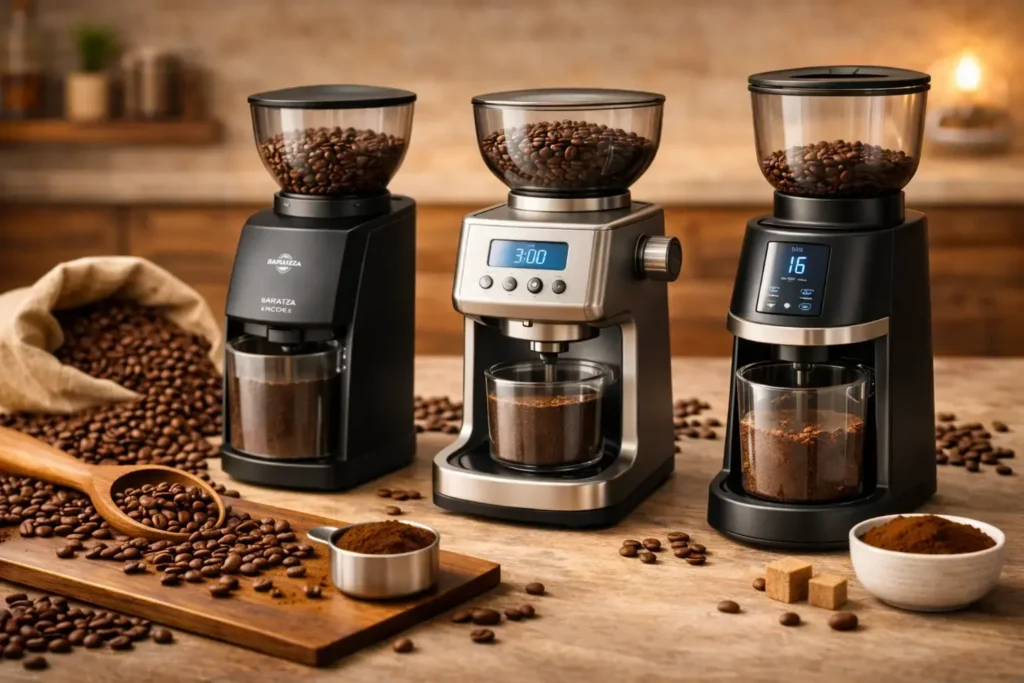
If you are just getting into home coffee brewing, the best coffee grinders for beginners are the most impactful purchase you can make — not a nicer coffee maker, not a temperature-controlled kettle, not a better bag of beans. Fresh, consistently ground coffee transforms your cup in a way that no other upgrade can match, and it does so immediately and obviously from the very first brew. The problem most beginners face is not a lack of options: it is the opposite. Blade grinders are marketed alongside burr grinders at every price point. Manual grinders look identical to cheap plastic ones. Electric grinders come with specifications that mean nothing to someone who has never ground coffee before. This guide cuts through all of it. We explain exactly what matters for a beginner grinder purchase, why burr grinders are the only correct starting point, which grinders are worth buying at each price and use case, and how to dial in your first grind setting so your first cup is actually good — not just better than pre-ground.
✍️ Editorial note: This guide is researched and written by the editors at CoffeeGearHub.com using published brewing science, SCA Brewing Standards, manufacturer specifications, and established specialty-coffee community knowledge. All product links are affiliate links — we may earn a commission at no cost to you. Affiliate Disclosure: CoffeeGearHub.com participates in the Amazon Services LLC Associates Program. As an Amazon Associate, we earn from qualifying purchases.
🛒 New to Amazon? Try Prime free for fast, free shipping on every pick in this guide — or try Audible free if you’d rather listen while your coffee brews.
🛒 New to Amazon? Try Prime free for fast, free shipping on every pick in this guide — or try Audible free if you’d rather listen while your coffee brews.
The 30-Second Answer
For most beginners, the Baratza Encore is the correct first electric burr grinder — 40 grind settings, proven consistency across drip, pour-over, and French press, and a decade of community endorsement from new and experienced home brewers alike. If budget is your primary constraint, the OXO Brew Conical Burr Grinder is the right first step: reliable burr grinding at a lower price. For a manual option that outperforms its price class by a significant margin, the KINGrinder K6 is the CoffeeGearHub standard recommendation across all beginner and intermediate brewing content. Skip blade grinders entirely — they produce simultaneous over- and under-extraction that no other variable can correct, regardless of what you spend on beans, brew gear, or technique.
- Best Overall Electric: Baratza Encore — the beginner electric standard for over a decade, 40 settings, repairable
- Best Budget Electric: OXO Brew Conical Burr Grinder — reliable and simple, honest value for a first burr grinder
- Best Manual: KINGrinder K6 — the CoffeeGearHub standard, 100-click precision, 48mm burrs that outperform the price
- Best Step-Up: Baratza Virtuoso+ — for beginners who outgrow the Encore on advanced pour-over within 12–18 months
- What to skip: Any blade grinder — the extraction problem they create cannot be fixed by any other variable
Who This Guide Is For — Jump to What You Need
☕ Total Beginner
Start with Why Your Grinder Matters and Burr vs Blade before reading the picks.
⚡ Budget Decider
Jump to How Much to Spend and then Top Picks for the right grinder at your budget.
🔧 Troubleshooter
Jump straight to the Troubleshooting Matrix — bitter, sour, muddy, and flat cup fixes all covered.
🎗 First Dial-In
See the Grind Settings Table for K6 click references and the Dial-In Guide for how to use them.
Table of Contents
- Why your grinder matters more than your coffee maker
- Burr vs blade: the only explanation a beginner needs
- What beginners should look for: 5 variables that matter
- Flat burr vs conical burr: which is right for beginners
- How much should a beginner spend on a grinder?
- Grinder type comparison by beginner use case
- Best coffee grinders for beginners: top picks
- Manual vs electric: which should a beginner buy?
Why Your Grinder Matters More Than Your Coffee Maker
Most beginners start their home coffee journey the same way: they buy a better coffee maker and keep using pre-ground coffee or a blade grinder. The result is reliably disappointing — a marginal improvement at best, and persistent frustration at worst. The machine is not the limiting variable. The grinder is.
The reason is extraction physics. Every cup of coffee is the result of water dissolving soluble compounds from ground coffee particles at different rates depending on particle size. Acids extract first and quickly. Sweetness and body extract in the middle phase. Bitter compounds extract last and slowly. The goal of any brew is to stop extraction after the desirable compounds are dissolved and before the undesirable ones dominate. A consistent grind — where all particles are approximately the same size — lets all grounds hit the optimal extraction window at the same time. You can tune your brew time, temperature, and ratio to dial that window in, and once you find it, it repeats reliably. An inconsistent grind — produced by any blade grinder — produces fine particles that over-extract (bitter, harsh) and large chunks that under-extract (sour, weak) simultaneously in the same cup. No adjustment to any other variable can fix both problems at once because they are caused by the same root issue: particle size inconsistency. This is why buying a burr grinder is the single most impactful step a beginner can take — not a better kettle, not a nicer dripper, not a more expensive bag of beans. For a full primer on how brewing variables interact, see our Coffee Brew Ratio Guide.
🔬 The freshness factor: Whole beans begin losing aromatic volatile compounds — the molecules responsible for differentiated coffee flavour — within minutes of grinding. Pre-ground coffee sold in bags has been oxidising since the roastery, typically days to weeks before you brew it. Grinding fresh immediately before brewing is not a specialty coffee preference: it is the fastest per-cup quality improvement available to any beginner at any budget. Even a $40 burr grinder grinding fresh beans immediately before brewing will outperform pre-ground coffee in any machine at any price.
Burr vs Blade: The Only Explanation a Beginner Needs
Before reading any product reviews or comparing any prices, a beginner needs to understand one thing: burr grinders and blade grinders are not different tiers of the same product. They work on fundamentally different mechanical principles and produce fundamentally different results. There is no blade grinder at any price that produces results comparable to a quality burr grinder.
| Burr Grinder | Blade Grinder | |
|---|---|---|
| How it works | Two abrasive surfaces set at a precise distance crush beans to a consistent size — the gap between burrs determines particle size | A spinning blade randomly chops beans — particle size is determined by how long you run it, not by any mechanical precision |
| Particle consistency | Highly consistent — all particles exit at approximately the same size for a given setting | Highly inconsistent — every grind produces a random mix of fine powder and large chunks |
| Cup result | Even extraction — balanced acidity, sweetness, and body; diallable; repeatable every session | Mixed extraction — simultaneously bitter (fines over-extract) and sour (chunks under-extract) in the same cup |
| Fixable by adjusting recipe? | Yes — grind coarser or finer and the cup changes predictably | No — the problem is particle inconsistency; no recipe change addresses two opposite extraction problems at once |
| Beginner verdict | ✓ The only starting point worth considering | ✗ Skip entirely — even the cheapest burr grinder produces better results |
⚠️ Already own a blade grinder? If your coffee currently tastes simultaneously harsh and flat in the same cup — bitter on the tongue but thin and weak in body — that is the blade grinder problem. You cannot fix it by adjusting brew time, dose, temperature, or bean quality. The fix is replacing it with any burr grinder. A $40 entry manual burr grinder will produce a noticeably better cup with the same beans in the same recipe.
What Beginners Should Look for in a Coffee Grinder: 5 Variables That Actually Matter
As a beginner, you do not need the most features, the most settings, or the most advanced burr geometry. You need a grinder that is consistent, adjustable, durable enough to use daily, and simple enough to not get in the way of learning. These five factors separate genuinely good beginner grinders from the rest.
| Factor | Why it matters for beginners | What to look for | What to avoid |
|---|---|---|---|
| Burr size | Larger burrs produce more consistent output, generate less heat, and wear more slowly — all important for daily beginner use | 38mm+ for manual; 40mm+ for electric grinders at beginner price points | Grinders with burr size undisclosed — usually indicates very small burrs |
| Grind adjustment range | More steps means more room to find the right grind for your brew method as a beginner — wider range covers more methods | 40+ settings for electric; 30+ clicks for manual; ability to cover both drip and pour-over | Fewer than 15 settings; large jumps between adjacent settings |
| Ease of use | A grinder that is difficult to adjust or read will slow down the beginner learning curve significantly | Clear setting markings; consistent tactile click feedback; simple on/off operation | Stepless adjustment without clear reference markings — difficult for beginners to reproduce settings |
| Build quality | A beginner grinder used daily must handle repetitive stress — cheap motors and plastic burr carriers fail quickly | Metal burr carrier; solid housing; brand with available replacement parts | All-plastic burr carrier; no-brand imports with no spare parts available |
| Beginner-appropriate price | The $80–$180 range covers all genuine quality beginner options; outside this range means either too cheap (poor burrs) or paying for precision you won’t use yet | $80–$100 manual; $60–$90 budget electric; $150–$180 buy-once electric | Under $40 electric burr — burrs and motor are too small for consistent daily output at that price |
Flat Burr vs Conical Burr: Which Is Right for Beginners
All quality burr grinders fall into one of two burr geometry categories: flat burr or conical burr. As a beginner, this distinction matters less than the burr vs blade decision — but it explains why most beginner grinders use conical burrs and why that is the correct choice at this level.
| Conical Burr | Flat Burr | |
|---|---|---|
| How it works | Cone-shaped inner burr inside a ring-shaped outer burr; beans travel downward through the gap | Two parallel flat rings with abrasive faces; beans ground in the gap between the faces |
| Particle output | Slightly bimodal — a primary peak at the target size plus a small fines peak; adds body to the cup | More unimodal — tighter particle distribution; cleaner, brighter cup |
| Heat generation | Lower — self-clearing geometry reduces friction; better for home daily use | Higher — more friction; matters for large doses; common in commercial machines |
| Noise level | Quieter — standard for most home and beginner grinders | Louder — common in prosumer and commercial equipment |
| Price entry point for quality | $35 (KINGrinder K6 manual) to $170 (Baratza Encore electric) | $200+ for quality flat burr home grinders |
| Best for beginners? | ✓ Yes — correct at every beginner price point | ⚠ Not necessary at beginner level; revisit for espresso or advanced pour-over later |
☕ Coffee Lover Gift Guide
Looking for a thoughtful gift for a coffee enthusiast? Browse our curated Amazon gift guide featuring coffee gear, mugs, grinders, brewers, and accessories for different budgets.
Shop the Coffee Lover Gift GuideAs an Amazon Associate, I may earn from qualifying purchases.
How Much Should a Beginner Spend on a Coffee Grinder?
This is the question every new buyer asks first, and it has a clear answer: the quality threshold for a beginner burr grinder starts around $60–$80 for electric and $80–$100 for manual. Below these thresholds, burr size and motor quality fall to the point where consistency is noticeably compromised. Above the $180 mark at the beginner stage, you are paying for grind precision — sub-100-micron particle uniformity, stepless adjustment, commercial-grade burrs — that most beginners cannot distinguish in the cup and cannot use effectively without several months of experience first.
| Budget Range | What you get | Best pick | Best for |
|---|---|---|---|
| Under $40 | Blade grinders only — inconsistent output; skip this category entirely | None — save and buy a burr grinder | Not recommended |
| $60–$90 | Entry electric burr — limited settings but reliable improvement over blade grinding | OXO Brew Conical Burr Grinder | Budget-conscious beginners; first step up from blade |
| $80–$100 | Quality manual burr — 48mm burrs, 100-click precision, better grind quality per dollar than electric at this price | KINGrinder K6 | Small kitchens, quiet mornings, grind quality per dollar priority |
| $150–$180 | Buy-once beginner electric — 40 settings, replaceable burrs, covers all non-espresso methods reliably | Baratza Encore | Beginners who want to buy once and not revisit the decision |
| $180–$250 | Step-up electric — DC motor, 54 settings, lower fines; meaningful improvement for serious pour-over | Baratza Virtuoso+ | Beginners who outgrow the Encore within 12–18 months |
Beginner Grinder Type: Quick-Comparison by Use Case
| Best For | Recommended Grinder | Why It Works for Beginners | Trade-Off | Budget |
|---|---|---|---|---|
| First electric grinder, daily drip or pour-over | Baratza Encore | Covers all non-espresso methods; 40 settings; proven beginner track record; repairable | Higher upfront cost; counter space required | $150–$180 |
| Budget-conscious beginner | OXO Brew Conical Burr | One-touch operation; timer dosing; clear improvement over blade grinding | 15 settings only; less precise for pour-over dial-in | $60–$90 |
| Small kitchen or quiet apartment | KINGrinder K6 | No counter space; very quiet; 48mm burrs produce output that beats most beginner electric grinders | Manual effort per dose; slower for 4+ cups | $80–$100 |
| Travel or camping | KINGrinder K6 | Portable, no electricity required; 100-click system portable across any brew method | Requires manual grinding effort away from home too | $80–$100 |
| Beginner who brews 4+ cups daily | Baratza Encore | Electric speed; no repetitive manual effort for large doses; hopper-based dosing | Permanent counter footprint; slightly louder than manual | $150–$180 |
Best Coffee Grinders for Beginners: Our Top Picks
These four picks represent the best beginner grinder at each use case and price point — verified by consistent community endorsement, grind consistency data, and alignment with how each is actually used by beginners in real daily brewing. All affiliate links use the CoffeeGearHub Amazon Associates tag.
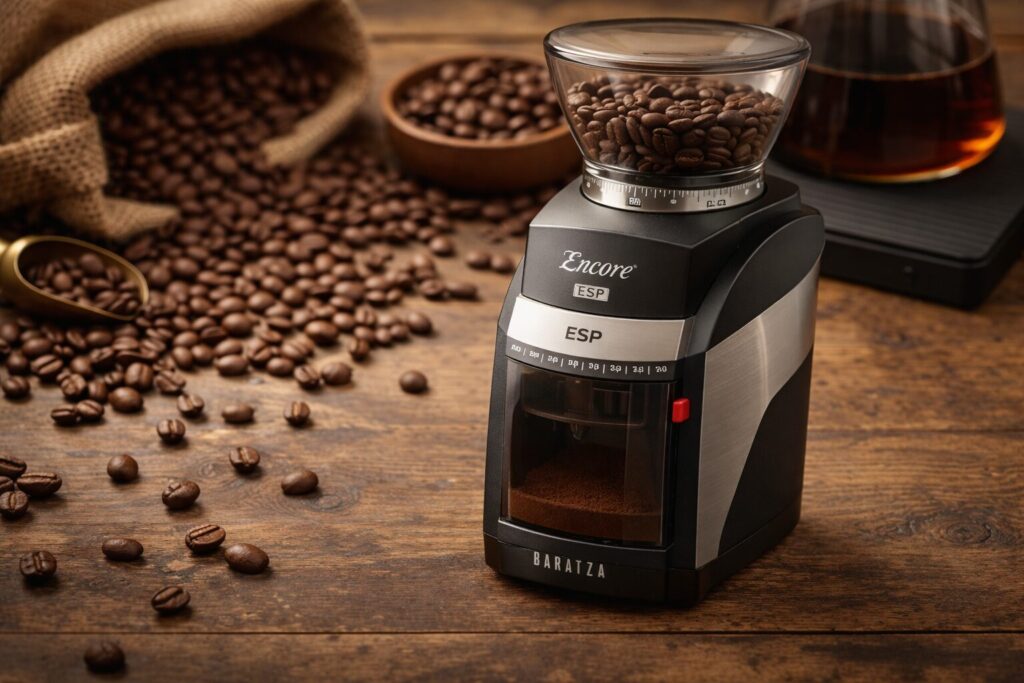
Best Overall: Baratza Encore
The Baratza Encore has been the most consistently recommended first electric burr grinder in the specialty coffee community for over a decade — and for good reason. The front-mounted grind dial gives beginners a simple, tactile interface with 40 clearly marked settings. The 40mm conical burrs produce output that is immediately and obviously better than any blade grinder. The grind range covers drip, pour-over, French press, and AeroPress from a single unit without any settings feeling cramped together. Most importantly for a beginner: Baratza sells replacement burrs, motors, and hoppers directly, which means this is a grinder you maintain rather than discard when something eventually wears. At the $150–$170 price point it is the most straightforward answer to “what should a beginner buy?”
- Burr type: 40mm conical stainless steel burrs
- Settings: 40 grind settings — covers drip, pour-over, French press, AeroPress
- Beginner-friendly features: Simple front dial; front-mounted pulse button; hopper holds up to 230g
- Brew method coverage: Drip (20–25), pour-over (15–20), French press (28–35), AeroPress (10–18)
- Best for: any beginner who wants to buy once and not revisit the grinder decision for years
Disclosure: CoffeeGearHub may earn from qualifying purchases.
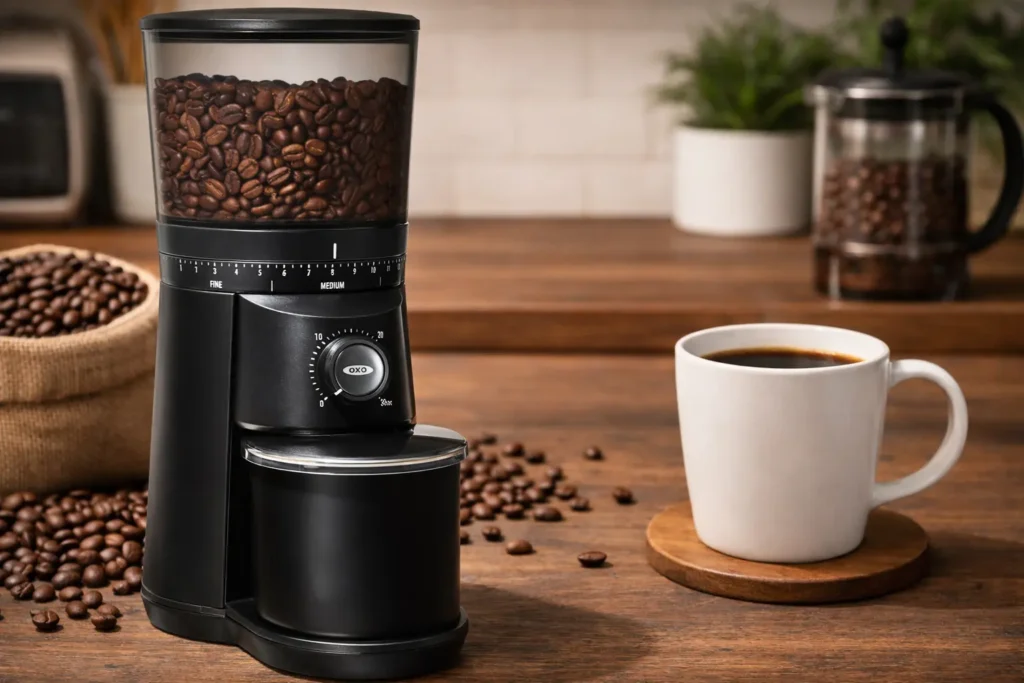
Best Budget Electric: OXO Brew Conical Burr Grinder
The OXO Brew Conical Burr Grinder is designed around simplicity and is the most beginner-friendly electric burr grinder at its price point. The one-touch timer dosing system removes the need to weigh every dose, the 15 grind settings are clearly labelled and cover home drip and French press reliably, and the conical stainless burrs produce output that is a clear, immediate improvement over any blade grinder. The OXO’s limitations are real — 15 settings is limiting once you start dialling in V60 or Chemex, and replacement parts are not as accessible as Baratza — but as a first step into burr grinding at under $80, it is the correct recommendation. Beginners who start here and develop a more serious interest in pour-over will naturally upgrade to the Encore or Virtuoso+ within 12–18 months, and that is a perfectly reasonable trajectory.
- Burr type: Conical stainless steel burrs
- Settings: 15 grind settings — covers home drip, French press, basic pour-over
- Beginner-friendly features: One-touch timer; clear setting dial; minimal interface to learn
- Brew method coverage: Drip (7–9), pour-over (5–7), French press (11–14)
- Best for: budget-constrained beginners; anyone who wants zero guesswork in their first grinder
Disclosure: CoffeeGearHub may earn from qualifying purchases.
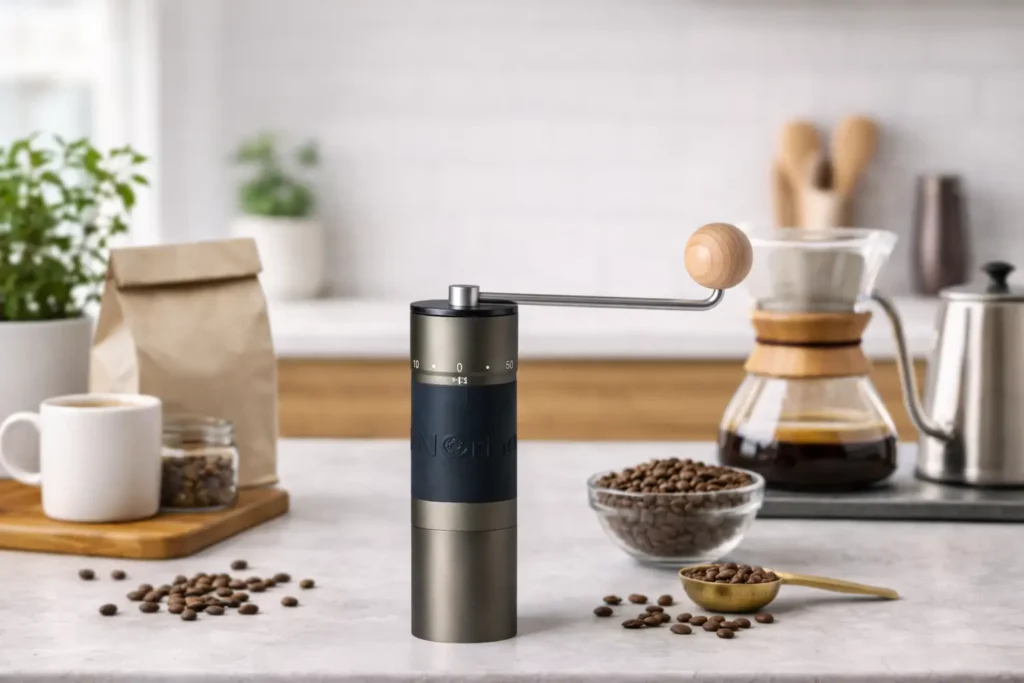
Best Manual: KINGrinder K6
The KINGrinder K6 is the CoffeeGearHub standard manual grinder recommendation and deserves serious consideration from any beginner who is choosing between this and an entry electric grinder. The 48mm stainless conical burrs are larger than most manual grinders in this price range — larger burrs mean lower fines production, which translates directly into a cleaner cup with less bitterness at the bottom of a pour-over or less mud in a French press. The 100-click adjustment system is the K6’s biggest beginner advantage: 5-click increments at any brew method setting produce a clear, readable extraction shift, making dial-in methodical rather than guesswork. Every CoffeeGearHub brewing guide references K6 click settings, so beginners following this site’s guides will always have a precise starting point regardless of method.
- Burr type: 48mm stainless conical burrs — large for the price class, noticeably low fines
- Settings: 100-click system — the most precise grind adjustment available to a beginner at this price
- Beginner-friendly features: Click feedback on every setting; no electricity; no counter space; quiet
- Brew method coverage: All non-espresso methods — full K6 click reference table below
- Best for: beginners in small kitchens or apartments; anyone wanting best grind quality per dollar
Disclosure: CoffeeGearHub may earn from qualifying purchases.
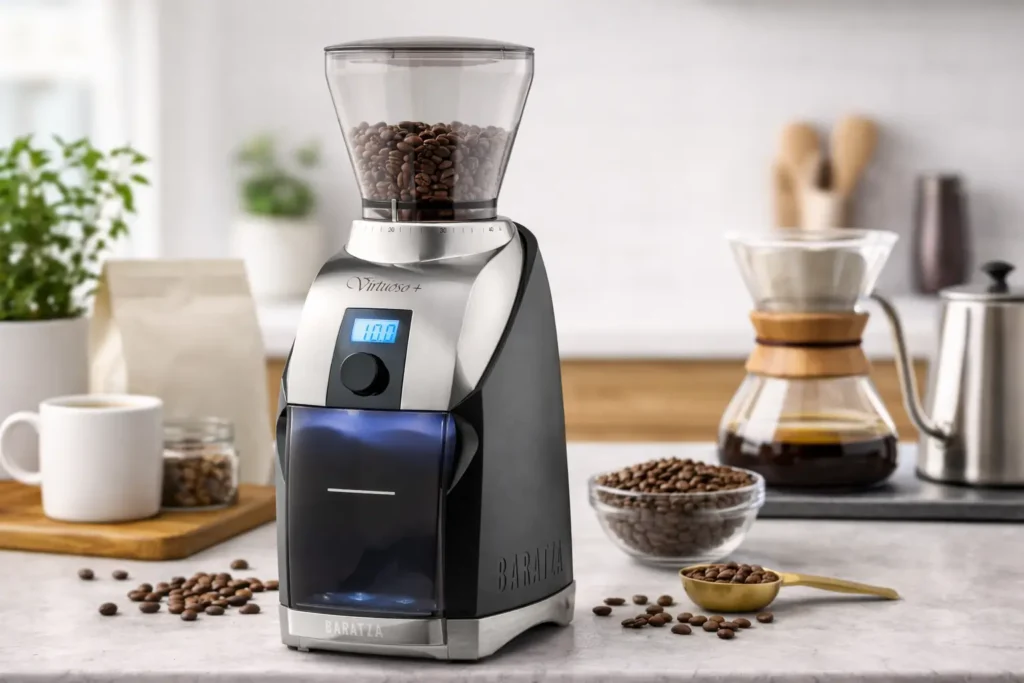
Best Step-Up: Baratza Virtuoso+
The Baratza Virtuoso+ is included here not as a first purchase recommendation but as the correct answer to a question many beginners arrive at within their first year: “I’ve outgrown the Encore — what’s next?” The 54-setting range gives more resolution at medium-fine pour-over than the Encore’s 40 settings, the DC motor runs quieter and more consistently than the Encore’s AC motor, and the 40mm high-carbon steel burrs produce a noticeably lower fines output that shows up clearly in V60 and Chemex clarity. The built-in digital timer allows repeatable dose-by-time grinding. The Virtuoso+ is not a necessary first purchase — beginners should start with the Encore and only consider this when pour-over precision becomes an active limiting factor.
- Burr type: 40mm high-carbon steel conical burrs — lower fines than standard Encore burrs
- Settings: 54 settings — more pour-over resolution than the Encore
- Beginner-relevant features: Digital dose timer; DC motor (quieter); same Baratza parts ecosystem
- Best for: Encore graduates; beginners who develop a serious interest in V60 or Chemex within their first year
Disclosure: CoffeeGearHub may earn from qualifying purchases.
Manual vs Electric: Which Should a Beginner Buy?
This is the second most common question after burr vs blade, and unlike burr vs blade it genuinely depends on your situation. Neither manual nor electric is universally better for beginners. The right answer depends on how much you brew, where you live, and what matters most to your morning routine.
| Manual Burr Grinder (K6) | Electric Burr Grinder (Baratza Encore) | |
|---|---|---|
| Grind quality per dollar | Higher — K6’s 48mm burrs at ~$80 outperform most electric grinders under $150 | Good — Encore’s 40mm burrs are excellent for the price |
| Speed for 1–2 cups | Practical — 15g takes about 60 seconds; acceptable for most beginners | Fast — 15g in under 10 seconds; negligible morning delay |
| Speed for 3+ cups | Slow — 30g+ requires multiple sessions; noticeable effort for larger doses | No limitation — electric handles any home dose without extra effort |
| Counter space | None — stores in a drawer; ideal for small kitchens and apartments | Permanent footprint — approximately 15cm × 15cm base |
| Noise | Very quiet — near-silent; no noise complaint risk in apartments or early mornings | Moderate — 70–80dB; audible but not disruptive in most homes |
| Portability | Excellent — travel-ready; works without electricity anywhere | Not portable — requires outlet; impractical outside the home |
| Learning curve | Very low — click system is intuitive; easy to log and repeat settings | Low — numbered dial is straightforward; settings are easy to find and return to |
| Best beginner scenario | Small kitchens, apartments, 1–2 cup daily, travel use, grind quality per dollar priority | 3+ cups daily, multiple household brewers, convenience priority, drip machine daily use |
Beginner Grind Size Guide: What Each Brew Method Requires
Every brew method requires a different grind size because every method extracts coffee at a different rate. Beginners are often surprised to find that the same beans in the same grinder can produce entirely different cups just by changing the grind setting. This is not a flaw — it is the system working correctly. Use the table below to find your starting point for any brew method. Then use the dial-in guide to refine from there.
| Brew method | Grind size | Visual reference for beginners | K6 starting clicks | Too fine result | Too coarse result |
|---|---|---|---|---|---|
| AeroPress (standard) | Medium-fine to medium | Fine sand — slightly coarser than table salt | 18–26 clicks | Bitter, slow press, clogged filter | Watery, sour, hollow body |
| V60 / Pour-over | Medium-fine | Coarse sand — like beach sand | 26–34 clicks | Stalling draw-down, bitter | Fast draw-down, sour, thin |
| Chemex | Medium to medium-coarse | Slightly coarser than V60 — Chemex paper is thicker | 32–40 clicks | Very slow draw-down, bitter | Fast, sour, pale cup |
| Drip / filter machine | Medium | Coarse sand — texture of granulated sugar | 35–45 clicks | Slow flow, bitter, over-extracted | Fast flow, weak, watery |
| French press | Coarse | Coarse sea salt or rough breadcrumbs | 68–78 clicks | Hard to press, bitter, muddy | Weak, thin, flat body |
| Cold brew | Extra-coarse | Very rough — almost pebble-like | 80–92 clicks | Over-extracted, bitter concentrate | Under-extracted, sour, flat |
Extraction Science: Why Grind Consistency Changes Everything in Your Cup
Understanding the extraction mechanism behind grind consistency is not optional knowledge for beginners — it is the foundation of every adjustment you will make to your brew for as long as you brew coffee. Three principles cover everything you need to know at this stage.
- Particle size determines extraction rate, and extraction rate determines what your cup tastes like. Coffee contains hundreds of soluble compounds — acids, sugars, oils, and bitter phenolics — that dissolve in water at different rates. Acids and bright notes extract first (quickly), sweetness and body extract in the middle phase, and bitter compounds extract last (slowly). The goal of every brew is to stop extraction in the middle zone — after the desirables are dissolved but before the undesirables dominate. A consistent grind lets all particles hit this window at the same time. An inconsistent grind — from any blade grinder — means fine particles overshoot the window (over-extracted, bitter) while large particles never reach it (under-extracted, sour) simultaneously in the same cup. This is why no recipe adjustment can fix a blade grinder problem: you are fighting two opposite extraction issues at once.
- Fines are the hidden variable in grind quality that most beginners don’t know about. Every burr grinder produces some ultra-fine particles as a grinding by-product. These fines extract almost instantly, contributing bitterness and muddiness before the main particles have even reached their optimal point. The quantity of fines varies significantly between grinders: small, cheap burrs produce more; large, quality burrs produce fewer. This is why the KINGrinder K6’s 48mm burrs produce a cleaner, less muddy cup than cheaper manual grinders with 38mm burrs — and it is why burr size is a meaningful specification, not marketing. For a deeper dive into grind consistency and particle distribution, see our Burr vs Blade Grinders guide.
- Freshness is the third variable beginners underestimate. Coffee begins losing aromatic volatile compounds within minutes of grinding. These volatiles are responsible for the differentiated flavours — fruit, floral, chocolate, caramel — that make specialty coffee worth buying. Pre-ground coffee in bags has been oxidising for days to weeks before you brew it. Grinding immediately before brewing preserves the full aromatic profile. This is not an advanced technique or a specialty preference: it is the most impactful quality improvement a beginner can make, and a burr grinder is what makes it practical at every morning brewing session.
KINGrinder K6 Grind Settings: Beginner Reference Table by Brew Method
All settings measured from zero (burrs touching). Find your method and roast, use the click number as your starting point, brew once, taste, and adjust 3–5 clicks at a time based on the dial-in guide below. Beginners: write down every setting change and what you tasted. It makes every subsequent session faster.
| Brew method | Roast | K6 clicks (from zero) | Water temp | Contact time | Ratio | Flavour target |
|---|---|---|---|---|---|---|
| AeroPress (standard) | Medium–Dark | 18–24 clicks | 88–93°C | 2–3 min | 1:12–1:15 | Full body, low acidity, smooth |
| AeroPress (light / fruity) | Light | 22–28 clicks | 78–85°C | 2 min | 1:13–1:15 | Delicate, fruit-forward, tea-like |
| V60 pour-over | Light | 26–32 clicks | 94–96°C | 2.5–3.5 min | 1:15–1:16 | Bright, complex, fruit-forward |
| V60 pour-over | Medium | 26–32 clicks | 92–94°C | 2.5–3.5 min | 1:15 | Balanced caramel, round body |
| Chemex | Light–Medium | 32–40 clicks | 93–95°C | 3.5–4.5 min | 1:15–1:17 | Clean, crisp, wine-like |
| Drip / filter machine | Medium | 35–45 clicks | 90–94°C | Machine-controlled | 1:15–1:17 | Balanced, everyday |
| French press | Medium | 65–72 clicks | 93°C | 4 min steep | 1:15 | Balanced caramel, nut, round body |
| French press | Dark | 74–82 clicks | 90–92°C | 3.5–4 min | 1:13–1:14 | Bittersweet, rich, heavy body |
| Cold brew | Med-dark / Dark | 80–92 clicks | Cold / room temp | 12–16 hrs | 1:8–1:10 | Sweet, low-acid concentrate; dilute 1:1 to serve |
Dial-In Guide: How a Beginner Finds Their First Good Grind Setting
Dial-in is the process of finding the grind setting that produces a balanced cup with your specific bean, brew method, and recipe. It is the skill that separates beginners who feel frustrated with their grinder from beginners who feel in control of their cup. The process is methodical, not intuitive, and the most important rule is also the simplest: change one variable at a time.
The Beginner Dial-In Process
- Start at the K6 click number from the table above for your method and roast
- Brew using standard parameters for your method: standard dose, standard temperature, standard pour or steep time
- Taste the cup. Identify the primary off-note: sour/thin OR bitter/harsh — pick the dominant one
- Adjust grind only: 3–5 clicks finer for sour; 3–5 clicks coarser for bitter
- Re-brew at the new setting, everything else identical
- Repeat until the cup is balanced — no dominant sour or bitter note
- Only then: adjust dose for strength or temperature for body/brightness
Taste → What to Adjust
- Sour / sharp / watery body: grind 3–5 clicks finer → re-brew
- Bitter / harsh / dry finish: grind 3–5 clicks coarser → re-brew
- Still sour after grind adjustment: raise water temp 2°C; extend brew time 15s
- Still bitter after grind adjustment: lower water temp 2°C; shorten brew time 15s
- Balanced but too weak: add 2–3g coffee; keep water volume the same
- Balanced but too strong: reduce 2–3g coffee; keep water volume the same
- No aroma at any setting: buy fresher beans — stale coffee cannot be fixed by grind adjustment
Common Beginner Grinder Mistakes to Avoid
| Mistake | Why beginners make it | What to do instead |
|---|---|---|
| Buying a blade grinder to save money | Blade grinders are cheaper and marketed alongside burr grinders in stores | Save an extra $30–$40 and buy the OXO Brew instead — the cup quality difference is immediate and obvious |
| Buying an espresso-focused grinder first | Espresso sounds impressive as a first home coffee goal | Start with a drip or pour-over setup — espresso requires a dedicated grinder with different precision than a standard burr grinder |
| Changing multiple variables in one brew session | When a cup tastes bad, beginners change grind, dose, temperature, and time simultaneously | Change grind only — taste — then adjust the next variable. One change per brew produces clear, usable information |
| Dosing by scoop rather than weight | Scoops seem simpler than scales | Buy a $10–$15 kitchen scale — light and dark roasts have different densities; a scoop of each can vary by 20% in actual weight, producing wildly different brew strengths |
| Never cleaning the grinder | Beginners don’t know coffee oil is a maintenance issue | Wipe the grounds bin after every use; do a full brush clean every 2–4 weeks — rancid oil produces a stale flat taste that is easy to mistake for a bean problem |
| Buying pre-ground coffee for a new burr grinder | It seems like a simpler start | Buy whole beans immediately — grinding fresh is the entire point of owning a burr grinder; pre-ground defeats the purpose |
Troubleshooting Matrix: What Your Cup Is Telling You and How to Fix It
| Symptom | Most likely cause | Fix (in order) |
|---|---|---|
| Bitter regardless of brew time | Grind too fine; or dark roast at medium-roast setting | Grind 4–5 clicks coarser → lower water temp 2°C → dark roasts: target 88–92°C, not 93–96°C |
| Sour and thin | Grind too coarse; or light roast at too-low temperature | Grind 3–5 clicks finer → raise water temp 2°C → light roasts: target 94–96°C |
| Bitter AND sour in the same cup | Blade grinder — simultaneous over-extraction (fines) and under-extraction (large chunks) | Replace blade grinder with any burr grinder — this is the only fix |
| V60 or Chemex draw-down stalls | Grind too fine; fines clogging the paper filter | Grind 3 clicks coarser → pour bloom more slowly → confirm filter is seated flat with no folds |
| French press muddy and hard to press | Grind too fine for immersion | Grind 5+ clicks coarser → press over 30 seconds → do not force the plunger |
| Flat cup with no aroma | Stale beans — CO2 and aromatics depleted | Buy beans with a roast date under 3 weeks old — no grind or technique fix works on stale coffee |
| Good first cup, worse second from same session | Stale retained grounds from previous session contaminating fresh grind | Purge 3–5g of beans before each dose after a gap between sessions |
| Static and clumping grounds | Low bean moisture or low ambient humidity | Add one or two drops of water to beans before grinding (Ross Droplet Technique) |
| Grinder sounds strained or slows mid-grind | Setting too fine; or clogged burrs | Grind coarser; disassemble and brush clean burrs; check grinding pathway for fragments |
| Coffee tastes different with same roaster, new bag | Seasonal crop variation — bean density changes between harvest lots | Use existing setting as starting point; adjust 2–3 clicks based on taste; same roast level does not guarantee same density |
Cleaning and Maintenance: What Every Beginner Needs to Know
Coffee oil is the maintenance problem most beginners discover too late. It coats burr surfaces and grinding pathways, goes rancid within days, and produces a stale, flat off-taste that is almost universally mistaken for a bean quality problem. The cleaning routine takes under five minutes when done regularly and prevents the most common source of beginner cup quality decline.
After Every Use
- Empty the grounds bin completely — never leave spent grounds between sessions
- Wipe the grounds bin with a dry cloth to remove surface coffee oil
- For manual grinders: wipe the catch cup and reassemble loosely to allow airflow
- Never use water on burr surfaces — moisture causes corrosion and promotes rancidity
Every 2–4 Weeks (Daily Users)
- Disassemble: remove hopper, upper burr, grounds bin, and accessible internal components
- Brush all burr surfaces and grinding pathway with a stiff dry brush — never water on burrs
- For electric grinders: Urnex Grindz cleaning tablets are the easiest beginner method — run through per instructions, then purge with a sacrificial dose before your next brew
- Inspect upper burr for wear — smooth-looking burr faces (rather than sharp) indicate dull burrs that need replacing
Beginner Coffee Grinder Buying Checklist
| Question | What to confirm | Red flag |
|---|---|---|
| Is it a burr grinder? | Product confirms two abrasive burr surfaces — conical or flat — as the grinding mechanism | Any mention of a “blade,” “chopper,” or “spice and coffee grinder”; single spinning blade visible in product photos |
| What brew methods do I use? | Grind range covers your methods — drip and pour-over need 15+ settings minimum; espresso needs its own dedicated grinder | Marketed for espresso under $200 — espresso-grade precision at beginner prices is a marketing claim |
| Manual or electric? | Electric for 3+ cups daily or multiple brewers; manual for small kitchens, 1–2 cups, or travel | Electric under $40 — burrs and motor too small for consistent output at this price |
| What is the burr size? | 38mm+ for manual; 40mm+ for electric — larger means lower fines and a cleaner beginner cup | Burr size not disclosed in product specifications |
| Are replacement parts available? | Baratza and KINGrinder both sell replacement burrs directly — a repairable grinder is a long-term investment | No-brand imports with no spare parts — disposable when burrs dull |
| Do I have a kitchen scale? | A scale accurate to 1g is the essential complement to any burr grinder — dose by weight, not scoops | Planning to use a coffee scoop — light and dark roasts have different densities; scoop volume is unreliable |
Final Verdict: Best Coffee Grinder for Beginners
The best coffee grinder for beginners is the one that removes inconsistent extraction from your brewing equation and makes grinding fresh a frictionless part of your daily routine. The Baratza Encore is the correct answer for most beginners buying their first electric grinder — 40 settings, a decade of proven reliability in the beginner grinder category, and replaceable parts that make it a long-term investment rather than a throwaway appliance. The KINGrinder K6 is the correct answer for beginners who want the best grind quality per dollar spent, are comfortable with manual grinding for 1–2 daily cups, and want a grinder whose 100-click settings carry across every CoffeeGearHub recipe and brewing guide. The OXO Brew Conical Burr Grinder is the correct entry point for budget-constrained beginners who need to step up from blade grinding without significant upfront cost. Whatever you choose: pair it with fresh whole beans (roast date on the bag, under three weeks old), weigh your dose in grams on a $10–$15 scale, and grind immediately before brewing. Those three habits, applied consistently with any quality burr grinder, will produce home coffee that surpasses the vast majority of what most beginners have ever tasted from their own kitchen.
FAQs: Best Coffee Grinders for Beginners
Is a burr grinder really worth it for beginners?
Yes — and it is the single most impactful upgrade a beginner can make. Burr grinders produce consistent particle sizes that extract evenly, producing a balanced cup. Blade grinders produce random particle sizes that over-extract and under-extract simultaneously. Even an entry-level burr grinder at $40 outperforms any blade grinder at any price.
What is the best coffee grinder for beginners?
The Baratza Encore is the best first electric burr grinder for beginners u002du002d 40 grind settings, proven consistency across drip, pour-over, and French press, and widely available replacement parts. For a manual beginner grinder, the KINGrinder K6 is the CoffeeGearHub standard recommendation. For budget-constrained beginners, the OXO Brew Conical Burr Grinder is a reliable step up from blade grinders.
What is the difference between burr and blade grinders?
Burr grinders crush beans between two abrasive surfaces set at a precise distance, producing consistent particle sizes. Blade grinders spin a blade that randomly chops beans, producing a mix of fine powder and large chunks. Consistent particle size produces even extraction and a balanced cup. Random particle size produces simultaneous over-extraction and under-extraction with no recipe adjustment capable of fixing both at once.
Manual or electric grinder: which is better for a beginner?
Both work well for beginners. Electric grinders (Baratza Encore) are faster and more convenient for daily use. Manual grinders (KINGrinder K6) are quieter, more portable, and often deliver better grind quality per dollar. For 1-2 cups daily a manual grinder is perfectly practical. For 3+ cups or multiple household brewers an electric grinder is more convenient.
Can I use one beginner grinder for all brew methods?
Yes. Any quality burr grinder with a wide adjustment range covers drip, pour-over, French press, and AeroPress. The Baratza Encore’s 40 settings and the KINGrinder K6’s 100-click system cover the full range every beginner needs. Espresso requires a dedicated grinder with finer precision.
What grind size should a beginner use for drip coffee?
Medium grind is the correct starting point u002du002d roughly the texture of coarse sand. On the KINGrinder K6, start at 35-45 clicks from zero for a medium roast. Too fine produces bitter drip; too coarse produces weak and watery drip. Adjust 3-5 clicks at a time and taste before changing anything else.
Why does my coffee taste bitter after I bought my first burr grinder?
A new burr grinder produces a finer effective grind than a blade grinder at any given setting. If your coffee tastes bitter after switching, grind coarser by 3-5 steps and re-brew. New grinders also need a break-in period of roughly 100-200 grams before grind quality fully stabilises.
How much should a beginner spend on a coffee grinder?
The sweet spot is $80-$180. The OXO Brew Conical Burr Grinder ($60-$80) is the correct budget entry point. The KINGrinder K6 ($80-$100) is the correct manual option. The Baratza Encore ($150-$170) is the correct buy-once electric option. Under $40 electric burr grinders have burrs too small for consistent daily output.
How often should a beginner clean their coffee grinder?
Wipe the grounds bin after every use. Do a full disassembly brush clean every 2-4 weeks for daily users. Coffee oils coat burr surfaces and go rancid within days, producing a stale flat taste. Use a dry brush only on burr surfaces u002du002d never water. Urnex Grindz tablets are the easiest cleaning method for beginner electric grinders.
What burr size should a beginner look for?
For manual beginner grinders: 38mm-48mm conical burrs. The KINGrinder K6’s 48mm conical burrs produce noticeably lower fines than smaller 38mm burrs in cheaper manual grinders. For electric beginner grinders: 40mm conical burrs at entry level (Baratza Encore). Larger burr diameter means lower heat, lower fines, and more consistent output.
Continue Learning
GRINDER GUIDES
Ready to dial in your first grind? Our companion guide covers every brew method with visual grind size references, K6 click settings, and a step-by-step adjustment system for beginners.
☕
Written by the CoffeeGearHub Editorial Team
CoffeeGearHub is a specialty coffee equipment resource produced by the CoffeeGearHub Editorial Team. Our guides are researched using published brewing science, SCA standards, grinder manufacturer specifications, and established specialty-coffee community knowledge. We review and update our content regularly. About CoffeeGearHub →
Compare current CoffeeGearHub product pages
Use these stable CoffeeGearHub product pages to compare specifications and current verified merchant offers before leaving the site.