Last Updated: March 2026 • 50–65 min read • Cornerstone Guide: Extraction Science + Dial-In System + Grinder Picks
✍️ Editorial note: This guide is researched and written by the editors at CoffeeGearHub.com using published brewing science, grinder manufacturer specifications, and established specialty-coffee community knowledge. Recommendations reflect research consensus rather than in-house lab testing. All product links are affiliate links — we may earn a commission at no cost to you.
The 30-Second Answer
Start at medium-fine — table-salt texture — and aim for a smooth, steady press that finishes in 20–30 seconds. If the cup tastes sour or hollow, grind slightly finer. If it tastes bitter or the press fights back, go slightly coarser. Keep your dose, temperature, and water volume fixed while you adjust grind, and stop when sweetness clearly “pops” and the finish is clean. That’s your locked setting for that coffee.
- Target press time: 20–30 seconds (steady, never forced)
- Target flavor: integrated acidity + sweetness + clean finish with no drying aftertaste
- Fastest path: adjust grind only across 2–3 brews, then fine-tune time or temperature
Who This Guide Is For — Jump to What You Need
☕ Complete Beginner
Read the Quick Answer, then the Dial-In Framework and Testing Protocol.
🔧 Troubleshooter
Jump straight to the Troubleshooting Matrix.
🎒 Traveler / AeroPress Go Owner
See AeroPress Go + travel grinder picks in Best Grinders.
🔬 Extraction Nerd
Read Extraction + Burr vs Blade.
Table of Contents
- Why grind size is the biggest variable
- Best grind size for AeroPress (quick ranges)
- Grind-range table (fast dial-in)
- Starting settings by grinder type
- AeroPress vs other brew methods
- How AeroPress extraction actually works
- Surface area & diffusion science
- Permeability, fines & plunge pressure
- Fines, muddiness & clarity
- Essential tools before you dial in
- The CoffeeGearHub dial-in framework
- Testing protocol (dial in 2–3 brews)
Why Grind Size Makes or Breaks Your AeroPress
If you’ve ever brewed two cups from the same bag of coffee with the same AeroPress and gotten wildly different results, grind size is almost certainly why. It’s the single biggest lever you have over flavor — more influential in most cases than water temperature, brew time, or even the beans themselves.
This guide covers practical grind ranges, the extraction science behind them, a protocol for dialing in any coffee in 2–3 brews, and grinder recommendations at every budget.
Best Grind Size for AeroPress: The Practical Ranges
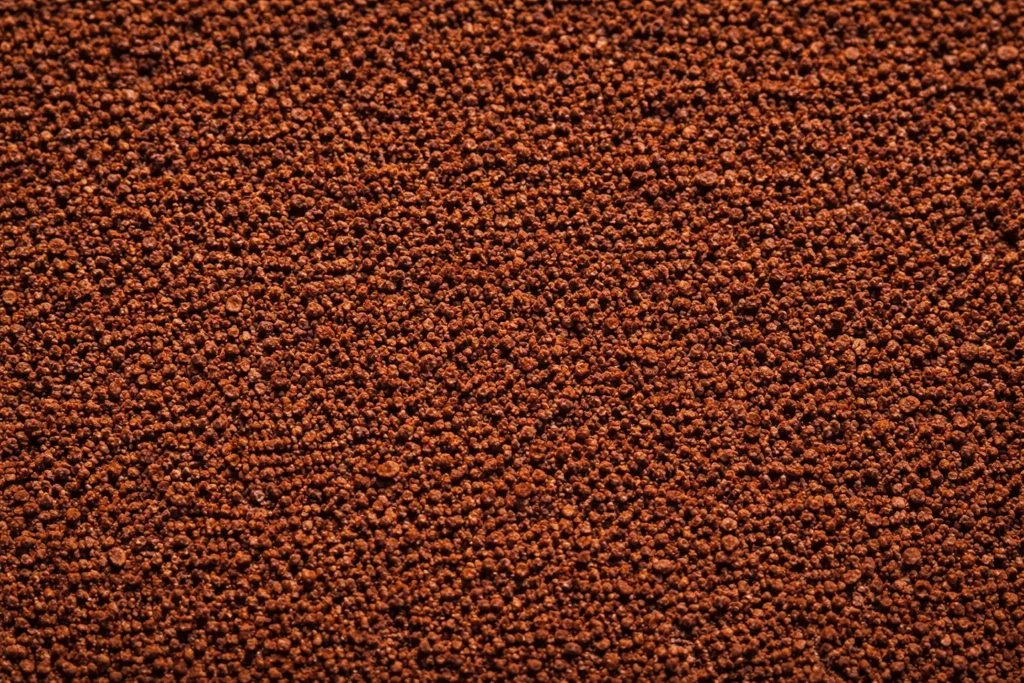
Your starting point for most paper-filter recipes is medium-fine — the texture of table salt. Let taste and press feel guide you: sour/hollow → finer; bitter/drying or hard press → coarser.
- Daily balanced cup: medium-fine (table salt)
- Inverted method with longer steep: medium to medium-fine
- Concentrate, iced, or milk drinks: fine (fine sand, not flour)
- Dark roast: 1–2 steps coarser than baseline
- Light roast: 1–2 steps finer than baseline
The Grind-Range Table: Fastest Way to Dial In
Start at Medium-Fine, then move one row at a time based on what you taste and feel.
| Grind range | Texture reference | Press feel / time | Most common taste | Best use | Most useful fix |
|---|---|---|---|---|---|
| Coarse | Sea salt / chunky sand | Very easy • 10–20s | Thin; often sour/hollow | Long steeps, very dark roasts | Sour: go finer or add 20–30s steep |
| Medium | Sand / kosher salt | Easy • 15–25s | Balanced but can feel light | Inverted method, darker roasts | Flat: slightly finer or increase dose |
| Medium-Fine ✦ Baseline | Table salt | Smooth • 20–30s | Sweet + balanced when dialed | Most recipes | Sour: finer. Bitter/hard press: coarser. |
| Fine | Fine sand | More resistance • 25–45s | Intense; can turn drying | Concentrates, iced, milk | Harsh: coarser or shorter steep |
| Espresso-fine | Powdery | Stall risk • 45s+ | Strong but harsh quickly | Experiments only | Stalls: coarser, less agitation |
Starting Grinder Settings by Grinder Type
Grind numbers don’t translate between grinders. Use these as directional starting points; taste + press time are the final authority.
| Grinder type | Start here | Target signal | How to adjust |
|---|---|---|---|
| Entry electric conical burr (Encore-class) | Mid-drip band, slightly finer (ex: 14–16 on a 40-step) | 20–30s smooth press; sweet finish | Sour → 1–2 steps finer. Bitter/hard → 1–2 steps coarser. |
| Modern precision electric (Opus-class) | Lower-middle range, closer to fine than drip | Intensity without harshness | Stalls → 1 step coarser + reduce agitation. |
| Hand grinder (click-based) | Mid pour-over band, slightly finer (about 2–3 rotations from closed on many) | Clean cups with low silt | Move 2–4 clicks at a time until sweetness pops. |
| Blade grinder | Avoid where possible | Sour and bitter simultaneously | Upgrade to burr grinder — see Best Grinders. |
Pro tip: If you’re torn between two adjacent settings, choose the one that gives a smoother press, then fine-tune time by ±15–30 seconds. Repeatability beats theoretical “perfect fineness.”
How AeroPress Grind Size Compares to Other Brew Methods
AeroPress sits between drip and espresso on most grinder dials, but closer to drip. Coming from pour-over or drip, start 1–3 steps finer.
| Brew method | Grind range | Texture | Contact time | Why different |
|---|---|---|---|---|
| French press | Coarse | Breadcrumbs / sea salt | 3–5 min | Long immersion; coarse reduces sludge and over-extraction |
| Drip | Medium | Sand / kosher salt | 3–5 min | Gravity flow; medium prevents clogging |
| Pour-over | Med → med-fine | Salt → fine salt | 2:30–4:00 | Often slightly coarser than AeroPress due to longer time |
| AeroPress | Medium-fine | Table salt | 1:30–2:30 + press | Shorter brew window benefits from slightly finer grind |
| Moka pot | Fine (not espresso) | Fine sand | 4–6 min | Pressure-driven; too fine stalls |
| Espresso | Extra fine | Powder | 25–30s | High pressure requires very fine grind |
How AeroPress Extraction Actually Works
AeroPress is primarily an immersion brewer: coffee and water steep together, then the press filters the brew. Most extraction happens during the steep; the press mainly separates liquid from the bed.
Grind size controls extraction rate via surface area and diffusion distance: finer extracts faster; too coarse under-extracts (sour/hollow), too fine over-extracts (bitter/drying) and can stall the press.
Surface Area & Diffusion Science
Finer grind increases surface area and shortens diffusion distance, making it easier to reach the “sweet” middle of extraction within AeroPress’s shorter brew window.
- Early extracts: acids/salts (brightness; can be sharp alone)
- Mid extracts: sugars/aromatics (sweetness + “coffee flavor”)
- Late extracts: bitters/astringents (drying finish)
Permeability, Fines & Plunge Pressure
Finer particles pack tighter and reduce permeability, increasing resistance. If you press too hard you risk channeling; if you press too slowly on a very fine grind you can unintentionally increase contact time and push extraction into bitter/drying territory.
Fines, Muddiness & How to Get Clarity
A cup that tastes simultaneously sour and muddy is often “boulders + fines”: coarse particles under-extract while fines over-extract and clog/dirty the cup.
- Use paper (or double paper) to catch fines
- Reduce agitation (swirl gently instead of vigorous stirring)
- Go 1 step coarser and add 10–20 seconds steep time
- Upgrade grinder for narrower particle distribution
🔬 If your cup tastes both sour and bitter: that’s classic inconsistent grinding. It’s the #1 sign a burr grinder upgrade will produce immediate improvement.
Essential Tools Before You Dial In
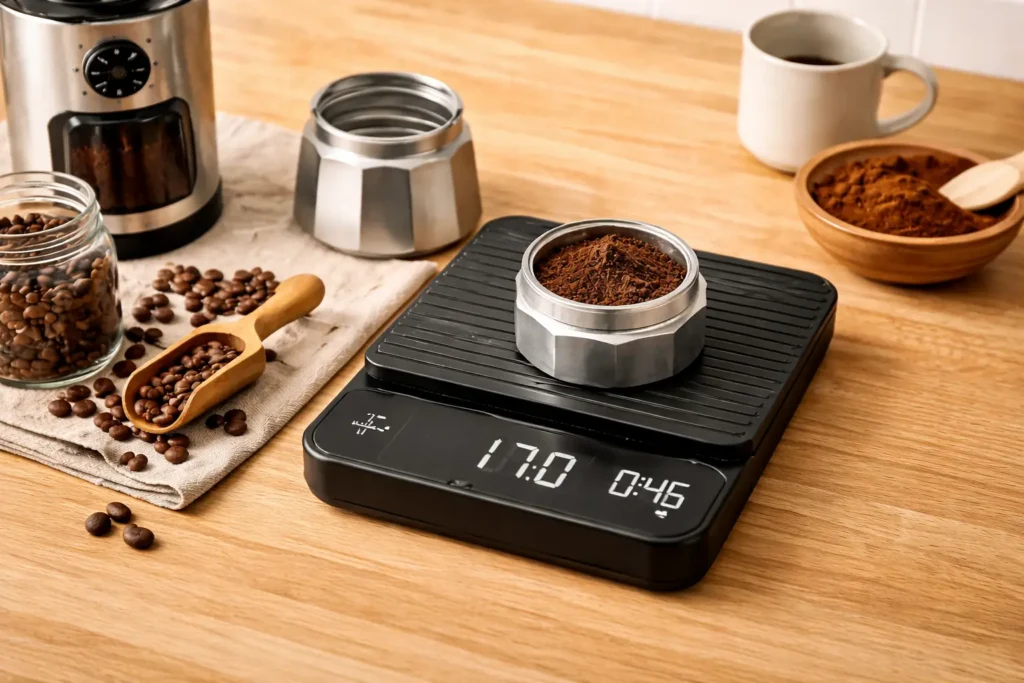
To dial in reliably, a digital scale and a temperature-controlled kettle remove guesswork so grind adjustments give clean feedback.
A Coffee-Capable Digital Scale
You can’t reliably dial in AeroPress grind size without weighing dose and water. Look for 0.1g resolution and a timer.
- Eliminates dose variability so grind changes show up clearly
- Makes the testing protocol repeatable
- Pays for itself in fewer wasted brews
Disclosure: CoffeeGearHub may earn from qualifying purchases.
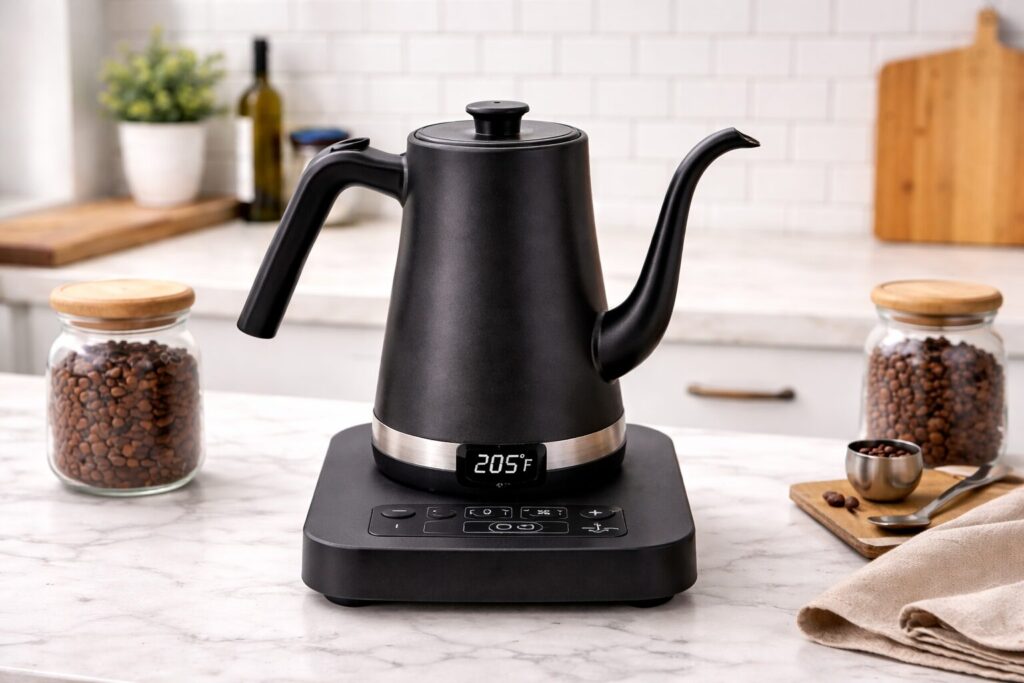
Temperature-Controlled Gooseneck Kettle
Temperature is a major extraction lever (especially light and dark roasts). A temp kettle removes guessing during grind testing.
- Light roast: 96–100°C helps sweetness
- Dark roast: 85–91°C reduces harshness
- More consistent dialing-in
Disclosure: CoffeeGearHub may earn from qualifying purchases.
The CoffeeGearHub Dial-In Framework
Dial-in works fastest when you isolate grind first, then use time/temperature for fine tuning.
Baseline “Control” Recipe
- Coffee: 15 g (weighed)
- Water: 245 g
- Temperature: 93°C / 200°F
- Filter: paper
- Steep: 1:15
- Agitation: 1 gentle swirl (or 6-second stir)
- Press: 20–30 seconds, steady
This is intentionally repeatable. It’s a diagnostic recipe that makes grind changes easy to hear.
Taste → Fix Order
- Sour or sharp: grind slightly finer
- Bitter/drying or hard press: grind slightly coarser
- Almost there: steep ±15–30 seconds
- Dark roast harsh: lower temp 3–6°C
- Balanced but weak: increase dose (strength issue)
Rule: change one variable per brew.
The Testing Protocol: Dial In Any Coffee in 2–3 Brews
Goal: clean feedback. Keep everything fixed except grind.
- Brew #1 baseline: brew the control recipe. Note press time + finish.
- Log 3 things: press time, press effort, and a one-word finish (clean / sour / drying / hollow / muddy).
- Adjust grind: 1–2 steps (electric) or 2–4 clicks (hand). Change nothing else.
- Brew #2: repeat exactly. Compare sweetness + finish.
- Brew #3 (optional): smaller move in same direction (or reverse if you overshot).
Stop when: sweetness is obvious, finish is clean, and press is smooth.
Grind by Brew Style: Standard, Inverted, Concentrate
Different AeroPress styles change contact time and flow behavior. Use this as your quick selector.
| Style | Why it’s different | Start grind | Steep window | Best for |
|---|---|---|---|---|
| Standard | Some drip-through during steep | Medium-fine | 1:30–2:00 | Clean, bright cups |
| Inverted | True immersion control | Medium to med-fine | 2:00–2:45 | Sweetness + body |
| Concentrate | High dose, low water, then diluted | Fine (not powder) | 0:45–1:20 | Iced + milk drinks |
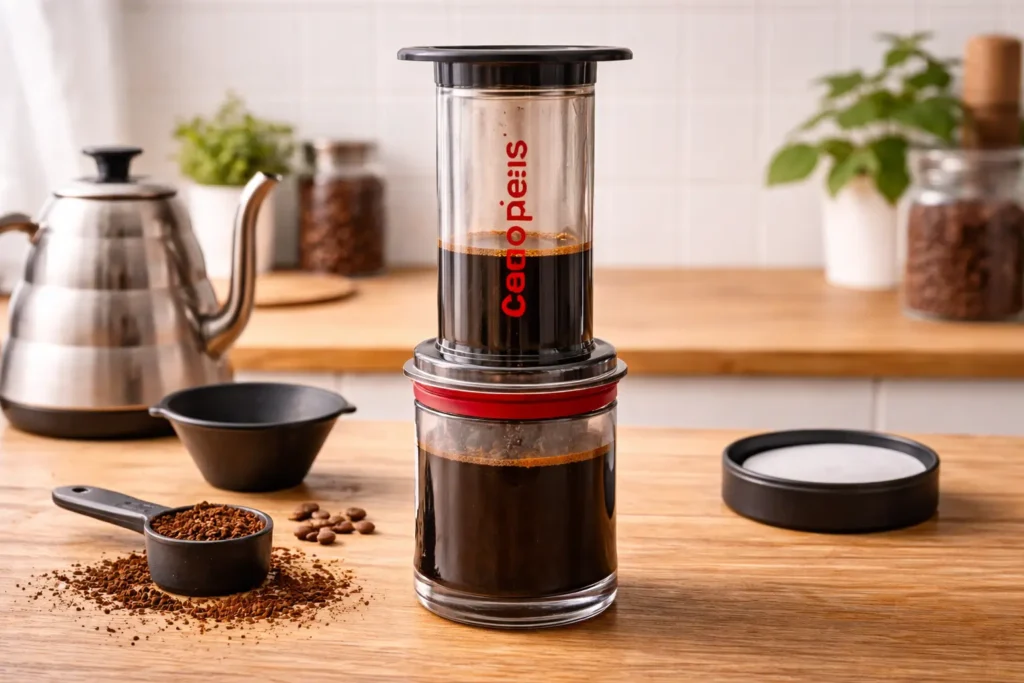
AeroPress Go: Grind and Dose Adjustments
The Go’s smaller chamber changes dose and water volume, but the grind range stays the same.
| Parameter | Original | Go | Why it differs |
|---|---|---|---|
| Dose | 15–18g | 12–15g | Scale down ratio for smaller volume |
| Water | 230–260g | 180–220g | Avoid overflow/leaks |
| Grind | Medium-fine baseline | Medium-fine baseline | Same particle target |
| Steep | 1:15–2:30 | 1:00–2:00 | Lower volume can extract faster |
| Press target | 20–30s | 20–30s | Same diagnostic signal |
💡 Go travel shortcut: scale any standard recipe down ~20% coffee and water, keep the same grind, and trust press feel (smooth 20–30s).
Two Recipe Playbooks with Grind Targets
These cover the common daily cup and an iced/milk concentrate base.
Playbook #1 — Daily Sweet Cup
- Coffee: 15g
- Water: 245g
- Temp: 93°C / 200°F
- Filter: paper
- Grind: medium-fine
- Method: steep 1:15 → 1 gentle swirl → press 20–30s
Fix sour: finer. Fix bitter: coarser or swirl less.
Playbook #2 — Iced Concentrate
- Coffee: 18g
- Water: 100–110g
- Temp: 90–95°C
- Filter: paper
- Grind: fine (not powder)
- Method: stir 10s → steep to 0:50 → press gently 25–40s
Fix harsh: coarser or shorten steep by ~10s.
Roast Level: Grind + Temperature Targets
Light roasts often need finer grind + hotter water; dark roasts often need coarser grind + cooler water to avoid harshness.
☀️ Light Roast
- Grind: 1–2 steps finer
- Temp: 96–100°C
- Steep: 2:00–2:30
🌤 Medium Roast
- Grind: baseline medium-fine
- Temp: 91–94°C
- Steep: 1:15–2:00
🌑 Dark Roast
- Grind: 1–2 steps coarser
- Temp: 85–91°C
- Steep: 1:00–1:30
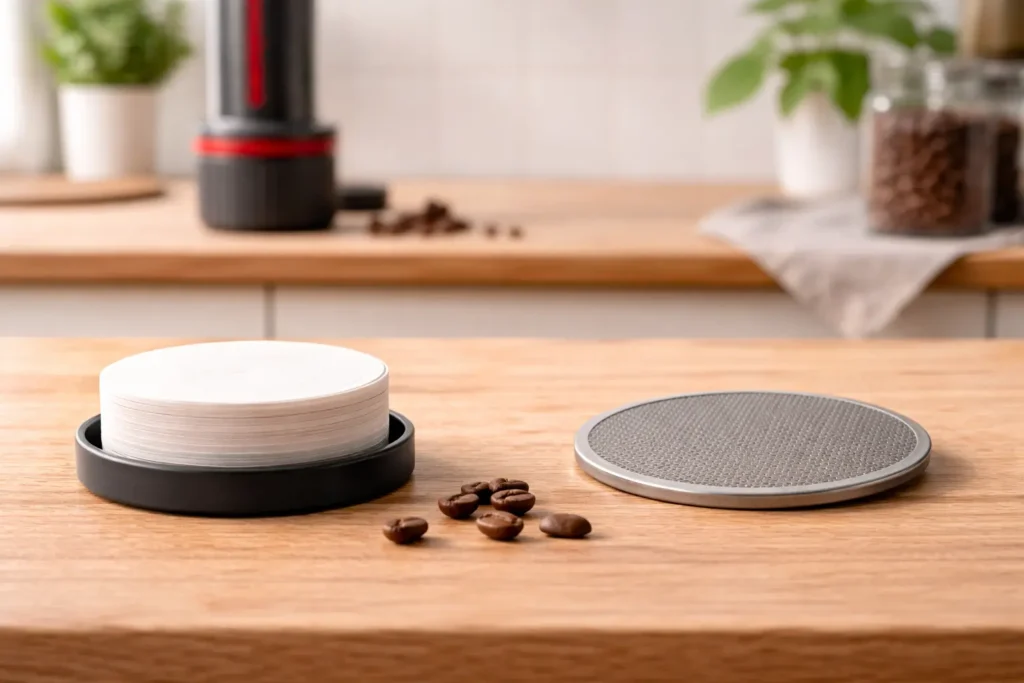
Paper vs Metal Filters
Paper catches fines and oils for clarity; metal increases body and lets fines through (often needing a slightly coarser grind and less agitation).
Paper
- Cleaner cup, easier dial-in
- Baseline: medium-fine
- Double paper for max clarity
Metal
- More body and oils
- Go 1–2 steps coarser than paper
- Reduce agitation; stop before the hiss
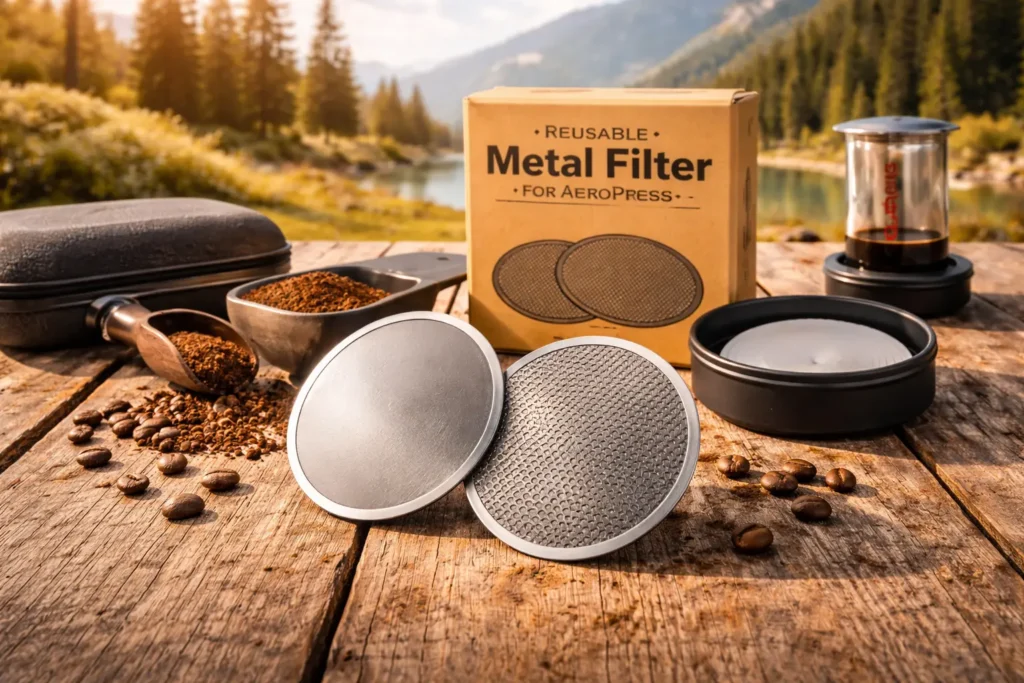
Fellow Prismo or Able Disk Fine (Metal Filter)
If you want a body-forward cup without excessive silt, these are the most popular quality metal options. Prismo’s valve helps concentrate-style brews.
- Less sediment than generic mesh filters
- Reusable indefinitely
- Prismo valve supports “espresso-style” concentrates
Disclosure: CoffeeGearHub may earn from qualifying purchases.
Temperature, Agitation and Time: The Secondary Levers
| Lever | Increase it to… | Decrease it to… | Best use case |
|---|---|---|---|
| Temperature | Boost extraction and sweetness | Reduce harshness | Light roast sour → raise. Dark roast bitter → lower. |
| Agitation | Speed up extraction | Reduce fines impact | Paper: moderate OK. Metal: minimal. |
| Time | Increase extraction without going finer | Avoid late-stage bitterness | When you’re between grind settings |
Strength vs Extraction
Strength = dose-to-water ratio (concentration). Extraction = flavor balance (grind, temp, time, agitation). If it tastes balanced but weak, adjust ratio—not grind.
- Balanced but weak: +1–2g dose or -10–20g water
- Sour/thin: go finer or brew longer/hotter (extraction issue)
- Bitter/drying: go coarser or brew shorter/cooler (extraction issue)
- Good flavor but too strong: add bypass water after pressing
Bean Freshness and Water Quality
If cups stay flat despite dial-in, check roast date and water. Fresh beans and decent water are non-negotiable for “sweetness pop.”
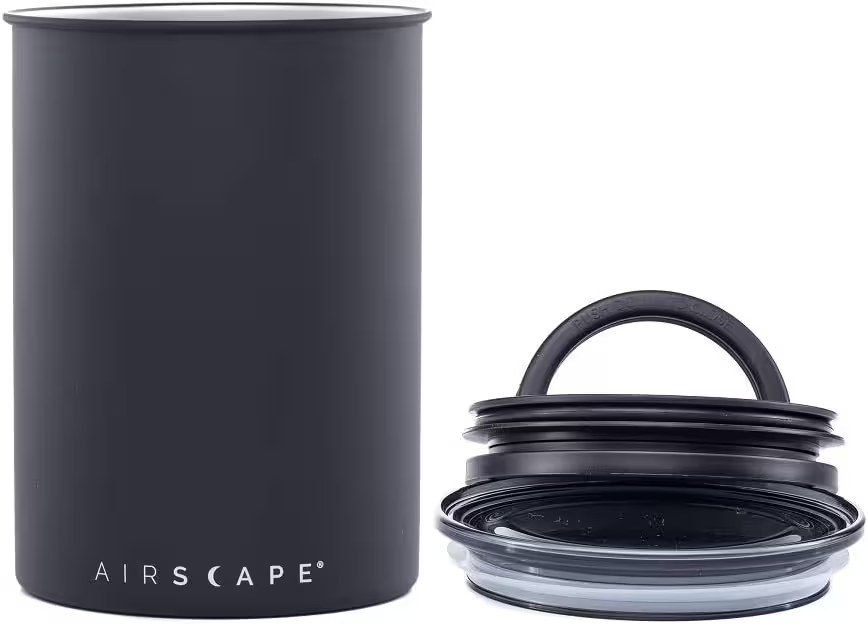
Airtight Coffee Storage Canister
Protecting beans from oxygen preserves sweetness and aromatics, making dial-in results more consistent from day to day.
Disclosure: CoffeeGearHub may earn from qualifying purchases.
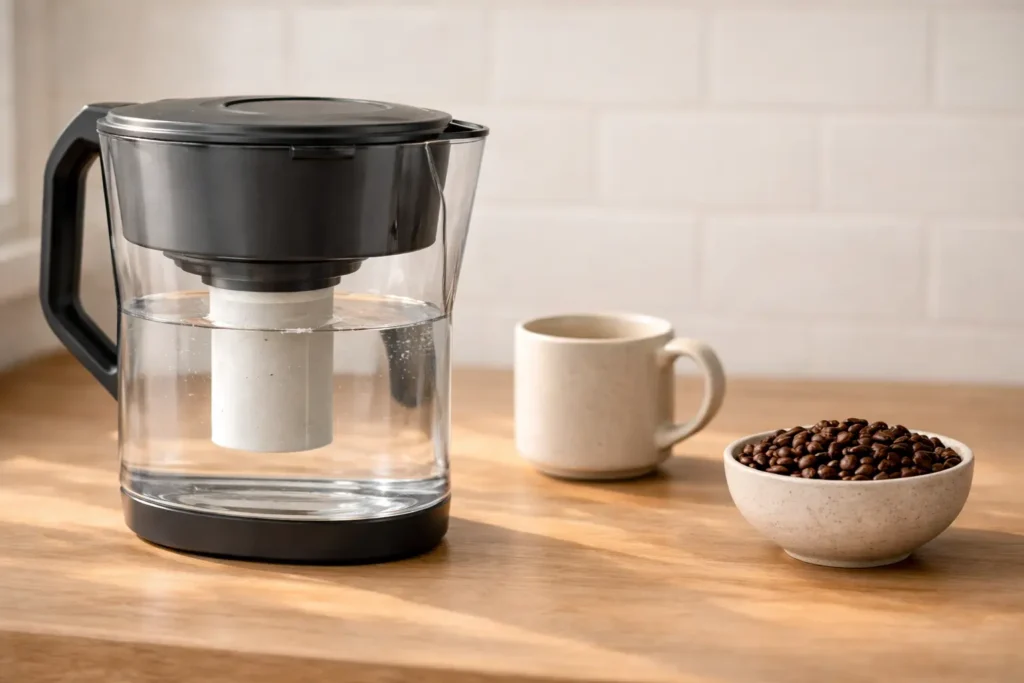
Coffee-Friendly Water Filter Pitcher
If your tap water tastes “off” (chlorine/metallic), your coffee will too. Filtering improves clarity and makes grind changes easier to taste.
Disclosure: CoffeeGearHub may earn from qualifying purchases.
Troubleshooting Matrix: Taste → Fix
Start with grind, then use time/temperature only after grind is close.
| Symptom | What it usually means | Fix (in order) |
|---|---|---|
| Sour + fast press | Too coarse / under-extracted | Finer → +15–30s steep → hotter (light roasts) |
| Bitter + hard/slow press | Too fine / too many fines | Coarser → less agitation → shorter steep → cooler (dark roasts) |
| Muddy/silty | Fines + metal or aggressive stirring | Paper/double paper → swirl only → slightly coarser |
| Balanced but weak | Strength issue | +1–2g dose or reduce water; don’t change grind |
| Press stalls | Clogged bed | Coarser → reduce agitation → gentle steady press |
| Sour AND bitter | Inconsistent grind distribution | Grinder upgrade (burr) |
Burr vs Blade Grinders: Why Consistency Is Everything
Blade grinders create “boulders + fines,” causing simultaneous under- and over-extraction. Burr grinders create a narrower particle distribution so your adjustments behave predictably.
Highest-impact AeroPress upgrade: if you’re using a blade grinder, switching to any decent burr grinder is the fastest path to better coffee.
Best Grinders for AeroPress
These picks prioritize AeroPress medium-fine consistency, adjustment resolution, and value.

Baratza Encore
- Best overall value (electric)
- Strong medium-fine consistency
- Repairable + long-term support
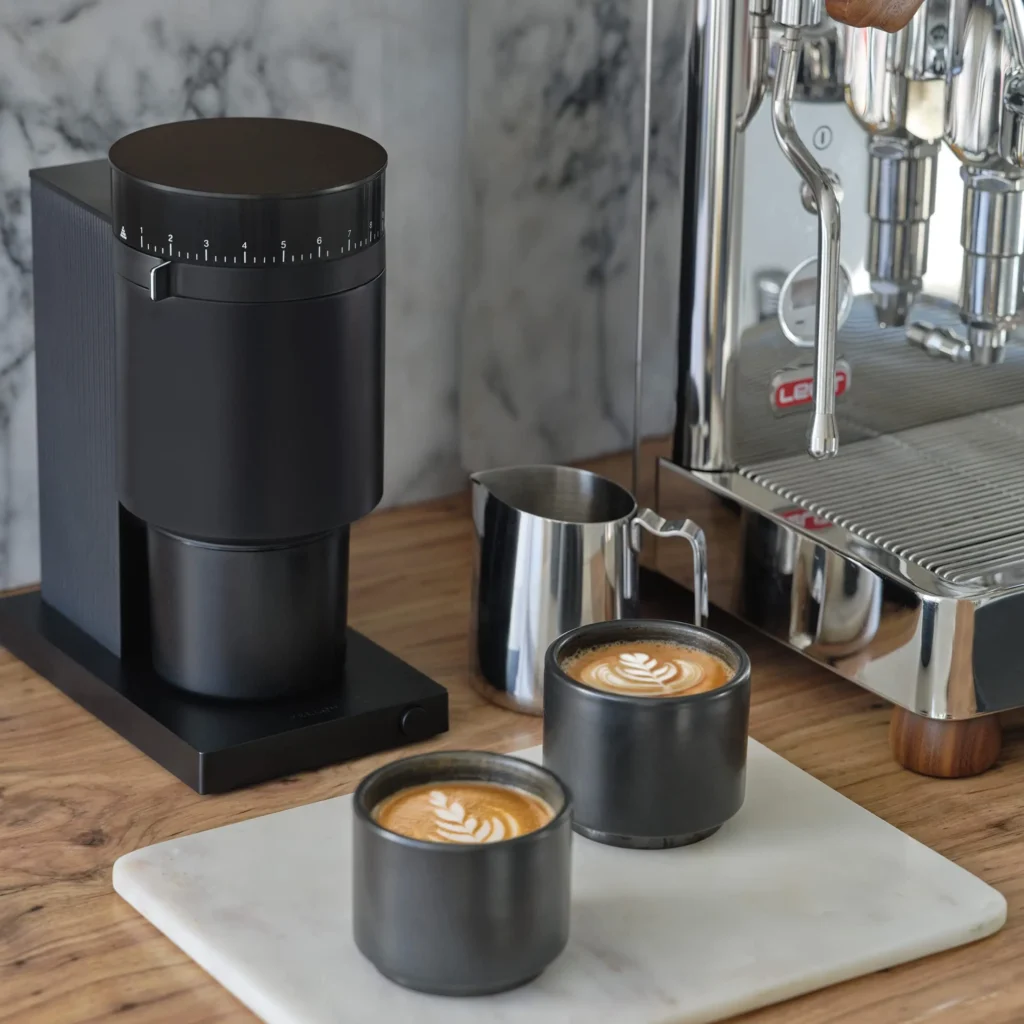
Fellow Opus
- Modern workflow + wide range
- Low static, tidy dosing
- Great for multi-method homes
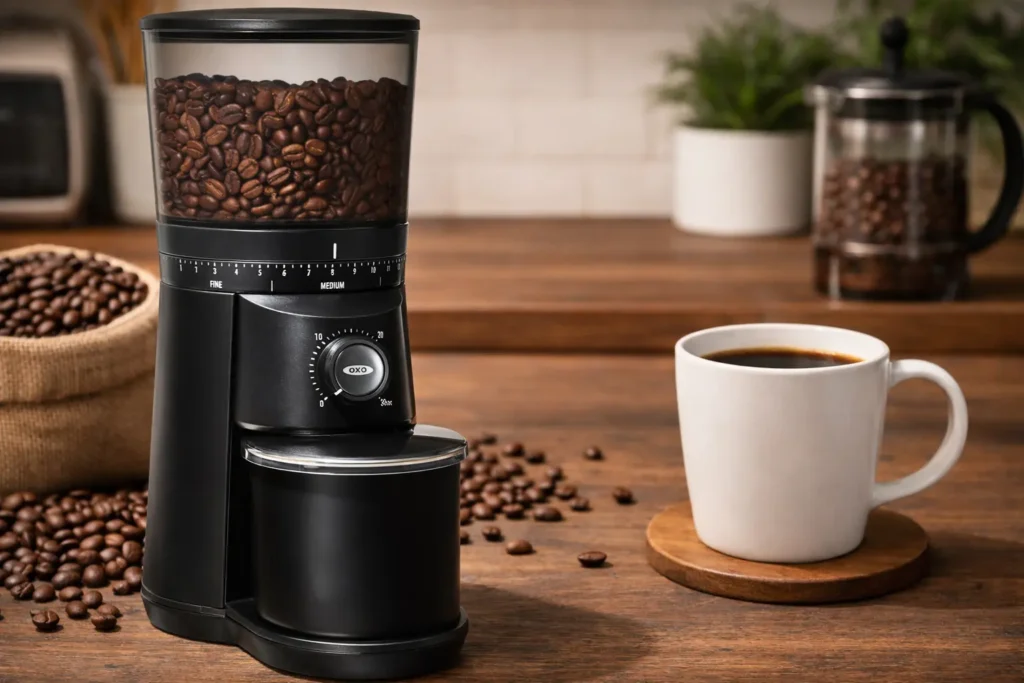
OXO Brew Conical Burr
- Best budget electric
- Easy workflow
- Good daily consistency
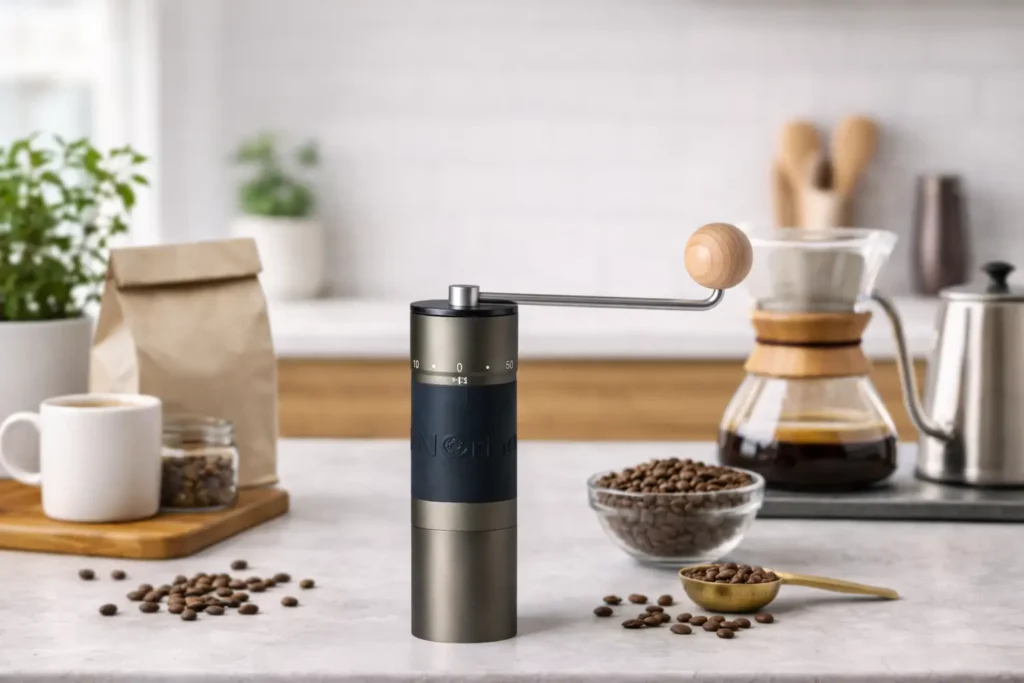
KINGrinder K6
- Best manual value
- Precise adjustments
- Great travel pick

Timemore Chestnut C3
- Best first burr upgrade
- Biggest flavor jump per $
- Solid build
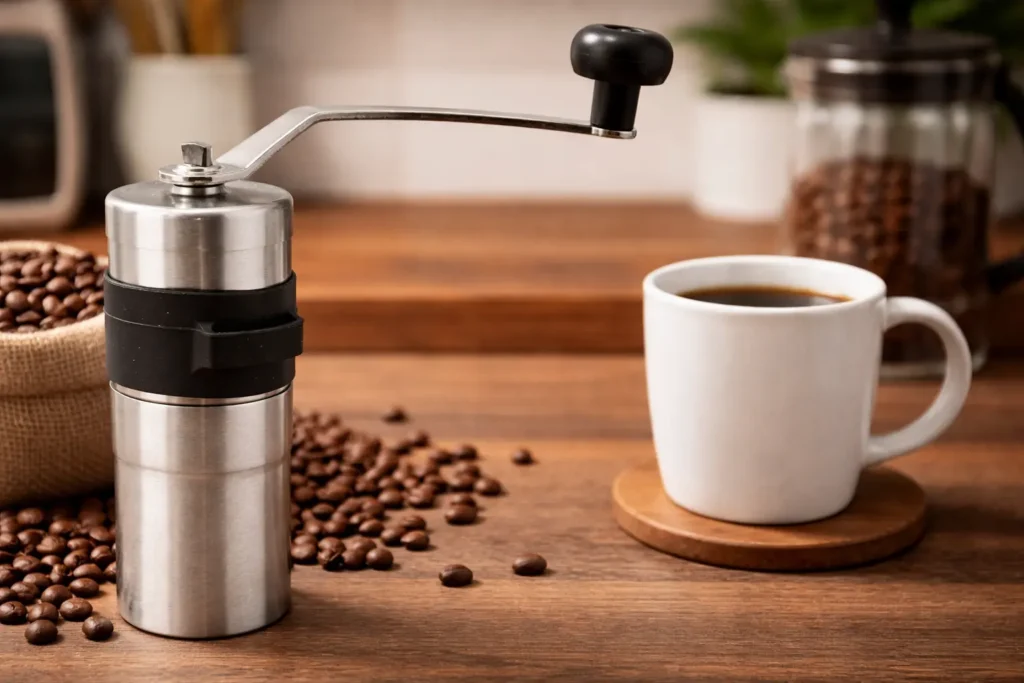
Porlex Mini II
- Ultra-portable
- Fits inside AeroPress
- Good travel durability
Full Grinder Comparison Table
| Grinder | Type | Price | Med-fine consistency | Adjustment resolution | Retention | Travel | Best for |
|---|---|---|---|---|---|---|---|
| Baratza Encore | Electric conical burr | $$ | Excellent | Good | Medium | Low | Daily home, multi-method |
| Fellow Opus | Electric conical burr | $$ | Very good | Good | Low–medium | Low | Multi-brew, exploration |
| OXO Brew | Electric conical burr | $ | Good | Fair | Medium | Low | Budget electric |
| KINGrinder K6 | Manual steel burr | $ | Excellent | Very good | Very low | High | Solo + travel |
| Timemore C2 | Manual steel burr | $ | Very good | Good | Very low | High | First burr upgrade |
| Porlex Mini II | Manual ceramic burr | $ | Good | Fair | Very low | Very high | Ultra-compact travel |
Final Takeaway
Medium-fine is your baseline. Taste is your feedback loop. A smooth 20–30 second press is your calibration signal. Change grind first (one variable at a time) and stop when sweetness pops and the finish is clean.
FAQs: AeroPress Grind Size
What grind size is best for AeroPress?
Medium-fine (table-salt texture) is the best starting point. Aim for a smooth 20–30 second press and adjust finer for sour cups and coarser for bitter/drying cups.
What about pre-ground coffee — which grind should I buy?
Choose “drip” or “medium-fine” pre-ground. Avoid espresso grinds (often too fine and stall-prone) and coarse grinds (often under-extract).
Why does my AeroPress taste sour?
Usually under-extraction: too coarse, too short, or too cool. Go slightly finer first. For light roasts, raise temp (96–100°C) and extend steep time.
Why is my AeroPress bitter or drying?
Usually over-extraction: too fine, too much agitation, too hot, or too long. Go slightly coarser first. For dark roasts, lower temp (85–91°C) and shorten steep time.
Balanced but weak — should I grind finer?
Almost never. That’s a strength issue. Increase dose by 1–2g or reduce water before changing grind.
Continue Learning
AEROPRESS CLUSTER
Want espresso-style AeroPress for lattes? Use the concentrate playbook above, then pair it with a strong milk frother for café-style drinks at home.
☕
Written by the CoffeeGearHub Editorial Team
CoffeeGearHub is a specialty coffee equipment resource run by home brewers and coffee enthusiasts. Our guides are researched using published brewing science, grinder manufacturer specifications, and established specialty-coffee community knowledge. We review and update our pillar content regularly. About CoffeeGearHub →