
Baratza Encore ESP Review
Editorial standards: this review separates manufacturer specifications, published independent testing, workflow analysis, ownership considerations, and CoffeeGearHub editorial interpretation.
At a glance
What this review covers
The Encore ESP is evaluated as an all-purpose home grinder: filter performance, espresso range, adjustment precision, retention, grind-setting workflow, serviceability, nearby alternatives, and when the ESP Pro becomes the more appropriate tool.
Editorial analysis
The real question is whether one grinder can cover your routine
The Encore ESP’s appeal is not that it replaces a dedicated high-end espresso grinder. It is that it gives a home brewer a credible filter range, practical espresso capability, easy setting recall, and an unusually repairable ownership model in one familiar platform. Whether that balance is useful depends on how often espresso is the primary method rather than one method among several.
What This Review Is Evaluating
The Encore ESP sits in an unusual part of the grinder market: it is designed to cover both filter coffee and espresso without becoming a dedicated espresso grinder. That makes the useful review question less about whether it can grind coffee and more about how well the dual-range adjustment system, M2 burr set, workflow, retention, repairability, and long-term support work together for a home brewer who may switch between methods.
This review is based on manufacturer documentation, published independent testing, established specialty-coffee guidance, and CoffeeGearHub’s editorial comparison of workflow, ownership cost, and product limitations. We do not claim hands-on testing where it has not occurred.
Where the Encore ESP Fits in Baratza’s Lineup
The original Encore remains a filter-focused entry point. The Encore ESP keeps the familiar platform but adds the M2 burr set and a dual-range collar that gives the first half of the adjustment range much finer steps for espresso. The newer ESP Pro pushes farther toward espresso with stepless adjustment, digital setting reference, anti-static features, and a more single-dose-oriented design.
| Model | Burrs | Adjustment | Espresso use | Best fit |
|---|---|---|---|---|
| Encore | 40mm M3 conical | 40 stepped settings | Not designed for serious espresso dialing | Filter-only users prioritizing price |
| Encore ESP | 40mm M2 conical | 40 stepped settings with finer espresso range | Practical for many home setups, especially medium/darker roasts | Mixed-method households wanting one grinder |
| Encore ESP Pro | 40mm M2 conical | Stepless collar with digital reference | More precise and espresso-oriented | Espresso-first users who still want filter range |
Build and Workflow: Familiar, Simple, and Serviceable
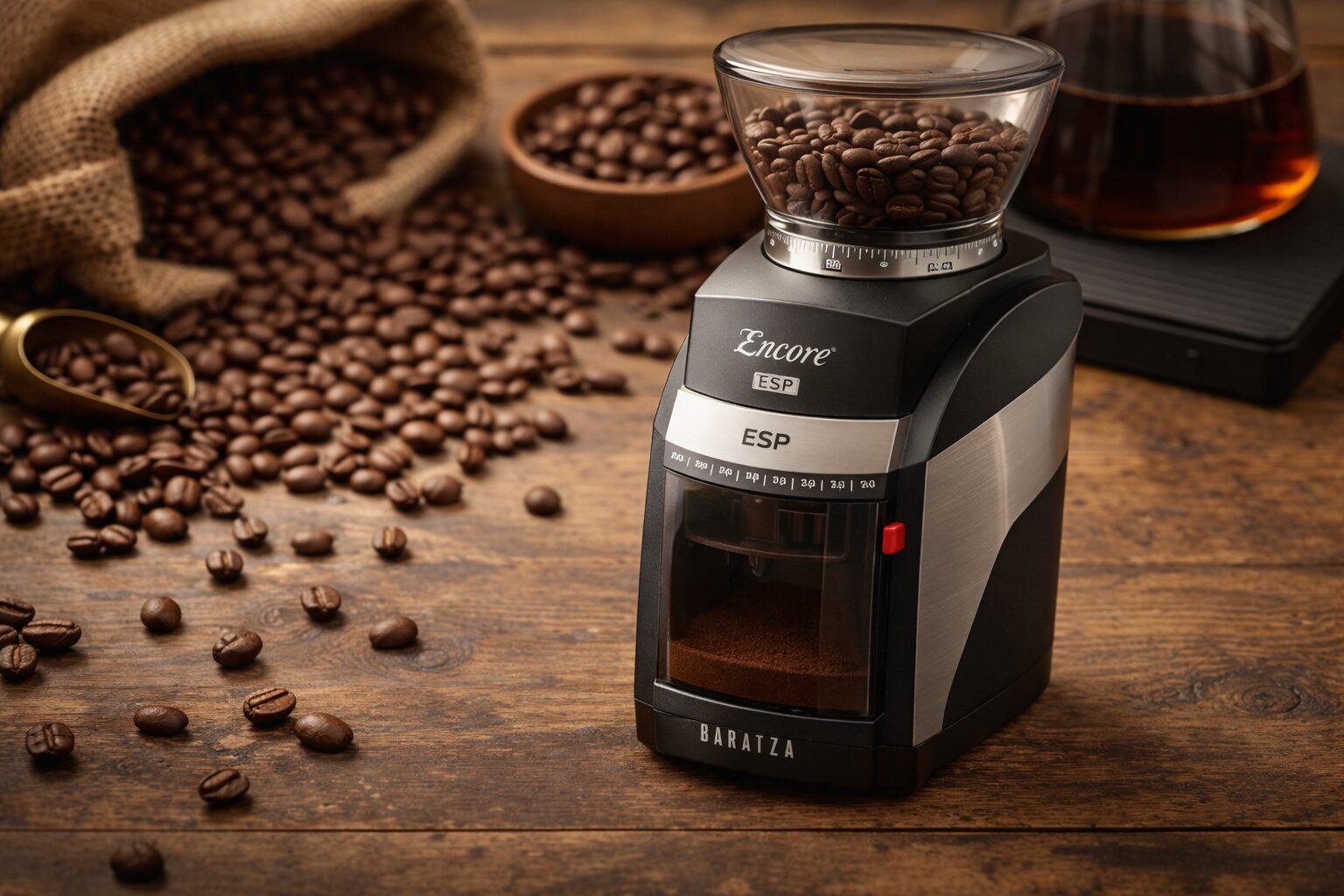
The Encore ESP keeps the utilitarian shape and straightforward controls that made the original Encore popular. The housing is not trying to feel like a premium metal appliance; the value proposition is functional simplicity and access to parts. The hopper, grounds bin, adjustment collar, and quick-release burr design make routine use easy to understand, while the dosing cup adds a more espresso-friendly workflow than the original Encore offered.
That simplicity matters because the grinder is expected to move between very different brew methods. The dual-range collar makes the transition understandable: the lower half of the scale is compressed for espresso, while the upper half covers the broader filter range. Returning to a known number after changing brew methods is easier than on fully stepless grinders, though the trade-off is that a stepped system can occasionally leave an espresso shot between two ideal settings.
What the M2 Burr Set Changes
The M2 burrs are a meaningful part of the ESP update. Compared with the original Encore’s M3 burrs, they are intended to produce a cleaner and more consistent grind distribution across common home brew ranges. Independent testing cited in the legacy review generally supports the view that the ESP is more capable than the original Encore when switching between filter coffee and espresso.
For filter brewing, the grinder is comfortably within its intended use. Pour-over, drip, AeroPress, French press, and cold brew all sit inside the broad macro range, and the setting numbers are easy to reproduce. Espresso is where the limitations become more important: the grinder can produce espresso-fine coffee, but the stepped collar does not give the near-continuous adjustment of a dedicated stepless espresso grinder.
Retention, Static, and Noise in Daily Use
The Encore ESP is not a dedicated zero-retention grinder, and that matters most for users who single-dose or switch coffees frequently. A small amount of ground coffee can remain in the chute and burr chamber after grinding. For filter brewing this is rarely a major practical issue, but espresso users measuring every dose in and out may notice it more.
Retention is also affected by bean condition and humidity. Very dry beans can create more static, causing grounds to cling to the bin or chute. A minimal Ross Droplet Technique—adding a tiny amount of water to the beans before grinding—can reduce static without materially changing the coffee dose. The grinder should not be wet internally; the goal is only to slightly reduce static on the bean surface.
Noise is typical of a compact conical-burr grinder: clearly audible, but brief because most home doses grind in seconds rather than minutes. The Encore ESP does not try to compete with heavily damped premium grinders on sound. Its advantage is a simple, serviceable mechanism rather than luxury appliance refinement.
| Workflow factor | Encore ESP behavior | Who will notice most |
|---|---|---|
| Retention | Modest; more than purpose-built single-dose grinders | Espresso users weighing dose in/out and frequent bean switchers |
| Static | Can increase in dry conditions | Users in low-humidity environments or grinding very dry beans |
| Noise | Typical compact conical-grinder sound level | Early-morning users in quiet homes |
| Setting recall | Easy because the collar uses numbered steps | Users switching between filter and espresso methods |
Espresso Capability: Useful, but Not Unlimited
The Encore ESP is genuinely more espresso-capable than the original Encore. Settings 1–20 are compressed into the fine range so each click makes a smaller change than the filter-oriented half of the collar. For many medium- and darker-roast home espresso recipes, that is enough control to move shot time and flavor in a useful direction.
Light-roast espresso and very exacting shot recipes expose the limitation sooner. Dense coffees can require finer grinding and smaller adjustment increments than a stepped collar comfortably provides. Baratza includes shims to extend the fine end of the range, but that does not turn the ESP into a dedicated prosumer espresso grinder. Users who expect frequent light-roast dialing, single-dosing, and sub-step adjustment are closer to the use case for the ESP Pro or another espresso-first grinder.
Compare current models
Encore ESP or ESP Pro?
The standard Encore ESP is the all-purpose model discussed throughout this review. The ESP Pro is the step-up option for users who want finer espresso adjustment and a more single-dose-oriented workflow.
Baratza Encore ESPDual-range stepped adjustment for filter brewing plus practical home espresso capability.View on Amazon → 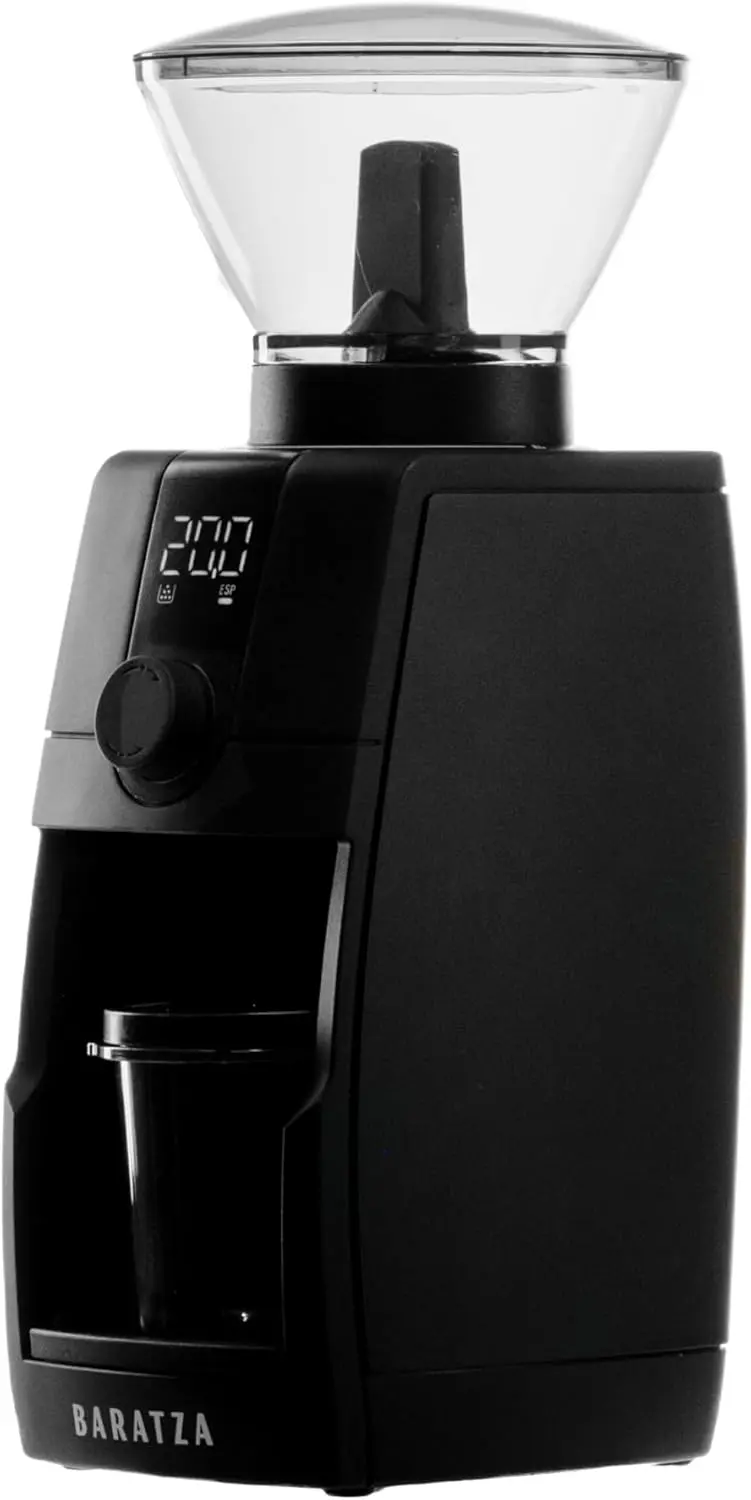 Baratza Encore ESP ProStepless adjustment, digital setting reference, and a more espresso-first workflow.View on Amazon →
Affiliate disclosure: These links may earn CoffeeGearHub a commission at no additional cost to you. As an Amazon Associate, we earn from qualifying purchases. Prices and availability can change.
Encore ESP Grind Settings by Brew Method
The numbers below are starting points, not universal prescriptions. Individual grinders vary slightly because of burr alignment, shim configuration, coffee density, and manufacturing tolerance. Use the setting to get into the right neighborhood, then finish the dial-in by taste and brew behavior.
| Brew method | Starting range | What to watch |
|---|---|---|
| Espresso, medium/dark roast | About 8–14 | Fast or sour shots usually need a finer move; slow or harsh shots usually need coarser |
| Espresso, light roast | About 2–8, sometimes with shims | If the grinder reaches the bottom of the range before the shot slows enough, the setup is at the edge of its intended use |
| Moka pot | About 14–18 | Use taste and flow rather than appearance alone |
| AeroPress | About 24–30 | Shorter recipes generally tolerate finer settings than long-steep methods |
| Pour-over / Chemex | About 24–30 | Chemex often starts a little coarser than V60 |
| Automatic drip | About 25–32 | Cone baskets often start finer than flat-bottom baskets |
| French press | About 32–36 | Move coarser if sediment or bitterness dominates |
| Cold brew | About 36–40 | Long extraction times usually favor the coarsest end of the range |
Repairability Is a Major Part of the Value Proposition
Baratza’s strongest differentiation is not a single grind setting or accessory. It is the support model around the grinder. Replacement burrs, motors, hoppers, and other components are available separately, and the company publishes repair guidance rather than treating the grinder as a sealed appliance. That changes the long-term ownership calculation because worn parts can be replaced without discarding the whole machine.
| Ownership factor | Encore ESP | Why it matters |
|---|---|---|
| Replacement burrs | Available separately | Burr wear can be addressed without replacing the grinder |
| Replacement motor / components | Available through Baratza support channels | Extends useful life beyond the warranty period |
| Burr removal | Quick-release design | Makes routine cleaning easier |
| Repair documentation | Published support materials | Improves serviceability for long-term owners |
The exact lifespan of any grinder depends on use and maintenance, but a product designed around replaceable parts is materially different from one whose economics assume full replacement after a component failure.
Cleaning and Maintenance Are Part of the Ownership Model
Routine cleaning is straightforward because the upper burr can be removed without a full teardown. For normal home use, brushing loose grounds from the burr chamber and chute periodically is more important than obsessing over a fixed cleaning calendar. Oily dark-roast coffee, flavored beans, or very frequent use can justify more frequent cleaning because residue builds faster.
Grinder-cleaning tablets can help remove oils from the burr path, but they do not replace physical inspection. If grind consistency changes suddenly, if the collar becomes unusually difficult to turn, or if the grinder sounds different, remove the hopper and inspect the burr chamber for trapped debris before assuming the motor or burrs have failed.
The repairable design changes how maintenance should be viewed. Burrs are wear components, not permanent parts. A gradual decline after years of use can often be addressed with replacement burrs rather than a new grinder. That is a meaningful advantage over appliance-style grinders where individual components are difficult or uneconomic to replace.
| Maintenance task | When to consider it | Purpose |
|---|---|---|
| Brush burr chamber and chute | When visible buildup appears or workflow becomes messy | Removes loose grounds and reduces stale carry-over |
| Use grinder-cleaning tablets | Periodically, especially with oily coffee | Helps remove coffee oils from the burr path |
| Inspect / replace burrs | After long use when grind quality declines despite cleaning | Restores cutting performance without replacing the grinder |
| Contact Baratza support | Persistent jams, motor issues, or component failure | Uses the product’s repair-oriented support ecosystem |
How the Encore ESP Compares With Nearby Alternatives
The sub-$250 grinder market is much more competitive than it was when the original Encore became the default beginner recommendation. The Fellow Opus is the closest all-purpose alternative for many buyers, while the Breville Smart Grinder Pro and Baratza Virtuoso+ serve somewhat different workflows.
| Grinder | Adjustment | Espresso | Workflow strength | Ownership strength |
|---|---|---|---|---|
| Encore ESP | 40 stepped, dual-range | Yes, within stepped-range limits | Easy setting recall across brew methods | Strong parts and repair ecosystem |
| Fellow Opus | Stepped with internal fine adjustment | Yes | Lower-retention, single-dose-friendly workflow | Less established repair ecosystem |
| Breville Smart Grinder Pro | 60 stepped settings | Yes | Programmable dosing convenience | More appliance-like ownership model |
| Baratza Virtuoso+ | 40 stepped settings | No serious espresso focus | Filter-focused workflow with timer | Strong Baratza repair ecosystem |
The Encore ESP is easiest to justify when the household uses several brew methods and values predictable setting recall plus long-term support. The Opus is attractive when low retention and single-dosing are more important. The Virtuoso+ still makes sense when espresso is not part of the plan.
When the ESP Pro Upgrade Makes Sense
The ESP Pro is not simply a cosmetic refresh. It changes the adjustment and workflow enough to target a different user. Its stepless collar offers much finer control for espresso, while the digital display gives the user a reference point for returning to previous settings. Anti-static features and single-dose-oriented behavior also move it closer to the expectations of an espresso-first setup.
For someone who mainly brews filter coffee and only occasionally makes espresso, those additions may not justify the higher price. For someone who frequently dials light-roast espresso or wants more precise shot control, the Pro addresses the exact limitation most likely to be felt on the standard ESP.
Common Encore ESP Problems and the First Fix to Try
| Symptom | Likely cause | First response |
|---|---|---|
| Weak or sour coffee | Grind too coarse or coffee too fresh/stale for the current recipe | Move finer in small steps and verify the coffee-to-water ratio |
| Bitter or harsh coffee | Grind too fine or extraction too aggressive | Move coarser before changing several other variables |
| Espresso runs too fast | Grind too coarse for the dose and basket | Move lower in the micro range; if already at the limit, consider shim adjustment |
| Espresso chokes | Grind too fine or dose too high | Move coarser and confirm dose before changing tamp technique |
| Static / grounds mess | Dry conditions and plastic contact surfaces | Use a very small amount of RDT moisture on beans before grinding |
| Unusual noise or jam | Foreign object, mis-seated burr, or motor thermal cutoff | Unplug, inspect the burr chamber, and reseat components before contacting support |
Original Encore vs Encore ESP vs ESP Pro
The three Encore models make more sense when viewed as different workflow tools rather than a simple good-better-best ladder. The original Encore remains a filter-focused grinder. The Encore ESP is the mixed-method model for households that want filter coffee plus practical espresso. The ESP Pro is the espresso-oriented step-up for people who feel the limits of stepped adjustment.
| Your routine | Most appropriate model | Why |
|---|---|---|
| Drip, pour-over, AeroPress, or French press only | Original Encore or Encore ESP | The original covers filter needs; the ESP adds future espresso flexibility |
| Filter coffee plus occasional espresso | Encore ESP | Dual-range collar covers both without forcing a dedicated espresso grinder |
| Espresso is the primary method | Encore ESP Pro | Stepless adjustment gives finer shot control |
| Frequent bean switching / single dosing | ESP Pro or a purpose-built single-dose alternative | Workflow matters more than simply having a wide grind range |
| Long-term repairability is the top priority | Any current Baratza model, with ESP as the broadest middle ground | Parts availability and support are central to the platform |
Who the Encore ESP Fits Best
The standard Encore ESP makes the strongest case for a home brewer who wants one electric grinder for several brew methods and values repairability as much as headline specifications. It is particularly well matched to households that move between drip, pour-over, AeroPress, French press, and occasional espresso.
It is less compelling for an espresso-only user who routinely works with light roasts and expects very fine control over shot time. In that case, the ESP Pro or a dedicated espresso grinder removes the stepped-adjustment compromise. It is also more grinder than a filter-only user needs if the original Encore or another filter-focused grinder already meets the workflow.
FAQs: Baratza Encore ESP Review
Is the Baratza Encore ESP worth it?
Yes, for most home brewers who want a reliable electric burr grinder for drip coffee, pour over, AeroPress, or French press — and want the option to grind for espresso as well. The Encore ESP’s dual-range adjustment system gives it meaningful espresso capability that the original Encore lacked entirely, while maintaining the same strong brew grind quality that made the Encore a specialty coffee staple for over a decade.
What is the difference between the Baratza Encore and the Encore ESP?
The Encore ESP replaces the original Encore’s M3 burrs with upgraded M2 burrs and adds a dual-range grind adjustment system: settings 1–20 are tuned for espresso-range precision, while settings 21–40 cover filter brewing from AeroPress to cold brew. The ESP also adds a dosing cup for portafilter use and a quick-release burr design for easier cleaning. The original Encore remains available but is a brew-only grinder — it cannot grind fine enough for serious espresso use.
What grind setting should I use on the Baratza Encore ESP for drip coffee?
For automatic drip coffee makers, start at setting 28–32 on the Encore ESP’s brew range (21–40). This places you in the medium grind zone — roughly the texture of coarse sand — which is the target for flat-bottom basket brewers. Cone-filter machines can go slightly finer; try 25–28. Adjust by taste: bitter means go coarser (higher number), sour or weak means go finer (lower number).
What grind setting should I use on the Encore ESP for AeroPress?
For standard AeroPress recipes, start around setting 24–28. For inverted AeroPress with longer steep times, go slightly coarser at 26–30. AeroPress is one of the most forgiving brew methods for grind size, so use these as starting points and adjust based on your preferred recipe and contact time.
Is the Baratza Encore ESP good for espresso?
It is capable for espresso with medium and dark roasts — settings 1–20 are specifically engineered for espresso-range precision. For light roast espresso at modern brew ratios, it can reach its limits, and Baratza includes shims to unlock even finer settings. Reviewers at CoffeeChronicler and CoffeeGeek found it produces genuinely good espresso shots, though it is not a replacement for a dedicated espresso grinder in a high-volume or light-roast-focused setup. For a home brewer who primarily drinks filter coffee and occasionally pulls espresso shots, it is a strong value.
How do I clean the Baratza Encore ESP?
The Encore ESP’s quick-release burr design allows removal of the upper cone burr without tools — a significant improvement over the original Encore. To clean: remove the hopper, twist off the cone burr, brush out the burr chamber with the included cleaning brush, and wipe the grounds bin. For deeper cleaning, Baratza recommends running grinder cleaning tablets through the burr chamber every 1–3 months. Full disassembly for deep cleaning is possible and documented in Baratza’s support materials.
How long does a Baratza Encore ESP last?
With regular cleaning and occasional burr replacement, a Baratza Encore ESP is designed to last many years. Baratza has built its reputation on repairability: replacement burrs, motors, and individual components are sold directly on their website, and the company provides free repair support. The original Encore had documented lifespans of 5–10+ years in regular home use. The ESP is built on the same platform with the same support commitment.
What is the difference between the Baratza Encore ESP and the Encore ESP Pro?
The Encore ESP Pro adds stepless grind adjustment (replacing the ESP’s 40 stepped settings with near-infinite fine control), a digital display showing your current setting, anti-static technology, a flow control disk above the burrs, single-dosing auto-stop mode, and a substantially more metal construction using anodized cast zinc. The ESP Pro costs significantly more. For filter coffee drinkers, the ESP’s stepped settings are more than adequate. The ESP Pro is primarily worth the upgrade for espresso enthusiasts who need sub-step precision to dial in shots.
Does the Baratza Encore ESP have high grind retention?
The Encore ESP has modest grind retention — slightly less than the original Encore thanks to the redesigned burr path, but more than dedicated single-dose grinders. For filter brewing, residual retention is not a meaningful issue. For espresso single-dosing, users who want to minimize retention can use a bellows or hopper knocker to purge the chute between doses, or step up to the ESP Pro which is better suited for single-dose workflows.
Is the Baratza Encore ESP better than the Fellow Opus?
Both are competitive all-purpose burr grinders at similar price points. The Encore ESP has a stronger reputation for long-term repairability and customer support, and its stepped adjustment system is easier to return to exact settings after switching brew methods. The Fellow Opus produces lower retention and is better suited for single-dose workflows. For a home brewer who primarily uses one or two brew methods and values long-term support infrastructure, the Encore ESP is the stronger choice.
CoffeeGearHub product page
Continue with the Encore ESP product page
Review specifications and current verified merchant offers on CoffeeGearHub before leaving the site.
Continue Learning
Use these guides to compare grinders, dial in brew methods, and decide whether one all-purpose grinder or a dedicated espresso grinder fits your setup better.
In this guide
- What This Review Is Evaluating
- Where the Encore ESP Fits in Baratza’s Lineup
- Build and Workflow: Familiar, Simple, and Serviceable
- What the M2 Burr Set Changes
- Retention, Static, and Noise in Daily Use
- Espresso Capability: Useful, but Not Unlimited
- Encore ESP Grind Settings by Brew Method
- Repairability Is a Major Part of the Value Proposition
- Cleaning and Maintenance Are Part of the Ownership Model
- How the Encore ESP Compares With Nearby Alternatives
- When the ESP Pro Upgrade Makes Sense
- Common Encore ESP Problems and the First Fix to Try
- Original Encore vs Encore ESP vs ESP Pro
- Who the Encore ESP Fits Best
- FAQs: Baratza Encore ESP Review