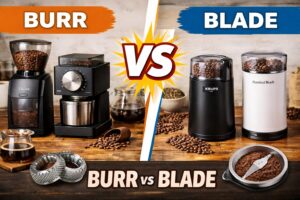
Last Updated: March 2026 • 35–45 min read • Cornerstone Guide: Espresso Grinder Science + Beginner Picks + Shot Dial-In System

The best coffee grinders for espresso are not the same as the best coffee grinders for drip or pour-over — and understanding that distinction is the most important thing an espresso beginner can know before spending a single dollar on equipment. Espresso is the most grind-sensitive brewing method that exists: a grind setting that is 20 microns too fine chokes the machine; a grind that is 20 microns too coarse produces a sour, under-extracted shot in under 20 seconds. That narrow precision window is why most general-purpose coffee grinders — including excellent grinders like the KINGrinder K6, which is the CoffeeGearHub standard for drip, pour-over, and French press — are not suitable for espresso. It is also why upgrading your espresso grinder produces a bigger improvement in shot quality than upgrading your espresso machine at almost any budget level. This guide covers everything a beginner espresso brewer needs to know: why espresso grinding is categorically different, what specifications actually matter, our verified picks from entry to intermediate level, a complete shot timing reference, the beginner dial-in system, and a full troubleshooting matrix for every common espresso shot problem.
✍️ Editorial note: This guide is researched and written by the editors at CoffeeGearHub.com using published brewing science, SCA Brewing Standards, manufacturer specifications, and established specialty-coffee community knowledge. All product links are affiliate links — we may earn a commission at no cost to you. Affiliate Disclosure: CoffeeGearHub.com participates in the Amazon Services LLC Associates Program. As an Amazon Associate, we earn from qualifying purchases.
The 30-Second Answer
For beginners using a pressurized portafilter, the Baratza Encore is a functional entry point — it grinds fine enough for pressurized baskets and has 40 settings to work with. For beginners using a non-pressurized (single-wall) basket, the Breville Smart Grinder Pro is the minimum requirement: dedicated espresso micro-adjustment, 60 grind settings, and a dose-by-weight timer. For beginners who want the best balance of espresso precision and long-term value, the Baratza Virtuoso+ delivers tighter consistency than the Encore at a price that remains accessible. The grinder is the most impactful upgrade in any espresso setup. An entry-level dedicated espresso grinder paired with a mid-range machine will produce better espresso than a budget general-purpose grinder paired with a premium machine.
- Best Entry (Pressurized Portafilter): Baratza Encore — functional for entry espresso, the floor not the ceiling
- Best Dedicated Espresso Grinder: Breville Smart Grinder Pro — 60 settings, true espresso micro-adjustment, dose by weight
- Best Step-Up (Non-Pressurized Baskets): Baratza Virtuoso+ — tighter consistency, DC motor, 54 settings
- Best Prosumer Entry: Eureka Mignon Silenzio — stepless adjustment, low retention, quiet motor for serious beginners
- What to avoid: Any blade grinder; any grinder not designed for espresso; the Fellow Ode (excellent for drip, not espresso-capable)
Who This Guide Is For — Jump to What You Need
☕ Total Espresso Beginner
Start with Why Espresso Grinders Are Different before reading any product picks.
⚡ Machine Owner, Needs Grinder
Jump to Pressurized vs Non-Pressurized to find which grinder matches your machine.
🔧 Shot Troubleshooter
Jump to the Troubleshooting Matrix for sour, bitter, channeling, and timing fixes.
🎗 Dialling In First Shots
See the Shot Timing Reference and Dial-In Guide for your first systematic approach.
Table of Contents
- Why espresso grinders are categorically different
- Pressurized vs non-pressurized: which grinder do you need?
- What to look for in a beginner espresso grinder
- Flat burr vs conical burr for espresso
- How much should a beginner spend on an espresso grinder?
- Espresso grinder type comparison
- Top picks: best espresso grinders for beginners
- A note on non-espresso home brewing
Why Espresso Grinders Are Categorically Different
Espresso and drip coffee look similar from the outside — ground coffee, hot water, a resulting cup. Inside the machine, they are almost entirely different processes operating under different physical constraints. Drip and pour-over brewing work by gravity: water passes through a bed of coffee at atmospheric pressure over 3–5 minutes. Espresso forces near-boiling water through a tightly packed coffee puck at 9 bar of pump pressure in 25–35 seconds. That pressure differential changes everything about what the grinder needs to do.
At 9 bar of pressure, water finds the path of least resistance through the coffee puck. If your grind is slightly too coarse, water flows through the puck too quickly — under 20 seconds total, producing a watery, sour, under-extracted shot. If your grind is slightly too fine, water cannot push through at all — the machine either chokes entirely or the shot runs so slowly that the coffee over-extracts to bitterness before the yield is complete. The margin between these two failure states is narrow: in most espresso setups, the entire range from “too fast” to “too slow” spans fewer than five grind adjustment steps. A drip grinder with 15 settings that are 50–100 microns apart cannot operate at this level of precision. An espresso grinder with 60 settings at 10–20 microns per step can. This is why espresso grinders are not simply “better” grinders — they are a different category of tool designed to operate within a fundamentally different brewing constraint.
⚠️ The grinder-machine priority rule: In espresso, the grinder contributes more to shot quality than the machine at almost every budget level. A $200 dedicated espresso grinder paired with a $300 entry machine produces better espresso than a $50 general-purpose grinder paired with a $1,000 machine. If you are currently under-budgeting the grinder to over-budget the machine, reverse the allocation. See our Best Espresso Machines for Beginners guide for machine pairing recommendations at every budget.
Pressurized vs Non-Pressurized Portafilter: Which Grinder Do You Need?
The most important variable in matching a grinder to your espresso setup is not machine brand or machine price — it is portafilter type. Most beginners do not know which type their machine uses. This single factor determines whether the Baratza Encore will work for you or whether you need a dedicated espresso grinder from the start.
| Pressurized (Double-Wall) Basket | Non-Pressurized (Single-Wall) Basket | |
|---|---|---|
| How it works | A second layer with a small hole creates artificial back-pressure regardless of grind consistency — compensates for grind imprecision | No compensation mechanism — extraction pressure is determined entirely by how well the puck is prepared and how precise the grind is |
| Grind sensitivity | Low — a wider range of grind sizes produce an acceptable shot | High — grind must be precise to within a narrow micron range to extract correctly |
| Who uses them | Standard on entry machines: Breville Bambino, DeLonghi Dedica, De’Longhi Stilosa, and most entry-tier machines | Standard on semi-professional machines: Gaggia Classic Pro, Breville Barista Express, Rancilio Silvia |
| Minimum grinder | Baratza Encore — entry-level capable; 40 settings is adequate for pressurized work | Breville Smart Grinder Pro or Baratza Virtuoso+ minimum — dedicated espresso micro-adjustment required |
| Upgrade path | Start with Encore; upgrade to Smart Grinder Pro or Virtuoso+ when you switch to non-pressurized | Do not start with the Encore — the grind imprecision will produce inconsistent shots that are hard to diagnose and learn from |
| How to check your machine | Look inside your portafilter basket — two holes at the bottom (one large, one very small above it) = pressurized | Multiple small holes across the entire basket bottom in a uniform pattern = non-pressurized |
What to Look for in a Beginner Espresso Grinder: 5 Variables That Matter
Espresso grinder marketing is full of specifications that are meaningful to experienced home baristas but useless to beginners. These five are the ones that actually determine whether a beginner grinder will produce consistent, diallable espresso shots.
| Factor | Why it matters for espresso | What to look for | What to avoid |
|---|---|---|---|
| Fine adjustment range | Espresso operates in a narrow precision window — your grinder needs enough resolution to make meaningful micro-adjustments within that window | 40+ settings minimum; dedicated espresso micro-adjustment dial; stepless or near-stepless adjustment preferred | Fewer than 20 settings; large jumps between adjacent settings that skip past the espresso range entirely |
| Burr size and quality | Larger burrs produce more consistent particle output at espresso fineness; cheap burrs produce excessive fines at fine settings, causing channeling and bitterness | 40mm+ conical or flat burrs for entry espresso grinders; hardened steel or titanium-coated burrs for durability at fine settings | Small plastic burr carriers; undisclosed burr specifications; grinders without a stated espresso capability |
| Grind retention | Coffee retained in the grinding pathway between doses stales between shots and contaminates the next dose with old grounds | Low-retention designs under 1g preferred; single-dose hoppers avoid stale beans between sessions | Large bean hoppers holding 200g+ — fine for drip, problematic for espresso where shot-to-shot consistency requires fresh grounds |
| Motor stability | Espresso grinding at fine settings requires consistent motor speed — speed variation changes particle size even at the same setting | DC motors produce more consistent speed than AC motors; look for motor ratings designed for fine-grind continuous operation | Entry drip grinders repurposed for espresso — their AC motors are not rated for the heat and friction of sustained fine grinding |
| Repeatability | Once you find a good shot setting you need to return to it reliably every session — a grinder with click settings or numbered positions makes this possible | Clear numbered settings; click or stepped adjustment that returns accurately; digital timer for dose repeatability | Stepless grinders without reference markings — hard for beginners to reproduce settings between sessions |
Flat Burr vs Conical Burr for Espresso
Both flat and conical burr designs produce excellent espresso. At the beginner tier the distinction matters less than burr size and adjustment range — but understanding it helps explain why certain grinders produce certain flavour profiles and why the Fellow Ode (flat burr, excellent grinder) is not an espresso grinder despite its quality.
| Conical Burr (Espresso) | Flat Burr (Espresso) | |
|---|---|---|
| Particle distribution | Bimodal — primary peak at target size plus fines; fines add sweetness and body to espresso | Unimodal — tighter clustering around target size; produces cleaner, more defined flavour clarity |
| Fines production | More fines at espresso fineness — contributes to crema and body but can cause channeling if excessive | Fewer fines — cleaner extraction; requires very consistent puck prep to avoid channeling |
| Espresso flavour profile | Richer body, more sweetness, slightly lower clarity — well-suited to milk-based espresso drinks | Higher clarity, defined acidity, cleaner finish — better suited to straight espresso tasting |
| Entry tier availability | Entry — conical burrs dominate beginner and intermediate espresso grinders | Intermediate / Prosumer — not necessary at beginner level |
| Beginner recommendation | ✓ Correct at beginner and intermediate levels | ⚠ Not necessary for beginners; revisit at intermediate/prosumer level |
🔬 Why the Fellow Ode is not an espresso grinder: The Fellow Ode Gen 2 is an excellent flat burr grinder for drip and pour-over. It does not grind fine enough for espresso by design — its adjustment range stops well above the 200–400 micron particle size that espresso requires. This is not a flaw in the Ode; it is a deliberate design choice that makes it exceptional for brewed coffee. If espresso is your goal, the Ode is not the correct purchase regardless of how positively it is reviewed for drip use.
How Much Should a Beginner Spend on an Espresso Grinder?
The espresso grinder budget question has a different answer than the general home brewing grinder question. For drip and pour-over, a wide range of entry-tier grinders cover a beginner’s needs. For espresso, the floor is higher because the precision requirements are stricter. General-purpose budget grinders without dedicated espresso adjustment ranges cannot produce consistent shots. The correct starting point is a grinder built specifically for espresso or one with a dedicated espresso-range adjustment system.
| Tier | What you get | Best pick | Best for |
|---|---|---|---|
| Budget | Drip-capable burr grinders without espresso-range adjustment — inadequate for consistent shot production | None — save the difference and buy a grinder designed for espresso | Not recommended for espresso |
| Entry | Entry electric burr grinders with limited fine adjustment; functional for pressurized portafilters only | Baratza Encore | Beginners with pressurized portafilter machines only |
| Entry / Dedicated Espresso | Dedicated entry espresso grinders with 60 settings, dose-by-weight timer, designed specifically for espresso | Breville Smart Grinder Pro | Most beginners — the correct first dedicated espresso grinder |
| Mid-Range | Step-up electric with DC motor, tighter consistency, 54 settings — works for non-pressurized baskets reliably | Baratza Virtuoso+ | Beginners with non-pressurized baskets or those who want room to grow into better technique |
| Prosumer Entry | Prosumer entry: stepless adjustment, low retention, quiet motors, flat or high-precision conical burrs | Eureka Mignon Silenzio | Serious beginners who want to skip the intermediate stage and buy equipment that keeps pace with advanced technique |
Espresso Grinder Type: Quick-Comparison by Beginner Use Case
| Best For | Recommended Grinder | Why It Works | Trade-Off | Tier |
|---|---|---|---|---|
| First espresso grinder, pressurized portafilter machine | Baratza Encore | Functional for pressurized baskets; 40 settings gives room to find the range; repairable long-term | Will not work for non-pressurized baskets; limited espresso precision ceiling | Entry |
| First dedicated espresso grinder, any machine | Breville Smart Grinder Pro | 60 settings designed for espresso micro-adjustment; dose timer; portafilter cradle for direct dosing | Larger footprint than manual options; some grind retention | Entry / Dedicated Espresso |
| Non-pressurized basket, serious beginner | Baratza Virtuoso+ | DC motor, 54 settings, tighter consistency than Encore — handles single-wall baskets reliably | Higher price than Smart Grinder Pro; not stepless | Mid-Range |
| Serious beginner who wants prosumer longevity | Eureka Mignon Silenzio | Stepless adjustment, very low retention, quiet motor, flat burrs — equipment that keeps pace as technique develops | Highest price in beginner range; stepless requires more experience to dial in | Prosumer Entry |
| Home brewer who also wants occasional espresso | Baratza Virtuoso+ | Covers drip and pour-over at the high end and espresso with pressurized basket at the fine end | Not ideal for non-pressurized espresso; a compromise rather than a dedicated tool | Mid-Range |
Best Coffee Grinders for Espresso: Our Top Picks
These picks are verified by consistent community endorsement, grind consistency data, and alignment with how each grinder actually performs in beginner espresso setups. Affiliate links use the CoffeeGearHub Amazon Associates tag. ⚠️ Note: Verify all ASINs against current Amazon listings before publishing — espresso grinder models and variants update frequently.

Best Entry Option: Baratza Encore (Pressurized Portafilter Only)
The Baratza Encore is the floor of espresso-capable grinders — it works, but only under specific conditions beginners need to understand before buying it for espresso use. The Encore’s 40 settings include a fine enough range for pressurized (double-wall) portafilter baskets, which are standard on most entry machines like the Breville Bambino and DeLonghi Dedica. For these setups it is functional and reliable. For non-pressurized (single-wall) baskets, the Encore does not have enough micro-adjustment precision — the gap between adjacent settings is too large to land reliably in the espresso extraction window. The Encore is an excellent grinder and the CoffeeGearHub standard for drip and pour-over. As an espresso grinder, it is the correct minimum for pressurized setups and the correct first grinder for anyone who is not yet sure how deeply they will pursue espresso.
- Burr type: 40mm conical stainless steel burrs
- Settings: 40 grind settings — espresso range approximately settings 3–8
- Portafilter compatibility: Pressurized (double-wall) baskets only — not recommended for non-pressurized
- Key advantage: Repairable; covers all non-espresso brew methods on the same grinder
- Best for: beginners with pressurized portafilter machines; anyone uncertain about their long-term espresso commitment
Disclosure: CoffeeGearHub may earn from qualifying purchases.
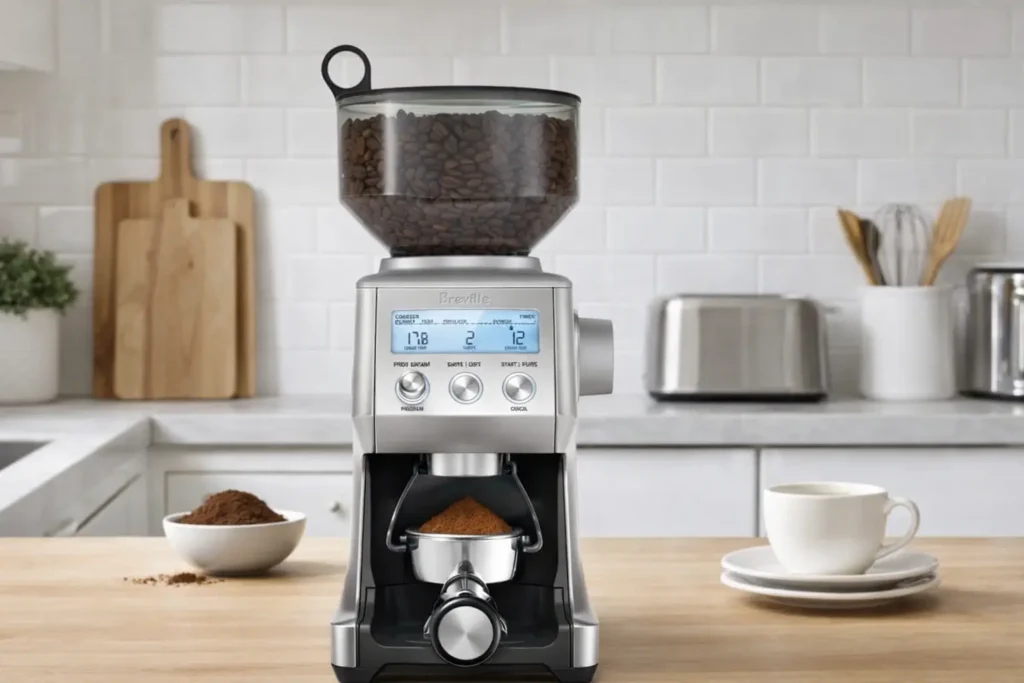
Best Dedicated Espresso Grinder: Breville Smart Grinder Pro
The Breville Smart Grinder Pro is the most complete dedicated espresso grinder for beginners at the entry price point. Unlike the Baratza Encore — which is a drip grinder pressed into espresso service — the Smart Grinder Pro is designed with espresso as its primary use case. The 60 grind settings give beginners a genuine precision range to work with: adjacent settings are close enough together to meaningfully change shot timing, but far enough apart to produce a readable result when adjusted. The portafilter cradle grounds directly into the portafilter without a catch cup, the LCD display shows dose time, and the built-in timer allows repeatable dosing once a good shot is found. For beginners who know they want to pursue espresso seriously, this is the correct starting point over the Encore.
- Burr type: Conical stainless steel burrs, designed for espresso fine range
- Settings: 60 grind settings — dedicated espresso micro-adjustment range
- Espresso features: Portafilter cradle for direct dosing; LCD dose timer; grounds directly into portafilter
- Portafilter compatibility: Both pressurized and non-pressurized baskets
- Best for: beginners who know espresso is their primary brewing goal; any machine type
Disclosure: CoffeeGearHub may earn from qualifying purchases.
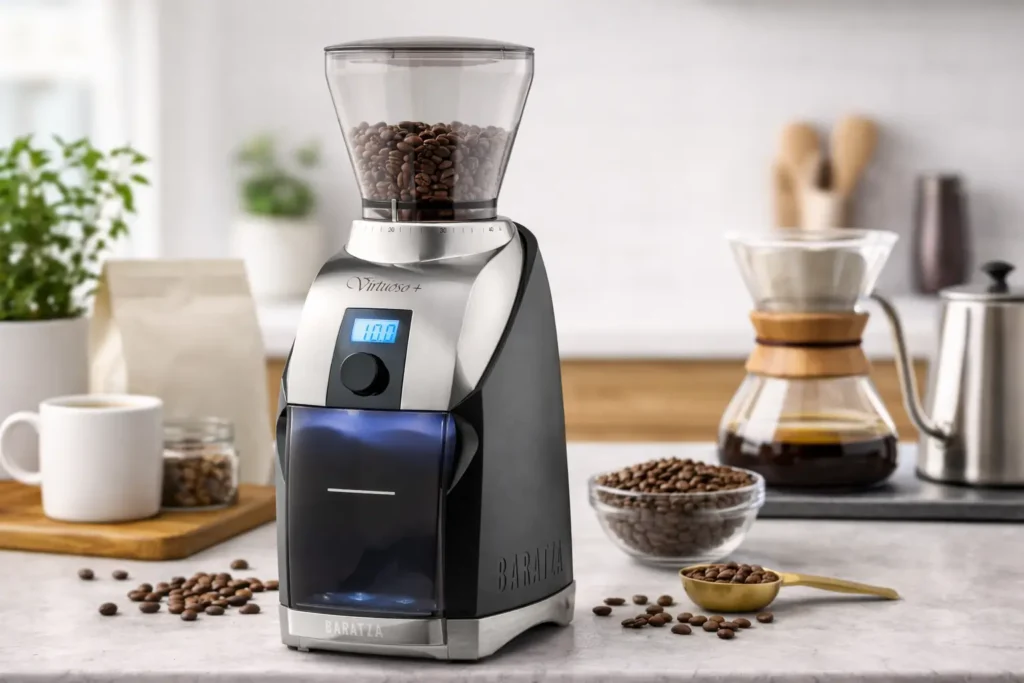
Best Step-Up for Non-Pressurized Baskets: Baratza Virtuoso+
The Baratza Virtuoso+ occupies a specific and useful position in the beginner espresso grinder market: it is the lowest-priced grinder that produces consistent enough output for non-pressurized (single-wall) portafilter baskets without requiring the investment of a prosumer machine. The DC motor maintains consistent grind speed better than the Encore’s AC motor — motor speed variation changes particle size even at a fixed setting, and this becomes significant for espresso precision. The 54 settings include a fine enough range for most home espresso machines with non-pressurized baskets, and the digital dose timer allows repeatable shot preparation once a setting is dialled in. Beginners with machines like the Gaggia Classic Pro or Rancilio Silvia who need a grinder that can produce consistent shots in a non-pressurized basket without a prosumer budget should start here.
- Burr type: 40mm high-carbon steel conical burrs — lower fines output than standard Encore burrs
- Settings: 54 settings — more espresso resolution than the Encore
- Motor: DC motor — more consistent speed than AC; important for espresso shot repeatability
- Timer: Digital dose timer — repeatable dosing without weighing every shot
- Best for: beginners with non-pressurized portafilter machines; serious beginners who want precision room to grow
Disclosure: CoffeeGearHub may earn from qualifying purchases.
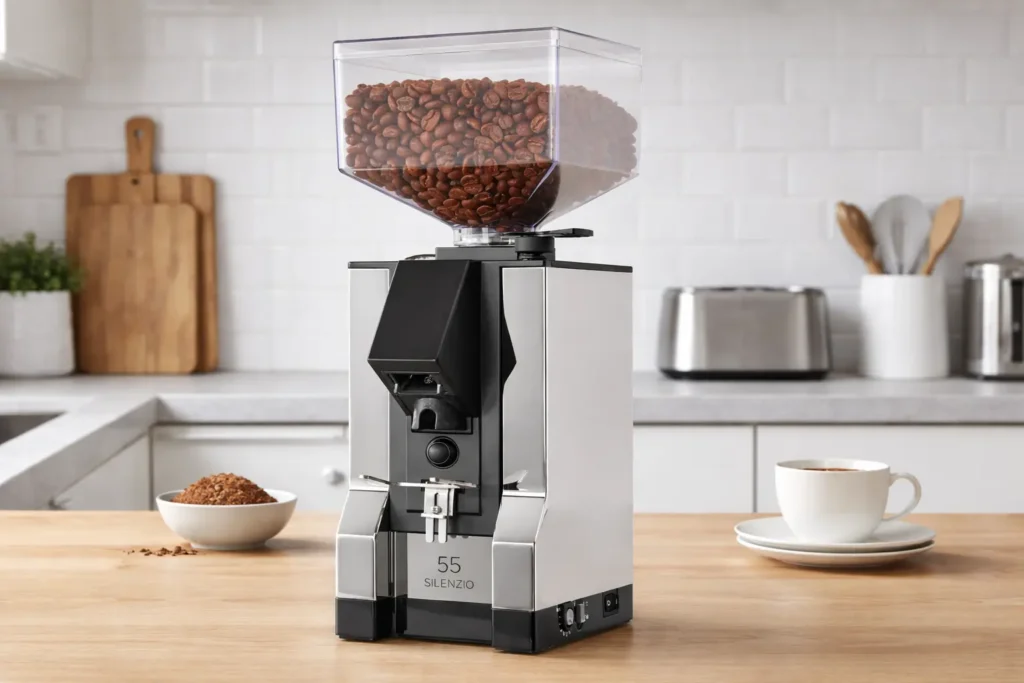
Best Prosumer Entry: Eureka Mignon Silenzio
The Eureka Mignon Silenzio is the correct choice for the beginner who has done enough research to know that they want equipment that will not limit them as their espresso technique develops. It is significantly quieter than every grinder in this roundup — the Silenzio (Italian for “silence”) name is accurate; it runs at 50dB, well below the 70–80dB of the Baratza grinders. The stepless adjustment wheel allows infinitely fine grind changes rather than jumping between preset steps, which is ideal for espresso precision once a beginner has developed enough palate sensitivity to use it. The 50mm flat burrs produce the unimodal particle distribution that delivers the flavour clarity espresso enthusiasts pursue. The retention is low. The build is compact and Italian-made. It is more grinder than a first-week espresso beginner needs, but it is the grinder that eliminates any equipment ceiling for at least the first 3–5 years of home espresso progression.
- Burr type: 50mm flat burrs — unimodal distribution; high clarity espresso
- Adjustment: Stepless — infinite fine adjustment; ideal for espresso precision as technique develops
- Noise: 50dB — significantly quieter than any other grinder in this roundup
- Retention: Very low — minimal stale grounds between shots
- Best for: serious beginners who want to buy once at prosumer level and not revisit the grinder decision for years
Disclosure: CoffeeGearHub may earn from qualifying purchases.
A Note on Non-Espresso Home Brewing
🔬 If you also brew drip, pour-over, or French press at home: The KINGrinder K6 is the CoffeeGearHub standard recommendation for all non-espresso home brewing — 100-click precision, 48mm conical burrs, and click settings that carry across every CoffeeGearHub brewing guide. However, the K6 is not an espresso grinder. It cannot grind fine enough for espresso and should not be used with an espresso machine. If you brew both espresso and non-espresso methods at home, you need two grinders: a dedicated espresso grinder (from this guide) and the K6 for everything else. Alternatively, the Baratza Encore or Virtuoso+ cover both use cases at acceptable (though not maximum) quality in each direction. See our Best Coffee Grinders for Home Brewing guide for non-espresso recommendations.
Extraction Science: Why Espresso Grind Precision Changes Everything
Understanding the extraction mechanism behind espresso precision is what allows beginners to diagnose shot problems systematically rather than changing variables randomly and hoping for improvement. Three principles cover everything a beginner needs to know.
- Pressure extraction amplifies every grind inconsistency. In drip brewing, gravity moves water through coffee gently and slowly. In espresso, a pump forces water through at 9 bar of pressure — approximately 130 pounds per square inch. At this pressure, every variation in particle size is magnified. Fine particles restrict flow far more aggressively than coarse ones; coarse particles allow water through far more easily. A grind that produces a wide range of particle sizes produces a puck with dramatically uneven flow resistance across its surface, which leads to channeling — water forcing through the easiest path rather than extracting evenly. This is why espresso grinders must produce tighter particle distributions than drip grinders, and why burr quality matters more for espresso than for any other brewing method.
- The espresso extraction window is narrow and identifiable by shot timing. Espresso extraction operates within a target window of 25–35 seconds for a standard double shot at a 1:2 dose-to-yield ratio (18g coffee in, 36g espresso out). Within this window, the shot extracts enough soluble compounds to produce balanced acidity, sweetness, and body. Outside the window — under 20 seconds produces sour and thin; over 40 seconds produces bitter and astringent — the shot is off in a way that no amount of milk or sugar can fully correct. Grind size is the primary lever for controlling this timing. Finer grind slows the shot; coarser grind speeds it up. Your espresso grinder’s adjustment resolution determines how precisely you can land in the window.
- Fines produce crema but also channeling. All burr grinders produce ultra-fine particles alongside their primary grind output. In espresso, fines serve two functions simultaneously: they pack into the spaces between larger particles and create the flow resistance that builds pressure and produces crema; and when produced in excess, they cause channeling by creating pockets of extreme flow resistance that redirect water pressure to adjacent, less-restricted areas. The balance between enough fines for crema and too many fines for consistent extraction is why burr quality and size matter for espresso: high-quality burrs produce a controlled, predictable fines profile. Cheap burrs produce erratic, uncontrollable fines at espresso-fine settings, making consistent shots nearly impossible regardless of how carefully you prepare the puck.
Shot Timing Reference: What a Good Espresso Shot Looks Like
Shot timing is the primary diagnostic tool for espresso grind adjustment. Every time you pull a shot, record the time from pump start to yield completion and compare it to the targets below. This table covers standard double shots at a 1:2 ratio (18g in, 36g out). Single shots and lungo pulls operate on different timing targets.
| Shot time | What it means | Primary cause | Fix | Flavour result |
|---|---|---|---|---|
| Under 15 seconds | Severe under-extraction — water flowing through with almost no resistance | Grind far too coarse; severely under-dosed puck; no tamping | Grind significantly finer (3–5 steps); confirm dose weight; confirm tamping | Sour, thin, no body; watery with little or no crema |
| 15–20 seconds | Under-extraction — shot running fast | Grind too coarse for current dose and puck prep | Grind 2–3 steps finer; re-pull at same dose | Sour, sharp, thin body, weak crema |
| 20–25 seconds | Approaching target — slightly fast | Grind 1 step coarser than ideal, or light tamping | Grind 1 step finer; ensure tamp is level and consistent | Some sourness; body present but not fully developed |
| 25–35 seconds ✓ | Target extraction window for standard double shot | Correct grind, dose, and puck prep | No adjustment needed; log the setting and reproduce it | Balanced acidity and sweetness; full body; rich crema |
| 35–45 seconds | Slightly over-extracted | Grind 1 step too fine; or over-dosed puck; uneven distribution | Grind 1 step coarser; check dose weight; check distribution | Some bitterness; body present but heavy; crema may be dark |
| Over 45 seconds | Over-extraction — severely restricted flow | Grind too fine; or channeling from uneven puck | Grind 2–3 steps coarser; check puck prep for uneven distribution | Bitter, harsh, astringent; ashy aftertaste; very dark crema |
| Machine chokes, no flow | Grind so fine water cannot push through at 9 bar | Grind far too fine; over-dosed; very hard tamp on fine grind | Grind 5+ steps coarser immediately; do not force the machine | No shot produced; machine safety valve may activate |
Dial-In Guide: How a Beginner Finds Their First Good Espresso Shot
Espresso dial-in is the systematic process of finding the grind setting that produces a shot in the target extraction window with your specific bean, dose, and machine. It is more demanding than drip dial-in because the tolerance is narrower and the feedback comes in the form of shot timing and taste simultaneously. The most important rule is the same as all home brewing dial-in: one variable at a time.
The Beginner Espresso Dial-In Process
- Set a starting dose: 18g for a standard double. Weigh every dose on a scale accurate to 0.1g
- Start at the manufacturer’s recommended espresso setting for your grinder
- Distribute grounds evenly in the portafilter — use a finger or distribution tool to break up clumps
- Tamp with approximately 15kg of downward pressure, level — use a bathroom scale to calibrate your tamp once
- Pull the shot and measure: time from pump start to shot completion; weight of espresso out
- Target: 25–35 seconds; 36g out (1:2 ratio)
- If shot runs fast (under 25s): grind 1–2 steps finer; re-pull at same dose
- If shot runs slow (over 35s): grind 1–2 steps coarser; re-pull at same dose
- Once in timing window: taste. Adjust grind fine for more body; coarser for more brightness
- Log the winning setting. Purge 2–3g at the start of every session to clear stale retained grounds before pulling your shot
Shot Taste → Grind Adjustment
- Sour / sharp / under 25 seconds: grind 1–2 steps finer → re-pull
- Bitter / harsh / over 35 seconds: grind 1–2 steps coarser → re-pull
- In timing window but flat / no brightness: lower brew temperature 1°C; use lighter roast
- In timing window but thin body: increase dose 0.5g; keep grind and yield the same
- Channeling (fast uneven shot, pale streaks in crema): improve distribution before tamping; grind 1 step finer
- Shot times vary randomly between pulls: check grinder retention; purge before each shot; confirm tamping consistency
- No improvement after 5+ pulls: change beans — very dark or very stale roasts resist dial-in
Common Beginner Espresso Grinder Mistakes to Avoid
| Mistake | Why beginners make it | What to do instead |
|---|---|---|
| Using a drip grinder for non-pressurized espresso | Already own a drip grinder; hoping it will work for espresso | The Baratza Encore works for pressurized portafilters only. For non-pressurized baskets, buy a dedicated espresso grinder before expecting consistent shots |
| Buying the Fellow Ode for espresso | The Ode is well-reviewed and visible in specialty coffee content | The Ode is not an espresso grinder by design. Buy the Smart Grinder Pro or Virtuoso+ for espresso |
| Changing dose, grind, and temperature in the same dial-in session | When shots are bad, beginners change everything simultaneously | Fix grind first — get into the 25–35 second window before touching dose or temperature. Grind is the primary dial |
| Not weighing doses | Scooping by volume or using the grinder timer as the sole dose control | Weigh every dose to 0.1g accuracy. A 1g dose variation at 18g changes shot timing by 3–5 seconds, masking the grind signal |
| Not weighing the yield | Stopping the shot by time alone without measuring output | Place a scale under the cup and weigh the espresso output. 36g out from 18g in (1:2 ratio) is the standard starting point |
| Not purging before the first shot of the day | Beginners don’t know grinders retain stale grounds between sessions | Grind and discard 2–3g of beans before pulling your first shot. Stale retained grounds from the previous session change the effective grind setting |
| Using very dark or oily espresso beans for dial-in | Dark roast espresso is familiar and seems appropriate | Start dial-in with a medium or medium-dark roast from a reputable roaster with a roast date under 2 weeks old. Very dark roasts degas quickly and produce erratic shots during dial-in |
Troubleshooting Matrix: Espresso Shot Symptoms → Causes → Fixes
| Symptom | Most likely cause | Fix (in order) |
|---|---|---|
| Shot runs under 20 seconds | Grind too coarse; under-dosed; not tamped | Grind 2–3 steps finer → confirm 18g dose → confirm level tamp with consistent pressure |
| Shot runs over 40 seconds | Grind too fine; over-dosed; channeling from uneven distribution | Grind 2–3 steps coarser → confirm dose is not over 18g → redistribute grounds before tamping |
| Machine chokes, pump strains, no flow | Grind far too fine; puck density too high for pump to overcome | Grind 5+ steps coarser immediately; do not force the machine repeatedly; re-pull at coarser setting |
| Shot tastes sour and in timing window | Light roast at too-low brew temperature; or under-extracted despite correct timing | Raise brew temp 1°C → grind 1 step finer → confirm beans are fresh (roast date under 2 weeks) |
| Shot tastes bitter and in timing window | Dark roast at too-high brew temperature; or over-extracted despite correct timing | Lower brew temp 1°C → grind 1 step coarser → try a lighter roast profile |
| Channeling — pale streaks in crema, fast uneven flow | Uneven ground distribution in the basket; insufficient or uneven tamp; coarse grind with poor puck prep | Use a distribution tool or finger stir before tamping → ensure tamp is level (no lean) → grind 1 step finer |
| Shot times vary significantly between pulls at the same setting | Grinder retention: stale grounds from previous session changing effective grind each pull | Purge 2–3g before each session → ensure grounds bin is empty between sessions → confirm dose weight each pull |
| Crema is pale, thin, or disappears immediately | Stale beans; or grind too coarse; or water too hot | Use beans under 2 weeks from roast date → grind 1 step finer → lower brew temperature 1°C |
| Crema is very dark brown or black with bitter taste | Over-extraction — grind too fine or brew temperature too high | Grind 1–2 steps coarser → lower brew temp 1°C → reduce dose by 0.5g |
| Shot improves then deteriorates over days without changing settings | Beans ageing past peak; or seasonal lot change in a new bag | Beans are best 4–21 days post-roast for espresso; buy smaller quantities more frequently; re-dial-in with each new bag |
Cleaning and Maintenance: Keeping Your Espresso Grinder Performing
Espresso grinders require more frequent cleaning than drip grinders because fine grinding generates more friction, more heat, and more coffee oil coating on burr surfaces per gram of coffee ground. Rancid coffee oil at espresso fineness produces a bitter, stale aftertaste that is almost impossible to distinguish from a grind or bean problem without eliminating the maintenance variable first. If your espresso suddenly tastes worse without any recipe change, clean the grinder before changing anything else.
After Every Session
- Purge 2–3g of beans at the start of each session to clear stale retained grounds
- Wipe the grounds chute and portafilter fork with a dry cloth after each session
- Empty any grounds remaining in the chute with a dry brush
- Never use water inside the grinder — moisture on espresso burrs promotes corrosion and rancidity
Every 1–2 Weeks (Daily Espresso Users)
- Fully disassemble: remove upper burr, lower burr where accessible, and all grinding pathway components
- Brush all burr surfaces and grinding pathway with a stiff dry brush — never water on burrs
- For electric espresso grinders: Urnex Grindz cleaning tablets are the easiest method — run through per instructions then purge a full dose of fresh beans before pulling your next shot
- After reassembly: re-dial-in your grind setting — reassembly can shift the burr position by 1–2 effective steps
Espresso Grinder Buying Checklist
| Question | What to confirm | Red flag |
|---|---|---|
| Is it designed for espresso? | Product explicitly states espresso capability — not just “fine” as an option on a drip grinder | “Also grinds for espresso” on a grinder with fewer than 30 settings; Fellow Ode listed as espresso-capable |
| What type of portafilter do I have? | Pressurized: Baratza Encore is adequate. Non-pressurized: Breville Smart Grinder Pro or Virtuoso+ minimum | Assuming the Encore works for all espresso setups — it does not for non-pressurized baskets |
| How many grind settings does it have? | 40+ settings minimum for pressurized espresso; 54+ settings for non-pressurized; stepless preferred for prosumer | Fewer than 20 settings; no dedicated espresso micro-adjustment range |
| Does it grind directly into the portafilter? | Portafilter cradle or fork eliminates a transfer step and reduces static clumping — particularly useful for beginners | No portafilter cradle on a grinder marketed for espresso — indicates it was not designed for this use case |
| Do I have a scale? | A scale accurate to 0.1g is essential for espresso — dose variation of 1g changes shot timing significantly | Planning to dose by grinder timer alone without weighing — timer dosing drifts as beans and retention change |
| Are replacement burrs available? | Baratza and Eureka both sell replacement espresso burrs; burrs dull over time and affect grind consistency | No-brand espresso grinders with no parts ecosystem — the grinder becomes disposable when burrs dull |
Final Takeaway: The Best Espresso Grinder for Beginners
The best coffee grinder for espresso is the one that gives you enough adjustment precision to land consistently in the 25–35 second extraction window, enough repeatability to pull the same shot the next morning, and enough room to grow as your technique develops. For beginners with a pressurized portafilter machine, the Baratza Encore is a functional starting point that also covers all non-espresso home brewing from the same grinder. For beginners who are serious about espresso from the start, the Breville Smart Grinder Pro is the correct dedicated first purchase — 60 settings designed for espresso, a portafilter cradle for direct dosing, and a dose timer that makes repeatable shot production achievable from day one. For beginners with non-pressurized machines who want the grinder out of the way as a variable, the Baratza Virtuoso+ is the correct investment. And for the beginner who has done enough research to want equipment with no ceiling for years to come, the Eureka Mignon Silenzio is the answer. Whatever you choose: pair your grinder with a 0.1g-accurate scale, use beans roasted within the past two weeks, and use the shot timing reference and dial-in system in this guide to find your first good shot systematically rather than by guesswork. Espresso is learnable. The grinder you choose determines how long that learning takes.
FAQs: Best Coffee Grinders for Espresso
Can I use a regular coffee grinder for espresso?
Not effectively. Most general-purpose grinders cannot grind fine enough or with enough micro-adjustment precision for consistent espresso shots. The Baratza Encore can work for entry espresso with a pressurized portafilter. For non-pressurized (single wall) baskets, a dedicated espresso grinder is required.
What is the best espresso grinder for beginners?
The Breville Smart Grinder Pro is the best dedicated espresso grinder for beginners at the entry price point — 60 settings designed for espresso micro-adjustment, portafilter cradle for direct dosing, and a dose timer. For beginners with pressurized portafilter machines, the Baratza Encore is a functional entry option that also covers all non-espresso home brewing.
Why is espresso grinding harder than drip or pour-over grinding?
Espresso forces water through a tightly packed coffee puck at 9 bar of pressure in 25-35 seconds. A grind 20 microns too fine chokes the machine; a grind 20 microns too coarse produces a sour under-extracted shot in under 20 seconds. Drip and pour-over are far more forgiving. Espresso grinders need both fine enough range and small enough adjustment steps to operate in this narrow precision window.
What is the correct espresso shot timing for a beginner?
Target 25-35 seconds from pump start to shot completion, producing approximately double the dose in output (1:2 ratio — 18g in, 36g out). Shots under 20 seconds are under-extracted and taste sour or thin. Shots over 40 seconds are over-extracted and taste bitter and ashy. Adjust grind finer to slow the shot; coarser to speed it up.
What is channeling and how does grind affect it?
Channeling occurs when water finds a path of least resistance through the coffee puck rather than extracting evenly. It produces a shot that is simultaneously over-extracted and under-extracted. Channeling is worsened by high fines production from low-quality grinders. A grinder that produces fewer fines and more consistent particles dramatically reduces channeling even with imperfect puck prep technique.
Do I need a pressurized or non-pressurized portafilter for a beginner espresso setup?
Pressurized (double-wall) portafilters are more forgiving of grind inconsistency and are standard on entry-level machines. The Baratza Encore is adequate for pressurized baskets. Non-pressurized (single-wall) baskets are sensitive to grind precision — beginners with these baskets need the Breville Smart Grinder Pro or Baratza Virtuoso+ minimum.
What is the difference between flat burr and conical burr espresso grinders?
Flat burr espresso grinders produce a more unimodal particle distribution — tighter clustering around the target size — which produces cleaner, brighter espresso with more defined flavour clarity. Conical burr grinders produce a slightly bimodal distribution with more fines, adding body and sweetness but potentially producing muddiness at very fine settings. Most beginner espresso grinders use conical burrs; flat burr grinders are suited to intermediate and prosumer setups.
How much should I spend on a beginner espresso grinder?
Look for a grinder with a dedicated espresso adjustment range. The Baratza Encore works for entry espresso with pressurized portafilters and also covers all non-espresso home brewing. The Breville Smart Grinder Pro is the correct dedicated entry espresso grinder — 60 settings designed for espresso micro-adjustment. The Baratza Virtuoso+ is the correct step-up for non-pressurized baskets. Budget grinders without dedicated espresso adjustment range cannot produce consistent shots.
Why does my espresso shot run too fast even at the finest setting?
If your shot runs under 20 seconds even at the finest grind setting, your grinder may not grind fine enough for your portafilter type. With a pressurized portafilter, confirm you are dosing enough coffee (17-18g). With a non-pressurized basket, this indicates the grinder cannot reach espresso-capable fineness and an upgrade is required. Also confirm tamping pressure is consistent — approximately 15kg of downward force, level.
How often should I clean my espresso grinder?
Wipe the grounds chute and portafilter fork after every session. Purge 2-3g of beans at the start of each session to clear stale retained grounds. Do a full disassembly brush clean every 1-2 weeks for daily espresso users — coffee oil builds up on espresso burrs faster than on drip grinders. Urnex Grindz tablets are the easiest cleaning method for electric espresso grinders.
Continue Learning
ESPRESSO CLUSTER
Ready to pair your grinder with the right espresso machine? Our beginner machine guide covers every entry to intermediate machine with portafilter type, pressure ratings, and grinder pairing recommendations.
☕
Written by the CoffeeGearHub Editorial Team
CoffeeGearHub is a specialty coffee equipment resource run by home brewers and coffee enthusiasts. Our guides are researched using published brewing science, SCA standards, manufacturer specifications, and established specialty-coffee community knowledge. We review and update our content regularly. About CoffeeGearHub →