Last Updated: March 1, 2026 • 18–24 min read • Covers: Grind Science + Electric & Manual Picks + Dial-In Guide + Troubleshooting Matrix
✍️ Editorial note: This guide is researched and written by the editors at CoffeeGearHub.com using published brewing science, equipment manufacturer specifications, and established specialty-coffee community knowledge. Recommendations reflect research consensus rather than in-house lab testing. All product links are affiliate links — we may earn a commission at no cost to you.
The 30-Second Answer
The best grinder for moka pot is a burr grinder capable of a consistent medium-fine grind — the texture of table salt, slightly coarser than espresso. Blade grinders produce uneven particles that cause bitter, harsh extractions in a moka pot. A good burr grinder is the single biggest taste upgrade available for stovetop coffee.
- Best overall electric: Baratza Encore ESP — 40 settings, hardened steel burrs, highly repairable
- Best modern electric: Fellow Opus — anti-static, wide grind range, compact footprint
- Best manual (site standard): KINGrinder K6 — precise click-step adjustment, low retention, excellent medium-fine consistency
- Key rule: never use espresso-fine grind in a moka pot, and never tamp — both restrict flow and cause over-extraction
Who This Guide Is For — Jump to What You Need
🔍 Choosing a grinder
Start at Quick Picks Table + Buying Guide + Decision Guide.
⚡ Electric only
Jump to Best Electric Grinders + Electric vs Manual Comparison.
✋ Manual only
Jump to Best Manual Grinders — includes the site-standard KINGrinder K6.
🛠️ Fixing bitter or weak coffee
Go straight to the Troubleshooting Matrix + Dial-In Guide.
Table of Contents
Quick Picks: Best Grinders for Moka Pot (2026)
| Grinder | Type | Best For | Grind Consistency | Our Take |
|---|---|---|---|---|
| Baratza Encore ESP | Electric burr | Most home brewers | Excellent | Best overall electric pick |
| Fellow Opus | Electric burr | Modern kitchen setups | Excellent | Best design + wide range |
| OXO Brew Conical Burr | Electric burr | Beginners | Very good | Best plug-and-play ease of use |
| KINGrinder K6 | Manual burr | Home + travel brewing | Excellent | Best overall manual — site standard pick |
| 1Zpresso JX-Pro | Manual burr | Enthusiasts and espresso range | Outstanding | Best premium manual grinder |
| Timemore Chestnut C2 Max | Manual burr | Budget manual option | Very good | Best entry-level manual grinder |
Why Grind Size Is the #1 Variable in Moka Pot Brewing
Finding the best grinder for moka pot starts with understanding why grind quality matters so much for this specific brewing method. A moka pot forces hot water through a compact bed of coffee using steam pressure — typically just 1–2 bars, compared to the ~9 bars of a true espresso machine. This lower pressure means the grind has to do a lot of the extraction work.
Grind too fine and the water has nowhere to go — pressure builds, extraction over-runs, and the result is bitter and harsh. Grind too coarse and the water blows straight through without picking up enough flavor — the result is sour and weak. The target zone is medium-fine, and hitting it consistently requires a burr grinder with repeatable settings.
💡 The moka pot grind rule: medium-fine — slightly coarser than espresso, slightly finer than drip. Never use espresso-fine grind and never tamp. Both restrict flow too aggressively for the moka pot’s pressure range.
Moka Pot Grind Size in Context
| Brewing Method | Grind Size | Texture Reference | Pressure Range |
|---|---|---|---|
| French Press | Coarse | Sea salt / coarse kosher salt | None (immersion) |
| Pour Over / Drip | Medium | Sand | Gravity only |
| Moka Pot ← target | Medium-Fine | Table salt | 1–2 bars (steam) |
| AeroPress concentrate | Medium-Fine | Table salt | Hand pressure |
| Espresso | Fine | Powdered sugar / fine sand | ~9 bars (pump) |
Burr vs Blade: Why It’s Not Even a Close Call for Moka Pot
Blade grinders chop beans randomly with a spinning blade — the result is a mixture of dust-fine particles and coarse chunks in the same batch. In a moka pot, those fine particles over-extract and create bitter, harsh notes while the coarse chunks under-extract and produce sourness. You get both problems simultaneously.
Burr grinders instead crush beans between two abrasive surfaces set at a precise gap. Every particle comes out the same size. When all your grounds are uniform, extraction is even — the flavors you want come through cleanly without the defects caused by mismatched particle sizes.
| Factor | Blade Grinder | Burr Grinder |
|---|---|---|
| Particle size consistency | Very inconsistent — dust + chunks | Uniform — all particles same size |
| Grind setting repeatability | None — time-based only | Excellent — numbered or click-step settings |
| Moka pot extraction result | Bitter + sour simultaneously | Even, balanced extraction |
| Heat generated | High — blade friction degrades aroma | Low — slow-crush burr action |
| Adjustability | None | Full range from coarse to fine |
Best Electric Coffee Grinders for Moka Pot (2026)
Electric burr grinders offer convenience for daily brewing, consistency across multiple cups, and hands-free operation. All three picks below handle the medium-fine range reliably and are available on Amazon.
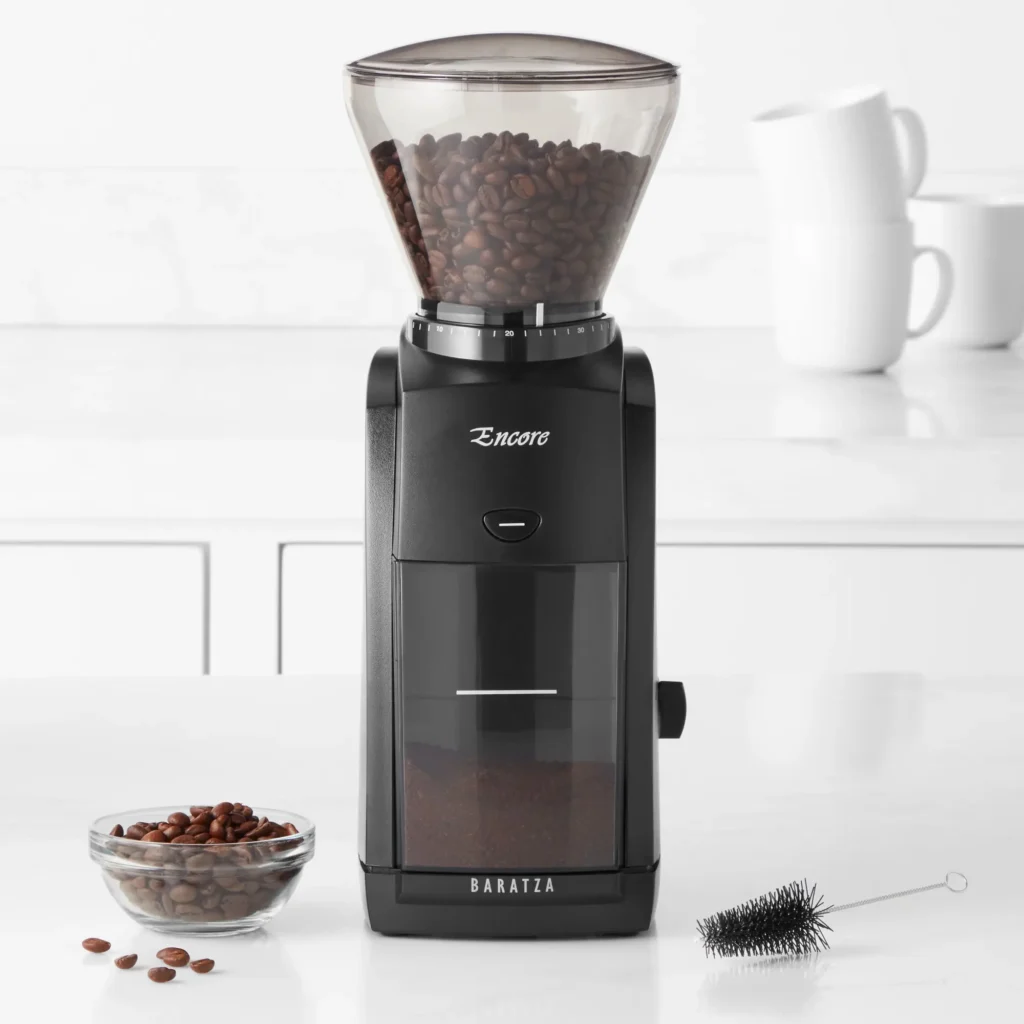
Baratza Encore ESP — Best Overall Electric Grinder for Moka Pot
Why it’s our top electric pick: The Encore ESP is the Encore updated specifically for espresso-adjacent fine grinding — making it the rare entry-level electric grinder that reliably hits the medium-fine zone moka pot requires without skating into espresso-too-fine territory. The hardened steel conical burrs produce clean, consistent particles across all 40 settings, and Baratza’s repair-first ethos means this grinder can last a decade or more.
- 40 grind settings with fine-step adjustment in the medium-fine range
- Hardened steel conical burrs — durable and low-heat grinding
- Highly repairable — parts widely available, Baratza sells them directly
- Quiet motor, compact countertop footprint
- Works well for moka pot, AeroPress, pour over, and entry-level espresso
Affiliate link — we may earn a commission at no cost to you.
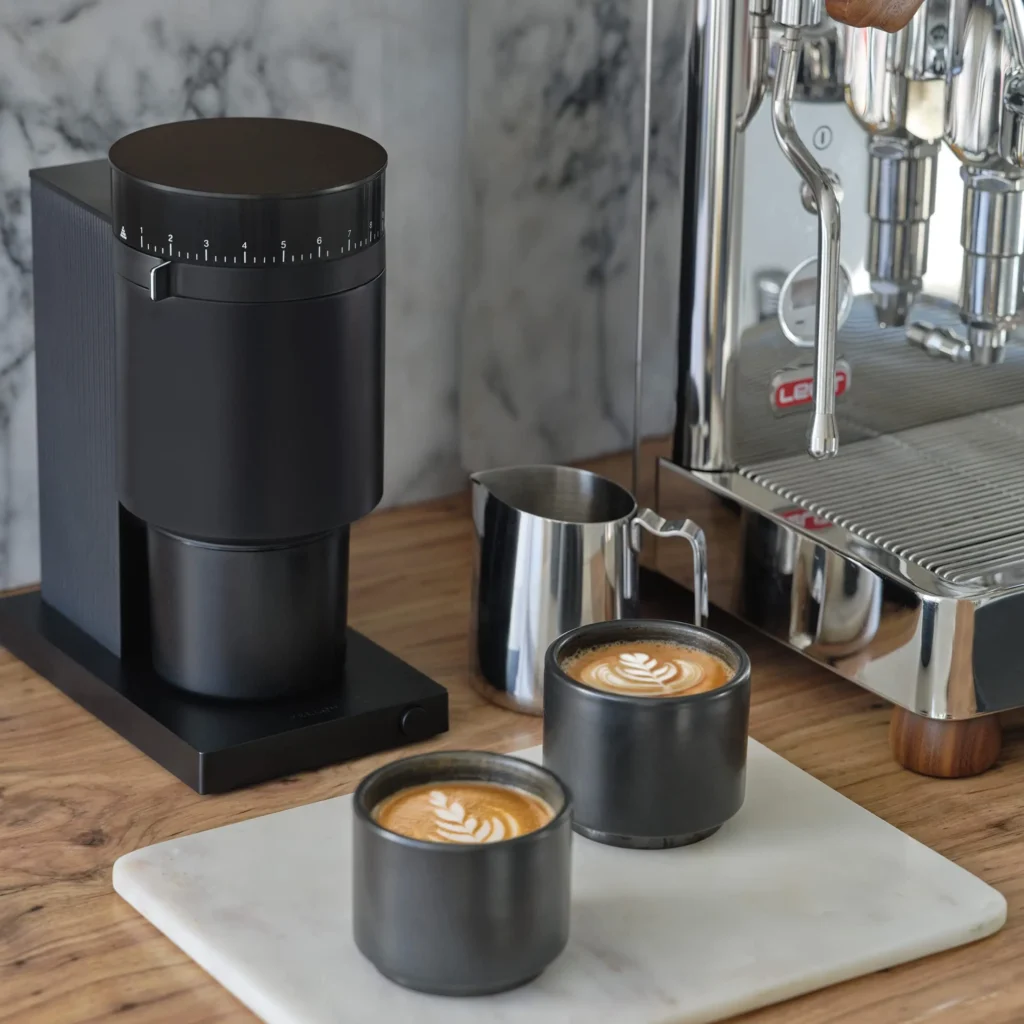
Fellow Opus — Best Modern Design + Widest Grind Range
Why it stands out: The Fellow Opus punches above its class with a genuinely wide grind range — 41 settings covering everything from coarse French press to espresso-fine — and built-in anti-static technology that dramatically reduces ground coffee clinging to the bin and chamber. For moka pot brewing, the medium-fine settings are precise and repeatable. It also looks exceptionally good on a modern kitchen counter.
- 41 grind settings — covers moka pot, AeroPress, pour over, espresso, and cold brew in one grinder
- Anti-static technology — less mess, less waste, faster cleanup
- Compact footprint — one of the smallest electric burr grinders available
- Grounds bin with lid reduces static and keeps grounds contained
- Excellent choice if you brew multiple methods with the same grinder
Affiliate link — we may earn a commission at no cost to you.
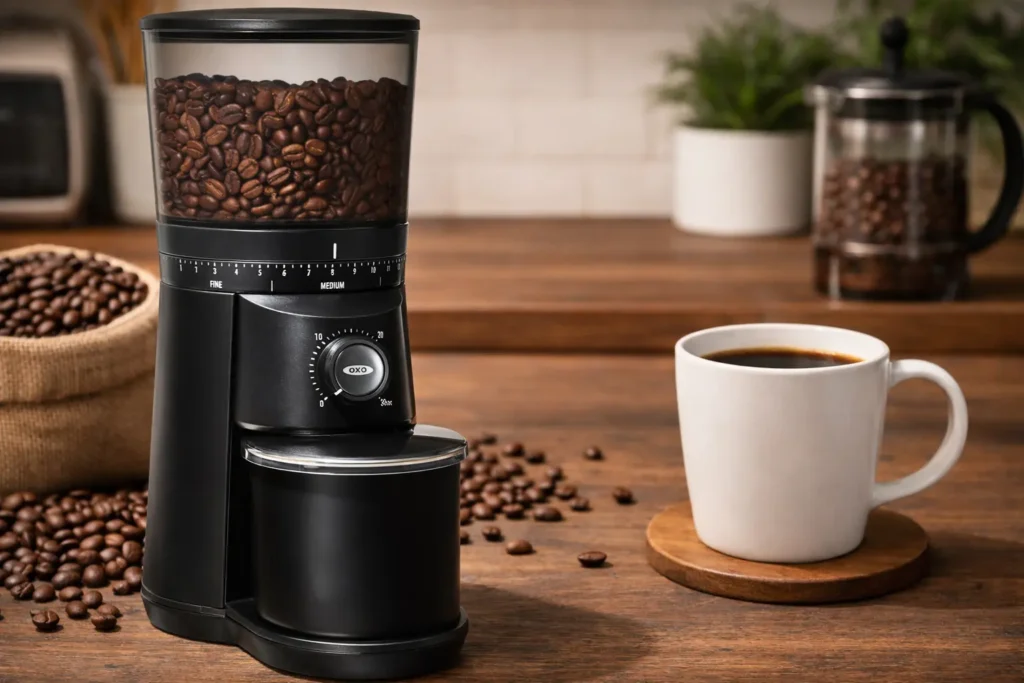
OXO Brew Conical Burr Grinder — Best Plug-and-Play for Beginners
Why it’s a great starter grinder: The OXO Brew is the most approachable electric burr grinder on this list. A single large dial controls grind size through 15 settings with clear visual markers — no confusing micro-adjustment. Stainless steel conical burrs produce reliable medium-fine output for moka pot without any learning curve. If you want to step up from a blade grinder today without overthinking it, this is the pick.
- 15 grind settings with clear one-knob adjustment — simplest interface available
- Stainless steel conical burrs — consistent, durable, easy to clean
- Large hopper — holds enough beans for multiple days of brewing
- Dose selector for 1–12 cups
- Best choice for those who want a reliable daily driver without fiddling with micro-settings
Affiliate link — we may earn a commission at no cost to you.
Best Manual Coffee Grinders for Moka Pot (2026)
Manual burr grinders can actually outperform many entry-level electric grinders in grind consistency, because the user controls the grinding speed and there’s no motor-generated heat. They’re quieter, more portable, and often better value per dollar of grind quality. All three picks below excel at the medium-fine range critical for moka pot.
⭐ COFFEEGEARHUB SITE STANDARD MANUAL GRINDER RECOMMENDATION
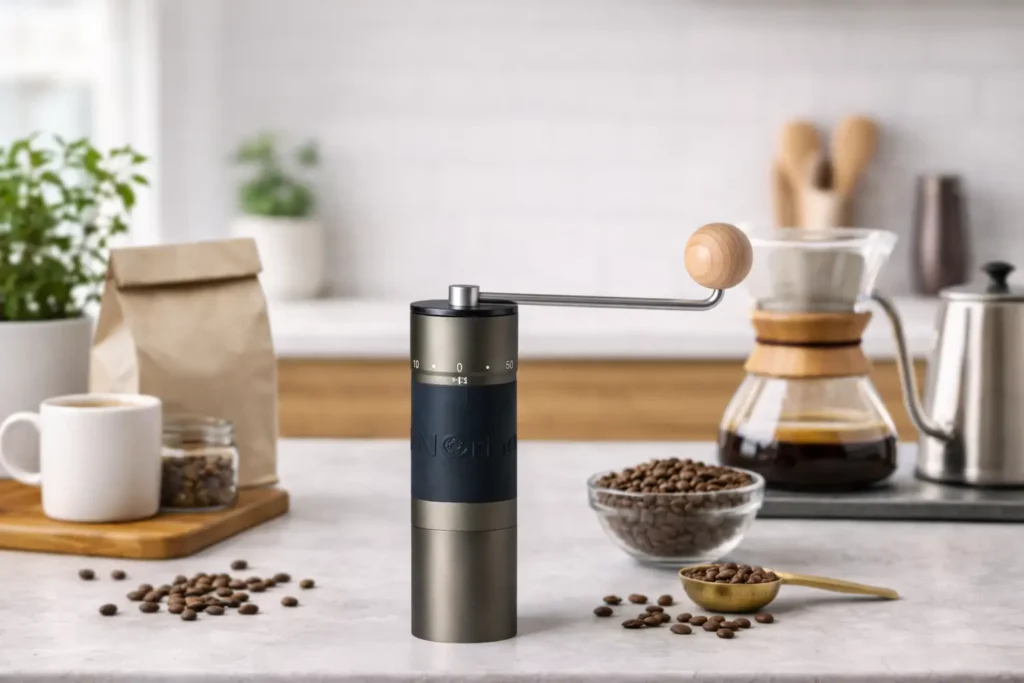
KINGrinder K6 — Best Manual Grinder for Moka Pot
Why it’s our site-standard manual pick: The KINGrinder K6 delivers exceptional grind consistency in the medium-fine range with precise click-step adjustment — the exact combination moka pot brewing demands. Its low retention design means almost no stale grounds carry over between sessions, which has a real and noticeable impact on cup clarity. It grinds moka pot doses quickly, travels easily alongside an AeroPress or compact moka pot, and costs significantly less than comparable-quality European manual grinders.
- Precise click-step adjustment — easy to dial in medium-fine and return to it exactly
- Very low grind retention — keeps each dose fresh with minimal stale-ground carry-over
- Excellent consistency in the medium-fine range critical for moka pot
- Compact — ideal for travel, camping, and home use
- Durable construction; handles daily use without wear issues
Affiliate link — we may earn a commission at no cost to you.

1Zpresso JX-Pro — Best Premium Manual Grinder
Why enthusiasts choose it: The 1Zpresso JX-Pro is a step above the K6 in precision and build quality — featuring an external adjustment ring with fine-resolution clicks, 48mm stainless steel burrs, and an exceptionally smooth grinding action. For moka pot it produces outstanding particle uniformity and can also cover light-to-medium AeroPress and entry espresso ranges. It’s the choice for someone who wants the absolute best manual grind quality money can buy at a non-audiophile price.
- External adjustment dial — change grind size without disassembly
- 48mm stainless steel burrs — outstanding particle uniformity
- Covers moka pot, AeroPress, pour over, and light espresso
- Premium feel — solid aluminum body, smooth crank action
- Best choice for the coffee enthusiast who wants to stay manual long-term
Affiliate link — we may earn a commission at no cost to you.

Timemore Chestnut C2 Max — Best Budget Manual Grinder
Why it’s a strong entry-level manual pick: The Timemore C2 Max is the updated version of the popular C2, featuring upgraded burrs and a larger catch cup for easier handling. It produces reliable medium-fine output for moka pot, is built noticeably well for its price point, and grinds quickly thanks to its efficient burr geometry. If you want to try a manual grinder without a significant investment, the C2 Max is the most accessible quality option available.
- Updated E&T burr design — improved consistency over the original C2
- Larger catch cup — easier to handle and pour
- Fast grinding — efficient burr geometry reduces effort per dose
- Solid build quality for the price — aluminum frame, stainless burrs
- Best pick for the budget-conscious buyer making the blade-to-burr upgrade
Affiliate link — we may earn a commission at no cost to you.
Electric vs Manual Grinders for Moka Pot: Which Is Right for You?
Both electric and manual burr grinders can produce excellent moka pot coffee. The right choice depends on how you use it — not on some inherent quality difference. Here’s how they actually compare for home moka pot brewing:
| Factor | Electric Burr Grinder | Manual Burr Grinder |
|---|---|---|
| Convenience | High — push button, hands-free | Moderate — 30–60 seconds of hand-cranking per dose |
| Grind consistency | Excellent (quality models) | Excellent — often better per dollar than electric |
| Portability | Not portable — needs power outlet | Very portable — fits in a bag, works anywhere |
| Noise | Noticeable motor noise | Quiet — no motor |
| Multiple cups | Much faster for 2+ cups | Slower for large doses |
| Grind heat | Slight motor heat (minimal impact) | Near-zero heat — preserves aromatics |
| Price-to-quality | Moderate — motors add cost | High — more grind quality per dollar |
| Best for | Daily home use, multiple cups, convenience-focused brewing | Travel, camping, small doses, quality-focused brewers |
🔬 The grind quality gap is smaller than most people expect. The KINGrinder K6 produces grind consistency that rivals electric grinders costing 2–3x more. For a single moka pot dose (17–22g), hand-cranking takes less than 45 seconds. Many home brewers find the ritual satisfying rather than inconvenient.
Grinder Buying Guide: What Specs Actually Matter for Moka Pot
Grinder marketing focuses on specs that don’t always translate to better moka pot coffee. Here’s what actually matters — and what doesn’t — when choosing a grinder for stovetop brewing:
| Spec | Why It Matters | What to Look For |
|---|---|---|
| Burr type | Determines particle uniformity and grind consistency | Conical burr (standard) or flat burr (premium) — either works. Avoid blade. |
| Grind settings in the medium-fine zone | More steps in the relevant range = finer control for dialing in | At least 10+ distinct settings in the medium-to-fine range |
| Grind retention | Grounds stuck in the grinder from the previous use are stale — low retention = fresher coffee | Under 0.5g retention is good; under 0.2g is excellent |
| Burr diameter | Larger burrs grind faster with less heat buildup | 40mm+ for electric; 38mm+ for manual |
| RPM (electric only) | Slower RPM = less heat generation = better aroma preservation | Under 600 RPM is ideal; most quality burr grinders comply |
| Hopper size | Convenience for daily brewing — holds beans between sessions | For single brewer: 50–100g is sufficient. Avoid storing weeks of beans in a hopper. |
| Repairability | A repairable grinder lasts a decade; a non-repairable one gets replaced | Baratza (electric) and most manual grinders offer replacement parts |
💡 What doesn’t matter as much as advertised: RPM numbers, watt ratings, and hopper capacity are frequently over-marketed. A lower-watt grinder with quality burrs will outperform a high-watt grinder with cheap burrs every time. For moka pot use, burr quality and grind setting precision in the medium-fine range are the specs that move the needle.
How to Dial In Grind Size for Moka Pot: Step-by-Step
Dialing in means finding the specific grind setting on your grinder that produces the best moka pot result with your beans. It takes 2–3 brew sessions and pays off every morning after. Change one variable per brew, taste, then adjust.
Step 1 — Set your grinder to medium-fine
Aim for the texture of table salt. On most grinders this is in the lower-middle portion of the range — nudged toward fine but clearly not espresso-fine. On the KINGrinder K6, a good starting point is around 3–4 clicks from fine (adjust from there based on your beans).
Step 2 — Brew a baseline moka pot
Fill the basket fully and level — do not tamp. Fill the water chamber to just below the safety valve. Brew on medium-low heat. Watch for a steady, controlled flow from the spout. Remove from heat when flow turns pale or aggressive sputtering begins.
Step 3 — Taste and evaluate
Let the coffee cool for 60 seconds before tasting — very hot coffee masks grind problems. Then evaluate:
| Taste result | What it signals | Next adjustment |
|---|---|---|
| Bitter, harsh, burnt | Over-extracted — grind too fine, or heat too high | Go coarser by 1–2 clicks; also lower heat if not already on medium-low |
| Sour, thin, sharp | Under-extracted — grind too coarse | Go finer by 1–2 clicks |
| Flat, weak, watery | Under-filled basket, or grind too coarse | Ensure basket is fully filled; go slightly finer |
| Balanced — sweet, smooth, chocolatey | Dialed in ✓ | Note the grind setting — you’re done |
Step 4 — Adjust one variable at a time
Don’t change heat and grind in the same brew. Change only the grind setting between tests so you can clearly attribute any flavor change to that variable. Two adjustments at once means you’ll never know which one worked.
Step 5 — Lock in your setting
Once the cup is balanced and repeatable, note the click count or setting number. With a quality burr grinder, this setting will be consistent batch to batch — which is the entire point of investing in a good grinder in the first place.
🔬 For a full any-brewer dial-in system covering TDS, extraction yield, and ratio science: How to Dial In Coffee at Home.
Troubleshooting Matrix: Fix Grinder-Related Moka Pot Problems
Most moka pot flavor problems trace back to grind size or grind consistency. Here’s a direct symptom-to-fix guide. Start with the grind adjustment before changing any other variable — grind is the single most common cause of off-tasting moka pot coffee.
| Symptom | Most Likely Grinder Cause | Fix (in order) |
|---|---|---|
| Bitter or burnt taste | Grind too fine; inconsistent grind with fines | Go coarser 1–2 clicks → if using blade grinder, upgrade to burr → check heat is medium-low |
| Sour or sharp | Grind too coarse; under-extraction | Go finer 1–2 clicks → ensure basket is fully filled → check roast date (very fresh beans can taste sour) |
| Both bitter and sour | Inconsistent grind (blade grinder or worn burrs) | Upgrade from blade to burr grinder — this symptom is the clearest sign of grind inconsistency |
| Flat or no aroma | Stale grounds; high grind retention in old grinder | Grind fresh per brew → switch to low-retention grinder → check bean roast date (use within 2–6 weeks) |
| Inconsistent day to day | No scale; variable dose; imprecise grinder settings | Use a digital scale for dose → use a grinder with indexed click-steps (not friction-based) → log your grind setting |
| Clogged filter or no flow | Grind too fine; tamped grounds | Go coarser immediately → never tamp moka pot grounds → do not use espresso-fine grind |
| Aggressive sputtering, harsh finish | Grind slightly too fine combined with high heat | Go coarser 1 click → reduce heat → remove pot earlier at first sign of sputtering |
💡 Still can’t isolate the problem? If you’ve tried grind adjustments and results are still inconsistent, the issue is often the grinder itself — particularly blade grinders and very cheap burr grinders with loose, imprecise adjustment mechanisms. See our full moka pot brewing troubleshooting guide: Moka Pot vs AeroPress: Full Extraction Science Guide.
Which Grinder Should You Buy? Practical Decision Guide
| Your situation | Best pick | Why |
|---|---|---|
| Best overall electric for moka pot | Baratza Encore ESP | Reliable medium-fine output, 40 settings, highly repairable and durable |
| You brew moka pot + pour over + AeroPress with one grinder | Fellow Opus | 41-setting range covers all three methods; anti-static design reduces daily mess |
| First-time burr grinder, want simple controls | OXO Brew Conical Burr | One-knob interface, zero learning curve, solid everyday results |
| Best overall manual grinder for moka pot | KINGrinder K6 | Site standard pick — precise click-step, low retention, excellent medium-fine consistency |
| You also want to dial in espresso-adjacent and AeroPress recipes | 1Zpresso JX-Pro | External adjustment dial, 48mm burrs, outstanding precision across all fine-medium ranges |
| First manual grinder, budget-conscious | Timemore Chestnut C2 Max | Best entry-level manual quality; upgraded burrs from original C2 |
| You travel with your moka pot | KINGrinder K6 | Compact, durable, no power needed — pairs with any stovetop moka pot on the road |
| You’re currently using a blade grinder | Any burr grinder above | Any burr grinder will produce a dramatically better moka pot cup than a blade grinder |
FAQs: Best Grinders for Moka Pot
What grind size is best for moka pot coffee?
Medium-fine is ideal for moka pot. It sits between drip coffee (medium) and espresso (fine) — roughly the texture of table salt. This grind rate balances extraction speed with the moka pot’s lower pressure range of 1–2 bars. Start here and adjust one click at a time based on taste.
Can you use a blade grinder for moka pot?
A blade grinder produces wildly inconsistent particle sizes — some powder-fine, some coarse chunks — leading to simultaneous over- and under-extraction. The result is usually bitter and sour at the same time. A burr grinder is strongly recommended and is the single biggest taste upgrade available for moka pot brewing.
Is the KINGrinder K6 good for moka pot?
Yes — it’s the manual grinder we recommend across CoffeeGearHub for moka pot use. The KINGrinder K6 produces excellent medium-fine consistency with precise click-step adjustment, very low grind retention, and a compact design that works well both at home and for travel brewing.
Do you need an expensive grinder for moka pot?
No. A mid-range burr grinder delivers excellent moka pot results. The KINGrinder K6 at its price point produces consistency that rivals electric grinders costing significantly more. Diminishing returns set in quickly past the $100–150 range for moka pot use specifically.
What’s the difference between flat burr and conical burr grinders for moka pot?
Both flat and conical burr grinders produce excellent moka pot grinds. Conical burrs tend to be quieter, generate less heat, and are more common at accessible price points. Flat burrs can produce slightly more uniform particle sizes at higher price ranges. For most home moka pot brewers, conical burr grinders are the most practical and cost-effective choice.
Can I use the same grinder for moka pot and espresso?
Yes, if the grinder has fine enough range. Moka pot sits just one step coarser than espresso on the grind spectrum. The Baratza Encore ESP and Fellow Opus both cover espresso-adjacent and medium-fine ranges well, making them practical dual-use grinders for home setups.
How fine is too fine for moka pot?
Espresso-fine grind is too fine for moka pot. It can clog the filter basket, restrict flow too severely, cause dangerous pressure buildup, and produce harsh over-extracted coffee. Never tamp moka pot grounds either — both behaviors create excessive resistance for the moka pot’s low operating pressure.
Does grind consistency really matter for moka pot?
Significantly. Inconsistent grinds — like those from blade grinders or worn burr grinders — contain a mixture of fine powder and coarse chunks. Fines over-extract and cause bitterness; coarse particles under-extract and add sourness. A quality burr grinder’s uniform particles extract evenly, producing a cleaner, more balanced cup with the same beans.
What’s the best electric grinder for moka pot in 2026?
The Baratza Encore ESP is our top electric pick for moka pot in 2026. It covers the medium-fine range reliably, offers 40 settings, uses hardened steel conical burrs, and is exceptionally well-supported for repairs and parts — making it one of the best long-term value grinders available.
How do I know if my grind is too coarse or too fine for moka pot?
Bitter, harsh, or burnt coffee usually means the grind is too fine — go coarser by 1–2 clicks. Sour, weak, or watery coffee usually means the grind is too coarse — go finer by 1–2 clicks. Always adjust one variable at a time and brew a fresh test batch between each change.
Continue Learning
MOKA POT CLUSTER
DIAL-IN & EXTRACTION
Ready to brew? Make sure your moka pot is the right size for your setup. Most buyers end up with a pot that’s too small. The full sizing guide explains what the cup numbers actually mean in real volume.
☕
Written by the CoffeeGearHub Editorial Team
CoffeeGearHub is a specialty coffee equipment resource run by home brewers and coffee enthusiasts. Our buying guides are researched using published brewing science, equipment manufacturer specifications, and established specialty-coffee community knowledge. We review and update our pillar content regularly to reflect current product availability and community consensus. About CoffeeGearHub →