
Last Updated: March 2026 • 30–40 min read • Espresso Cluster: Equipment Fundamentals

Do You Need a Grinder for Espresso? The most common question beginners ask after buying their first espresso machine is whether they also need to buy a grinder — or whether pre-ground espresso from the store, or freshly ground beans from a coffee shop, will get them to a good cup. The short answer is yes, you need a grinder. The longer answer explains why — and why the grinder is a more impactful purchase than the espresso machine itself at almost every budget level. This guide covers the complete honest answer to the grinder question: what a grinder actually does to your shot, why pre-ground coffee fundamentally cannot produce consistent espresso regardless of quality, when a pressurized portafilter changes the calculation, and which grinders are the correct starting points for every type of beginner espresso setup.
✍️ Editorial note: This guide is researched and written by the editors at CoffeeGearHub.com using published brewing science, SCA Brewing Standards, manufacturer specifications, and established specialty-coffee community knowledge. All product links are affiliate links — we may earn a commission at no cost to you. Affiliate Disclosure: CoffeeGearHub.com participates in the Amazon Services LLC Associates Program. As an Amazon Associate, we earn from qualifying purchases.
The 30-Second Answer
Yes, you need a grinder for espresso — and it should be the first purchase you make after (or alongside) your espresso machine, not an afterthought. Pre-ground espresso has three problems that cannot be fixed by any other variable: it is stale by the time you brew it, it cannot be adjusted to match your machine, and it cannot be corrected when the shot runs wrong. A grinder gives you control over the single variable that matters most in espresso: grind size. Without it, you have an espresso machine but no ability to make it work correctly. The grinder is not optional equipment — it is the other half of an espresso setup.
- Pressurized portafilter machine: The Baratza Encore is the minimum — functional entry espresso grinder that also covers all non-espresso home brewing
- Dedicated espresso use, any machine: Breville Smart Grinder Pro — 60 settings designed specifically for espresso micro-adjustment
- Non-pressurized (single-wall) basket: Baratza Virtuoso+ minimum — tighter consistency and DC motor required for reliable shots
- Serious beginner, prosumer longevity: Eureka Mignon Silenzio — stepless adjustment, 50mm flat burrs, low retention; equipment that removes the grinder ceiling for years
- What to skip: Pre-ground espresso from any source; blade grinders; general drip grinders without dedicated espresso fine adjustment
Who This Guide Is For — Jump to What You Need
☕ New Espresso Machine Owner
Start with Why a Grinder Matters for Espresso before reading any product sections.
⛰ Pre-Ground User
Jump to Pre-Ground vs Fresh-Ground to understand exactly what you are giving up and why it cannot be fixed.
⚡ Portafilter Matcher
Jump to Pressurized vs Non-Pressurized to find which grinder your specific machine needs.
🔧 Ready to Buy
Jump straight to Top Grinder Picks for verified recommendations at every beginner setup level.
Table of Contents
- Why a grinder matters more than any other espresso variable
- Pre-ground vs fresh-ground: what actually changes in your shot
- What a grinder controls and why it cannot be skipped
- Pressurized vs non-pressurized: does it change the grinder you need?
- Can a coffee shop grind for you?
- Why blade grinders don’t work for espresso
- What to look for in an espresso grinder
- Top picks: best grinders for beginner espresso setups
- Should you spend more on a grinder or the machine?
- Extraction science: why espresso demands grind precision
- Shot timing: how grind size determines extraction
- How to start dialling in with a new grinder
- Common mistakes beginners make with espresso grinding
- Troubleshooting: shot problems caused by grinding
- Buying checklist
- FAQs
Why a Grinder Matters More Than Any Other Espresso Variable
Most beginners approach espresso equipment in the wrong order. They spend the majority of their budget on the machine — drawn to features like pressure profiling, PID temperature control, or brand recognition — and treat the grinder as an optional add-on or a later upgrade. This is the single most common mistake in home espresso, and it produces the single most common outcome: an expensive machine that consistently pulls bad shots.
The reason is straightforward once you understand what espresso actually is. An espresso machine forces water through a tightly packed coffee puck at 9 bar of pressure in 25–35 seconds. At that pressure, water finds paths of least resistance through the puck. If the grind is inconsistent — particles of different sizes scattered through the puck — water rushes through the loose zones while bypassing the dense ones, producing a shot that is simultaneously over-extracted in some areas and under-extracted in others. No machine feature can compensate for this. A machine with precise temperature control and variable pressure profiling pulling through an inconsistent puck still produces an inconsistent shot. The puck preparation — which starts with the grind — is what determines whether good espresso is even possible from a given dose. Everything the machine does happens after the grind determines the puck’s flow resistance profile. This is why every experienced home barista will tell you the same thing: buy the best grinder you can afford and a modest machine, not the other way around. For a deeper look at how machine and grinder interact, see our Best Espresso Machines for Beginners guide.
⚠️ The grinder-machine allocation rule: At almost every budget level, a capable espresso grinder paired with a modest machine produces better espresso than a budget grinder paired with an expensive machine. If you are currently considering a machine upgrade to improve your shots, check your grinder first. In the majority of beginner espresso problems, the grinder is the limiting variable — not the machine.
Pre-Ground vs Fresh-Ground: What Actually Changes in Your Espresso Shot
Pre-ground espresso from a bag or a coffee shop produces a different extraction result than fresh-ground espresso from the same beans, and the differences are not subtle. They are the kind of differences that make a shot taste flat and muddy versus bright and complex — or that make crema thick and persistent versus thin and instantly disappearing. Understanding exactly what changes helps explain why there is no workaround for grinding fresh immediately before brewing.
| Variable | Pre-Ground Espresso | Fresh-Ground Espresso | Why It Matters |
|---|---|---|---|
| CO2 content | CO2 mostly dissipated — degassing began at the moment of grinding, days or weeks before brewing | CO2 intact — grounds retain gas from roasting until the moment of brewing | CO2 is what produces crema and contributes to the pressure differential that drives extraction; without it, shots are flat and crema is thin or absent |
| Volatile aromatics | Significantly degraded — volatile compounds responsible for fruit, floral, and complex notes begin oxidising within minutes of grinding | Fully intact — volatile compounds preserved in the whole bean until grinding | These compounds are what differentiate a complex, interesting espresso from a flat, generic one; once gone, no technique recovers them |
| Grind adjustability | Fixed — set by the roastery or coffee shop for a generic machine; you cannot change it | Fully adjustable — you set the grind for your specific machine, portafilter, beans, and conditions each session | Shot timing and extraction quality depend entirely on matching grind to your specific setup; a fixed grind cannot be dialled in |
| Shot timing control | None — if the shot runs too fast or too slow, you have no lever to correct it | Full — grind finer to slow; coarser to speed up; adjustable at any point | Shot timing determines whether the extraction window is hit; no other variable fully compensates for a timing miss |
| Day-to-day consistency | Degrading — each shot from the same bag is worse than the one before as grounds continue oxidising | Consistent — grounds are always at the same freshness point (immediately post-grind); each shot starts from the same baseline | Consistency is what makes espresso learnable and reproducible; pre-ground is a moving target |
| Crema quality | Thin, pale, quickly dissipating — CO2 loss and oxidation reduce crema formation at 9 bar | Thick, persistent, richly coloured — intact CO2 produces crema that holds for 30–90 seconds after pulling | Crema is both a visual quality indicator and a textural component that contributes to mouthfeel; it is also the first sign of grind freshness |
🔬 The freshness window for espresso: Ground espresso begins degrading within minutes of grinding. Most specialty roasters and baristas consider ground espresso usable for about 15–30 minutes before the extraction profile begins to shift noticeably. Pre-ground espresso in a bag has been oxidising since the roastery — typically days to weeks before you open it. Nitrogen-flushed packaging slows this significantly but does not stop it, and once opened, the bag degrades rapidly. Grinding immediately before pulling the shot is not a specialty preference — it is the only way to use espresso at full quality.
What a Grinder Controls and Why It Cannot Be Skipped
A grinder controls three things in an espresso setup, each of which is critical and none of which can be replicated by any other piece of equipment or technique.
- Grind size, which controls shot timing. Espresso is a timed extraction. A correctly brewed double shot runs 25–35 seconds from pump start to yield completion. Finer grind increases flow resistance and slows the shot; coarser grind decreases resistance and speeds it up. Shot timing determines whether the extraction is in the correct window — too fast produces sour and under-extracted; too slow produces bitter and over-extracted. Without a grinder, you cannot move this dial. You are locked into whatever grind the bag was set to, and you have no ability to correct a shot that runs in 12 seconds or 55 seconds.
- Grind consistency, which controls even extraction. Every particle in the coffee puck needs to be approximately the same size for water to flow evenly through it at 9 bar. A burr grinder crushes beans between two precisely spaced abrasive surfaces, producing a consistent particle size at the selected setting. A blade grinder chops beans randomly, producing a chaotic mix of fine powder and large chunks. Pre-ground coffee, even from a quality grinder, is set to one fixed size that may or may not match your machine. Your own grinder lets you set the exact size and adjust it in small increments until extraction is correct.
- Freshness, which controls extraction complexity. Coffee begins losing aromatic volatile compounds — the molecules responsible for differentiated flavour — within minutes of grinding. At 9 bar of extraction pressure, espresso is the most efficient brewing method for dissolving soluble compounds from coffee. That efficiency extracts both the desirable aromatics you want and the stale, flat compounds that develop as coffee oxidises after grinding. Grinding immediately before pulling preserves the full aromatic profile and produces extraction that reflects the bean’s actual character. Pre-ground coffee produces extraction that reflects how long it has been oxidising since it left the roastery.
Pressurized vs Non-Pressurized Portafilter: Does It Change the Grinder You Need?
Your portafilter type is the most important factor in determining which specific grinder you need. Most beginners do not know which type their machine uses. Checking takes ten seconds: remove the portafilter basket from the handle and look at the bottom. If you see one large hole and one very small hole above it, it is pressurized. If you see a uniform grid of small holes across the entire bottom, it is non-pressurized. This distinction affects your minimum grinder requirement significantly.
| Pressurized (Double-Wall) Portafilter | Non-Pressurized (Single-Wall) Portafilter | |
|---|---|---|
| Mechanism | A second basket wall with a single tiny exit hole creates artificial back-pressure regardless of how the puck was prepared | No artificial back-pressure — flow resistance is determined entirely by grind precision and puck prep quality |
| Grind tolerance | Wide — a range of grind sizes from medium-fine to fine will all produce an acceptable result because the basket compensates | Narrow — grind must be precise to within a small window; a grind that is 10–20 microns off produces a noticeably bad shot |
| Common machines | Breville Bambino, DeLonghi Dedica, De’Longhi Stilosa, Gaggia Magenta, most entry-tier machines | Gaggia Classic Pro, Breville Barista Express, Rancilio Silvia, ECM Classika, most semi-professional machines |
| Minimum grinder | Baratza Encore — 40 settings covers the pressurized range reliably; also covers all non-espresso home brewing | Breville Smart Grinder Pro or Baratza Virtuoso+ minimum — dedicated espresso micro-adjustment required |
| What happens with pre-ground | Shots are more forgiving but still cannot be adjusted; freshness problem remains; crema will still be thin | Pre-ground is completely unworkable — without grind adjustment you cannot land in the narrow extraction window at all |
| Upgrade path | Start with Encore; when you switch to non-pressurized baskets (a common upgrade path), add Smart Grinder Pro or Virtuoso+ | Start with Smart Grinder Pro or Virtuoso+ — do not begin with the Encore for non-pressurized; inconsistent shots make learning much harder |
Can a Coffee Shop Grind Espresso for You?
Asking a coffee shop to grind espresso for your home machine is a common workaround beginners attempt — and it is worth understanding precisely why it does not work before you try it.
Coffee shops grind espresso on commercial grinders — typically Mahlkönig EK43s, Mazzer Roburs, or similar professional equipment — calibrated for their specific commercial machines running at specific temperatures and pressures. A commercial La Marzocco or Synesso pulls espresso at 9 bar with extremely precise temperature stability and consistent flow rates. Your home Breville Bambino or Gaggia Classic Pro runs at slightly different temperature, slightly different pressure, and with different flow dynamics. The grind setting that produces a perfect 28-second shot on a commercial machine may produce a 10-second shot or a complete choke on your machine.
Even setting the machine calibration difference aside, the freshness problem remains. Once the shop grinds the beans, the clock starts. By the time you drive home and set up your machine, 20–40 minutes have passed. By the second or third day of using the same bag of pre-ground, the extraction profile will have shifted enough to produce noticeably different results — and you have no way to compensate. The grind cannot be adjusted as the coffee changes. Every bag of coffee behaves differently as it ages, and the only correct response is to grind finer or coarser as the extraction drifts. Without a grinder, you cannot make that adjustment.
⚠️ The one partial exception: If a coffee shop will grind espresso on the same day you plan to brew and calibrate the grind specifically for your machine type, you can get one or two sessions of acceptable espresso from it. This requires the shop to know your portafilter type and basket type, and it still produces degrading results over subsequent days. It is a reasonable short-term bridge while you wait for a grinder to arrive — not a sustainable workflow.
Why Blade Grinders Do Not Work for Espresso
If you currently own a blade grinder — the kind with a spinning propeller-style blade, often marketed as a “spice and coffee grinder” — you may be wondering whether it can produce espresso-fine grounds if you just run it long enough. It cannot, for reasons that are mechanical rather than a matter of degree.
| Burr Grinder | Blade Grinder | |
|---|---|---|
| Grinding mechanism | Two abrasive surfaces set at a precise fixed distance crush beans to a consistent size determined by the gap setting | A spinning blade randomly chops beans; particle size is determined by how long you run it, not by any mechanical precision |
| Particle consistency | All particles exit at approximately the same size for a given setting — the fundamental requirement for even espresso extraction | Every batch produces a random mixture of fine powder and large chunks; no setting change produces consistency |
| Espresso fine range | Quality burr grinders with dedicated espresso settings can reach 200–400 micron particle sizes consistently | Running longer does produce finer results on average but simultaneously produces more overheated, clumped fines that cause channeling |
| Heat generation | Controlled — crushing mechanism generates less heat than high-speed blade chopping | High — the blade spins at thousands of RPM; extended running to achieve fine results scorches the coffee |
| Shot timing effect | Consistent setting produces consistent shot timing — adjustable in small increments | No shot timing control — inconsistent particle sizes produce unpredictable flow resistance; shots are neither repeatable nor adjustable |
| Verdict for espresso | ✓ The only acceptable mechanism for espresso grinding | ✗ Completely unsuitable — not a matter of quality level but of mechanical incompatibility with espresso requirements |
What to Look for in an Espresso Grinder
Once you have established that you need a burr grinder, the question becomes which burr grinder. Espresso grinders are a distinct category from general home brewing grinders — they need to operate in a finer adjustment range with smaller steps between settings. These four factors separate espresso-capable grinders from everything else at the beginner level.
| Factor | Why it matters | What to look for | What to avoid |
|---|---|---|---|
| Dedicated espresso adjustment range | Espresso requires a narrow fine grind range; a grinder needs to both reach that range and allow small adjustments within it | 40+ settings minimum for pressurized portafilters; 54–60 settings for non-pressurized; stepless adjustment for prosumer setups | General drip grinders with “fine” as one of five settings; the fine setting gap is too large for meaningful espresso adjustment |
| Burr quality | Cheap burrs produce excessive fines at espresso-fine settings, causing channeling and bitter extraction | 40mm+ conical or flat burrs; hardened steel; brand with stated espresso capability | Undisclosed burr size; plastic burr carriers; grinders that do not explicitly state espresso capability |
| Motor consistency | Motor speed variation at fine settings changes particle size even at the same numbered setting — making shot-to-shot consistency impossible | DC motors for step-up grinders; AC motors are acceptable at entry level for pressurized portafilters where tolerance is wider | Grinders with stated variable motor speed under load; very cheap motors in fine-grind operation |
| Repeatability | Once you find a good shot setting, you must be able to return to it precisely every session | Numbered settings; click or stepped adjustment; digital timer on dedicated espresso grinders; portafilter cradle for direct dosing | Stepless adjustment without reference markings — difficult to reproduce settings for beginners |
Best Grinders for Beginner Espresso Setups: Our Top Picks
These four picks represent the correct grinder at each beginner espresso setup type — verified by community endorsement, grind consistency, and alignment with how each grinder actually performs in real beginner setups. All affiliate links use the CoffeeGearHub Amazon Associates tag. ⚠️ Verify ASINs against current Amazon listings before publishing — espresso grinder variants update regularly.

Best Entry Option: Baratza Encore (Pressurized Portafilter Machines)
The Baratza Encore is the minimum recommended grinder for beginners using pressurized (double-wall) portafilter machines — the type standard on most entry espresso machines. Its 40 settings include a fine enough range to produce acceptable shots with pressurized baskets, and the front-mounted adjustment dial is simple enough for a beginner to use without confusion. The Encore is not a dedicated espresso grinder and will not produce the precision required for non-pressurized (single-wall) baskets, but for the majority of entry-level machines it is a functional and reliable starting point. Its most important advantage for beginners is versatility: the same grinder covers drip, pour-over, and French press at the coarser settings, making it a single grinder that handles all your home brewing rather than a specialist tool for espresso alone. If you are not yet certain how deeply you will pursue espresso, the Encore is the correct starting point.
- Burr type: 40mm conical stainless steel burrs
- Settings: 40 grind settings — espresso range approximately settings 3–8
- Portafilter compatibility: Pressurized (double-wall) baskets only — not suitable for non-pressurized
- Key advantage: Covers all non-espresso home brewing on the same grinder; repairable; replacement parts available directly from Baratza
- Best for: entry machines with pressurized baskets; beginners uncertain about their long-term espresso commitment
Disclosure: CoffeeGearHub may earn from qualifying purchases.
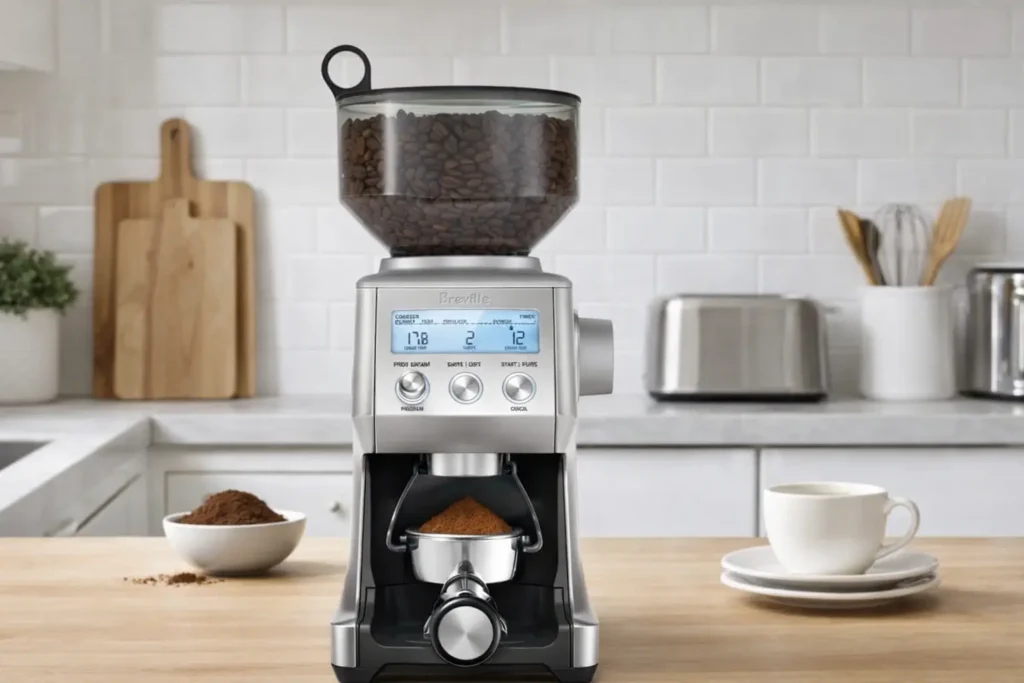
Best Dedicated Espresso Grinder: Breville Smart Grinder Pro
The Breville Smart Grinder Pro is the most complete purpose-built espresso grinder for beginners at the entry tier. Unlike the Encore — which is a drip grinder that also works for espresso at pressurized settings — the Smart Grinder Pro is designed with espresso as its primary use case. The 60 grind settings are calibrated specifically for the espresso fine range, with adjacent settings close enough together to make meaningful shot timing adjustments but distinct enough to produce a clear, readable result when changed. The portafilter cradle holds your portafilter directly under the chute so grounds fall straight into the basket without an intermediate catch cup step, reducing clumping and static. The LCD dose timer allows repeatable dosing once you have found a good setting. For any beginner who is committed to espresso as their primary home brewing method, this is the correct first grinder.
- Burr type: Conical stainless steel burrs, calibrated for espresso fine range
- Settings: 60 grind settings with dedicated espresso micro-adjustment
- Espresso features: Portafilter cradle for direct dosing; LCD dose timer; grounds directly into portafilter basket
- Portafilter compatibility: Both pressurized and non-pressurized baskets
- Best for: beginners who know espresso is their primary goal; any machine type
Disclosure: CoffeeGearHub may earn from qualifying purchases.
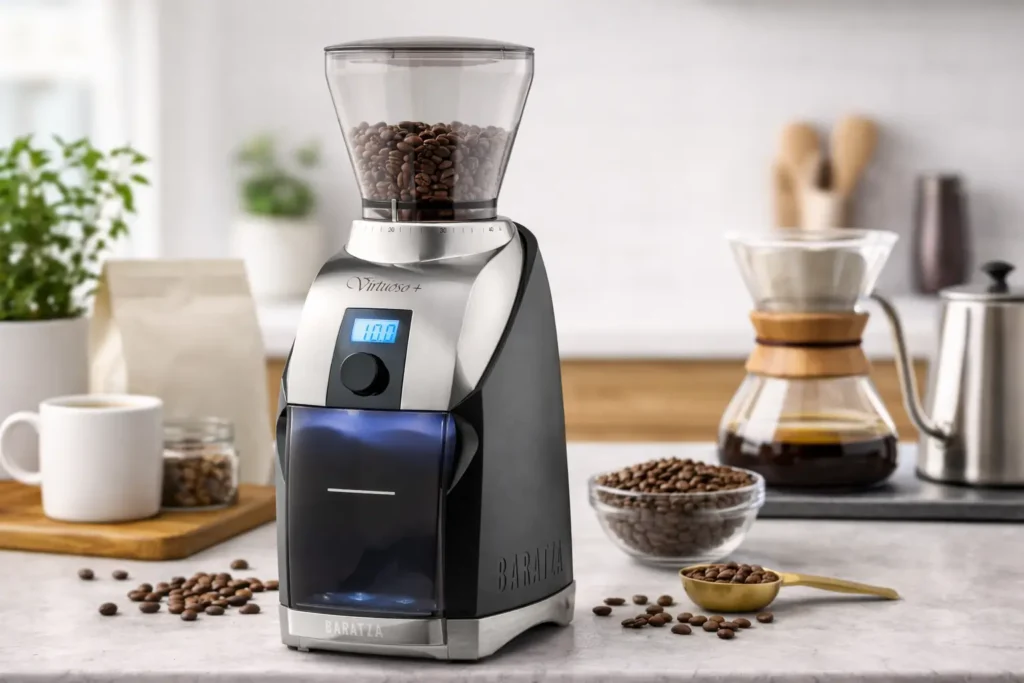
Best for Non-Pressurized Baskets: Baratza Virtuoso+
The Baratza Virtuoso+ is the correct grinder for beginners using non-pressurized (single-wall) portafilter machines — the Gaggia Classic Pro, Rancilio Silvia, Breville Barista Express, and similar semi-professional machines. Non-pressurized baskets have no compensation mechanism: the grind must be precise to within a narrow window or the shot will run far too fast or too slow. The Virtuoso+’s DC motor maintains consistent grind speed better than the Encore’s AC motor — speed variation at fine settings changes particle size even at the same numbered setting, which matters significantly for non-pressurized precision. The 54 settings provide enough resolution to make small, meaningful adjustments within the espresso range, and the digital dose timer enables repeatable shot preparation. The high-carbon steel burrs produce lower fines output than the Encore’s standard burrs, reducing channeling on non-pressurized baskets.
- Burr type: 40mm high-carbon steel conical burrs — lower fines than Encore standard burrs
- Settings: 54 settings with more espresso resolution than the Encore
- Motor: DC motor — more consistent speed under load; critical for non-pressurized shot repeatability
- Timer: Digital dose timer for repeatable dosing
- Best for: non-pressurized portafilter machines; beginners who want grind precision room to grow
Disclosure: CoffeeGearHub may earn from qualifying purchases.
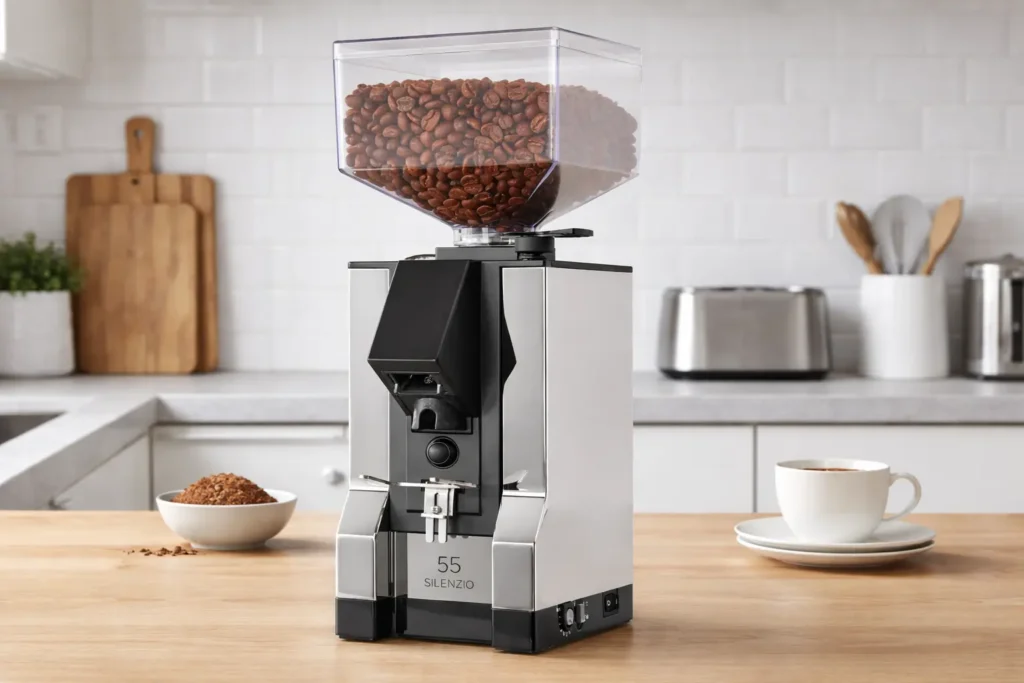
Best Prosumer Entry: Eureka Mignon Silenzio
The Eureka Mignon Silenzio is the answer to the question: “What grinder do I buy if I want to skip the intermediate stage entirely?” It is purpose-built for home espresso — stepless adjustment, 50mm flat burrs, very low retention, and a motor that runs at 50dB, significantly quieter than either Baratza model. The stepless adjustment wheel allows infinitely fine grind changes within the espresso range, which is the most precise adjustment system available below prosumer commercial pricing. The 50mm flat burrs produce a unimodal particle distribution — tight clustering around the target size — that delivers the clarity and defined flavour profile that espresso enthusiasts pursue as their technique matures. Very low retention means the grounds in your portafilter are always from the current dose, not contaminated by yesterday’s stale residue. This is more grinder than a beginner needs on day one, but it is the grinder that remains the right tool as your espresso knowledge and palate develop over years.
- Burr type: 50mm flat burrs — unimodal particle distribution; high clarity espresso
- Adjustment: Stepless — infinite fine adjustment; best precision available at this tier
- Noise: 50dB — significantly quieter than the Baratza grinders
- Retention: Very low — minimal stale ground contamination between sessions
- Best for: serious beginners who want to buy once at prosumer level; no grinder ceiling for years of development
Disclosure: CoffeeGearHub may earn from qualifying purchases.
Should You Spend More on a Grinder or the Espresso Machine?
This is the question that most beginners get backwards, and getting it wrong is the most expensive mistake in home espresso. The community consensus — built across decades of home barista experience — is unambiguous: allocate more of your espresso budget to the grinder than the machine, not less.
| Scenario | Grinder Quality | Machine Quality | Outcome |
|---|---|---|---|
| Typical beginner mistake | Budget blade grinder or no grinder | Premium espresso machine | Machine cannot compensate for grinding problems; consistently bad shots regardless of machine features; cannot dial in at all |
| Common beginner mistake | Entry drip grinder (Encore) used for non-pressurized basket | Semi-professional machine (Gaggia Classic Pro) | Machine is capable; grinder lacks espresso precision; shots inconsistent; learning curve extended; difficult to diagnose problems |
| Correct approach | Dedicated espresso grinder (Smart Grinder Pro or Virtuoso+) | Modest entry machine (Breville Bambino) | Grinder can produce consistent, adjustable shots; machine executes what the grinder prepares; learning proceeds quickly; shots improve visibly |
| Optimal approach | Prosumer entry grinder (Eureka Mignon Silenzio) | Mid-range machine | Grinder eliminates equipment ceiling for years; machine performs at its designed level; technique development is the only remaining variable |
The reason this hierarchy exists is that the machine executes what the grinder prepares. A premium machine with precise temperature control and variable pressure profiling is pulling those shots through a puck that the grinder created. If the puck is inconsistent — wrong grind, inconsistent particle size, too many fines — the machine’s precision features are being applied to a fundamentally flawed input. A more capable grinder improves the input quality that the machine works with. Everything the machine does then becomes more effective.
Extraction Science: Why Espresso Demands Grind Precision More Than Any Other Method
Understanding the physics behind espresso extraction clarifies why the grinder requirement is stricter for espresso than for drip, pour-over, or French press — and why workarounds like pre-ground or blade-ground coffee fail at espresso in ways they do not fail as severely at other brewing methods.
- Pressure extraction at 9 bar amplifies every grind variable. Drip brewing uses gravity — water falls through the coffee bed under its own weight at atmospheric pressure. Small grind inconsistencies produce mild extraction variations that are noticeable but not catastrophic. Espresso uses a pump forcing water through the puck at approximately 130 pounds per square inch. At that pressure, water pressure actively seeks the path of least resistance. A single low-density zone in the puck — caused by inconsistent grind, poor distribution, or channeling — allows water to rush through at high speed while bypassing adjacent dense zones entirely. The result is a shot that simultaneously over-extracts (the easy-flow path) and under-extracts (the bypassed zones) in the same 30 seconds. Drip brewing’s gentler pressure cannot produce this effect to the same degree.
- The espresso extraction window is narrow and identifiable by timing. A correctly brewed double shot runs 25–35 seconds from pump start to the completion of 36g of yield from 18g of coffee. Within this window, extraction balances acids (which extract first), sweetness and body (middle phase), and bitter compounds (last). Outside the window in either direction, the balance collapses. A shot that runs 12 seconds under-extracts acids and sweetness, producing a sour, thin result. A shot that runs 50 seconds over-extracts bitter compounds, producing a harsh, astringent result. Grind size is the primary lever for controlling this timing. This means the grinder — not the machine, not the dose, not the tamp pressure — is the first adjustment to make when a shot is wrong. For a complete shot timing reference, see our Best Coffee Grinders for Espresso guide.
- Fines production determines channeling risk. Every burr grinder produces ultra-fine particles as a byproduct. In espresso, fines pack into pores between larger particles and create the overall flow resistance that builds extraction pressure and produces crema. When fines are produced in excess — by cheap burrs, blade grinders, or grinders forced into a finer range than their burrs can handle — they create dense pockets of extreme resistance that redirect pump pressure to adjacent, less-restricted areas. This is channeling: visible as pale streaks in crema, identifiable as a fast shot with sour taste despite fine grind setting. A quality burr grinder produces a controlled fines profile. A blade grinder or inadequate burr grinder produces erratic fines that make channeling essentially unavoidable.
Shot Timing: How Grind Size Controls What Your Espresso Tastes Like
Shot timing is the most important diagnostic tool a beginner espresso brewer has. Every time you pull a shot, measuring the time from pump start to the end of yield tells you whether the grind is in the right zone — and in which direction to adjust if it is not. Use this table as your first reference whenever a shot tastes wrong.
| Shot time (18g in, 36g out) | Extraction status | Grind adjustment | Taste result |
|---|---|---|---|
| Under 15 seconds | Severe under-extraction | Grind significantly finer — 4–5 steps; also confirm dose weight and tamping | Sour, thin, watery; little or no crema |
| 15–20 seconds | Under-extraction — shot too fast | Grind 2–3 steps finer; re-pull at same dose | Sour, sharp, thin body |
| 20–25 seconds | Slightly fast — approaching target | Grind 1 step finer; ensure tamp is level | Some sourness; body not fully developed |
| 25–35 seconds ✓ | Target window — correct extraction | No adjustment — log this setting and reproduce it | Balanced acidity, sweetness, and body; rich crema |
| 35–45 seconds | Slightly over-extracted | Grind 1 step coarser; check dose is not over 18g | Some bitterness; heavy body; dark crema |
| Over 45 seconds | Over-extraction — shot too slow | Grind 2–3 steps coarser; check puck prep for channeling | Bitter, harsh, astringent; very dark crema |
| Machine chokes — no flow | Grind too fine for pump to overcome | Grind 5+ steps coarser immediately; do not force the machine | No shot produced |
How to Start Dialling In With a New Espresso Grinder
The first session with a new espresso grinder is the most important one. Setting up a systematic dial-in process from the start — rather than changing variables randomly — compresses the learning curve from weeks to a few sessions. The process is the same regardless of which grinder you buy.
First Session Dial-In Process
- Use medium or medium-dark roast beans, roasted within the past two weeks — not very dark, not very light
- Set dose: 18g. Weigh every dose on a scale accurate to 0.1g before grinding
- Start at the manufacturer’s recommended espresso setting for your grinder
- Distribute grounds evenly in the portafilter basket — use a finger or small tool to break up any clumps
- Tamp with approximately 15kg of downward pressure, level — use a bathroom scale once to calibrate what 15kg feels like
- Pull the shot. Measure time from pump start and weight of espresso out
- Target: 25–35 seconds, 36g out (1:2 ratio)
- Adjust grind only: finer if shot is fast; coarser if shot is slow. One adjustment per pull
- Once in timing window: taste. Then adjust fine for more body; coarser for more clarity
- Log every setting and result. Your winning number is now your starting point for each new bag
Essential Equipment to Pair With Your Grinder
- Scale accurate to 0.1g: Required for consistent dose weight — a 1g variation at 18g changes shot timing by 3–5 seconds, masking the grind signal entirely
- Scale under the cup: Required to measure yield weight — stopping by time alone without weighing output produces inconsistent ratios
- Distribution tool or WDT needle: Breaks up clumps before tamping; reduces channeling dramatically; a straightened paper clip works for beginners
- Tamper: A flat-base tamper sized to your basket diameter (58mm standard for most home machines)
- Fresh beans with a roast date: Specialty roasters print roast dates on every bag; target 4–21 days post-roast for espresso
- Shot notebook or notes app: Log every setting and result; dial-in becomes systematic rather than random when you have a record to build on
Common Mistakes Beginners Make With Espresso Grinding
| Mistake | Why beginners make it | What to do instead |
|---|---|---|
| Using pre-ground espresso and assuming the grinder is optional | Pre-ground is available, cheaper upfront, and seems simpler | Pre-ground cannot be adjusted and degrades continuously; a grinder is the other half of an espresso setup, not an optional accessory |
| Buying a blade grinder to save money | Blade grinders are cheap and visible everywhere | A blade grinder is mechanically incompatible with espresso, not just lower quality; no blade grinder at any price produces espresso-suitable output |
| Using a drip grinder for a non-pressurized basket | Already own the Baratza Encore; assuming it covers all espresso | The Encore works for pressurized portafilters only; for non-pressurized baskets, a dedicated espresso grinder is required from the start |
| Changing multiple variables simultaneously when a shot is bad | Frustration leads to changing grind, dose, temperature, and tamp at once | Change only grind, measure timing, taste, then adjust; one variable per pull produces usable diagnostic information |
| Not weighing doses or yield | Scooping by volume or stopping by time alone seems simpler | Weigh dose to 0.1g; weigh yield from the cup; ratios are the foundation of repeatable espresso |
| Not purging stale grounds before the first shot | Beginners don’t know grinders retain grounds between sessions | Grind and discard 2–3g before pulling each session’s first shot; retained grounds from the day before change the effective grind setting |
| Over-budgeting the machine and under-budgeting the grinder | Machine features are visible and exciting; grinders look interchangeable | Allocate more to the grinder; it determines whether good espresso is achievable at all; machine features only matter after grind quality is established |
Troubleshooting: Shot Problems Caused by Grinding
| Symptom | Grinding cause | Fix |
|---|---|---|
| Shot runs too fast, sour taste | Grind too coarse; or using pre-ground set for a different machine | Grind 2–3 steps finer → re-pull at same dose and tamp; if using pre-ground, no fix available — get a grinder |
| Shot runs too slow, bitter taste | Grind too fine | Grind 2–3 steps coarser → re-pull; confirm distribution is even before tamping |
| Shot timing varies randomly between pulls | Stale retained grounds contaminating each dose; or grinder not producing consistent output | Purge 2–3g before each session → confirm burrs are clean → confirm dose weight is consistent to 0.1g |
| Channeling — pale streaks in crema | Excessive fines from blade grinder or inadequate burrs; or inconsistent distribution | If using blade grinder: replace immediately — channeling cannot be fixed with blade-ground coffee. If using burr grinder: use WDT or distribution tool before tamping → grind 1 step finer |
| No crema or very thin crema | Pre-ground coffee with depleted CO2; or stale beans; or grind too coarse | If using pre-ground: grind fresh immediately before pulling — crema requires intact CO2. If using fresh-ground stale beans: buy fresher beans (roast date under 3 weeks) |
| Shot consistently improves then gets worse over several days | Pre-ground oxidising from day one; or beans ageing past their peak post-roast window | If pre-ground: switch to fresh-ground immediately — there is no fix for oxidation. If fresh-ground: buy smaller quantities; espresso beans peak at 4–21 days post-roast |
| Good shot impossible regardless of grind adjustment | Grinder does not reach espresso-fine range; or grinder is a blade grinder | Confirm grinder is a burr grinder with dedicated espresso settings; Encore only covers pressurized portafilters; non-pressurized baskets need Smart Grinder Pro or Virtuoso+ minimum |
| Machine chokes at finest setting | Grinder is too fine for the machine; or puck over-tamped at fine grind | Back off grind 3–5 steps immediately; reduce tamp pressure slightly; confirm dose is 18g not over |
Espresso Grinder Buying Checklist
| Question | What to confirm | Red flag |
|---|---|---|
| Is it a burr grinder? | Product confirms two abrasive burr surfaces as the grinding mechanism — conical or flat | Any mention of “blade,” “chopper,” or “spice and coffee grinder”; single spinning blade in product photos |
| Is it designed for espresso? | Product explicitly states espresso capability; dedicated espresso adjustment range | “Also grinds for espresso” on a grinder with fewer than 30 settings; Fellow Ode listed as espresso-capable (it is not) |
| What type of portafilter do I have? | Pressurized basket: Baratza Encore is the minimum. Non-pressurized basket: Smart Grinder Pro or Virtuoso+ minimum | Assuming the Encore works for all portafilter types — it does not for non-pressurized baskets |
| How many grind settings? | 40+ settings for pressurized espresso; 54–60 settings for non-pressurized; stepless preferred for prosumer | Fewer than 20 settings; large jumps between adjacent settings; no dedicated espresso zone |
| Do I have a scale? | A scale accurate to 0.1g is essential — dose variation of 1g changes shot timing by 3–5 seconds | Planning to dose by scoop or timer alone without weighing |
| Are replacement burrs available? | Baratza and Eureka both sell replacement burrs; grinder becomes a long-term investment rather than a disposable item | No-brand grinders with no parts ecosystem — disposable when burrs dull |
Final Answer: Do You Need a Grinder for Espresso?
Yes — and not as a nice-to-have upgrade but as the foundational piece of equipment that determines whether good espresso is achievable at all from your setup. Pre-ground coffee cannot be dialled in, degrades continuously from the moment of grinding, and produces shots you cannot meaningfully improve regardless of how carefully you do everything else. A blade grinder is mechanically incompatible with espresso requirements. A dedicated burr grinder — matched to your portafilter type and set up with a systematic dial-in process — is what converts an espresso machine from an appliance that makes hot coffee into a tool you can actually control.
The correct starting point depends on your machine. For pressurized portafilter machines, the Baratza Encore is the minimum — functional for pressurized espresso and versatile enough to cover all non-espresso home brewing from the same grinder. For beginners committed to espresso as their primary method, the Breville Smart Grinder Pro is the correct dedicated first purchase. For non-pressurized basket machines, the Baratza Virtuoso+ is the minimum required for consistent shots. And for beginners who want to buy once at the prosumer level and not revisit the grinder decision for years, the Eureka Mignon Silenzio is the answer. Pair whichever you choose with a 0.1g-accurate scale, fresh beans with a visible roast date, and the shot timing reference in this guide — and you will pull your first genuinely good espresso shot faster than you expect.
FAQs: Do You Need a Grinder for Espresso?
Do you need a grinder for espresso?
Yes, for any serious home espresso setup. Pre-ground espresso goes stale within minutes of grinding and cannot be adjusted to match your machine, portafilter, beans, or daily variables. A grinder lets you control the single variable with the most impact on shot quality: grind size. Without a grinder, you are locked into a fixed grind set for someone else’s machine.
Can I use pre-ground coffee for espresso?
You can pull a shot with pre-ground espresso, but you cannot dial it in. Pre-ground is set to a fixed grind for a generic machine. Your machine, portafilter type, bean freshness, and ambient conditions all affect what grind setting produces a good shot. Without a grinder you have no way to adjust when the shot runs too fast or too slow.
What grinder do I need for espresso?
You need a burr grinder with a dedicated espresso adjustment range. The Baratza Encore is the entry point for pressurized portafilter machines. The Breville Smart Grinder Pro is the correct first dedicated espresso grinder for most beginners. The Baratza Virtuoso+ is the correct minimum for non-pressurized baskets. Any blade grinder or general drip grinder without fine adjustment capability is not suitable for espresso.
Can I use a blade grinder for espresso?
No. Blade grinders produce random particle sizes that make even extraction at espresso pressure impossible. The fine particles over-extract and cause channeling; the large chunks under-extract entirely. No tamping technique or machine quality can compensate for this inconsistency at 9 bar. A blade grinder is mechanically incompatible with espresso, not just lower quality.
Does grinder quality matter more than espresso machine quality?
Yes, at almost every budget level. A capable espresso grinder paired with a modest machine produces better espresso than a budget grinder paired with an expensive machine. The grinder determines whether you can dial in a good shot at all. Allocate more of your espresso budget to the grinder than most beginners instinctively do.
What is the difference between a pressurized and non-pressurized portafilter for grinding?
A pressurized (double-wall) portafilter creates artificial back-pressure regardless of grind consistency, so a wider range of grind sizes produce an acceptable shot. The Baratza Encore works for pressurized portafilters. A non-pressurized (single-wall) basket has no compensation — the grind must be precise within a narrow window. Non-pressurized setups require a dedicated espresso grinder with fine adjustment capability.
How does grind freshness affect espresso?
Espresso amplifies freshness effects more than any other brew method because pressure extraction at 9 bar is highly efficient at extracting both desirable aromatics and the degraded stale compounds that develop after grinding. Fresh-ground espresso retains CO2 that produces crema and contributes to flavour complexity. Pre-ground espresso produces flatter shots with less crema because the volatile aromatic compounds have already dissipated.
Can a coffee shop grind espresso for me to use at home?
A coffee shop can grind espresso for your machine, but the grind is calibrated for their commercial machine, not yours. Home machines run at different temperatures and pressures than commercial machines. A grind that produces a perfect shot on their equipment may run far too fast or choke your machine entirely. Even if the initial grind is close, you cannot adjust it as the bag ages.
Is a manual grinder good enough for espresso?
A manual burr grinder can produce excellent espresso if it has the right adjustment range and burr quality. The KINGrinder K6 — the CoffeeGearHub standard for home brewing — is not an espresso grinder and should not be used for espresso. Manual grinders designed specifically for espresso exist but are in a different price and effort class than the electric beginner grinders covered in this guide.
What is the minimum grinder needed for a pressurized portafilter espresso machine?
The Baratza Encore is the minimum recommended electric burr grinder for a pressurized portafilter espresso machine. It has 40 settings, covers the fine range that pressurized baskets require, is repairable, and also covers all non-espresso home brewing from the same unit. Any general-purpose drip grinder without a dedicated fine adjustment range is not recommended even for pressurized setups.
Continue Learning
ESPRESSO CLUSTER
Decided you need a grinder? Our full espresso grinder guide covers every option at every beginner level — with a complete shot timing reference, dial-in system, and troubleshooting matrix.
☕
Written by the CoffeeGearHub Editorial Team
CoffeeGearHub is a specialty coffee equipment resource run by home brewers and coffee enthusiasts. Our guides are researched using published brewing science, SCA standards, manufacturer specifications, and established specialty-coffee community knowledge. We review and update our content regularly. About CoffeeGearHub →

