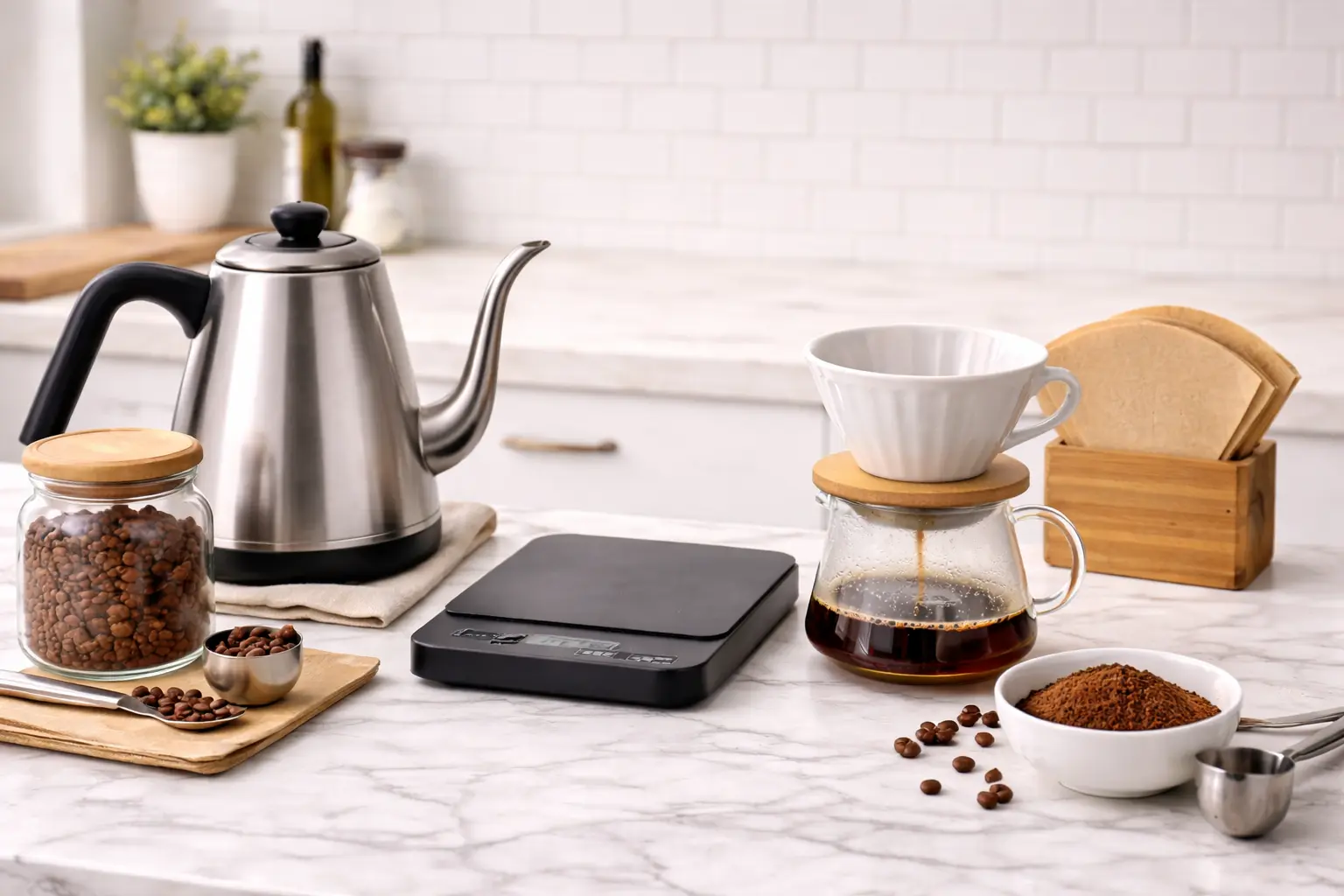
Last Updated: March 2026 • 30–40 min read • Espresso: Beginner Setup, Dialing In & Troubleshooting
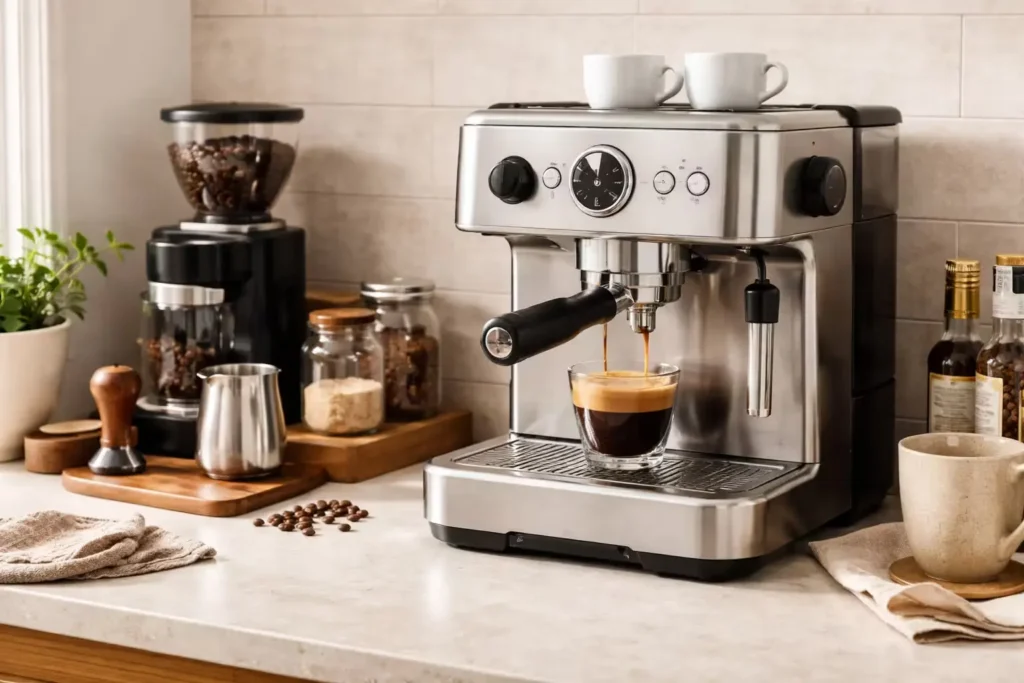
Most beginners do not know how to make espresso at home; they think bad home espresso is a machine problem. It almost never is. After extensive testing of entry-level and mid-range setups, the pattern is consistent: the espresso tastes bad because the grind is wrong, the dose wasn’t weighed, or the beans are stale — not because the machine is inadequate. The good news is that all three of those problems are fixable without spending more money. This guide gives you the exact setup, method, and troubleshooting system that gets beginners pulling balanced, café-quality shots within a week — along with honest guidance on where to invest and where not to.
✍️ Editorial note: This guide is researched and written by the editors at CoffeeGearHub.com using hands-on testing, published brewing science, and established specialty-coffee community knowledge. Affiliate Disclosure: This post contains affiliate links. CoffeeGearHub.com participates in the Amazon Services LLC Associates Program. As an Amazon Associate, we earn from qualifying purchases at no extra cost to you. All product recommendations are editorially independent.
The 30-Second Answer
Espresso is a brewing method — not a special bean — that uses pressure to force hot water through finely ground coffee in 25–30 seconds. Getting it right at home comes down to four fundamentals: fresh beans (roasted within 2–4 weeks), a capable grinder (the most important purchase), a scale for dose and yield (the fastest way to stop guessing), and a repeatable workflow. When allocating your setup budget, the grinder should receive as much as the machine — or more.
- Espresso is a brewing method: pressure + fine grind + 25–30 seconds = concentrated, syrupy shot with crema
- Budget realistically: allocate as much to the grinder as the machine — or more; the grinder is the higher-impact purchase
- Don’t skimp on the grinder: it affects every variable and is the root cause of most bad espresso
- Fresh beans are non-negotiable: use beans 5–14 days post-roast; espresso exposes staleness fast
- Weigh everything: dose in (18g) and yield out (36g) — this is the fastest path to consistency
- Sour = grind finer. Bitter = grind coarser. Change one variable at a time.
Who This Guide Is For — Jump to What You Need
☕ Just Getting Started
Start at What Is Espresso and read through — the whole guide is written for you.
🛒 Choosing Gear
Jump to Essential Equipment for honest beginner guidance on machines, grinders, and accessories.
🔧 Shots Taste Off
Jump to the Troubleshooting Matrix for a direct symptom → cause → fix diagnosis.
📐 Ready to Dial In
Jump to Dialing In Espresso for the systematic method that gets most beginners dialed within 5–10 shots.
Table of Contents
What Is Espresso, Really?
Espresso is a brewing method that uses pressure — typically around 9 bars at the group head — to force hot water through very finely ground coffee, producing a concentrated, syrupy shot with a rich body and crema, typically in 25–30 seconds.
Espresso is not a type of bean, a roast level, or a flavour profile. Any coffee can be brewed as espresso. What makes it espresso is the brewing method: fine grind + pressure + short extraction time = a small, intense, concentrated shot (typically 1–2 oz) that forms the base for lattes, cappuccinos, and Americanos.
Classic starting parameters: water at 195–205°F (90–96°C), approximately 9 bars at the group head, and a recipe of 18g coffee in → 36g out (a 1:2 ratio). These are starting points — you will adjust grind size to hit a 25–30 second extraction at this recipe.
Espresso vs Regular Coffee
| Feature | Espresso | Drip / Pour-Over |
|---|---|---|
| Brew time | 25–30 seconds | 2–4 minutes |
| Grind size | Fine (like fine salt) | Medium to coarse |
| Pressure | ~9 bars | Gravity only |
| Flavor | Concentrated, syrupy, intense | Clean, diluted, bright |
| Volume | 1–2 oz | 8–12 oz |
| Margin for error | Low — variables interact tightly | Higher — more forgiving |
What Espresso Should Taste Like
When espresso is dialed in, it is balanced: you get sweetness, complexity, and a pleasant lingering finish — without sharp sourness or harsh, drying bitterness. A small pool of honey-coloured crema on top indicates a healthy extraction from fresh beans.
| What You Taste | What It Means | Fix |
|---|---|---|
| Sweet, rounded, complex, pleasant finish | Balanced — this is the target | Record your recipe and repeat it |
| Sour, sharp, thin, salty | Under-extraction | Grind finer (or increase yield slightly) |
| Bitter, harsh, dry, hollow | Over-extraction | Grind coarser (or reduce yield slightly) |
If your shots taste bad, do not assume espresso is not for you — most problems are a one-step grind adjustment away. The extraction science section below explains exactly why.
Beginner Expectations: Your First Week at Home
Here is the honest version: your first few shots will probably run too fast or taste sour. If you are using a bottomless portafilter, they may spray. This is normal — espresso is a skill developed through repetition, not a button press. Expect a real learning curve, and expect it to feel frustrating before it clicks.
The encouraging part: once you start weighing dose and yield and adjusting grind size in single steps, most beginners see a dramatic improvement within 5–10 shots. The workflow becomes muscle memory quickly. By week two, you will be pulling shots that would embarrass most café drip offerings.
Essential Equipment: What You Actually Need
The Espresso Machine
Your espresso machine provides heat and pressure. You do not need a commercial machine to pull great shots at home — but you do need temperature stability and consistent pressure at the group head. These two factors separate machines that teach you espresso from machines that frustrate you.
What to look for in a beginner machine
- Temperature stability: consistent water temperature throughout the shot — this is what separates okay from great at every price point
- Realistic group head pressure: ~9 bars is the classic target; some beginner machines run higher through the pump, which is fine as long as the basket restricts to ~9 bars at the puck
- Build quality: metal components, solid portafilter, reliable heating element — cheap plastic builds wear quickly under daily use
- Heat-up speed: thermoblock machines heat in under 30 seconds; single-boiler machines may need 15–30 minutes to fully stabilise — this matters for daily use
Machine Types: Thermoblock vs Single Boiler vs Dual Boiler
Understanding the three main machine architectures helps you spend your budget in the right place — and set accurate expectations for what you are buying.
| Type | How It Works | Pros | Cons | Best For |
|---|---|---|---|---|
| Thermoblock / Thermojet | Water heated on-demand as it passes through a heated block or coil | Fast heat-up (20–30 sec); compact; lower cost | Can have temperature variation; less thermal mass to stabilise | Beginners who want fast, convenient daily espresso (Breville Bambino) |
| Single Boiler | One boiler used for both brewing and steaming — you switch modes between the two | More thermal mass = better stability; often more rebuildable and community-supported | Wait time between brewing and steaming; needs longer warm-up; temperature-surfing technique recommended | Beginners who want to learn “real” espresso technique and want community/mod support (Gaggia Classic Pro) |
| Dual Boiler / Heat Exchanger | Separate heating systems for brewing water and steam boiler | Simultaneous brewing and steaming; best temperature consistency | Significantly higher cost; larger footprint; more complexity | Intermediate to advanced home baristas — generally not a beginner’s first machine |
The Grinder: Don’t Skimp Here
The grinder is the single most important purchase in any espresso setup — and the part most beginners underestimate. Espresso demands a fine, uniform grind and the ability to make very small adjustments (one click at a time) to move the shot. An inconsistent grinder produces inconsistent extraction: sour and bitter in the same shot simultaneously, with no way to fix it by adjusting anything else. A consistent burr grinder makes every other variable in your setup readable and adjustable.
⚠️ The grinder rule: If you are debating between spending more on the machine or more on the grinder, spend it on the grinder. A great grinder with a mid-range machine will outperform a great machine with a mediocre grinder. Every time.
Stepped vs Stepless
Stepless grinders offer infinite micro-adjustment — any position between clicks is valid. Stepped grinders have defined click positions. Both work well for espresso as long as the steps are fine enough to hit your sweet spot. What matters most is that the adjustment range covers espresso-fine and that adjacent steps produce a clear, readable difference in extraction.
Accessories: What Actually Makes a Difference
| Accessory | Why It Matters | Priority |
|---|---|---|
| 0.1g Scale | Weighing dose and yield is the single fastest way to accelerate dialing in — guessing by eye or feel produces inconsistent results that are impossible to diagnose | 🔴 Non-negotiable |
| Tamper (correct size) | Consistent, level tamping prevents channeling; most 58mm machines include a mediocre tamper — a spring-loaded model helps beginners tamp at consistent pressure and level | 🟠 High |
| WDT Tool | Breaks up clumps and distributes grounds evenly before tamping — often the fastest fix for spraying shots and channeling; inexpensive | 🟡 Medium–High |
| Dosing Cup / Puck Screen | Makes the workflow cleaner and more consistent; puck screens also help protect the shower screen from grounds | 🟢 Optional |
Budget Breakdown by Setup Tier
Espresso has a wide price range. Here is an honest breakdown of what different budgets actually get you — and where the meaningful performance jumps are.
| Setup Tier | What You Get | Best Pick |
|---|---|---|
| Entry | Functional espresso with a learning curve; temperature may vary; manual milk frothing — a capable starting point for most beginners | Breville Bambino + Baratza Encore ESP |
| Mid-Range | Better temperature stability; more consistent shots; easier milk workflow; grinder with finer stepless adjustment — the sweet spot for serious beginners | Breville Bambino Plus + Eureka Mignon Silenzio |
| Prosumer | Near-commercial thermal stability; huge mod and community support; significant longevity — a long-term investment that rewards developing technique | Gaggia Classic Pro + Eureka Mignon Silenzio or Baratza Vario |
A note on “super-automatic” machines (with built-in grinders): they are convenient, but the integrated grinder typically compromises espresso quality and the two components cannot be upgraded independently. Not recommended for anyone who wants to learn espresso technique.
Top Beginner Gear Picks
These picks are the most beginner-friendly options at each category. All links go to Amazon — verify pricing and availability before purchasing.

Best Beginner Machine (Milk Drinks): Breville Bambino Plus
The Breville Bambino Plus is the most beginner-friendly thermoblock machine on the market for anyone who wants to make lattes and cappuccinos. Its three-second heat-up time makes daily espresso practical without the wait, its auto-steam wand dramatically lowers the barrier to microfoam for beginners, and the 54mm portafilter with pressurised and non-pressurised basket options lets you start with a more forgiving basket and graduate to standard baskets as your technique develops. It is not the machine that teaches you the deepest espresso technique, but it is the machine that makes the routine achievable from day one.
- Boiler type: Thermojet — heat-up in ~3 seconds
- Portafilter: 54mm; includes pressurised and non-pressurised baskets
- Steam wand: Auto-steam with manual override — beginner-friendly milk frothing
- Best for: daily espresso + milk drinks; beginners who prioritise convenience and a fast workflow
- Pair with: Baratza Encore ESP or Eureka Mignon Silenzio for a complete setup
Disclosure: CoffeeGearHub may earn from qualifying purchases.
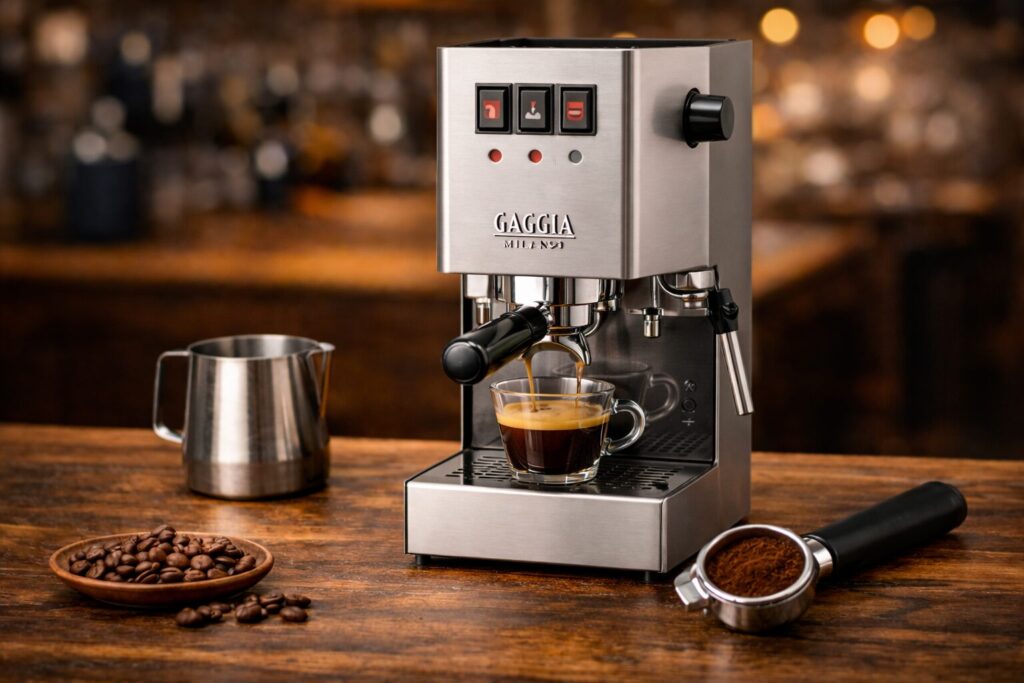
Best for Learning Espresso Properly: Gaggia Classic Pro
The Gaggia Classic Pro is the starting point for serious home espresso. Where the Bambino Plus prioritises convenience, the Gaggia Classic Pro rewards investment in technique. It uses a commercial 58mm portafilter, a traditional single-boiler system, and has one of the largest modification and community-support ecosystems of any home machine — meaning as your skill grows, your machine can grow with it. Temperature-surfing technique is required to get the best from it, but once mastered, this machine is capable of genuinely excellent espresso. It is also one of the most repairable machines in its class.
- Boiler type: Single boiler — warm-up 15–20 min for full stability
- Portafilter: 58mm commercial-size — compatible with a wide range of accessories
- Steam wand: Manual, single-hole — requires milk steaming technique to learn
- Best for: learners who want to develop real espresso skill; those planning to mod or upgrade over time
- Pair with: Baratza Encore ESP or Eureka Mignon Silenzio at minimum
Disclosure: CoffeeGearHub may earn from qualifying purchases.

Best Electric Espresso Grinder: Baratza Encore ESP
The Baratza Encore ESP is the most commonly recommended first electric espresso grinder — and the reason is simple: it works, it is repairable, and it teaches you exactly what you need to learn about grind adjustment without overwhelming you. Its 40-step adjustment range extends into genuine espresso-fine territory (unlike the standard Encore, which does not), the stepped adjustments are close enough together to make meaningful one-click extraction corrections, and Baratza’s direct-sale replacement parts program means this grinder is not a throw-away purchase. For anyone pairing with a Bambino or Bambino Plus, this is the most balanced setup at the entry-to-mid price range.
- Burr type: 40mm conical steel burrs — engineered for espresso range
- Settings: 40 stepped settings; espresso range at the fine end
- Best for: Breville Bambino, Bambino Plus, pressurised baskets; drip and pour-over at coarser settings
- Repair: Parts sold directly from Baratza — long service life
Disclosure: CoffeeGearHub may earn from qualifying purchases.
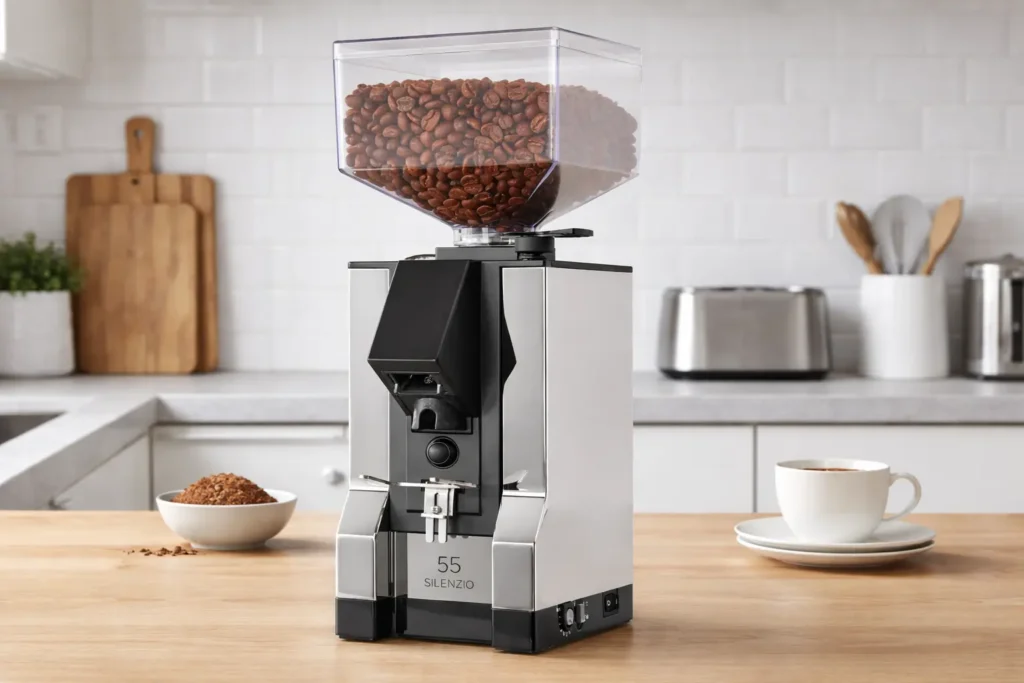
Best “Buy Once” Starter Grinder: Eureka Mignon Silenzio
The Eureka Mignon Silenzio is the right choice if you want a stepless espresso grinder at entry-level pricing — meaning you can dial in to any position between clicks, not just defined steps. This is the feature that experienced espresso drinkers specifically look for in a grinder, and the Silenzio delivers it at a price that still makes sense for a first setup. Its 50mm flat burrs produce a very consistent particle distribution, the compact footprint fits most counters, and its quiet operation is a genuine quality-of-life feature for early mornings. If you are planning to stick with espresso long-term and want one grinder that will not require an upgrade in 12 months, the Silenzio is the better investment over the Encore ESP.
- Burr type: 50mm flat steel burrs
- Adjustment: Stepless — infinite micro-adjustment for precise dialing in
- Best for: Gaggia Classic Pro; any 58mm portafilter machine; long-term espresso setup
- Standout feature: Stepless adjustment + quiet motor at this price point
Disclosure: CoffeeGearHub may earn from qualifying purchases.
For a complete comparison of espresso grinders at every price point, see our full Best Espresso Grinders Buying Guide. For a full comparison of beginner machines, see Best Espresso Machines for Beginners.
Choosing Coffee Beans for Espresso
Freshness is non-negotiable
Espresso is an unforgiving brewing method — the pressure and concentration amplify everything, including staleness. Always buy beans with a printed roast date on the bag. For espresso, a resting window of 5–14 days post-roast is the sweet spot: fresh enough to retain aromatics, but rested enough that excess CO2 (which causes uneven extraction) has dissipated. Most coffees roasted specifically for espresso will note a recommended rest period on the bag.
Best roast level for beginners
Medium to medium-dark roasts are the most forgiving when you are learning. They extract reliably within a wider temperature range, require less precise dialing in, and produce the classic espresso flavour profile most beginners are aiming for. Light roasts can produce exceptional espresso — but they are denser and less soluble, requiring tighter temperature control and a finer grind than medium roasts. Save light-roast espresso for after you have the process locked in.
Blends vs single origin
Espresso blends are formulated specifically to balance and perform consistently across a range of temperatures and ratios — they are more forgiving day-to-day and bag-to-bag. Single origin espresso can be extraordinary, but each bag may need significant dialing in and the extraction window is often narrower. Start with a quality espresso blend and graduate to single origins once your workflow is consistent.
For specific bean recommendations, see our Best Coffee Beans for Espresso guide.
The Basic Espresso Process (Step by Step)
This is the repeatable workflow that turns espresso from a mystery into a system. Follow these steps in order every time — consistency in process is what makes dial-in adjustments readable.
- Warm up your machine fully: thermoblock machines are ready in under 30 seconds; single-boiler machines need 15–20 minutes for full thermal stability. Run a blank (water-only) shot through the portafilter to pre-heat the group head and basket.
- Weigh your dose: target 18g for a standard double shot on a 0.1g scale. Zero out the scale with the portafilter on it, then dose directly.
- Grind fresh: grind directly into the portafilter or a dosing cup. Do not grind in advance — espresso stales in minutes once ground.
- Distribute the grounds: level the bed with a gentle finger sweep and use a WDT tool to break up clumps. Even, clump-free distribution is the foundation of a clean extraction.
- Tamp level: apply firm, even pressure straight down — level and consistent matters more than “as hard as possible.” A spring-loaded tamper helps beginners apply consistent pressure.
- Lock in and start the shot + timer together: lock the portafilter into the group head, place your cup on the scale, tare to zero, and start both the shot and a timer simultaneously.
- Stop at target yield: stop the shot when your scale reads 36g out (1:2 ratio from 18g dose). Note the time — your target is 25–30 seconds. Too fast = grind finer next shot. Too slow = grind coarser.
- Taste and record: drink the shot and note what it tastes like. Sour = under-extracted. Bitter = over-extracted. Balanced and sweet = you are there. Record the grind setting.
- Clean immediately: knock the puck, rinse the basket under hot water, and run a short group flush to clear grounds from the shower screen. Do not leave spent grounds in the portafilter.
Understanding Extraction (The Science Made Simple)
Extraction is how much flavour you dissolve from coffee grounds into water. Espresso is intense, so the difference between “too little” and “too much” is obvious in the cup. Understanding this one concept explains every sour shot, every bitter shot, and every dial-in decision you will ever make.
When hot water contacts coffee, it dissolves soluble compounds in sequence. Acids dissolve first — bright, clean flavours that become sharp and sour if they are all you get. Sugars and complex aromatics dissolve next — this is the sweet spot where espresso tastes balanced. Bitter polyphenols dissolve last — harsh, drying, unpleasant if over-extracted. Great espresso lives in the middle of this sequence. Grind size is the primary lever that controls how quickly you move through it.
| Extraction Stage | Flavours Released | Too Much Of This Tastes Like |
|---|---|---|
| Early (acids) | Citric, malic, acetic acid — brightness | Sour, sharp, vinegar-like, thin |
| Middle (sugars + aromatics) | Sweetness, complexity, body — the target zone | Balanced when correctly hit |
| Late (polyphenols) | Bitter chlorogenic acids, tannins | Harsh, dry, hollow, ashy aftertaste |
⚠️ The most important rule in espresso troubleshooting: Change one variable at a time. If a shot is bad, changing grind, dose, and temperature simultaneously makes it impossible to know what fixed it. Adjust grind size first — it is the biggest lever and the right first move 90% of the time.
Dialing In Espresso: A Beginner Method That Works
Every new bag of beans needs dialing in — different beans extract differently, and what worked for your last bag may be one or two grind steps off for the new one. Here is the simplest method for getting to a good shot quickly.
The Dial-In System
- Lock your dose at 18g — do not change this during dial-in
- Lock your yield at 36g out (1:2) — do not change this during dial-in
- Adjust grind size to hit 25–30 seconds: too fast = finer, too slow = coarser
- Taste: if it tastes balanced, you are done — record the grind setting
- Fine-tune by yield if needed: still sour after grind is at ~28s? Try stopping at 38–40g. Still bitter? Try stopping at 32–34g
- Record and repeat: log grind setting + yield for this bag as your starting point
Taste → Variable → Direction
- Sour / sharp: Grind finer → 1 step; or increase yield to 38–40g
- Bitter / harsh: Grind coarser → 1 step; or reduce yield to 32–34g
- Watery / thin: Grind finer and/or increase dose by 0.5g
- Shot choking (barely drips): Grind coarser OR reduce dose by 0.5–1g
- Shot gushing (under 15s): Grind finer + check distribution
- Spraying (bottomless): WDT + level tamp — a puck prep issue, not grind
- Inconsistent times: Weigh every dose + fix your distribution routine
Beginner Espresso Troubleshooting Matrix
Use the symptom that most closely matches your shot. Start with the first fix listed — change one variable, pull a shot, and re-evaluate before moving to the next fix.
| Symptom | Most Likely Cause | First Fix | If Problem Persists |
|---|---|---|---|
| Sour, sharp, thin, salty | Under-extraction | Grind 1 step finer | Try increasing yield to 38–40g; confirm water is 92–96°C |
| Bitter, harsh, dry, hollow | Over-extraction or dirty equipment | Grind 1 step coarser | If gradual onset — clean basket, shower screen, and portafilter thoroughly before adjusting anything |
| Shot too fast (under 20 seconds) | Grind too coarse, or channeling | Grind finer + check distribution is even | WDT tool to break up clumps; verify tamp is level |
| Shot too slow / choking (barely drips) | Grind too fine or dose too high | Grind 1–2 steps coarser | Reduce dose by 0.5g and re-test |
| Spraying or channeling (visible in bottomless) | Uneven distribution or puck prep | WDT + level tamp + consistent distribution | Check for clumps in the grind; ensure basket is not overfilled |
| Shot time correct but tastes sour | Yield may be too low; or light roast needs finer grind | Increase yield to 38g and taste | For light roast: grind finer and raise temperature 1–2°C |
| Shot time correct but tastes bitter | Yield may be too high; or dirty equipment | Reduce yield to 32–34g; clean equipment | Grind 1 step coarser |
| Watery, weak, flat | Under-dosed, or stale beans | Verify dose is 18g by weight (not volume scoop) | Check beans: roast date under 4 weeks, rested 5+ days? |
| Inconsistent shot times day to day | Inconsistent puck prep or dose | Weigh dose every shot + repeat distribution routine exactly | Purge grinder before each session; check for retained grounds |
Common Beginner Mistakes (And How to Avoid Them)
| Mistake | Why It Causes Problems | Correct Approach |
|---|---|---|
| Buying stale coffee | Espresso amplifies stale flavours; flat, lifeless shots regardless of technique | Always buy beans with a printed roast date; use within 2–4 weeks; rest 5–14 days post-roast for espresso |
| Underbuying the grinder | An inconsistent grinder produces simultaneously sour and bitter shots that no recipe change can fix | Prioritise grinder budget over machine features; a better grinder always returns more than a better machine at this price level |
| Not weighing dose and yield | Dose variation of even 0.5g changes shot time meaningfully; yield guessing makes dial-in impossible | Weigh in (dose) and weigh out (yield) for every shot; a 0.1g scale is the lowest-cost, highest-impact accessory |
| Changing multiple variables at once | If grind, dose, and temperature all change simultaneously, you cannot identify what improved or broke the shot | Change one variable per shot; taste; record; adjust the next variable only if needed |
| Giving up too early | Espresso rewards repetition; the first bag of beans is a learning exercise, not a performance test | Budget at least one full bag of beans for dial-in practice before evaluating your setup |
| Neglecting cleaning | Coffee oil oxidises on basket, shower screen, and portafilter within days; produces progressive bitterness that no grind change fixes | Rinse portafilter and basket after every session; flush group head; full backflush weekly if machine supports it |
Milk Steaming Basics (Lattes & Cappuccinos)
Milk steaming is a separate skill from pulling espresso — but it is very learnable. The goal is microfoam: silky, glossy milk with tiny, uniform bubbles that integrate into the espresso rather than sitting on top as stiff “bubble bath” foam.
- Stretching (adding air): Position the wand tip just below the milk surface; a few seconds of air incorporation as the milk starts moving. You should hear a soft tearing sound, not a loud bubbling — too much air = stiff foam.
- Texturing (polishing): Submerge the wand tip slightly and create a whirlpool motion to incorporate the foam into the milk. Hold here until you reach temperature.
- Target temperature: 140–150°F (60–65°C) — this is sweet and stable. Above 160°F (71°C) the milk begins to scald and taste flat.
- Cleanup is immediate: wipe the wand and purge a short burst of steam right after every use. Milk residue dries and bakes onto the wand rapidly and is significantly harder to remove when dry.
Maintenance and Longevity
After Every Session
- Knock puck and rinse portafilter and basket under hot running water
- Run a short group head flush (1–2 seconds of water without portafilter)
- Wipe and purge the steam wand if used
- Empty drip tray
Weekly
- Backflush with water (if machine supports it); use Cafiza for a thorough chemical backflush monthly
- Remove and scrub the shower screen
- Soak basket in hot water and scrub to clear oil build-up
- Brush grinder chute and burr area to clear fines and retained grounds
Descaling: frequency depends on water hardness — every 4–8 weeks in hard water areas, every 2–3 months with filtered or soft water. Use filtered water daily to reduce scale buildup and improve flavour. Avoid distilled water unless your machine’s manufacturer specifically recommends it.
Is Home Espresso Right for You?
Home espresso is not difficult — it is precise. If you enjoy learning a repeatable skill and want café-quality espresso at home, the payoff is significant once the fundamentals click. If you want true push-button simplicity, a super-automatic machine or a different brew method (pour-over, AeroPress, Moka pot) may be a better fit for your lifestyle.
Start with fresh beans, a capable grinder, a scale, and a repeatable workflow. Give yourself 2–3 weeks and a full bag of beans for dial-in practice. You will be surprised how quickly it comes together.
FAQs: How to Make Espresso at Home
How much should I budget for home espresso equipment?
Most beginners need to budget for three components: a capable espresso machine, a dedicated espresso grinder, and a 0.1g scale. The grinder should receive as much of the budget as the machine — or more. Check current Amazon prices on the specific products in this guide for up-to-date costs, as prices change regularly. If you have to prioritise, the grinder is the higher-impact purchase.
Can I use pre-ground coffee for espresso?
You can, but it is not recommended. Espresso requires a fine, precise grind and the ability to adjust grind size one small step at a time to dial in your shots. Pre-ground coffee cannot be adjusted, and it goes stale within hours of grinding. Without fresh grinding, you cannot fix sour or bitter shots and your ceiling is set low from the start.
How long does it take to learn to pull good espresso shots?
Many beginners start pulling decent shots within 2–4 weeks of regular practice. Consistently excellent shots may take a few months — especially since each new bag of beans requires dialing in from scratch. Using a scale for dose and yield dramatically accelerates the learning curve.
What is the difference between a thermoblock, single boiler, and dual boiler espresso machine?
A thermoblock heats water on-demand — fast heat-up, compact, lower cost, but can have temperature variation. A single boiler uses one reservoir for both brewing and steaming — more thermal mass and stability, but requires a wait between brewing and steaming. A dual boiler has separate heating systems for each — the most consistent, but significantly more expensive and not typically a beginner’s first machine.
Do I need a separate grinder, or can I use a built-in grinder?
A separate dedicated grinder is strongly recommended. Dedicated espresso grinders produce finer, more consistent particles than built-in combination machines, give you precise adjustment control, and can be upgraded independently of the machine. A good grinder outlasts several machines.
What is the best coffee to start with as a beginner?
Start with a medium to medium-dark espresso blend from a roaster that prints roast dates on the bag. Use beans 5–14 days post-roast for espresso (they need to rest after roasting to degas). Blends are more consistent and forgiving than single-origin espresso — save single origins for after your workflow is locked in.
How important is water quality for espresso?
Very important. Espresso is mostly water, and water chemistry affects both extraction quality and machine longevity. Filtered water between 75–150ppm TDS is the SCA recommendation. Avoid distilled water (causes under-extraction and can damage some machines) and very hard tap water (causes scale buildup and harsh, chalky flavour).
Why does my espresso taste sour or bitter?
Sour usually means under-extraction — grind finer, or increase yield slightly. Bitter usually means over-extraction — grind coarser, or stop the shot at a lower yield. If bitterness appeared gradually without changes to your recipe, clean the basket, portafilter, and shower screen before adjusting grind — rancid coffee oil causes persistent bitterness that no grind change fixes.
How do I know when my espresso is dialed in?
A dialed-in shot runs 25–30 seconds for an 18g in / 36g out (1:2) recipe and tastes balanced — sweet, rounded, complex, with a pleasant finish and no sharp sourness or harsh bitterness. If the time is correct but taste is still off, fine-tune yield: stop at 38–40g if sour, 32–34g if bitter.
Why does my espresso taste different every morning at the same settings?
Day-to-day inconsistency is almost always caused by not weighing dose — scooping by volume varies by 0.5–1.5g per dose depending on grind size and bean density. Weigh both dose and yield every shot. If you are already weighing, check that your distribution and tamping routine is consistent, and purge 3–5g from the grinder before each session to clear retained stale grounds from the burr pathway.
Continue Learning
ESPRESSO GEAR
Ready to choose your first setup? Our full beginner espresso machine guide covers every option at every budget — with side-by-side comparisons, a setup pairing guide, and the single recommendation for each type of home barista.
☕
Written by the CoffeeGearHub Editorial Team
CoffeeGearHub is a specialty coffee equipment resource run by home brewers and coffee enthusiasts. Our guides are researched using hands-on gear testing, published brewing science, SCA Brewing Standards, and established specialty-coffee community knowledge. We review and update our content regularly. About CoffeeGearHub →