Last Updated: March 2026 • 20–25 min read • Complete Guide: AeroPress Brewing Science + Standard & Inverted Recipes + Model Comparisons + Gear Picks + Troubleshooting
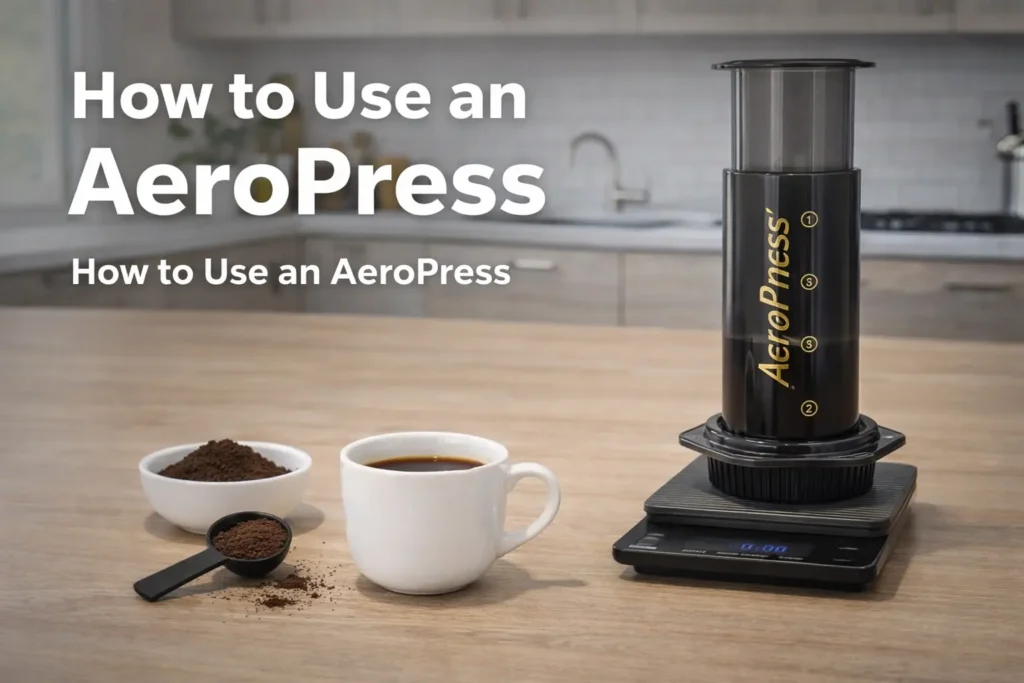

So, you need to know how to use AeroPress? The AeroPress is the most versatile coffee brewer ever made. It weighs 230 grams, costs less than $40, fits in a backpack, brews a cup in under two minutes, and produces coffee good enough that World Championship competitors choose it over every other device. Invented by Alan Adler in 2004 and still owned by the same team, the AeroPress uses a combination of immersion and gentle hand pressure to push hot water through a fine filter — a hybrid method that can produce everything from a clean, tea-like cup to a thick, espresso-style concentrate, depending on grind, ratio, and technique.
The challenge is that this versatility also produces a baffling amount of conflicting advice online. Every AeroPress user has a different recipe, a different method, a different opinion on water temperature. This guide cuts through that noise. It covers the science of why AeroPress works the way it does, the exact parameters for the standard and inverted methods, a full recipe library covering every major style, the complete model comparison (Original, Go, Go Plus, XL), gear picks with Amazon links, and the full troubleshooting matrix for every problem AeroPress brewers encounter.
✍️ Editorial note: This guide explains exactly how to use an AeroPress for balanced, repeatable coffee. It is researched and written by the editors at CoffeeGearHub.com using published brewing science, SCA brewing standards, World AeroPress Championship recipes, and established specialty-coffee community knowledge. All product links are affiliate links — we may earn a commission at no cost to you. Affiliate Disclosure: CoffeeGearHub.com participates in the Amazon Services LLC Associates Program. As an Amazon Associate, we earn from qualifying purchases.
🛒 Already know what you need? Jump straight to our top AeroPress picks.
AeroPress Original
Best for most brewers
AeroPress Go
Best for travel
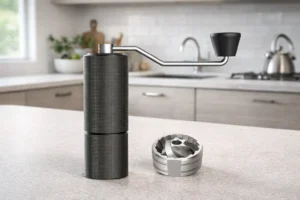
Timemore C2
Best value grinder
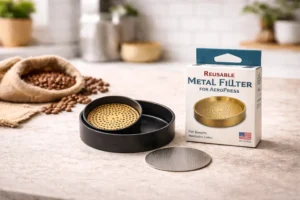
Metal Filter
Best reusable upgrade
As an Amazon Associate, CoffeeGearHub earns from qualifying purchases. See full gear guide with all picks →
The 30-Second Answer
Add 15g of medium-fine ground coffee to the AeroPress. Pour 240g of 200°F water. Stir 10 times. Insert the plunger to create a seal. Wait until 1:00 total. Press slowly over 20–30 seconds. Stop at the hiss. If it tastes bitter, grind coarser or shorten steep. If sour or thin, grind finer or extend steep. The AeroPress is almost impossible to ruin permanently — one variable change per brew, and you will reach a great cup within three sessions.
- Target grind texture: medium-fine — table salt; finer than French press, similar to V60
- Target ratio: 1:16 starting point (15g coffee / 240g water) — adjust to 1:14 for more body
- Target steep time: 1:00 minute total before pressing
- Target press time: 20–30 seconds — stop at the hiss, never force past it
- Bitter = over-extracted: grind coarser, shorten steep, lower temperature
- Sour / thin = under-extracted: grind finer, extend steep, raise temperature
Jump to What You Need
☕ First brew, never used an AeroPress
Read What the AeroPress Is and Baseline Parameters — then go to the Standard Method Recipe.
☕ Coffee tastes bitter or sour
Jump to Brew Diagnosis for the exact fix — then the Troubleshooting Matrix.
🔬 Want to try the inverted method
See the Inverted Method Recipe and Standard vs Inverted comparison before flipping.
🛒 Choosing between Original, Go, or XL
Jump to Model Comparison — complete specs and which to buy for your use case.
Table of Contents
What the AeroPress Is — and Why It Works
The AeroPress is a manual coffee brewer that uses a combination of immersion and gentle hand pressure to extract coffee through a fine filter. At its simplest: ground coffee and hot water steep together inside a sealed plastic chamber, and then a rubber plunger is pressed down to force the brew through the filter and into the cup below. The entire process takes under two minutes from kettle to cup.
What makes the AeroPress remarkable is the breadth of what it can produce. The same device — with the same coffee and the same water — can produce a clean, tea-like filter coffee, a rich, full-bodied cup similar to French press, or a thick espresso-style concentrate suitable for dilution into an Americano or use as a base for milk drinks. The variable is technique: grind size, ratio, steep time, pressure, and filter type all shift the result dramatically. This is why the World AeroPress Championship — now in its 19th year — still attracts thousands of competitors annually, all using the same device with recipes that look nothing alike.
🔬 The science of AeroPress extraction: AeroPress generates approximately 0.5–0.75 bars of pressure during pressing — far below the 9 bars of a true espresso machine, but meaningfully above gravity alone. This gentle pressure accelerates extraction relative to immersion methods like French press, allowing shorter brew times without under-extraction. The paper micro-filter removes oils and fine particles that pass through French press mesh, producing a cleaner cup than unfiltered immersion methods despite using a similar immersion-first approach.
| Brew method | Extraction type | Pressure | Brew time | Cup character | AeroPress similarity |
|---|---|---|---|---|---|
| AeroPress ✓ | Immersion + pressure | ~0.5–0.75 bar (manual) | 1–3 min | Clean, rich, versatile — depends on recipe | — |
| French press | Immersion | Gravity only | 4 min | Heavy body, oily, sediment | Similar immersion principle; AeroPress is cleaner |
| Pour over (V60) | Percolation | Gravity only | 2:30–3:30 min | Clean, bright, origin-forward | Similar clarity; AeroPress allows more body via ratio |
| Espresso | Pressure extraction | 9 bar (machine) | 25–30 sec | Concentrated, intense, crema | AeroPress can mimic concentrate but not true espresso |
| Moka pot | Steam pressure | ~1.5 bar | 5–8 min | Strong, bitter-edged concentrate | AeroPress produces a cleaner, less bitter concentrate |
Why Choose the AeroPress Over Other Brewers
The AeroPress has a genuinely short list of weaknesses. Understanding what it does exceptionally well — and where it has real limitations — makes it easier to decide whether it belongs in your kitchen and how it fits alongside other brewing methods.
✅ What AeroPress does exceptionally well
- Speed: under 2 minutes from start to a great cup — faster than any other quality manual brewer
- Portability: 230g, shatterproof, TSA-safe — travels without protection or anxiety
- Cleanup: under 30 seconds, puck ejects cleanly, dishwasher-safe — the fastest cleanup of any manual brewer
- Versatility: filter coffee, espresso-style concentrate, cold brew, Americano — one device, many outputs
- Forgiveness: grind variation, temperature variation, and technique variation produce a narrower flavour penalty than pour over methods
- Price: no other brewer produces comparable cup quality at this price point
⚠️ Where AeroPress has real limitations
- Single serve: maximum 10 oz (296 ml) from the Original per press — the XL doubles this, but it still requires multiple presses for groups
- Not true espresso: 0.75 bar is not 9 bar — the concentrated output is espresso-style, not the real thing; no crema, no latte capability without a separate frother
- Inverted method spill risk: inverting a full chamber of hot water requires care — not recommended for hurried morning use
- Proprietary filters: AeroPress paper filters are not interchangeable with V60 or Chemex filters — requires a separate stock of its own filters
Baseline Parameters: Lock These Before Brewing
AeroPress produces consistent, readable results only when all variables except one are fixed. Changing grind, ratio, temperature, and steep time simultaneously when a brew tastes wrong is the most common reason people struggle to dial in the AeroPress. Set these baseline parameters and change only one variable per brew.
| Parameter | Starting value | Why this number | When to adjust |
|---|---|---|---|
| Dose | 15g | Standard single-serving reference for AeroPress Original — produces a 240–250g yield at 1:16 that fills a 10 oz mug comfortably | Increase to 17g for more body; decrease to 13g for a lighter cup — always adjust dose and water together to maintain ratio |
| Yield target | 240g (1:16 ratio) | SCA filter coffee standard — produces a balanced, clean extraction for most medium roast beans | Reduce to 210g (1:14) for a richer, stronger cup; extend to 255g (1:17) for more delicacy and clarity |
| Water temperature | 200°F / 93°C for medium roast | Mid-range of the SCA-recommended 195–205°F window; correct for most medium roast beans | Raise 2–3°C for light roasts; lower 2–3°C for dark roasts; adjust after grind and steep time are in window |
| Grind size | Medium-fine — table salt texture | Produces a 1:00 steep time with a 20–30 second press at standard ratio — the baseline extraction point for this device | Finer for under-extraction (sour, thin); coarser for over-extraction (bitter, harsh) — adjust one click at a time |
| Steep time | 1:00 minute total before pressing | Short enough to prevent over-extraction from the immersion component; long enough to allow even saturation | Extend to 1:30–2:00 for the inverted method or when using a coarser grind; shorten to 0:30 for fine-grind espresso-style recipes |
| Press time | 20–30 seconds | Slow, controlled press maintains even pressure and prevents over-extraction from forced turbulence at the filter | Stop pressing when you hear a hiss — this signals the coffee bed has been fully pressed. Never force past this point. |
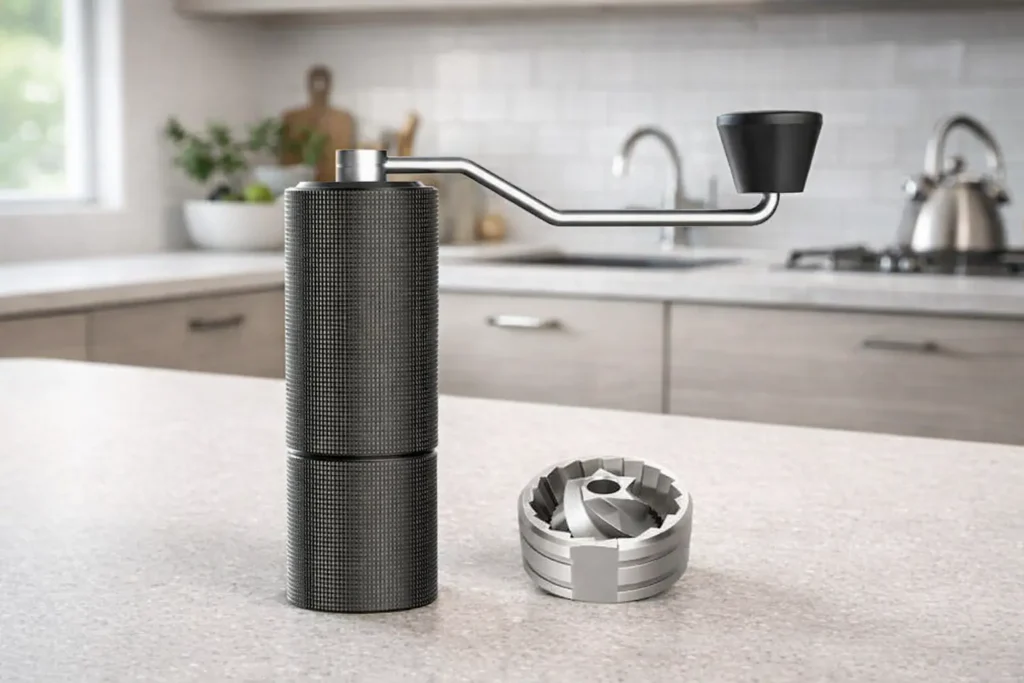
⚙️ Grind consistency is the single variable with the most impact on your AeroPress cup. A blade grinder makes the dial-in system in this guide completely unworkable — random particle sizes mean you cannot make a reliable “one click finer” adjustment. The Timemore Chestnut C2 is CoffeeGearHub’s recommended value grinder for AeroPress: consistent medium-fine to fine range, fast grinding, durable stainless steel burrs, and compact enough to travel with the AeroPress.
As an Amazon Associate, CoffeeGearHub earns from qualifying purchases.
Brew Diagnosis: Using Taste to Calibrate Your AeroPress
The AeroPress does not have a brew time indicator like a drip machine or a flow-rate signal like pour over. Taste is your primary calibration tool. Understanding what specific off-flavours indicate makes every adjustment targeted rather than random.
| What the cup tastes like | What it means | Primary fix | Secondary fix |
|---|---|---|---|
| Bitter, harsh, dry aftertaste | Over-extraction — too much dissolved from the grounds | Grind 1–2 steps coarser | Shorten steep time or lower water temperature 1–2°C |
| Sour, sharp, mouth-puckering | Under-extraction — not enough dissolved from the grounds | Grind 1–2 steps finer | Extend steep time or raise water temperature 1–2°C |
| Weak, thin, watery | Concentration too low — too much water for the dose | Increase dose to 17g (maintain 1:16 ratio) or reduce water to 210g (1:14) | Grind slightly finer to increase extraction yield |
| Flat, no aroma or complexity | Stale beans — no amount of technique adjustment recovers flavour from old coffee | Buy fresh beans roasted within the last 3–5 weeks | Check water temperature is at least 193°F / 89°C |
| Gritty, sediment in cup | Grind too coarse for the paper filter; or filter not seated correctly | Grind 1–2 steps finer so particles are smaller than the filter pores | Confirm filter is flat against the cap with no fold or gap at the edge |
| Plunge stalls or is very hard to push | Grind too fine — excess resistance at the filter | Grind 2–3 steps coarser | Confirm filter cap is not overtightened; rinse filter before use |
| Balanced, sweet, clean | Correct extraction — record this recipe immediately | No adjustment needed | Write down grind setting, dose, yield, temperature, steep time |
🔬 The AeroPress is the most forgiving manual brewer for beginners precisely because it has so many levers. On a V60, a grind error produces a sour or bitter cup with limited recovery options. On an AeroPress, if grind is wrong, you can compensate with steep time and vice versa. This does not mean all combinations taste the same — it means you can reach a good cup via multiple paths, which makes the learning curve shorter than pour over and the daily variance smaller.
How to Use an AeroPress
Learning how to use an AeroPress starts with a simple 15g coffee to 240g water recipe, medium-fine grind, and a one-minute steep. The standard method is how Alan Adler originally designed the AeroPress to be used: filter cap down, AeroPress sitting on the mug, coffee brews and is pressed directly downward. It is faster and simpler than the inverted method and the correct starting point for anyone new to the device.
What You Need — Standard Method
- AeroPress (Original, Go, or XL) + paper or metal filter — AeroPress Original on Amazon →
- Burr grinder set to medium-fine — Timemore C2 on Amazon →
- Digital scale measuring in grams — Coffee scale on Amazon →
- Kettle — any type; variable temperature preferred — Electric kettle on Amazon →
- Timer (phone timer works), stirrer (AeroPress includes one), sturdy mug or server
- 15g of fresh whole bean coffee, medium or light roast; 260g filtered water (240g brew + 20g for filter rinse)
Setup (before you start the timer)
- Heat water to 200°F / 93°C
- Grind 15g to medium-fine immediately before brewing
- Place paper filter in filter cap; rinse with ~20g of hot water to remove paper taste and help the filter adhere to the cap
- Lock filter cap onto the bottom of the AeroPress chamber
- Set AeroPress filter-cap-down on your mug on the scale; zero the scale
- Add 15g of grounds to the chamber; shake gently to level
The Brew (start timer at first pour)
- 0:00 — Pour 240g of water evenly over the grounds; pour in a gentle circular motion to saturate all grounds evenly
- 0:10 — Stir 10 times — 5 North-South, 5 East-West; ensures full, even saturation with no dry pockets
- 0:15 — Insert plunger just enough to create a seal — this stops dripping but does not begin pressing; the seal holds the brew inside
- 1:00 — Begin pressing slowly and steadily; aim for 20–30 seconds of press time; maintain consistent, even pressure
- ~1:25 — Stop at the hiss — when you hear the hissing sound, all coffee has been pressed and only air remains; stop immediately; never force past this point
- Serve immediately or dilute to taste; unlock filter cap over bin, eject puck, rinse and done
✅ The recipe log habit: After every session where the cup tastes good, write down: bean name, roast date, grinder setting, dose, yield, temperature, steep time, and press time. The AeroPress is so variable that muscle memory alone is unreliable. A written log makes every new bag of coffee a starting-point exercise rather than a from-zero rebuild.
How to Use an AeroPress with the Inverted Method
The inverted method flips the AeroPress upside down during brewing — plunger at the bottom, open chamber at the top. This prevents any water from dripping through the filter before you are ready to press, giving you complete control over steep time. It is the method preferred by most World AeroPress Championship competitors and by home brewers who want the longest, most consistent immersion possible.
⚠️ Safety note before attempting the inverted method: You are inverting a chamber containing nearly boiling water. Place the AeroPress on a flat, stable surface while adding water and during steeping. When flipping, hold both the chamber and the mug firmly with both hands. Flip with confidence — hesitation increases spill risk. Do not attempt the inverted method on a wobbly surface or while distracted. The AeroPress XL is not recommended for the inverted method due to its larger volume and higher spill risk.
Setup — Inverted Method
- Assemble inverted: insert the plunger into the chamber from the bottom to the 4 mark (approximately 1cm insertion) — just enough to create a seal and support the assembly upside down without blocking water flow later
- Stand AeroPress upright inverted — plunger pointing down, open chamber pointing up — on your scale; zero the scale
- Heat water to 200°F / 93°C
- Grind 15g to medium-fine or slightly coarser than the standard method (the longer steep means slightly coarser grind avoids over-extraction)
- Add grounds to the inverted chamber; shake to level
- Rinse paper filter in the cap; set aside until steep time is complete
The Brew — Inverted Method
- 0:00 — Pour 240g of water in a gentle circular motion over the grounds
- 0:10 — Stir 10 times — 5 North-South, 5 East-West; ensures full saturation with no dry pockets
- Steep undisturbed until 1:30 total — the longer steep is the functional advantage of the inverted method over standard
- 1:20 — Attach filter cap with rinsed paper filter while the brew is still steeping; screw on firmly but do not overtighten
- 1:30 — The flip: place your mug upside-down on top of the AeroPress; grip firmly with both hands — one on the mug, one on the chamber; flip in one smooth, confident motion; set on a flat surface
- 1:30–2:00 — Press slowly over 20–30 seconds; stop at the hiss; serve immediately
Standard vs Inverted: Which Method Is Right for You?
| Factor | Standard Method | Inverted Method |
|---|---|---|
| Ease of use | Simpler — no flip required | More steps; flip requires care with hot water |
| Speed | Faster — complete in ~1:30 | Slightly slower — ~2:00 total with longer steep |
| Control over steep time | Less precise — some coffee drips before press begins | Complete control — no drip until you are ready to flip and press |
| Cup character | Slightly cleaner, faster extraction | Richer, more developed — longer immersion extracts more body |
| Spill risk | None | Low with care; higher if surface is unstable or technique is hesitant |
| Used by World Champions | Some (upright recipes exist) | Majority — most WAC-winning recipes use inverted for steep time control |
| Best for | Beginners, fast mornings, anyone new to the device | Enthusiasts who want maximum control; anyone who has mastered the standard method |
| Recommended grind | Medium-fine (table salt) | Medium-fine to medium (slightly coarser to compensate for longer steep) |
🔬 Why World AeroPress Champions prefer inverted: In the standard method, some coffee begins dripping through the filter during the pour and stir phase — before the intended steep time begins. This reduces the precision of steep time as a variable. The inverted method eliminates this early drip entirely, making steep time a fully controlled variable. For competition recipes where steep time is dialled to 10-second increments, this precision matters. For home brewing, the practical difference is small — start with standard, move to inverted when you want more control.
AeroPress Recipe Library: 5 Styles, One Device
The AeroPress’s defining feature is that the same device produces radically different cups depending on recipe. These five recipes cover every major AeroPress output style from a clean filter cup to a thick concentrate.
Recipe 1: Classic Filter Cup
Style: Clean, balanced — best everyday AeroPress recipe
- Method: Standard upright
- Dose: 15g, medium-fine grind
- Water: 240g at 200°F
- 0:00: pour all 240g; stir 10× at 0:10
- 0:15: insert plunger to seal
- 1:00: press 20–30 seconds
- Filter: paper for clarity; metal for more body
Recipe 2: Rich Inverted (WAC-Style)
Style: Full body, complex — World Championship inspiration
- Method: Inverted
- Dose: 17g, medium-fine grind
- Water: 200g at 200–205°F + 70g bypass in cup
- 0:00: pour 200g; stir 10× at 0:10
- 1:20: attach filter cap
- 1:30: flip; press 20–25 seconds
- After pressing: pour 70g hot water into cup to dilute concentrate to full serving
Recipe 3: Espresso-Style Concentrate
Style: Thick, intense — use as Americano base or with milk
- Method: Standard upright
- Dose: 20g, fine grind (finer than table salt)
- Water: 100g at 205°F (brew only — dilute after pressing)
- 0:00: pour 100g; stir 5× at 0:10
- 0:30: press quickly over 20 seconds
- After pressing: dilute with 150–200g hot water for Americano; use as-is for milk-based drinks
- Filter: paper preferred for clarity
Recipe 4: AeroPress Cold Brew
Style: Smooth, low-acid concentrate — ready in minutes not hours
- Method: Inverted with cold or room-temp water
- Dose: 20g, medium-coarse grind
- Water: 200g cold or room-temperature filtered water
- Steep: 2–5 minutes at room temperature; stir at start and midway
- Press: slowly over 30–40 seconds (cold water = more resistance)
- Serve: over ice; dilute 1:1 with cold water or milk; stronger than traditional cold brew per unit time
Recipe 5: Iced AeroPress
Style: Bright, clean iced coffee — ready in 2 minutes
- Method: Standard upright; brew directly over ice
- Dose: 18g, medium-fine grind
- Water: 130g at 205–210°F (hot — ice will dilute)
- Ice: 110g in the glass below the AeroPress
- 0:00: pour 130g hot water; stir 10×
- 0:15: seal with plunger; steep to 1:00; press 20 seconds directly onto ice
- Result: the hot concentrate flash-chills as it hits the ice — bright, clear, cold immediately
Roast-Level Grind and Temperature Reference
Roast level changes the density, porosity, and solubility of the bean in ways that directly affect how a given grind size and temperature performs in the AeroPress. These adjustments apply to both the standard and inverted methods.
| Roast level | Grind vs medium | Water temperature | Steep time | Common problem |
|---|---|---|---|---|
| Light roast ☀️ | 1–2 steps finer — dense beans extract slowly | 203–205°F / 95–96°C | 1:15–1:30 | Persistent sourness — confirm temperature is truly above 200°F; many thermometers read 5–8°F lower than actual kettle temperature |
| Medium roast 🌤 ✓ | Baseline — all recipes in this guide use medium as the reference | 198–202°F / 92–94°C | 1:00 | Most forgiving — standard recipe applies directly |
| Medium-dark roast | 1–2 steps coarser — more porous beans extract faster | 196–200°F / 91–93°C | 0:45–1:00 | Early bitterness — coarsen grind before adjusting temperature |
| Dark roast 🌑 | 2–3 steps coarser — highly soluble; extracts bitter compounds rapidly | 193–197°F / 89–92°C | 0:30–0:45 | Harsh, ashy notes — the AeroPress is excellent for dark roast at short steep times; do not use the standard 1:00 steep |
| Very fresh beans (<7 days) | 1 step coarser than same bean at 10–14 days | Standard for roast level | Standard; may need 10–15 seconds longer if CO2 is interfering with saturation | Inconsistent extraction — rest beans 5–10 days; pour slowly to prevent CO2 creating dry pockets during saturation |
Model Comparison: AeroPress Original, Go, Go Plus, and XL
All AeroPress models use identical brewing mechanics and produce identical cup quality. The differences are entirely about capacity, portability, and the accessories included. Choosing the wrong model for your use case does not affect coffee quality — it affects convenience.
☕ Not sure which AeroPress model to buy? Here is the quick answer by use case.
AeroPress Original
Best for most home brewers. Affordable, compact, 10 oz capacity. The default recommendation.
AeroPress Go
Best for frequent travel. Packs into its own mug. Slightly less capacity (8 oz).
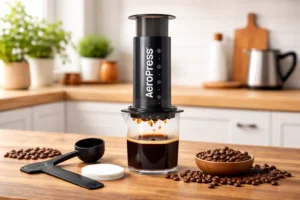
AeroPress XL
Best for brewing for two. Double the capacity (20 oz). Includes 500ml Tritan carafe.
As an Amazon Associate, CoffeeGearHub earns from qualifying purchases.
| Model | Capacity | Best for | Inverted? | Included accessories | Recommended? |
|---|---|---|---|---|---|
| AeroPress Original | 10 oz / 296 ml | Home brewing; everyday single-serve | Yes ✓ | 350 paper filters, stirrer, scoop, funnel | ✅ Best overall value |
| AeroPress Clear | 10 oz / 296 ml | Same as Original but transparent; aesthetic preference | Yes ✓ | Same as Original | ✅ Good if you prefer seeing the brew |
| AeroPress Go | 8 oz / 236 ml | Dedicated travel brewer; backpacking; office | Yes ✓ | Travel mug, paper filters, stirrer, scoop | ✅ Best travel pick |
| AeroPress Go Plus | 10 oz / 296 ml | Travel with better tumbler quality; frequent flyers | Yes ✓ | Premium tumbler with filter storage compartment, paper filters, stirrer, scoop | ✅ Best travel kit quality |
| AeroPress XL | 20 oz / 590 ml | Brewing for two; large mug drinkers; home use | ⚠️ Not recommended — higher spill risk with larger volume | Tritan 500ml carafe, XL paper filters, stirrer, scoop | ✅ Best for two-person households |
Gear Picks: What CoffeeGearHub Recommends for AeroPress Brewing
The AeroPress itself is affordable and already excellent. The accessories below make a meaningful difference to daily consistency and cup quality — grind, scale, and filter type are the three areas where a small investment produces an immediately noticeable improvement.
Disclosure: CoffeeGearHub may earn a commission on qualifying purchases through affiliate links on this page, at no cost to you. Our recommendations are editorially independent. CoffeeGearHub.com participates in the Amazon Services LLC Associates Program. As an Amazon Associate, we earn from qualifying purchases.
AeroPress Models
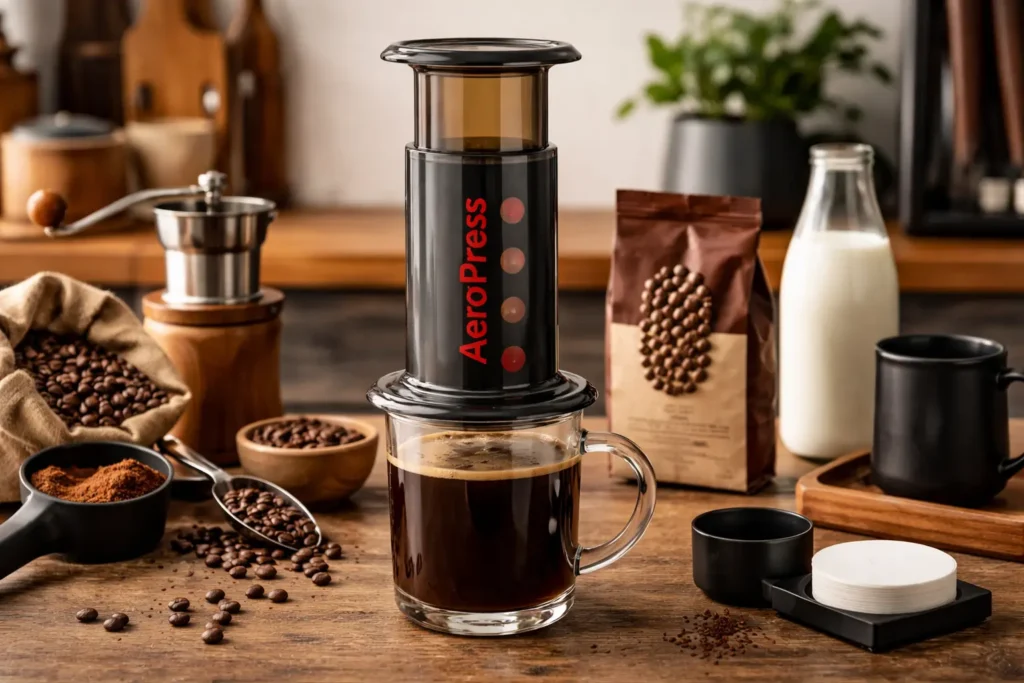
🏆 Best AeroPress for Most Brewers: AeroPress Original
Best for: anyone starting with AeroPress or brewing one cup at a time at home
The AeroPress Original remains the correct recommendation for most home brewers. It brews up to 10 oz per press, weighs 230 grams, survives being dropped on stone floors and stuffed into bags, and costs less than most single espresso drinks at a specialty café. Every recipe in this guide is calibrated for the Original. It comes with 350 paper micro-filters, stirrer, scoop, and funnel — everything you need to start brewing immediately. Made in the USA.
- Capacity: 10 oz / 296 ml per press
- Inverted method: fully compatible
- Cleaning: under 30 seconds; dishwasher-safe (top rack)
- Manual grinders that fit inside the plunger: Porlex Mini, Hario Skerton Pro, 1Zpresso Q-Air — a significant travel convenience
Disclosure: CoffeeGearHub may earn from qualifying purchases.
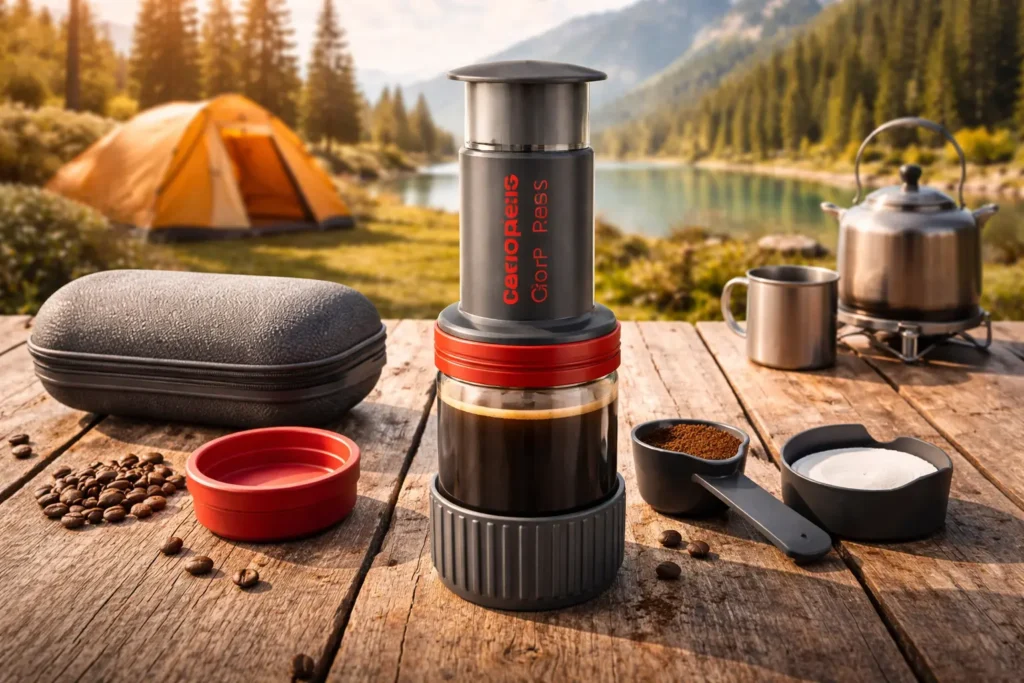
Best Travel AeroPress: AeroPress Go
The AeroPress Go is the correct model for anyone whose primary use case is travel. It packs entirely inside its own lightweight plastic travel mug — the AeroPress body, filters, stirrer, and scoop all nest inside the mug, with the mug lid serving as the cap. The slight capacity reduction (8 oz vs 10 oz) is the only meaningful trade-off, and for most single-serving travel brewing it makes no practical difference. The Go Plus is the upgraded version with a better quality tumbler and a hidden filter storage compartment in the base.
- Capacity: 8 oz / 236 ml per press (Go); 10 oz / 296 ml (Go Plus)
- All-in-one travel pack: AeroPress + mug + accessories in a single unit
- Go Plus upgrade: better tumbler quality; filter storage compartment in base; recommended for frequent travellers
Disclosure: CoffeeGearHub may earn from qualifying purchases.
Grinders
🏆 Best Value Grinder for AeroPress: Timemore Chestnut C2
Best for: beginners and daily brewers who want consistent medium-fine grind without a large investment
The Timemore Chestnut C2 is the CoffeeGearHub recommended value grinder for AeroPress. Its stainless steel conical burrs produce consistent medium-fine to fine particles well-suited to the AeroPress range, it grinds a 15g AeroPress dose in under a minute, and its compact form factor travels with the AeroPress comfortably. The textured body gives good grip, the internal adjustment mechanism holds settings reliably, and the price point makes it accessible as a first burr grinder upgrade from a blade grinder.
- Burr type: stainless steel conical — sharp, consistent, long-lasting
- Range: covers fine (AeroPress espresso-style) through medium-coarse (French press) — versatile for multiple brew methods
- Travel-ready: compact enough to pack alongside the AeroPress Go
Disclosure: CoffeeGearHub may earn from qualifying purchases.
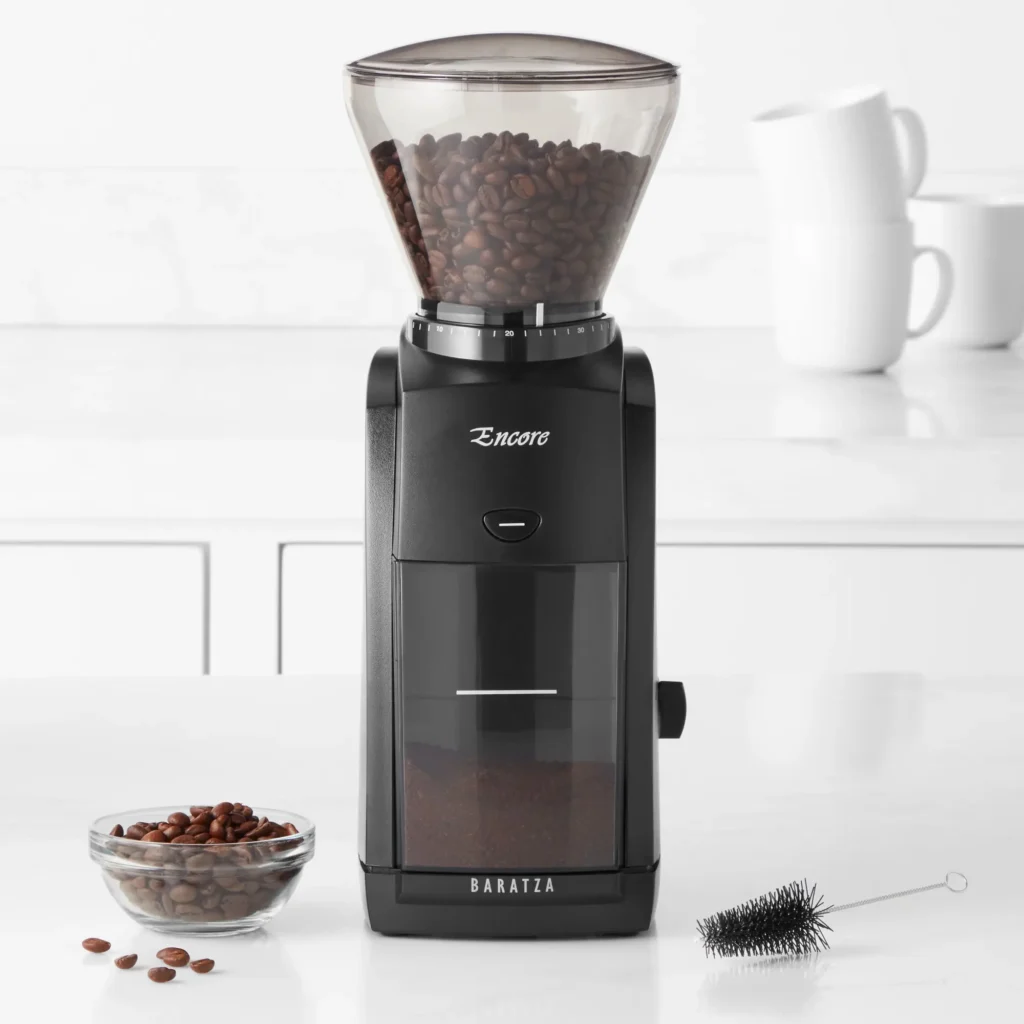
Best Electric Grinder for AeroPress: Baratza Encore ESP
The Baratza Encore ESP is the electric grinder recommendation for home AeroPress brewers who also make pour over or drip coffee from the same grinder. Its 40 settings cover the full filter range including the medium-fine zone ideal for AeroPress, and each click produces a consistent, measurable particle size change. One-button operation, a large hopper for household use, and Baratza’s well-regarded repair ecosystem make it a reliable long-term daily driver.
- 40 settings: linear adjustment across AeroPress and filter range
- Best for: home brewers using AeroPress, pour over, and drip from the same machine
- Repair ecosystem: burrs, motors, and parts all available separately — long-term investment
Disclosure: CoffeeGearHub may earn from qualifying purchases.
Filters, Scales, and Key Accessories
🔄 Paper vs metal filter — this single swap changes the cup character significantly. Paper filters produce a clean, bright cup by trapping coffee oils and fine particles. Metal (reusable) filters allow those oils through, adding body, richness, and a heavier mouthfeel — closer to French press character but without the sediment. If your current AeroPress cup tastes clean but thin, a metal filter is the first upgrade to try. One metal filter also eliminates your paper filter running cost entirely.
As an Amazon Associate, CoffeeGearHub earns from qualifying purchases.
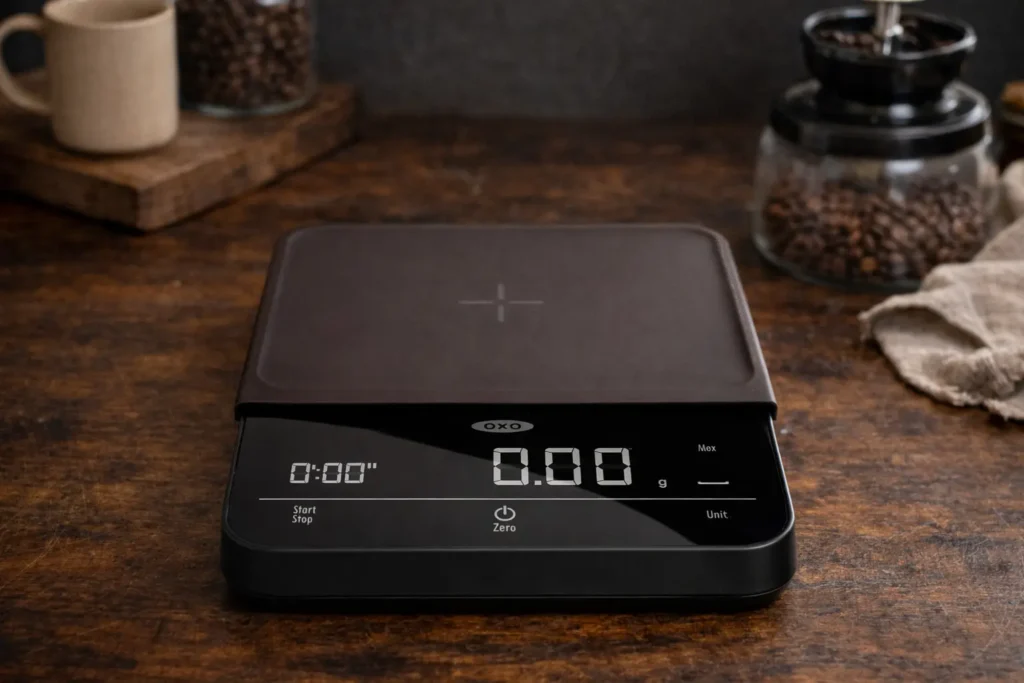
Makes Every Recipe Reproducible: Digital Coffee Scale
Measuring water by volume (the AeroPress scoop or a measuring jug) introduces significant inconsistency — and AeroPress recipes are sensitive enough to dose and yield that scoop measurements shift the extraction meaningfully. A simple digital kitchen scale reading in grams is the most effective single upgrade for AeroPress consistency. For AeroPress, a basic 1g resolution kitchen scale is sufficient; a dedicated coffee scale with a built-in timer (such as the Hario V60 Drip Scale) also covers pour over and other brew methods from the same device.
- Minimum specification: 1g resolution, at least 500g capacity, tare function
- Upgrade option: built-in timer for simultaneous dose and steep time tracking
- What it solves: dose and yield inconsistency that makes recipe comparison impossible
Disclosure: CoffeeGearHub may earn from qualifying purchases.
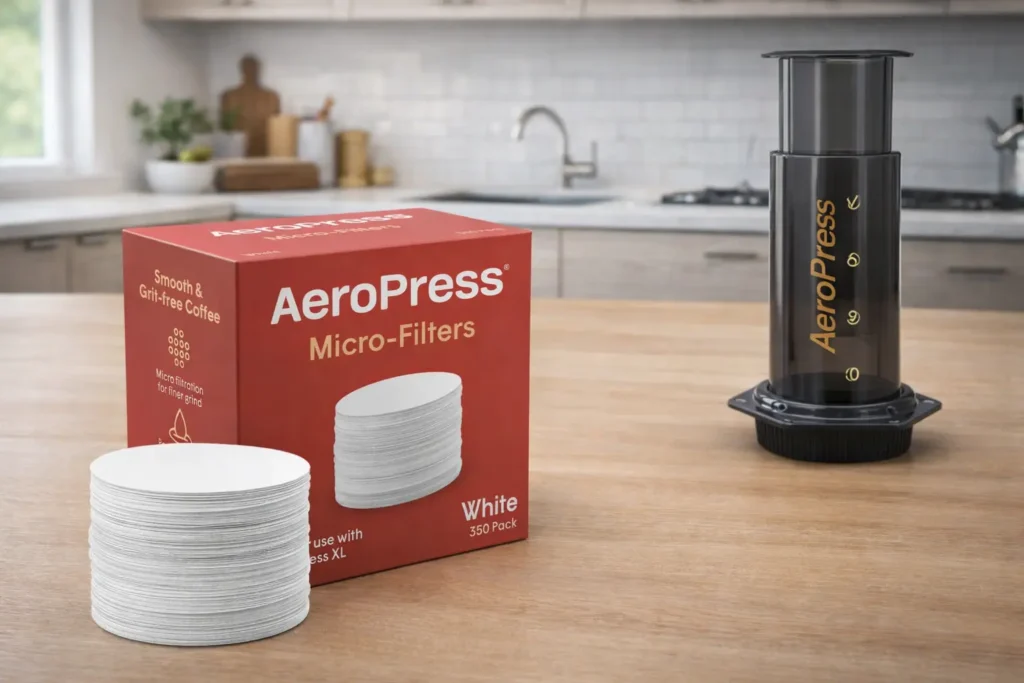
AeroPress Replacement Paper Filters (350 pack)
AeroPress paper micro-filters are proprietary and not interchangeable with V60, Chemex, or standard Melitta filters. Each AeroPress ships with 350 filters, which is approximately 350 brews — roughly one year of daily brewing. Replacement packs are widely available on Amazon. Individual filters can typically be rinsed and reused 3–10 times before degrading, which extends one pack considerably. The standard paper filter is the correct choice for clean, bright cups; use metal or nylon reusable filters for fuller-bodied, oil-forward cups.
- 350 filters per pack: approximately one year of daily single brews
- Reusable? Yes — individual paper filters can be rinsed, allowed to dry, and reused up to approximately 10 times
- Compatible models: AeroPress Original, Clear, Go, Go Plus — not compatible with AeroPress XL (requires XL-size filters)
Disclosure: CoffeeGearHub may earn from qualifying purchases.
Troubleshooting Matrix: Every AeroPress Problem Diagnosed
Once you know how to use an AeroPress, you can adjust grind size, ratio, and steep time to match any roast. Identify your symptom in the first column. Apply fixes in the order listed — the first fix resolves the problem in the majority of cases. Change one variable per brew throughout.
| Symptom | Likely cause | Fix — in order |
|---|---|---|
| Bitter, harsh, dry aftertaste | Over-extraction — grind too fine, steep too long, or temperature too high | Grind 1–2 steps coarser → shorten steep by 15 seconds → lower water temperature 2–3°C |
| Sour, sharp, acidic — not pleasant | Under-extraction — grind too coarse, steep too short, or temperature too low | Grind 1–2 steps finer → extend steep by 15 seconds → raise water temperature 2–3°C |
| Weak, thin, watery | Concentration too low — ratio too dilute or dose too light | Increase dose to 17g (and water to 272g at 1:16) → or reduce water to 210g at same 15g dose → or grind slightly finer to increase extraction yield |
| Plunge is extremely hard or stalls | Grind too fine; or filter cap overtightened; or unrinsed paper filter not seated flat | Grind 2–3 steps coarser → confirm filter is flat and not folded at the edge → rinse paper filter before use to help it seat correctly → do not overtighten the filter cap |
| Coffee drips through before you press (standard method) | Paper filter not seated flat; or filter cap not fully locked; or water added before seating the plunger to create a seal | Ensure filter is flat against the cap with no air gap at the edge → confirm cap is fully locked (not just resting in place) → insert plunger just enough to create a seal immediately after adding water |
| Gritty or sediment in cup | Grind too coarse for the paper filter; or paper filter has a small tear | Grind 1–2 steps finer → inspect the paper filter for tears before use → double-stack two paper filters for a cleaner cup |
| Flat, no aroma, hollow flavour | Stale beans — CO2 depleted, aromatic compounds oxidised | Check roast date — if over 5–6 weeks, buy fresh beans; no recipe adjustment recovers flavour from stale coffee |
| Inverted method spill during flip | Hesitation during flip; unstable surface; plunger not seated deep enough before filling | Ensure the plunger is inserted at least 1cm before adding water → place on a stable, flat surface → flip in one smooth, confident, quick motion — hesitation causes spills, not speed |
| Coffee tastes good sometimes and flat other times | Inconsistent dose or water weight — measuring by scoop or eye rather than scale | Weigh every dose and every water pour on a digital scale — this single change eliminates most batch-to-batch variance |
| Papery taste in the cup | Paper filter not rinsed before use | Always rinse the paper filter in the cap with hot water before adding coffee — takes 5 seconds and eliminates paper taste entirely |
| Cup quality declining over weeks at same settings | Bean age — coffee gets progressively staler within the bag after opening | Grind 1 step finer every few days to compensate for reducing density as beans age; buy fresh bags monthly |
Final Takeaway: The AeroPress System
The AeroPress rewards systematic experimentation more than any other manual brewer. Its variables — grind size, ratio, temperature, steep time, press speed, and filter type — each produce clearly perceptible changes in the cup, and the brew log you build across months of daily use becomes a reference library that makes every new bean a starting-point exercise rather than a from-zero rebuild. Start with the standard method at 1:16, medium-fine grind, 200°F, 1:00 steep, and a paper filter. Once that baseline tastes good, every adjustment from that point is an exploration rather than a rescue. The World AeroPress Championship has been running for nearly two decades because the device’s ceiling is genuinely high — and its floor, for beginners, is higher than any other manual brewer at this price.
FAQs: How to Use AeroPress
What is the best grind size for AeroPress?
Medium-fine is the standard starting point for AeroPress — a texture similar to table salt. This applies to both the standard and inverted methods at a 1:16 ratio. For shorter, espresso-style AeroPress recipes with less water and a faster press, grind finer. For longer immersion recipes, grind slightly coarser. The correct setting is the one that produces a balanced, sweet cup at your preferred steep time — use taste as the calibration tool, not a fixed number.
Standard vs inverted AeroPress — which is better?
Neither is inherently better — they suit different preferences. The standard method is faster, simpler, and lower-risk. The inverted method gives you complete control over steep time because no water drips before you are ready to press, making it preferred by enthusiasts and World AeroPress Championship competitors who want to maximise immersion consistency. Start with the standard method to learn the device; move to inverted when you want more control over steep time.
What water temperature should I use for AeroPress?
195–205°F (90–96°C) is the recommended range for AeroPress. Use 200°F (93°C) as your baseline. Go higher (203–205°F) for light roasts and lower (193–197°F) for dark roasts. The original AeroPress recipe recommends 175°F — most specialty coffee experts consider this too low for full flavour development; it produces flat, underdeveloped cups in most cases.
What is the best coffee-to-water ratio for AeroPress?
1:16 (1g coffee per 16g water) is the SCA-standard starting ratio and produces a clean, balanced cup. Many AeroPress enthusiasts prefer 1:12–1:14 for a richer, stronger brew. The original AeroPress recipe uses a concentrate ratio (1:6) intended for dilution with hot water. Start at 1:16 and adjust to taste: use 1:14 for more body, 1:17 for more delicacy.
AeroPress Original vs Go vs XL — which should I buy?
AeroPress Original: best for most home brewers — affordable, compact, 10 oz capacity. AeroPress Go: best if you travel frequently — packs into its own mug, slightly less capacity (8 oz). AeroPress Go Plus: upgraded travel version with better tumbler and hidden filter compartment. AeroPress XL: best if you regularly brew for two or want large 16–20 oz servings — double the capacity of the Original. All models produce the same cup quality; the differences are capacity and portability only.
Do I need a gooseneck kettle for AeroPress?
No — a gooseneck kettle is not required for AeroPress. Unlike pour over, AeroPress brewing involves a single full pour into the chamber rather than a controlled spiral pour over a filter bed. A standard kettle with a thermometer, or a variable-temperature electric kettle, is entirely sufficient. A gooseneck can make the pour slightly neater but provides no meaningful functional advantage for AeroPress technique.
Can I make espresso with an AeroPress?
Not true espresso — espresso requires 8–10 bars of pressure, and the AeroPress generates approximately 0.5–0.75 bars by hand. However, the AeroPress can produce a strong, concentrated, espresso-style coffee that works well diluted as an Americano or used as a base for milk drinks. Use a finer grind, a 1:5 to 1:8 ratio, and press quickly for a concentrated, rich output.
How do I clean an AeroPress?
AeroPress is the easiest coffee brewer to clean. After pressing, unscrew the filter cap over a bin and push the plunger to eject the coffee puck and filter in one motion. Rinse the rubber seal and chamber under running water. The entire device is dishwasher-safe (top rack, except AeroPress Premium which is hand-wash only). Total cleaning time is under 30 seconds — one of the AeroPress’s most significant practical advantages over every other quality manual brewer.
Continue Learning
BREW GUIDES
Ready to compare the AeroPress against other manual brewers? The complete AeroPress vs French Press comparison guide covers cup character, technique, cleanup, and which brewer suits which lifestyle — with gear picks for both.
☕
Written by the CoffeeGearHub Editorial Team
CoffeeGearHub is a specialty coffee equipment resource run by home brewers and coffee enthusiasts. Our guides are researched using published brewing science, SCA standards, World AeroPress Championship recipe archives, and established specialty-coffee community knowledge. We review and update our pillar content regularly. About CoffeeGearHub →