Last Updated: March 2026 · 25–35 min read · CoffeeGearHub Brewing Science

✍️ Editorial note: This guide is written by the CoffeeGearHub editorial team using published brewing science, specialty-coffee community consensus, and hands-on AeroPress testing across multiple roast levels and methods. We test temperature targets against taste outcomes — not just theory. All product links are affiliate links; we may earn a commission at no extra cost to you. See our editorial policy.
The 30-Second Answer
CoffeeGearHub Verdict The best water temperature for AeroPress is 185–195°F (85–90°C) for most medium roasts — balanced sweetness, controlled bitterness, clean finish. Light roasts need hotter water (195–205°F) to unlock sweetness from dense beans. Dark roasts need cooler water (175–185°F) to prevent harsh, ashy bitterness. If you have no way to control temperature precisely, wait 60–120 seconds after boiling and you’ll land in range for most coffees.
- Best overall AeroPress temperature: 185–195°F (85–90°C) — works for most medium roasts, most methods
- Light roasts: 195–205°F — hotter water is essential for unlocking sweetness from dense beans
- Dark roasts: 175–185°F — cooler prevents harsh bitterness and ashiness
- Fastest fix for a sour cup: raise temp +5–10°F or steep 15–30 seconds longer
- Fastest fix for a bitter cup: lower temp −5–10°F and reduce stirring
- No temperature kettle? Boil and wait — 90 sec ≈ 195°F, 120 sec ≈ 190°F
Who This Guide Is For — Jump to What You Need
☕ Just starting out
Start at Why Temperature Matters, then go to Best Overall Range.
🌟 Brewing light or dark roasts
Jump to Temperature by Roast Level or the matching recipe.
🔧 Fixing a bitter or sour cup
Go straight to Troubleshooting or the Dial-In table.
🎒 No temperature kettle yet
See How to Control Temperature and Gear Picks.
Table of Contents
Why AeroPress Water Temperature Matters
Water temperature is the single fastest lever you have for changing how your AeroPress coffee tastes. More than grind size, more than steep time — a 10°F shift in water temperature produces an immediate, obvious difference in the cup. Understanding why helps you fix problems faster and dial in new beans with fewer test brews.
AeroPress is an immersion brewer with a short, pressurized press at the end. Water contacts coffee grounds directly and dissolves flavor compounds — and the rate and character of that dissolution changes dramatically with temperature. Hot water extracts faster and more completely; cooler water extracts more slowly and selectively.
Coffee contains hundreds of compounds that dissolve at different rates and temperatures. The broad pattern that matters for brewing:
- Organic acids (bright, fruity notes) dissolve readily at most temperatures — including cooler ones
- Sugars and Maillard compounds (sweetness, caramel, chocolate body) need adequate heat to dissolve fully — under-extraction from cool water leaves these behind
- Bitter phenolic compounds and chlorogenic acid degradation products extract readily at higher temperatures, especially with fine grinds and long contact time
The goal of temperature dial-in is to hit the zone where sweetness and body are fully extracted before bitterness dominates. That zone is different for every roast level — which is why a single temperature doesn’t work for all coffees.
💡 AeroPress vs pour-over — why temperature is more forgiving here: AeroPress is significantly more forgiving of temperature variation than a V60 or Chemex. The sealed chamber and short brew time create a buffer — a 5°F error won’t ruin your cup the way it might in a pour-over. This doesn’t mean temperature doesn’t matter; it means your first brew at the right approximate temperature will already be good, and dialing in tightens it further.

Best Overall AeroPress Temperature Range
If you want one starting point that works across most coffees and most AeroPress methods, use this:
Best overall AeroPress water temperature: 185–195°F (85–90°C)
Balanced sweetness, clean finish, and enough extraction power for most medium roasts at medium-fine grinds. From there, adjust for roast level — cooler for dark, hotter for light — and for grind size — finer means cooler, coarser means hotter.
This 10-degree window (185–195°F) is where the majority of World AeroPress Championship recipes cluster, where most specialty-coffee community defaults land, and where most medium-roast coffees produce their best flavor. It’s the right place to start for nearly any new bean.
AeroPress temperature quick reference:
☀️ Light roast: 195–205°F (90–96°C) | 🌤 Medium roast: 185–195°F (85–90°C) | 🌑 Dark roast: 175–185°F (80–85°C) | 🧊 Cold brew: room temp or cooler
Extraction Science: What Temperature Actually Changes
You don’t need a chemistry degree to brew great AeroPress coffee — but understanding the two or three things temperature actually changes makes troubleshooting much faster. Here’s the practical version:
Under-extraction (too cool, too short, too coarse) → tastes sour, sharp, lemony, or thin
Over-extraction (too hot, too long, too fine, too much agitation) → tastes bitter, dry, harsh, or astringent
Correct extraction → tastes sweet, balanced, full-bodied, and clean
Temperature affects extraction in three distinct ways:
1. Extraction rate: Hotter water dissolves coffee solids faster. At 205°F, the same grind at the same time produces significantly higher extraction yield than at 175°F. This is why light roasts — which are denser and harder to extract — need hotter water to reach the same yield in the same time.
2. Compound selectivity: Temperature doesn’t just change how much extracts — it changes the relative balance of what extracts first. Sweet and body-contributing compounds (sucrose degradation products, Maillard compounds) need heat to dissolve well. At 175°F, acids extract more readily than sweetness, producing thin, bright, potentially sour cups even if total extraction is adequate. At 200°F with fine grinds, bitter compounds extract faster than they would at 185°F.
3. Agitation amplification: Temperature multiplies the effect of stirring. Heavy agitation at 200°F extracts significantly more than heavy agitation at 185°F. This is why lowering agitation should always be tried before lowering temperature when a cup is bitter — and why raising agitation can often replace raising temperature for under-extracted cups.
Lower temps (175–185°F): what you get
- Cleaner, softer cup overall
- Reduced bitterness and harshness
- Bright acids more prominent
- Risk of sourness if grind is coarse or steep is short
- Best for dark roasts, fine grinds, inverted method
Higher temps (195–205°F): what you get
- More sweetness, body, and complexity
- Higher overall extraction yield
- Fruit and floral notes more accessible
- Risk of bitterness if grind is fine or steep runs long
- Best for light roasts, coarser grinds, concentrates
Pro tip — change one variable at a time: When diagnosing a cup problem, adjust temperature first (±5–10°F) and rebrew before changing grind or time. One variable per brew makes the feedback loop clear. Two simultaneous changes make it impossible to know what fixed (or broke) the cup.
AeroPress Temperature by Roast Level
Roast level changes bean density, solubility, and the balance of acids to sugars to bitter compounds — which means the optimal brewing temperature shifts significantly between a light Ethiopia and a dark espresso blend. Here’s how to approach each:

Light roast AeroPress temperature: 195–205°F (90–96°C)
Start here: 200°F for most light roasts | Range: 195–205°F | Common mistake: brewing light roasts at 185°F and blaming the bean for sourness
Light roasts are physically denser than medium or dark roasts because the bean structure hasn’t been broken down by extended roasting. That density means they’re harder to extract — compounds dissolve more slowly, and you need more thermal energy to access the sweetness locked inside.
Brewing a light roast at 185°F almost always produces a sour, under-developed cup — not because the recipe is wrong, but because the temperature isn’t high enough to fully dissolve the sugars and body-contributing compounds that make light roasts taste special. Pushing to 200–205°F pulls fruit notes, floral aromas, and structured sweetness that simply don’t appear at lower temperatures.
Fast dial-in for light roasts: Still sour at 200°F? Push to 203–205°F and grind slightly finer simultaneously. If it turns harsh or sharp at 200°F, reduce agitation (stir 3–5 times instead of 8–10) before lowering temperature — over-stirring is a more common cause of harshness than temperature at this roast level.
Medium roast AeroPress temperature: 185–195°F (85–90°C)
Start here: 190°F for most medium roasts | Range: 185–195°F | Why it’s easiest: solubility and sweetness are already balanced in the bean
Medium roasts are the most forgiving to brew with AeroPress because the roasting process has already balanced the bean’s structure — it’s soluble enough to extract efficiently at moderate temperatures without needing the high heat that light roasts require or the low heat that dark roasts demand.
The 185–195°F range gives you the most margin for error and works well across origins, processing methods (washed, natural, honey), and grind settings. Start at 190°F and move from there — you’ll typically find your sweet spot within two brews.
Fast dial-in for medium roasts: Bitter → drop 5–10°F. Flat or weak → raise 5°F or grind slightly finer. Thin and balanced → try a metal filter or increase dose by 1–2g. Most medium-roast problems resolve in one temperature adjustment.
Dark roast AeroPress temperature: 175–185°F (80–85°C)
Start here: 180°F for most dark roasts | Range: 175–185°F | Biggest win: dropping from 200°F to 180°F can completely transform a harsh dark roast
Dark roasts are more porous, more soluble, and extract much faster than lighter roasts. The same grind that produces a balanced medium roast at 190°F will over-extract a dark roast and taste bitter, harsh, and ashy. The roasting process has already degraded much of the sugars and acids — what remains extracts quickly and aggressively at higher temperatures.
Dropping temperature to 175–185°F slows extraction and prevents the most aggressive bitter compounds from dominating. The result is a smooth, round cup with chocolate and caramel notes rather than a harsh, drying, ashy one. Many home brewers who “don’t like AeroPress” have simply been brewing dark roasts too hot — a 15–20°F temperature drop can turn a disappointing cup into an excellent one.
Fast dial-in for dark roasts: Still harsh at 180°F? Reduce stirs to 3–4 and switch to a paper filter. If it tastes thin or sour at 175°F, grind slightly finer rather than increasing temperature — the bean needs more surface area, not more heat.
AeroPress Temperature by Brewing Method
Method changes total immersion time, which changes how aggressively water extracts at a given temperature. The longer water stays in contact with coffee, the lower your temperature should be to avoid over-extraction:
| Method | Best Temp Range | Why |
|---|---|---|
| Standard (upright) | 185–195°F | Short contact time allows moderate-high temps without over-extraction |
| Inverted | 180–190°F | True full immersion — longer contact time requires cooler water to stay balanced |
| Concentrate (1:3–1:5) | 195–205°F | High dose-to-water ratio needs maximum extraction yield before dilution |
| AeroPress Go | 188–198°F (+3–5°F vs standard) | Smaller 220g chamber loses heat faster — start 3–5°F higher to compensate |
| Bypass (brew strong, dilute) | 195–200°F | High-strength brew benefits from maximum sweetness extraction before dilution |
🟢 AeroPress Go note: The Go’s 220g chamber is ~12% smaller than the original. That smaller thermal mass means heat dissipates faster during the steep. Either brew 3–5°F hotter than you would with the standard model, or reduce steep time by 10–15 seconds. All recipes in this guide use the standard model; apply that adjustment for Go.
Temperature vs Grind Size: How They Work Together
Grind size and water temperature are the two dominant extraction variables in AeroPress — and they interact directly. When you change one, you often need to compensate with the other. The core rule is simple: finer grind = use cooler water; coarser grind = use hotter water.
A fine grind already extracts fast because of the large surface area exposed to water. Adding high temperature on top creates a double extraction pressure that easily tips into bitterness. Conversely, a coarse grind has less surface area, extracts more slowly, and benefits from hotter water to reach adequate extraction yield in the available brew time.
| Grind size | Description | Best temp range | Flavor goal |
|---|---|---|---|
| Extra fine | Powdery, near espresso | 170–180°F | Avoid bitterness; uses high agitation to compensate |
| Fine | Fine sand texture | 175–185°F | Avoid rapid over-extraction; best for concentrates |
| Medium-fine | Table salt texture (most common) | 185–195°F | Balanced sweetness + clarity; the AeroPress default zone |
| Medium | Kosher salt / coarse sand | 190–200°F | More body, clean finish; works well inverted |
| Coarse | Raw sugar granule | 200–205°F | Maximum extraction power for large particles |
💡 When to use this: If you raise temperature to fix sourness and the cup immediately turns bitter, the problem is likely grind distribution (inconsistent grind, too many fines) — not temperature. A more even grind from a burr grinder often solves what looks like a temperature problem. See our best AeroPress grinder guide for specific recommendations.
Temperature vs Brew Time: The Tradeoff
Temperature and brew time are inversely linked — as temperature increases, extraction happens faster, so total brew time should decrease to reach the same extraction level. These ranges give practical starting points; adjust based on taste:
| Water temp | Suggested total brew time | Best used for |
|---|---|---|
| 175°F | 90–120 seconds | Dark roast, fine grind, smoother cup, inverted method |
| 185°F | 75–100 seconds | Most medium/dark roasts at medium-fine grind |
| 190°F | 65–90 seconds | Balanced everyday medium roast brewing |
| 195°F | 55–80 seconds | Medium-light roasts, standard method |
| 200°F | 45–70 seconds | Light roasts, medium grind, bloom-based recipes |
| 205°F | 40–60 seconds | Light roasts, coarser grinds, concentrates |
Note that “total brew time” includes the press time. A 20–30 second press is standard; faster presses extract less, slower presses extract more. If your press takes longer due to resistance (often fine grinds), account for that in your total time estimate.
Bloom, Agitation, and Temperature: The Three-Way Interaction
Temperature doesn’t work in isolation — it interacts with bloom technique and agitation level in ways that can make or break your cup. Understanding these interactions makes troubleshooting much faster:
How temperature affects the bloom
A bloom (pouring 30–50g of water first and waiting 20–30 seconds) degasses the coffee and promotes more even extraction. Temperature affects how aggressively this works:
- Hotter water (195–205°F) blooms more vigorously — you’ll see significant bubbling from CO₂ release. This is especially important for fresh, gassy light roasts where trapped CO₂ causes channeling and uneven extraction. The bloom essentially clears the path for the main pour.
- Cooler water (175–185°F) blooms more gently — less CO₂ is released, which is fine for dark roasts (which are less gassy) and prevents pre-extraction bitterness if the bloom takes longer than 30 seconds.
- Advanced option — split temperature: Some brewers use slightly hotter water for the bloom (to degas fully) then cool water for the main pour. This is most useful for very fresh light roasts where CO₂ is significant. Not essential for most home brewing.
The agitation × temperature multiplier
This is the most commonly overlooked interaction in AeroPress brewing: stirring and temperature multiply each other’s extraction effect. 10 stirs at 200°F extracts substantially more than 10 stirs at 185°F — often more than enough to push from balanced into bitter territory.
⚠️ The agitation rule: When you increase temperature, reduce agitation. When you lower temperature, you can increase agitation to compensate. A practical guide:
- 175–183°F → stir 8–12 times or swirl vigorously
- 184–193°F → stir 5–8 times (the standard zone)
- 194–200°F → stir 3–5 times or just swirl once
- 201°F+ → gentle swirl only; no stirring for most recipes
Water Quality and AeroPress Temperature: The Hidden Variable
Water mineral content (TDS — total dissolved solids) interacts with temperature in a way that can make your temperature adjustments feel ineffective. If you’ve been adjusting temperature without seeing expected flavor changes, water quality may be the limiting factor.
Minerals in water — primarily calcium and magnesium — act as extraction facilitators. They help carry flavor compounds from the coffee into solution. Without adequate minerals, hot water simply cannot extract coffee efficiently regardless of temperature:
| Water type | TDS range | Effect on extraction | Temperature adjustment |
|---|---|---|---|
| Distilled / reverse osmosis | <10 ppm | Severely under-extracts; flat, metallic, lifeless cups at any temp | Mineral supplement required; temp adjustment alone won’t help |
| Very soft | 10–50 ppm | Under-extracts; dull, thin cups even at high temperatures | Raise temp +5°F as a partial fix; better solution is filtered tap or minerals |
| Ideal | 75–150 ppm | Best balance of extraction efficiency and flavor clarity | Use standard temperature ranges from this guide |
| Moderately hard | 150–200 ppm | Slight amplification of body; may slightly over-extract at high temps | Lower temp −3–5°F from standard targets |
| Very hard | 200+ ppm | Amplifies bitterness significantly at higher temperatures | Lower temp −5–10°F; use filtered water |
💡 Simple water quality check: If cups always taste dull and flat regardless of temperature, origin, or recipe — water quality is usually the cause. A simple test: brew the same recipe with filtered tap water (most municipal tap water filtered through a Brita is in the 75–150 ppm range) and compare. If it tastes dramatically better, your water was the issue. Products like Third Wave Water mineral packets add precise mineral content to distilled or RO water for ideal brewing conditions.
Altitude and AeroPress Water Temperature
Atmospheric pressure decreases at higher elevations, which directly lowers the boiling point of water. This is one of the most commonly overlooked brewing variables — if you live above 4,000 feet, every temperature target in this guide assumes conditions you physically cannot reach without pressurized equipment:

| Elevation | Water boiling point | Difference from sea level | Practical impact |
|---|---|---|---|
| Sea level (0 ft) | 212°F (100°C) | — | Standard guide ranges apply directly |
| 2,500 ft | ~208°F (98°C) | −4°F | Minor; slight steep time extension may help |
| 5,000 ft (Denver, CO) | ~202°F (94°C) | −10°F | Brew light roasts at full boil; extend steep +10–15 sec for medium/dark |
| 7,500 ft | ~199°F (93°C) | −13°F | Maximum available temperature is sea level’s “medium” target; extend steep times significantly |
| 8,000 ft (Park City, UT) | ~197°F (92°C) | −15°F | Brew everything at full boil; extend steep +20–25 sec; grind finer for medium/dark |
| 10,000+ ft | ~194°F (90°C) | −18°F | Extend steep +30–45 sec; grind noticeably finer; consider longer inverted immersion |
⛰️ High-altitude compensation strategy: You cannot make water hotter than its boiling point at your elevation. Compensate entirely through grind size and contact time. At 5,000 feet: grind 1–2 settings finer than normal and extend steep time by 15–20 seconds. At 8,000+ feet: grind 2–3 settings finer and extend steep time by 25–40 seconds. The inverted method is especially useful at altitude because the longer immersion compensates for lower temperature.
AeroPress Cold Brew and Iced Coffee Temperature
AeroPress is exceptionally well-suited to cold and iced coffee — more so than almost any other manual brewer because the seal and press mechanism work independently of temperature. Here are the three main cold-temperature approaches, from fastest to slowest:

Flash Iced (Hot Over Ice)
Brew temp: 205°F | Time: 45–60 sec brew
Brew a concentrated shot directly over pre-weighed ice (typically 100g ice, 150g hot water, 18–20g coffee). Hot concentrate hits the ice and chills immediately, locking in volatile aromatics. Bright, sweet, aromatic — ready in under 3 minutes. Best for light and medium roasts. Requires paper filter for clarity.
Key tip: weigh your ice; melted ice = dilution water, and the ratio matters as much as in hot brewing.
Room-Temp Steep
Brew temp: 68–75°F | Time: 8–12 hours
Cold or room-temperature water steeped overnight, pressed in the morning. Produces smooth, low-acid concentrate — excellent in milk drinks. Use a coarser grind than hot brewing (medium-coarse) and a 1:6–1:8 coffee-to-water ratio. Store pressed concentrate in the fridge for up to 2 weeks.
Fridge Cold Brew
Brew temp: 38–42°F | Time: 12–24 hours
Slowest extraction, lowest acidity, most chocolatey and round body. Steep assembled AeroPress in the refrigerator. Use medium-coarse grind and 1:7–1:9 ratio. Press in the morning — resistance will be higher than hot brewing; apply steady pressure. Classic cold brew profile: smooth, sweet, minimal brightness.
How to Control AeroPress Water Temperature: 3 Methods

Method 1: Temperature-Controlled Kettle ★
Precision: ±1°F | Repeatability: Excellent
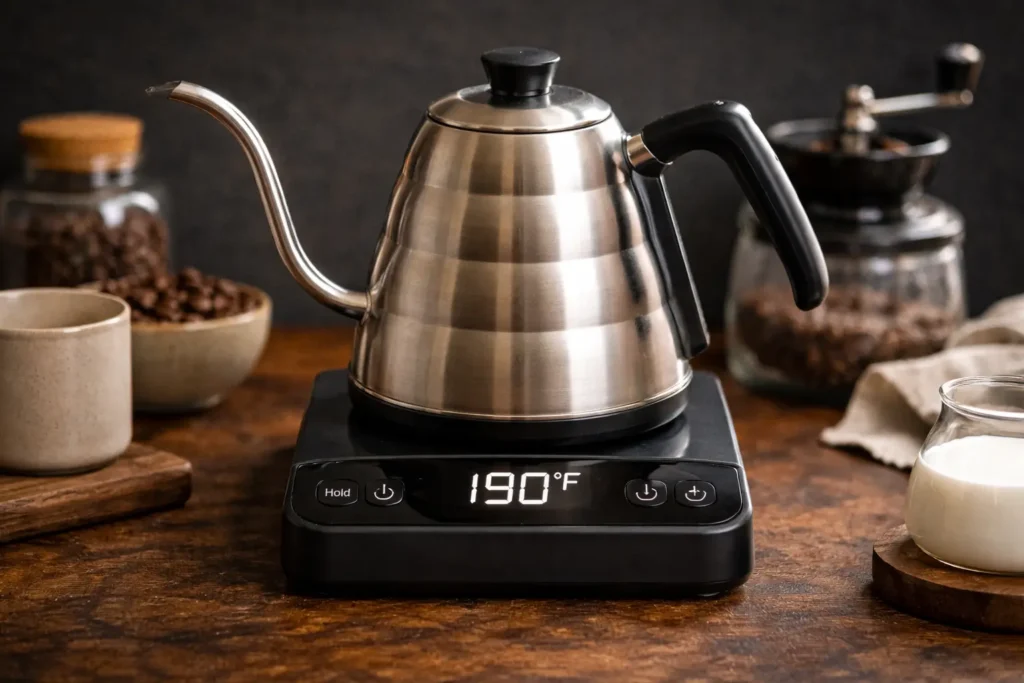
Set the exact target temperature (e.g., 190°F), and it holds there — brew after brew, day after day. Removes all guesswork. A temperature kettle is especially impactful for light roasts, where a 5–10°F swing produces obvious flavor differences. Gooseneck models offer both temperature precision and controlled pour rate, making them the top upgrade for serious AeroPress brewers.
Best for: anyone who has already upgraded to a burr grinder and scale — the kettle is the logical next step.
Method 2: Boil + Wait
Precision: ±5–8°F | Repeatability: Good
Boil water, then wait before pouring. Approximate cooling times from boiling (varies by kettle material, volume, and room temp):
- 30 sec → ≈ 205°F
- 60 sec → ≈ 200°F
- 90 sec → ≈ 195°F
- 2 min → ≈ 190°F
- 3 min → ≈ 185°F
- 4+ min → ≈ 180°F
Best for: casual brewing or when traveling without gear.
Method 3: Instant-Read Thermometer
Precision: ±1–2°F | Repeatability: Excellent
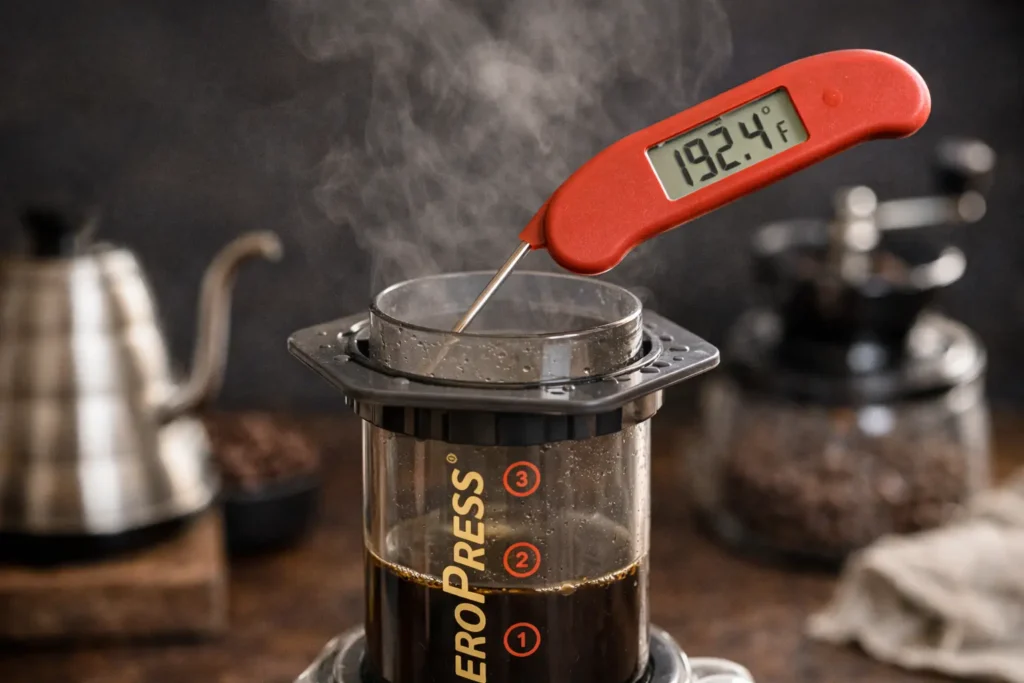
A kitchen instant-read thermometer (like a Thermapen or similar probe thermometer) stuck into the kettle gives you an accurate reading in 2–3 seconds. Works with any stovetop or standard electric kettle — no new kettle required. At $20–50, it’s the cheapest path to precise temperature control and eliminates the uncertainty of the boil-and-wait method.
Best for: brewers who already own a gooseneck or stovetop kettle and don’t want to buy a new one.

3 Tested AeroPress Recipes (Temperature-First)
These three recipes are built around temperature targets for specific roast levels. Each one has been tested for flavor balance across multiple brewing sessions. The “why it works” explanations help you understand which lever to adjust first if your beans behave differently.
🔑 The dial-in rule: When adapting any recipe to a new bean, adjust temperature first (±5–10°F before changing anything else). Temperature is the fastest feedback loop — one brew tells you whether to go up or down. Then fine-tune grind and time.
Recipe 1: Balanced Everyday (Medium Roast) — 190°F
Best for: medium roast daily driver, beginners, clean balanced cups | Yield: ~240ml (8 oz) | Ratio: 1:15
What it tastes like: caramel sweetness, medium body, balanced acidity, clean finish. The most versatile starting point — works for most commercially available medium roasts.
| Coffee dose | 16g | Water | 240g at 190°F / 88°C |
| Grind | Medium-fine (table salt texture) | Filter | Paper (rinse first) |
| Total time | 75–90 seconds | Method | Standard (upright) |
Step-by-step
- Rinse paper filter with hot water; discard rinse water and place AeroPress on mug
- Add 16g freshly ground coffee at medium-fine grind
- Start timer. Pour 240g of 190°F water steadily over 10–15 seconds
- Stir 6–8 times in a circular motion
- Cap and steep until timer shows 1:00–1:05
- Press steadily over 20–25 seconds. Stop pressing when you hear a hiss.
Why it works
190°F sits squarely in the sweetness window for medium roasts — hot enough to fully dissolve body-contributing compounds and sugars, but below the threshold where bitter phenolics dominate. The 1:15 ratio produces a balanced cup rather than a concentrate. Medium-fine grind provides adequate surface area for full extraction in the short steep window without producing the resistance that creates channeling during the press.
Dial-in: Sour/thin → raise to 193–195°F OR steep +15 sec. Bitter/dry → drop to 187°F and reduce stirs by 2. Weak → increase dose to 17–18g or reduce water to 225g.
Recipe 2: Light Roast Clarity (Bright + Sweet) — 200°F
Best for: light roasts, washed Ethiopians, fruit-forward coffees, high-clarity cups | Yield: ~230ml | Ratio: 1:13.5
What it tastes like: fruit notes, floral aromas, structured sweetness, clean bright finish. No lemon-sour bite — just the complex character that makes specialty light roasts worth the price.
| Coffee dose | 17g | Water | 230g at 200°F / 93°C |
| Grind | Medium (kosher salt texture) | Filter | Paper (rinse thoroughly) |
| Total time | 65–80 seconds | Method | Standard with bloom |
Step-by-step
- Rinse paper filter thoroughly (clarity matters most with light roasts)
- Add 17g coffee at medium grind
- Start timer. Pour 40g of 200°F water; stir 5 times; wait 20 seconds (bloom)
- Pour remaining water to 230g total over 10–15 seconds
- Stir gently 3–4 times only (controlled agitation is critical at 200°F)
- Cap and steep until 1:00; press steadily over 20 seconds
Why it works
200°F provides the thermal energy needed to extract sweetness and floral complexity from light roast beans without requiring a fine grind (which would increase bitterness risk at this temperature). The bloom degasses the fresh coffee and promotes more even extraction — especially important for very fresh light roasts where CO₂ can cause channeling. Reduced agitation (3–4 stirs vs the usual 6–8) prevents over-extraction at this higher temperature.
💡 Light roast temperature note: If this recipe tastes sharp or astringent at 200°F, reduce agitation to 2–3 stirs before lowering temperature. Over-stirring at 200°F is the most common cause of harshness with light roasts — and it’s a much faster fix than recalibrating temperature.
Dial-in: Still sour at 200°F → push to 203–205°F and grind slightly finer. Sharp/harsh → cut agitation to 2 stirs; don’t lower temp first. Thin/watery → increase dose to 18g or try a 30-second longer steep.
Recipe 3: Dark Roast Smooth (Zero Bitterness) — 180°F
Best for: dark roasts, espresso beans, anyone who brews dark roasts at boiling and finds results too harsh | Yield: ~220ml | Ratio: 1:14.7
What it tastes like: rich chocolate, smooth caramel body, zero ashiness, round finish. The temperature drop from boiling to 180°F is the single biggest quality upgrade most dark-roast AeroPress brewers can make.
| Coffee dose | 15g | Water | 220g at 180°F / 82°C |
| Grind | Medium-fine (table salt) | Filter | Paper |
| Total time | 90–110 seconds | Method | Standard |
Step-by-step
- Rinse paper filter; place AeroPress on mug
- Add 15g coffee at medium-fine grind
- Pour 220g of 180°F water in a steady circle
- Stir gently 4–5 times (less agitation = less bitterness extraction)
- Cap and steep until 1:20–1:30
- Press steadily over 25–35 seconds at moderate pressure
Why it works
Dark roasts are porous and soluble — they extract aggressively at higher temperatures. At 180°F, extraction slows just enough to prevent the harsh, phenolic bitter compounds from dominating the cup, while the longer steep time (90–110 seconds vs the 75–90 for medium roasts) compensates for the lower temperature by maintaining total extraction yield. Minimal agitation (4–5 stirs) further reduces bitterness risk without sacrificing body.
Dial-in: Still harsh → reduce stirs to 2–3 or switch from stir to gentle swirl. Thin or sour at 180°F → grind finer (not hotter) — the bean needs more surface area, not more heat. Too strong → reduce dose to 14g or increase water to 230g.
AeroPress Temperature Dial-In Decision Table
Use this as a decision tree. Identify the symptom in your cup, follow the fix order, and change only one variable per brew. Most temperature problems resolve in one or two iterations:
| Cup tastes like… | Root cause | Fix — in this order |
|---|---|---|
| Sour / lemony / sharp / thin | Under-extraction | +5–10°F → steep +15–30 sec → grind finer |
| Bitter / dry / harsh / astringent | Over-extraction | Reduce stirs → −5–10°F → grind coarser |
| Flat / dull / lifeless | Too cool, or water quality | +5–10°F → check water TDS → grind finer |
| Strong but rough | Hot + fine + long + heavy agitation | Reduce stirs → −5–10°F → press slightly faster |
| Sour AND bitter simultaneously | Inconsistent grind (blade grinder) | Burr grinder upgrade — see Best AeroPress Grinders |
| Always weak at altitude | Boiling point below target temp | Brew at full boil → extend steep +20–30 sec → grind finer |
| Consistent despite temperature changes | Water quality (TDS too low) | Filtered tap water or mineral supplement |
| Press stalls / very hard to press | Grind too fine or overpacked bed | Grind coarser → reduce agitation → press at steady medium pressure |
Roast level temperature quick reference
☀️ Light roast: 195–205°F
Hotter unlocks sweetness; control harshness through reduced agitation
🌤 Medium roast: 185–195°F
Most forgiving range; start at 190°F for any new bean
🌑 Dark roast: 175–185°F
Cooler water prevents bitterness; longer steep compensates
Troubleshooting AeroPress Temperature Problems
Identify your symptom below, make one change, and rebrew. Most problems resolve in two adjustments or fewer. If a problem persists despite following these steps, the root cause is usually grind inconsistency or water quality — not temperature.
“My AeroPress coffee is always sour — even at 200°F”
When raising temperature to 200°F+ doesn’t fix sourness, grind distribution is almost certainly the problem. A blade grinder — or cheap burr grinder with wide distribution — creates large boulders that under-extract alongside fine dust that over-extracts. The result is a confusing sour-bitter mix that temperature adjustments cannot resolve because different particle sizes need different temperatures simultaneously. A consistent burr grinder (see our guide) solves this in one step.
“I lowered temperature but the bitterness is still there”
Agitation is the next variable to reduce. Cut your stir count by half. Also check press speed: pressing extremely slowly — longer than 40–45 seconds — keeps wet grounds in contact with already-brewed coffee and adds bitterness independent of water temperature. A 20–30 second press is the standard; try that range if you’ve been pressing slowly. For dark roasts that remain harsh after both steps, switch from metal filter to paper for a cleaner, drier extraction.
“My coffee tastes flat and dull at every temperature”
Flat, lifeless cups that don’t respond to temperature changes are almost always a water quality issue. If you use distilled water, reverse osmosis filtered water, or very soft tap water, the water lacks the minerals needed to carry flavor compounds into solution — and no amount of temperature adjustment will fix that. Try filtered municipal tap water (most Brita-filtered tap is in the 75–150 ppm TDS range) or use specialty mineral supplements like Third Wave Water. The improvement is immediate and dramatic.
“My cups are inconsistent despite consistent temperature”
Inconsistency when temperature is controlled points to either dose variation (eyeballing coffee weight) or grind consistency (blade grinder or worn burrs). A scale with 0.1g resolution removes dose as a variable in one purchase — a 1–2g difference in dose produces an obvious flavor shift. After that, a burr grinder removes grind inconsistency. Temperature control is only fully effective when these two variables are also under control.
Recommended Kettles, Scales & Thermometers for AeroPress Temperature Control
Two tools directly control AeroPress temperature — a temperature kettle and a thermometer. Here’s the priority order: if you don’t have a consistent burr grinder yet, that comes first. Once grind is dialed in, temperature control is the next highest-impact upgrade.
Upgrade priority for temperature: burr grinder → scale → temperature kettle → thermometer. A temperature kettle is only fully effective when dose and grind are already consistent — otherwise you’re controlling one variable while two others vary.
Temperature-Controlled Kettles
Best Overall — Temperature Kettle
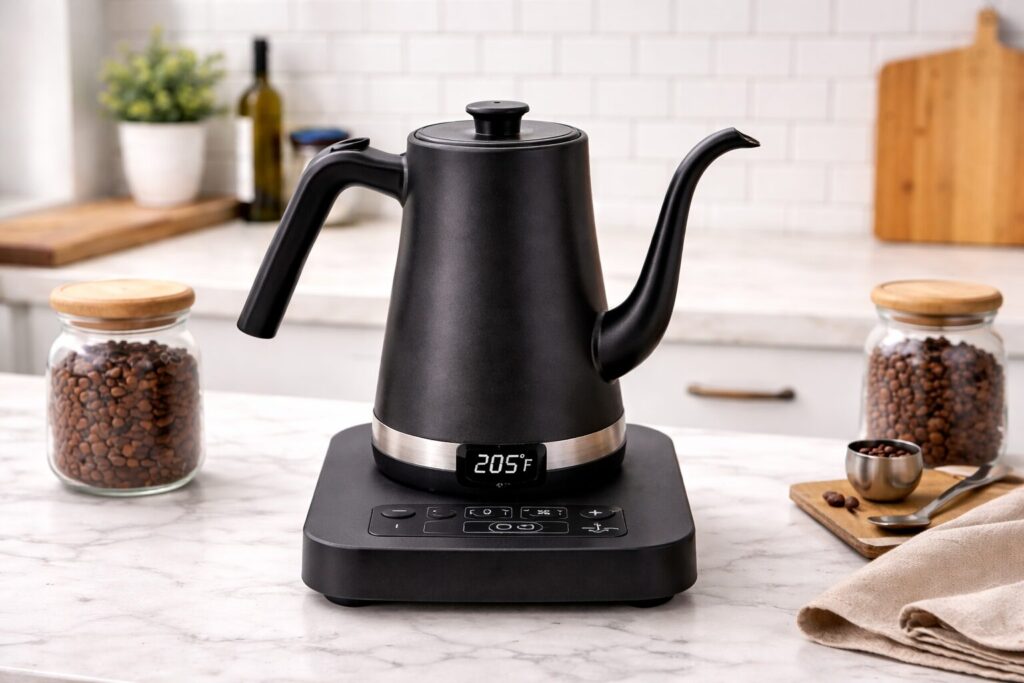
Fellow Stagg EKG Electric Gooseneck
1°F precision temperature control with a 60-minute hold function — set 190°F and it stays there from the first cup to the last. The precision gooseneck pour gives fine-tuned control over bloom pours and fill rate, which also affects extraction consistency. The definitive AeroPress temperature upgrade for serious home brewers.
Pick this if: you’ve already upgraded your grinder and scale, brew light roasts regularly, or want maximum repeatability.
Disclosure: CoffeeGearHub may earn from qualifying purchases.
Best Value — Temperature Kettle
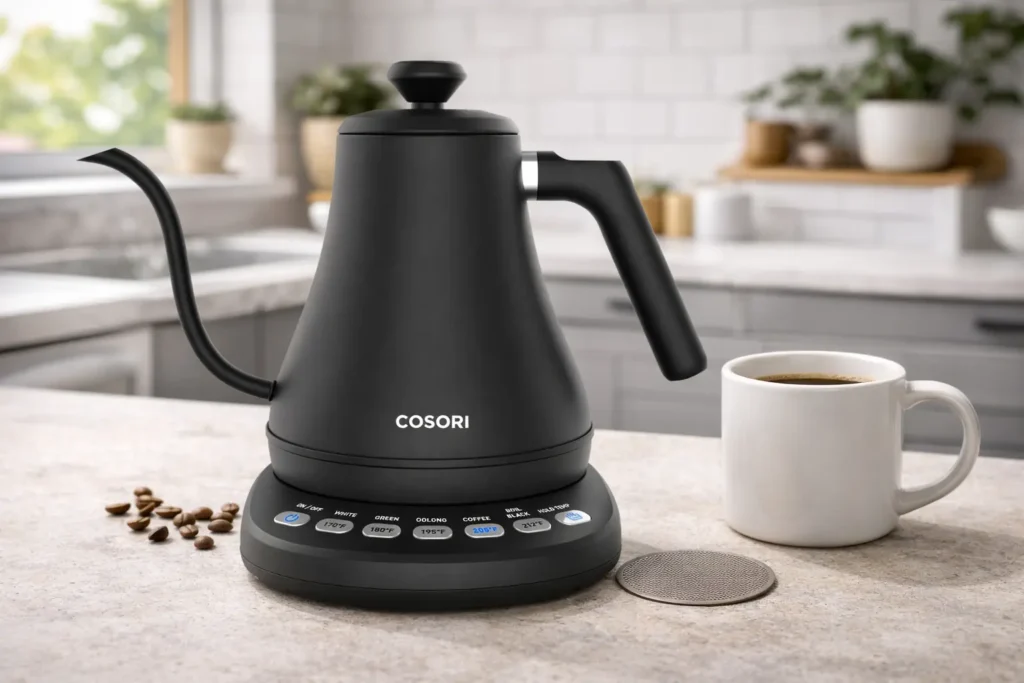
COSORI Electric Gooseneck Kettle
Solid temperature-control performance at a significantly lower price than premium options. Adjustable presets, a 60-minute keep-warm function, and a precision gooseneck. The most-recommended budget temperature kettle in the home brewing community for good reason — it handles the job reliably.
Pick this if: you want precise temperature without the premium price — the best value upgrade for most home AeroPress brewers.
Disclosure: CoffeeGearHub may earn from qualifying purchases.
Best Budget Entry — Temperature Kettle
Budget Temperature-Control Kettle
Preset temperature buttons (typically 160°F, 175°F, 185°F, 195°F, 212°F), simple controls, and adequate temperature accuracy for everyday AeroPress brewing. Not as precise as the Fellow or COSORI, but removes all guesswork at a lower price point. A strong upgrade over standard kettles for the price.
Pick this if: you want temperature presets on the smallest possible budget — good first upgrade if you’re currently using the boil-and-wait method.
Disclosure: CoffeeGearHub may earn from qualifying purchases.
Instant-Read Thermometer (Best Budget Option)
Best Budget — Precision Without a New Kettle
Instant-Read Kitchen Thermometer
If you already own a stovetop kettle or standard electric kettle, an instant-read thermometer gives you precise temperature readings in 2–3 seconds without any new equipment. Look for under 5-second read time and accuracy within 1–2°F. A Thermapen, ThermoPop, or similar probe thermometer costs $20–50 and works perfectly for confirming AeroPress water temperature across any kettle type.
Pick this if: you don’t want to replace your kettle but want to stop guessing temperature — the cheapest path to precision.
Disclosure: CoffeeGearHub may earn from qualifying purchases.
Coffee Scales (For Ratio Consistency + Timing)

Best Overall — Coffee Scale
Coffee Scale with Built-In Timer
Temperature dial-in only produces meaningful feedback when dose and water weight are consistent. A scale with 0.1g resolution and a built-in brew timer removes both dose variation and timing guesswork in one purchase — the two most common sources of inconsistency that make temperature adjustments feel ineffective. Fast response rate (under 1-second refresh) shows real-time pour weight without lag.
Pick this if: you’re dialing in temperature seriously and want your 5°F adjustments to show up clearly rather than being masked by dose variation.
Disclosure: CoffeeGearHub may earn from qualifying purchases.
Best Budget — Coffee Scale
Budget Scale with Timer
Accurate enough for dose and water weight consistency, with a simple built-in timer. The immediate consistency improvement over eyeballing is dramatic — most brewers notice it in their first cup. Covers the basics reliably at a low price point.
Pick this if: you want the fastest possible consistency improvement on a tight budget.
Disclosure: CoffeeGearHub may earn from qualifying purchases.
Complete AeroPress Temperature Control Kit
For consistently great AeroPress temperature results, the full kit is: burr grinder + scale with timer + temperature-controlled kettle + paper filters. If you add only one upgrade today, make it the grinder — then the scale — then the kettle. Each step compounds on the previous one.
6 Common AeroPress Temperature Mistakes (And How to Fix Them)
- Using boiling water by default: The most common mistake. Boiling (212°F) works for some very light roasts with coarser grinds, but produces bitterness in most medium and dark roasts — especially with fine grinds or long steep times. Let water cool 60–90 seconds after boiling for medium roasts; 3–4 minutes for dark roasts.
- Not adjusting agitation when you raise temperature: Agitation and temperature multiply each other. If you raise temp to fix sourness, cut stirs by 2–3 simultaneously. Failing to do this trades sourness for bitterness without improving the cup.
- Changing temperature and grind simultaneously: Two variables change at once means you have no idea which one fixed (or broke) the cup. Change temperature first; if that doesn’t fully resolve the issue, adjust grind on the next brew.
- Ignoring altitude: If you live above 4,000 feet, your boiling water is already cooler than 205°F. The targets in this guide assume sea level. Compensate through grind size and contact time rather than temperature.
- Blaming temperature for a water quality problem: Distilled or very soft water under-extracts at every temperature. If cups are always flat despite temperature adjustments, check water TDS — this is the fix, not more heat.
- Expecting temperature to fix grind inconsistency: A blade grinder produces a particle distribution so wide that no single temperature can optimize for it. The fine particles over-extract at any temperature that fully extracts the coarse particles. A burr grinder is the prerequisite for effective temperature dial-in.
Complete AeroPress Temperature Reference
Everything in this guide, condensed into one reference table. Bookmark this section for quick access when brewing a new coffee or troubleshooting a problem:

| Variable | Cooler (175–185°F) | Middle (185–195°F) | Hotter (195–205°F) |
|---|---|---|---|
| Best roast | Dark roast | Medium roast | Light roast |
| Best grind | Fine to medium-fine | Medium-fine to medium | Medium to coarse |
| Best method | Inverted, standard (dark) | Standard, most methods | Concentrate, bypass |
| Steep time | 90–120 sec | 65–95 sec | 45–70 sec |
| Agitation | 8–12 stirs | 5–8 stirs | 2–5 stirs |
| Cup character | Smooth, soft, low bitterness | Balanced, sweet, medium body | High extraction, sweet, bright |
| Altitude offset | +15–30 sec steep at 5,000 ft | +10–15 sec at 5,000 ft | Full boil at 5,000+ ft |
FAQs: AeroPress Water Temperature
What is the best water temperature for AeroPress?
The best overall water temperature for AeroPress is 185–195°F (85–90°C) for most medium roasts — balanced sweetness, controlled bitterness, and clean finish. Adjust based on roast: 195–205°F for light roasts (to extract sweetness from dense beans) and 175–185°F for dark roasts (to prevent harsh bitterness).
What temperature does AeroPress recommend?
AeroPress originally recommended around 175°F (80°C) for a smoother, less bitter cup. Modern specialty coffee recipes often brew higher — 195–205°F for light roasts — to unlock more sweetness and complexity. The original recommendation is a good starting floor for medium and dark roasts, not an absolute ceiling.
Is boiling water bad for AeroPress?
Boiling water (212°F / 100°C) is not always bad — it works well for very light roasts with coarser grinds and short steep times. However, for most medium and dark roasts, boiling water extracts too quickly and pulls harsh bitter compounds, especially with fine grinds. For best results with most coffees, wait 60–120 seconds after boiling before pouring.
What temperature should I use for light roast AeroPress?
Light roasts brew best at 195–205°F (90–96°C). Light roasts are denser and less soluble than dark roasts — they need more thermal energy to extract sweetness and body. If your light roast tastes sour or hollow at lower temperatures, the water is not hot enough to fully extract the flavor compounds locked in the dense bean structure.
What temperature should I use for dark roast AeroPress?
Dark roasts brew best at 175–185°F (80–85°C). Dark roasts are porous, soluble, and extract quickly — higher temperatures extract bitter compounds too aggressively. Dropping from boiling (212°F) to 180°F can completely transform a harsh, ashy dark roast into a smooth, chocolatey cup.
My AeroPress coffee tastes sour — should I increase temperature?
Usually yes. Sourness typically indicates under-extraction. Increase temperature by 5–10°F first, then extend steep time by 15–30 seconds if still sour. If the problem persists after reaching 200°F+, grind inconsistency is likely the cause — fine dust is over-extracting while coarse boulders under-extract simultaneously, producing a confusing sour note that temperature alone cannot fix.
My AeroPress coffee tastes bitter — should I lower temperature?
Often yes — but reduce stirring/agitation first. Heavy agitation at high temperatures is the most common cause of bitterness in AeroPress. Cut stirs by half, then lower temperature by 5–10°F on the next brew if needed. If bitterness persists, grind slightly coarser. For dark roasts specifically, check that you’re not pressing extremely slowly — a press longer than 40 seconds adds bitterness.
What is the easiest way to control AeroPress water temperature without a temperature kettle?
Two options: (1) Boil and wait — approximate targets: 30 sec after boiling ≈ 205°F, 60 sec ≈ 200°F, 90 sec ≈ 195°F, 2 min ≈ 190°F, 3 min ≈ 185°F. (2) Instant-read thermometer — a $20–50 kitchen probe thermometer gives accurate readings in 2–3 seconds with any kettle and eliminates the guesswork of the wait method.
Can I use a meat thermometer for AeroPress water temperature?
Yes — any fast instant-read kitchen thermometer works perfectly. It doesn’t need to be coffee-specific. Look for a read time under 5 seconds and accuracy within 1–2°F. A Thermapen, ThermoPop, or similar probe thermometer is fully adequate for checking AeroPress water temperature in any kettle.
Does altitude affect AeroPress brewing temperature?
Yes, significantly. At 5,000 feet (Denver, CO), water boils at approximately 202°F — not 212°F. At 8,000 feet it drops to approximately 197°F. At high altitude, you cannot physically reach the higher temperature targets in this guide without pressurized equipment. Compensate by grinding finer and extending steep time: at 5,000 feet, add 15–20 seconds; at 8,000 feet, add 25–35 seconds.
Does water hardness affect how AeroPress temperature works?
Yes. Very soft or distilled water (under 50 ppm TDS) under-extracts at every temperature — the lack of minerals means hot water cannot carry flavor compounds into solution efficiently. Cups taste flat regardless of how hot you brew. Ideal brewing water is 75–150 ppm TDS. Very hard water (200+ ppm) can amplify bitterness at higher temperatures — try filtered tap water and lower your target temp by 5°F.
How does water temperature affect AeroPress extraction differently from grind size?
Temperature and grind size both increase extraction — but they affect it differently. Grind size changes the physical surface area exposed to water (finer = more surface = faster extraction). Temperature changes both extraction rate and compound selectivity — which flavor compounds dominate the cup. A fine grind at low temperature can achieve similar total extraction to a coarse grind at high temperature, but the cup character will be different: fine-low produces cleaner, more precise flavors; coarse-high produces more body and sweetness. This is why both variables need to be considered together.
Final Verdict: AeroPress Water Temperature
Water temperature is the fastest and most impactful brew adjustment you can make in AeroPress — faster to test than grind changes, more immediate in effect than time adjustments. The sweet spot for most brewers is 185–195°F, with light roasts pushing toward 200–205°F and dark roasts dropping to 175–185°F. The boil-and-wait method gets you close enough to taste your way to the right number, and a $20–50 instant-read thermometer eliminates the remaining uncertainty.
The key principles from this guide: temperature works together with agitation (hotter = stir less), grind size (finer = cooler), and contact time (hotter = shorter steep). Address water quality and altitude before fine-tuning temperature if cups don’t respond as expected. And change one variable at a time — temperature first, then grind, then time — to make each adjustment clearly interpretable.
If you want the fastest upgrade path: control temperature first (with any of the three methods above), then dial in with the recipe that matches your roast level. Once that’s dialed in, the kettle upgrade and the grinder upgrade make that good cup perfectly repeatable.
Continue Learning: AeroPress Guides
AEROPRESS BREWING
- AeroPress Grind Size Guide (With Settings Chart)
- Best AeroPress Coffee-to-Water Ratio Explained
- AeroPress Inverted Method: Is It Actually Better?
- AeroPress Paper vs Metal Filters: Which to Use When
- How to Make Iced Coffee with AeroPress (Flash Brew)
- AeroPress Troubleshooting: Fix Sour, Bitter, and Weak Cups
Ready to dial in your AeroPress grind size next? Temperature and grind work together — get both right for the most consistent cups.
☕
Written by the CoffeeGearHub Editorial Team
CoffeeGearHub is a specialty coffee equipment resource run by home brewers and coffee enthusiasts. Our brewing guides are built from published extraction science, specialty-coffee community consensus, and hands-on testing across roast levels, grind settings, and temperature targets. We update pillar content regularly as brewing consensus evolves. About CoffeeGearHub →