
Last Updated: March 2026 • 30–35 min read • Cornerstone Guide: French Press Grinder Science + Top Picks + Coarse Grind Reference + Sediment Fix + Troubleshooting
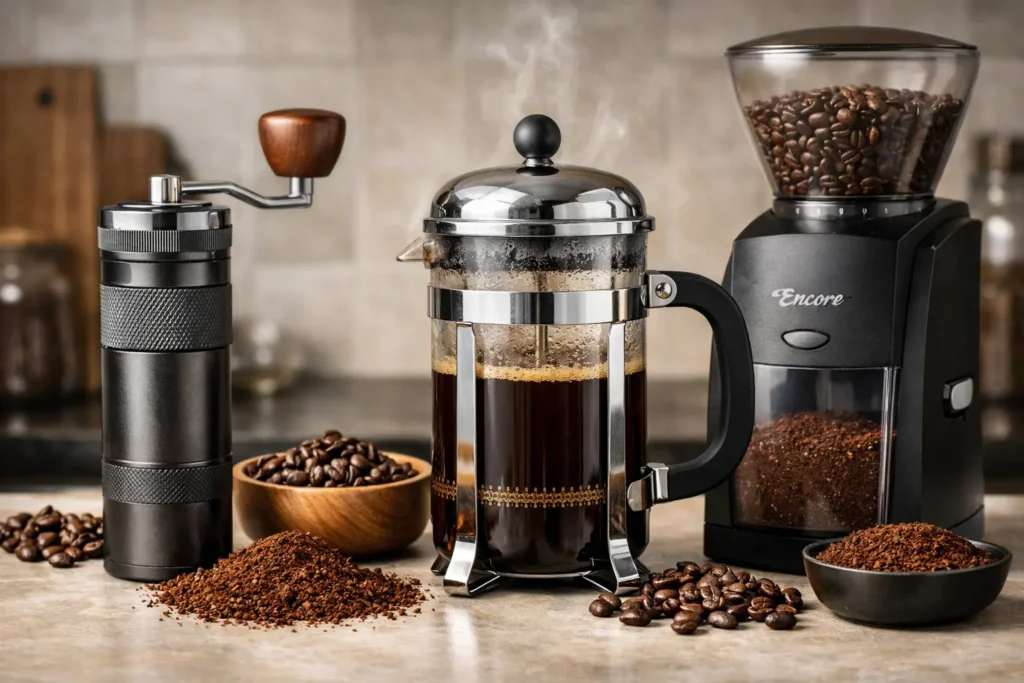
The best coffee grinders for French press are the upgrade that turns muddy, sediment-heavy, bitter French press coffee into something clean, rich, and consistently excellent. French press is the most grind-sensitive of all common home brewing methods — not because it requires the most precision, but because the metal mesh filter is the only thing standing between your grind and your cup. Every fine particle your grinder produces goes straight through that filter. A blade grinder produces fine dust in every batch, which means muddy sediment, bitterness, and an undrinkable texture are guaranteed regardless of technique. A quality burr grinder at a coarse setting produces consistent large particles that steep correctly for 4 minutes, press cleanly through the mesh, and stay in the press where they belong. This guide covers the best French press grinders at every budget — manual and electric — with the exact coarse grind settings, a French press ratio reference, full comparison tables, sediment science, and the troubleshooting matrix for every grind-related French press problem.
✍️ Editorial note: This guide is researched and written by the editors at CoffeeGearHub.com using published brewing science, SCA Brewing Standards, and established specialty-coffee community knowledge. All product links are affiliate links — we may earn a commission at no cost to you. Affiliate Disclosure: CoffeeGearHub.com participates in the Amazon Services LLC Associates Program. As an Amazon Associate, we earn from qualifying purchases.
🛒 New to Amazon? Try Prime free for fast, free shipping on every pick in this guide — or try Audible free if you’d rather listen while your coffee brews.
The 30-Second Answer
For manual grinding, the KINGrinder K6. For electric grinding, the Baratza Encore. Both produce consistent coarse particles that extract correctly during a 4-minute French press steep and stay above the metal mesh filter where they belong. If you are getting sediment, bitterness, or muddy texture from your French press, the grinder is almost certainly the cause — and switching from any blade grinder to either of these produces an immediate, dramatic improvement from the first brew.
- Best manual pick: KINGrinder K6 — 100-click coarse range, low fines output, covers all non-espresso methods
- Best entry electric: Baratza Encore — consistent coarse output, repairable, practical for large-volume daily brewing
- Best step-up electric: Baratza Virtuoso+ — DC motor for more consistent coarse output; digital timer for large carafe doses
- What to avoid: any blade grinder; any grinder without a dedicated coarse range above medium
- Grind setting: coarse — K6: 65–80 clicks from zero; Encore: steps 28–38
- Sediment fix: grind coarser — fine particles pass through the metal mesh filter. This is always a grind problem, not a press or technique problem.
Who This Guide Is For — Jump to What You Need
☕ Ready to Buy
Jump to Top Picks or the Comparison Table to match a grinder to your brewing volume and budget.
☕ Getting Sediment or Bitterness
Start with Sediment Science — why fine particles cause every common French press problem and the single fix that resolves all of them.
🔧 Troubleshooting Bad French Press
Jump to the Troubleshooting Matrix — every grind-related problem mapped to a specific fix.
🔬 Grind Settings + Ratio
See the Coarse Grind Reference and Ratio Guide for exact numbers for your press size and roast level.
Table of Contents
☕ Coffee Lover Gift Guide
Looking for a thoughtful gift for a coffee enthusiast? Browse our curated Amazon gift guide featuring coffee gear, mugs, grinders, brewers, and accessories for different budgets.
Shop the Coffee Lover Gift GuideAs an Amazon Associate, I may earn from qualifying purchases.
Sediment Science: Why the Grinder Is Always the Cause
French press uses a metal mesh plunger filter — not a paper filter. Paper filters in drip and pour over methods trap fine particles and coffee oils before they reach the cup. The French press metal filter does not. Particles fine enough to pass through the mesh gaps go directly into your coffee, where they continue extracting (producing bitterness and harshness) and settle as muddy sediment at the bottom of the cup. Understanding this mechanism is the foundation for every French press grinder decision.
The correct French press grind — coarse, like sea salt — produces particles large enough that the metal mesh physically cannot pass them. Those particles steep correctly during the 4-minute contact time, extraction stops when you plunge, and the finished coffee is clean, rich, and essentially sediment-free. Move the grind even slightly finer than coarse and some particles slip through. Use a blade grinder and the fine dust in every batch passes through without exception, producing muddy sediment and bitter over-extraction in every single cup regardless of technique.
🚫 Blade grinders cannot produce clean French press coffee — ever. Every batch a blade grinder produces contains fine dust regardless of how briefly you grind. That dust passes through the French press mesh filter without exception. The simultaneous bitterness (from fine particles over-extracting) and sediment (from those same particles in the cup) cannot be fixed by adjusting steep time, ratio, water temperature, or plunge speed. The only fix is a burr grinder at a coarse setting. No blade grinder technique workaround produces a reliably clean French press cup.
| Grinder type | French press result | Why |
|---|---|---|
| Blade grinder | Muddy sediment, bitter, inconsistent every cup | Produces fine dust in every batch that passes through the metal mesh filter — unavoidable |
| Cheap burr grinder (under-quality burrs) | Reduced sediment vs blade, but still elevated fines output | Inconsistent burr alignment and low-quality burr steel produce higher fines fraction than quality burrs at coarse settings |
| Quality burr grinder at medium setting | Some sediment — too many small particles at medium grind | Medium particles include a fines fraction that passes the mesh — coarse setting required |
| Quality burr grinder at correct coarse setting ✓ | Clean cup, rich body, minimal sediment, consistent extraction | Consistent large particles that cannot pass the mesh filter and extract correctly across the full 4-minute steep |
What to Look for in a French Press Coffee Grinder
French press places specific demands on a grinder that are different from pour over or espresso requirements. The coarse range is the primary performance zone, and what happens there determines whether your French press produces a clean, rich cup or a muddy, inconsistent one.
| Factor | Why it matters for French press | What to look for | What to avoid |
|---|---|---|---|
| Low fines output at coarse settings | The most important factor — even one percent extra fine particles at coarse settings produces noticeably more sediment in a French press cup because the metal filter cannot catch them | Quality hardened steel or stainless conical burrs rated for coarse brewing; 40mm+ for manual, 40mm+ for electric; community track record for low fines at coarse settings | Plastic burr carriers; undisclosed burr materials; grinders designed exclusively for espresso where the coarse range is an engineering afterthought |
| Dedicated coarse range with usable steps | French press requires coarser than every other common method — you need steps above medium that produce meaningful, usable differences between clicks | Grinders with 20+ steps dedicated above medium; the K6’s 100-click system gives 15–20 usable coarse steps; Encore’s 40 steps include 10+ genuinely coarse positions | Grinders with only 15–20 total steps where “coarse” is the final 2–3 positions — no resolution for adjustment |
| Large dose capacity | French press commonly requires 55–104g doses for 6–12 cup batches — one of the largest doses of any home brewing method | For manual: strong ergonomic handle with all-metal construction for sustained hand-grinding; for electric: continuous motor with dose timer that handles 90-second grinding sessions without overheating | Small hoppers (under 50g capacity); grinders without a dose timer that require you to stand holding a button through a long large-batch grind |
| Repeatable coarse setting | Once you find the right coarse click for your roast and press, you need to return to it reliably every morning without recalibrating | Numbered settings; click or stepped adjustment mechanisms that lock at the same position each session | Stepless grinders without reference marks — appropriate for espresso, unnecessary friction for daily French press |
Manual vs Electric Grinders for French Press
French press’s coarse grind setting actually favours manual grinders more than any other brewing method — coarse particles produce less resistance when hand-grinding than fine particles, making even large doses manageable. The decision shifts at volume: a full 8-cup or 12-cup carafe dose requires grinding 69–104g at a time, which is where electric grinders become clearly more practical for daily use.
| Factor | Manual (KINGrinder K6) | Electric (Baratza Encore) |
|---|---|---|
| Grind time — 23g (3-cup press) | ~45 seconds — fast and effortless at coarse settings | ~14 seconds |
| Grind time — 35g (4-cup press) | ~70 seconds — comfortable daily habit | ~22 seconds |
| Grind time — 69g (8-cup press) | ~2.5 minutes — manageable but effortful daily | ~44 seconds — clearly more practical |
| Grind time — 104g (12-cup press) | ~4 minutes — impractical as a daily habit for most people | ~66 seconds — correct choice for large batches |
| Grind quality at coarse | Excellent — 48mm conical burrs produce consistent coarse particles with very low fines; rivals entry electric grinders | Excellent — 40mm conical burrs produce clean, consistent coarse output; low fines at coarse settings |
| Best for | Solo to couple brewing (3–4 cup press, under 35g); anyone prioritising quality per dollar; travel | Households grinding 40g+ daily; 8–12 cup press brewing; daily family-size batches |
🔬 Why French press is the most forgiving method for manual grinding: Coarse grinding at the K6’s 65–80 click range produces significantly less burr resistance than fine grinding for pour over or espresso. The larger particle size means the burrs are separating beans into large chunks rather than grinding them into fine powder — the mechanical work per gram is lower. A 35g French press dose at coarse is faster to grind by hand than a 15g pour-over dose at medium-fine.
How Much Should You Spend on a French Press Grinder?
French press is the most accessible brewing method for grinder budgeting — its coarse setting requirements are less mechanically demanding than espresso or even pour over, meaning a well-designed entry grinder performs closer to a premium grinder at French press coarse settings than at any finer setting. The minimum spend is also lower than any other method: any quality burr grinder produces dramatically better French press than any blade grinder at any price.
| Tier | What you get | Best pick | Best for |
|---|---|---|---|
| Entry manual | 100-click manual burr grinder; 48mm conical burrs; covers French press, drip, pour over, AeroPress from one grinder | KINGrinder K6 | Solo to couple daily French press; travelers; best quality per dollar available |
| Entry electric | 40-step electric burr; repairable; consistent coarse output; hands-free dose grinding | Baratza Encore | Households grinding 40g+ daily; 8–12 cup press; push-button convenience |
| Step-up electric | DC motor for more consistent output; digital timer; tighter particle distribution at coarse settings | Baratza Virtuoso+ | Quality-focused brewers; large-volume daily brewing; those who also brew pour over from the same grinder |
French Press Grinder Comparison: All Picks at a Glance
| Best for | Grinder | Why it works for French press | Trade-off | Tier |
|---|---|---|---|---|
| Best overall manual — solo/couple French press | KINGrinder K6 | 100-click coarse range (65–80 clicks); 48mm burrs produce large consistent particles with very low fines; one grinder covers all non-espresso methods | Manual grinding — 45–70 seconds per 3–4 cup dose; not practical for full 12-cup carafe daily | Entry manual |
| Best entry electric — any volume | Baratza Encore | Steps 28–38 for French press coarse; consistent low-fines output at coarse settings; Baratza repair program; decade-long lifespan | 40 steps total means less adjustment resolution at coarse than K6’s 100-click system | Entry electric |
| Best step-up — quality-focused or large batches | Baratza Virtuoso+ | DC motor maintains consistent grinding speed across large doses; 54 settings with more coarse resolution than Encore; digital timer for batch grinding | Higher cost; incremental improvement over Encore specifically for French press coarse settings | Step-up electric |
| French press + pour over from one grinder | KINGrinder K6 or Baratza Encore | Both cover French press coarse (K6: 65–80 / Encore: 28–38) and pour over medium-fine (K6: 35–55 / Encore: 12–22) without any performance compromise at either method | Neither is single-purpose optimised; the versatility comes with no quality trade-off at either method | Entry (both) |
| French press + drip from one grinder | KINGrinder K6 or Baratza Encore | Both cover French press coarse and drip medium (K6: 32–42 / Encore: 15–24) without re-purchasing; the most common multi-method household pairing | Same as above — versatile by design | Entry (both) |
Best Coffee Grinders for French Press: Our Top Picks
These picks are selected based on coarse-range performance, fines output at French press settings, and direct relevance to how each grinder performs in daily French press brewing. All affiliate links use the CoffeeGearHub Amazon Associates tag.
Disclosure: CoffeeGearHub may earn a commission on qualifying purchases through affiliate links on this page, at no cost to you. Our recommendations are editorially independent. CoffeeGearHub.com participates in the Amazon Services LLC Associates Program. As an Amazon Associate, we earn from qualifying purchases.
🛒 New to Amazon? Try Prime free for fast, free shipping on every pick in this guide — or try Audible free if you’d rather listen while your coffee brews.
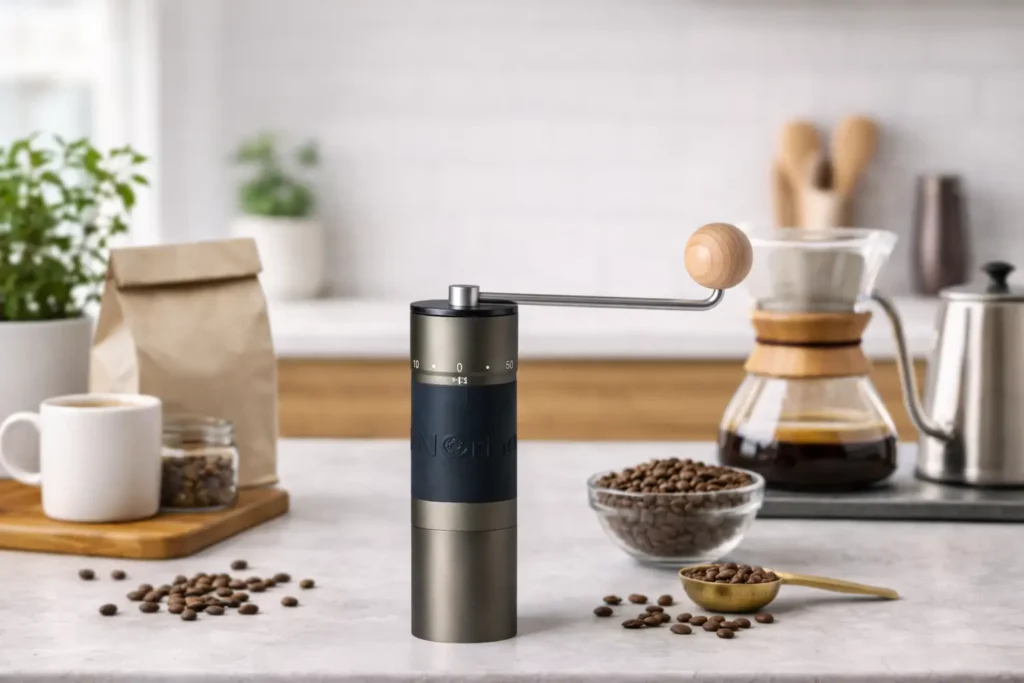
Best Manual Grinder for French Press: KINGrinder K6
The KINGrinder K6 is the CoffeeGearHub standard recommendation for all non-espresso home brewing — and for French press specifically, it performs better at coarse settings than almost any other grinder at its price. At 65–80 clicks from zero, the 48mm stainless conical burrs produce large, consistent particles with an exceptionally low fines fraction — which is exactly what the French press metal mesh filter needs. Most sediment and bitterness problems in French press brewing come from fine particles in the grind; the K6’s coarse output at this setting produces so few fines that the pressed coffee is noticeably cleaner than with most entry electric grinders. The 100-click system gives 15+ usable steps across the French press coarse range, meaning a 2–3 click change produces a readable, meaningful difference in extraction during the 4-minute steep. At coarse settings, grinding a full 3-cup carafe dose (23g at 1:13) takes under 45 seconds — one of the fastest hand-grinding experiences of any method at this grinder’s precision level.
- French press setting: 65–80 clicks from zero — adjust within this range by roast level (lighter roasts: lower end; darker roasts: higher end)
- Fines output at coarse: very low — measurably cleaner cup with less sediment than most grinders at this tier
- Also covers: drip (32–42 clicks), pour over (35–55 clicks), AeroPress (20–30 clicks)
- Best for: solo to couple daily French press (3–4 cup press); best quality-per-dollar available; anyone who wants one grinder for all non-espresso methods
Disclosure: CoffeeGearHub may earn from qualifying purchases.
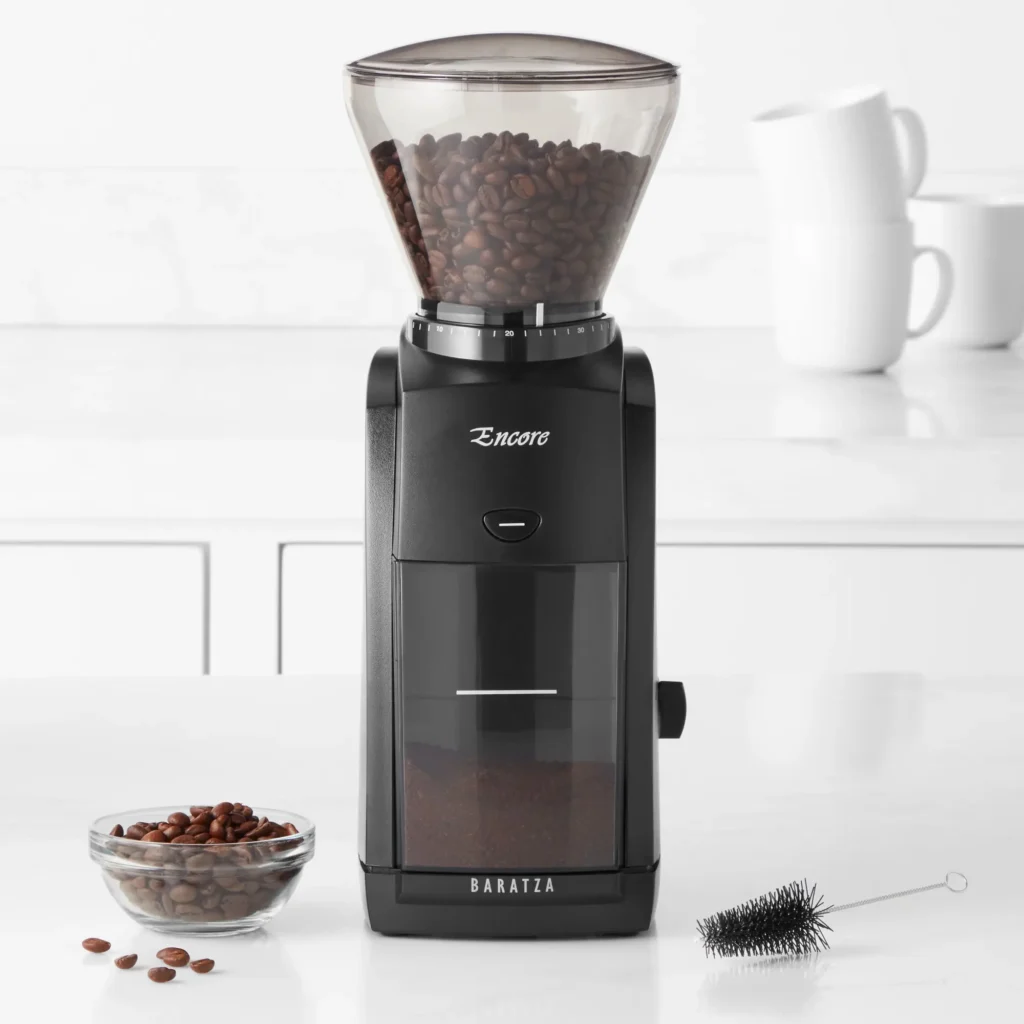
Best Entry Electric Grinder for French Press: Baratza Encore
For households brewing 8-cup or 12-cup French press batches daily, or anyone for whom hand-grinding is impractical, the Baratza Encore is the CoffeeGearHub standard entry electric recommendation. At French press coarse settings (steps 28–38), the Encore’s 40mm conical burrs produce consistent, clean coarse particles with low fines output — enough that the sediment improvement over any blade grinder is immediate and dramatic. The push-button auto-stop means you set the grind size once, press the button, and the Encore stops automatically — hands-free grinding of large doses without standing and holding for 45 seconds. What separates the Encore from competitors at its price tier is Baratza’s repair ecosystem: replacement burrs, motors, and all internal parts are sold separately, and Baratza publishes full repair guides. A well-maintained Encore is a 10-year daily grinder rather than a disposable appliance.
- French press setting: Steps 28–38 (coarse range) — 28–32 for light roast, 32–36 for medium, 34–38 for dark
- Key advantage: Baratza repair program — decade-long lifespan with replacement parts available
- Also covers: drip (steps 15–24), pour over (steps 12–22)
- Best for: households grinding 40g+ daily; 8–12 cup press brewing; anyone who wants push-button convenience and long-term repairability
Disclosure: CoffeeGearHub may earn from qualifying purchases.
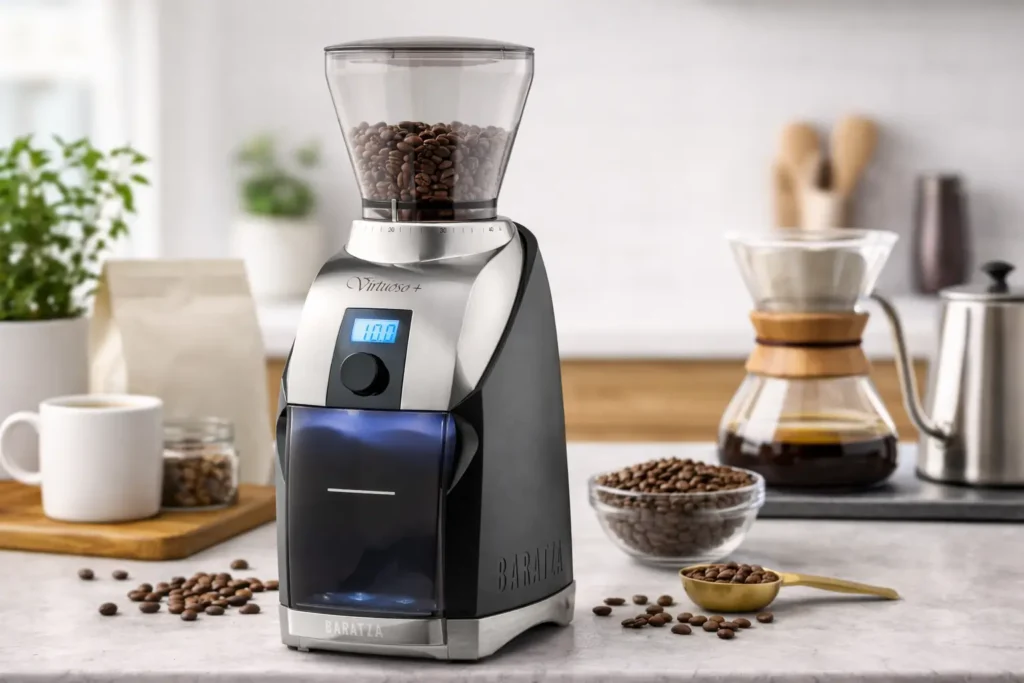
Best Step-Up Electric for French Press: Baratza Virtuoso+
The Baratza Virtuoso+ is the correct upgrade for French press brewers who want consistently minimal sediment across large daily batches, or who brew both French press and pour over from the same grinder and want full performance at both methods. Its DC motor maintains more consistent grinding speed than the Encore’s AC motor — which matters for large French press doses (69–104g) where a slowing motor produces inconsistent particle output through the session. The 54 settings give more coarse resolution than the Encore’s 40 steps, and the digital dose timer makes large-batch grinding repeatable without standing over the grinder or weighing every output. For the quality-focused daily French press household, the Virtuoso+ eliminates the grinder as a limiting variable entirely.
- French press setting: Steps 32–44 — more resolution than Encore across the coarse range
- DC motor: maintains consistent grinding speed through large doses — important for 8–12 cup batches
- Digital dose timer: repeatable large-batch output without weighing every grind session
- Best for: quality-focused daily French press; households also brewing pour over; large-volume batch brewing
Disclosure: CoffeeGearHub may earn from qualifying purchases.
Coarse Grind Reference for French Press
The correct French press grind is coarser than any other common home brewing method. All K6 click settings measured from zero (burrs touching); adjust 2–3 clicks at a time at coarse settings — changes in extraction are gradual. Target brew time for a 4-minute steep is just that: 4 minutes, not variable. The grind controls extraction quality, not steep time.
| Roast level | K6 clicks | Baratza Encore | Virtuoso+ | Grind descriptor | If muddy/bitter → | If sour/weak → |
|---|---|---|---|---|---|---|
| Light roast ☀️ | 65–72 | Steps 28–32 | Steps 32–38 | Coarse — slightly finer end of coarse range | Grind 3 clicks coarser | Grind 2 clicks finer + confirm 4-min steep |
| Medium roast 🌤 ✓ | 68–76 | Steps 30–35 | Steps 34–42 | Coarse — sea salt texture; the standard reference point | Grind 3 clicks coarser | Grind 2 clicks finer |
| Medium-dark roast | 72–78 | Steps 33–37 | Steps 38–44 | Coarse — slightly coarser than medium reference | Grind 3 clicks coarser | Grind 2 clicks finer |
| Dark roast 🌑 | 74–82 | Steps 35–40 | Steps 40–48 | Coarse to very coarse — dark roasts extract faster; coarser grind prevents bitterness | Grind 3 clicks coarser | Grind 2 clicks finer |
⚠️ Why dark roast needs a coarser grind for French press: Dark roast beans are more porous and soluble than medium or light roast — the extended roasting process degrades cell walls and increases dissolution rate. At the same coarse setting used for medium roast, dark beans extract more quickly during the 4-minute steep and produce bitterness before the steep is complete. Grinding 3–6 clicks coarser for dark roast slows the dissolution rate enough to reach the sweetness phase without overshooting into bitterness — and reduces the fines fraction that dark roast’s more brittle bean structure produces at any given setting.
Ratio Guide: How Much Coffee for Every French Press Size
A quality grinder produces its full benefit only when paired with a correct dose. Most French press brewers under-dose significantly — producing a weak, flat cup that gets mistaken for a grind or beans problem when the fix is simply more coffee. Weigh every dose on a kitchen scale; tablespoon scoops vary by up to 40% between roast levels and grind densities.
| Press size | Brew water | 1:11 (strong) | 1:13 ✓ (standard) | 1:15 (lighter) | Steep time |
|---|---|---|---|---|---|
| 1-cup / 230ml | 200g | 18g | 15g | 13g | 4 min |
| 3-cup / 350ml | 300g | 27g | 23g | 20g | 4 min |
| 4-cup / 500ml | 450g | 41g | 35g | 30g | 4 min |
| 6-cup / 800ml | 700g | 64g | 54g | 47g | 4 min |
| 8-cup / 1,000ml | 900g | 82g | 69g | 60g | 4 min |
| 12-cup / 1,500ml | 1,350g | 123g | 104g | 90g | 4 min |
🔬 Why brew water is less than press capacity: Coffee grounds absorb approximately 2g of water per gram of coffee during steeping — a 69g dose absorbs roughly 138g of water. Using slightly less water than the press’s stated capacity prevents overflow when pressing the plunger and accounts for absorption so your finished cup volume matches what you expected. The ratios above already account for this.
For the complete French press ratio guide — including roast-level adjustments, cup size calculator, and the full dial-in system — see French Press Coffee Ratio: The Complete Guide.
Pairing Your Grinder with the Right French Press
The grinder and the French press work together: the grinder sets particle consistency and the press’s filter determines how much of that consistency translates into a clean cup. A quality grinder paired with a press that has a poor-fitting or damaged filter still produces more sediment than expected. Match the tier of your grinder to the tier of your press for best results.
| Grinder tier | Recommended press pairing | Why they work together |
|---|---|---|
| KINGrinder K6 or Baratza Encore | Bodum Chambord — the CoffeeGearHub standard French press pick | The Chambord’s three-part stainless mesh filter maintains consistent plunge resistance that matches what a calibrated coarse grind produces — no channeling through filter gaps, no excessive sediment from filter bypass |
| KINGrinder K6 — travel use | Stanley Adventure All-In-One French Press | Stainless double-wall insulation keeps the brew temperature stable during the 4-minute steep even without an insulating carafe; all-metal construction travels without breakage risk |
| Baratza Virtuoso+ | Bodum Chambord or Espro P3 | The Espro P3’s double micro-filter produces the cleanest French press cup available — pairs with the Virtuoso+’s tighter consistency for the most sediment-free French press result at any home setup |
Troubleshooting Matrix: Every French Press Grind Problem Fixed
Almost every French press problem that persists despite correct technique traces back to the grinder. Identify your symptom and apply fixes in order — change one variable per brew.
| Symptom | Grinder-related cause | Fix — in order |
|---|---|---|
| Heavy sediment / muddy texture | Grind too fine — particles passing through metal mesh filter | Grind 4–5 clicks coarser immediately → confirm grind is true coarse sea salt texture, not medium → if using blade grinder: switch to burr grinder — this problem cannot be fixed with a blade grinder |
| Bitter, harsh finish | Fine particles over-extracting in the cup; or grind too fine producing long extraction time | Grind 3–4 clicks coarser → confirm 4-minute steep (not longer) → decant immediately after pressing |
| Sour, sharp, hollow — weak body | Grind too coarse — under-extracting during 4-minute steep | Grind 2–3 clicks finer within the coarse range → confirm dose is correct (see ratio table) → confirm water is at 93–96°C |
| Simultaneously sour and bitter | Blade grinder: fine dust over-extracts (bitter) while large chunks under-extract (sour) — both arrive in the same cup | Switch to a burr grinder — this is the only fix. No coarse adjustment, steep time change, or ratio adjustment resolves simultaneous sour and bitter from a blade grinder. |
| Inconsistent result day to day at same setting | Dose varying; or retained grounds in grinder chute mixing with fresh dose | Weigh every dose on a kitchen scale → purge 2–3g at session start → confirm grind click setting is unchanged between sessions |
| Good cup from first press, bitter from second pour from same carafe | Not a grinder problem — coffee left in press on grounds after pressing continues extracting | Decant the entire brew into a separate preheated vessel immediately after pressing — never leave brewed French press coffee sitting in the press |
| Grind quality has declined over months at same click | Burr wear or rancid oil buildup on burrs changing effective grind output | Clean grinder burrs → if electric: Urnex Grindz tablets → re-confirm click setting after cleaning — burr wear on heavily used grinders may require burr replacement |
| Shot tastes flat and muted despite correct grind and ratio | Not a grinder problem — stale beans | Check roast date — use beans within 35 days of roast. No grind adjustment or technique change recovers flavour from stale beans. |
Cleaning and Maintenance: Keeping Your French Press Grinder Performing
At coarse settings, coffee oils accumulate more slowly on burr surfaces than at fine espresso settings — larger particles produce less friction and surface heat per gram. But accumulation still happens, and rancid coffee oil at coarse settings produces a stale, flat background taste that is very difficult to distinguish from a bean freshness problem. If your French press coffee quality has declined and you cannot identify a bean, ratio, or technique cause — clean the grinder first, before investigating anything else.
KINGrinder K6 (Manual)
Weekly
- Rinse the catch cup and lid with warm water; dry fully before next use
- Brush loose grounds from the grinding chamber with a dry brush
Monthly
- Fully disassemble: remove upper burr, brush all burr faces and the grinding chamber wall
- Never use water on the burrs — moisture promotes corrosion and accelerates rancidity
- After reassembly: grind and discard 3–4g of the current bean before brewing to re-season
Baratza Encore / Virtuoso+ (Electric)
Weekly
- Wipe hopper, chute, and catch bin with a dry cloth between sessions
- Empty and wipe the grounds catch bin before each grind to prevent cross-session contamination
Every 3–4 Weeks (Daily Users)
- Remove hopper and brush the burr chamber with a stiff dry brush
- Urnex Grindz cleaning tablets: run per instructions, then purge a full dose of the current bean before brewing
- After any cleaning: re-confirm your coarse click setting is unchanged before the next brew
Final Takeaway: The Best French Press Grinder for You
If you are getting sediment, bitterness, or inconsistency from your French press, the grinder is the fix — not the press, not the technique, not the beans. A blade grinder at any setting produces fine particles that pass through the metal filter every single cup. Any quality burr grinder at a coarse setting eliminates this problem from the first brew. For solo to couple daily brewing, the KINGrinder K6 is the best quality-per-dollar choice on the market — 100 clicks of coarse adjustment, low fines output at French press settings, and coverage of every non-espresso method from one grinder. For households grinding full 8–12 cup batches daily, the Baratza Encore is the correct entry electric choice — consistent, repairable, and designed to last. Once you have the right grinder at the right coarse setting, use the ratio table in this guide to dial in your dose, weigh everything, decant immediately after pressing, and the cup quality difference is immediate and sustained.
FAQs: Best Coffee Grinders for French Press
What is the best grinder for French press coffee?
For manual grinding, the KINGrinder K6 — 100-click coarse range at 65–80 clicks from zero; 48mm conical burrs with very low fines output at coarse settings. For electric grinding, the Baratza Encore — consistent coarse output at steps 28–38; repairable; practical for large-volume daily brewing. Both produce dramatically better French press than any blade grinder from the first brew.
What grind size is best for French press?
Coarse — the texture of coarse sea salt or coarse kosher salt. On the K6: 65–80 clicks from zero. On the Baratza Encore: steps 28–38. Too fine and particles pass through the metal mesh filter producing muddy sediment and bitterness. Too coarse and the coffee under-extracts during the 4-minute steep producing sourness and weakness.
Why does my French press coffee have so much sediment?
Sediment is almost always grind too fine — particles small enough to pass through the metal mesh filter into the cup. The fix is to grind significantly coarser until the texture looks like coarse sea salt. A blade grinder produces this problem unavoidably — its random chopping creates fine dust that always passes through the French press filter. A burr grinder at a coarse setting produces consistent large particles that stay above the filter where they belong.
Can I use a blade grinder for French press?
Technically yes, but the results are poor. A blade grinder produces a chaotic mix of fine dust and large chunks — the dust passes through the metal filter (causing muddy sediment and bitterness) while the large chunks barely extract (causing sourness and weakness). These problems arrive simultaneously and cannot be fixed by adjusting any other variable. A burr grinder at a coarse setting is the only reliable solution.
Is a manual grinder good enough for French press?
Yes — French press is actually the most forgiving method for manual grinding because coarse settings produce less burr resistance than fine settings. A 23g solo dose for a 3-cup press takes under 45 seconds at coarse settings on the K6. For full 8–12 cup carafe doses (69–104g), an electric grinder is significantly more practical for daily use.
What is the best coffee-to-water ratio for French press?
Start at 1:13 — 1 gram of coffee for every 13 grams of water. For an 8-cup press (900g water), this is 69g of coffee. For a 3-cup press (300g water), 23g. Raise to 1:14 or 1:15 if too strong; lower to 1:12 if too weak. Always weigh both coffee and water — tablespoon measurements vary by up to 40% between roast levels.
Why does my French press coffee taste bitter?
Almost always one of three causes: grind too fine (fine particles over-extract and pass through the filter), steep time too long, or leaving brewed coffee sitting on the grounds in the press after pressing. Fix by grinding coarser, keeping steep to 4 minutes exactly, and decanting the entire brew into a separate vessel immediately after pressing.
How much should I spend on a French press grinder?
French press has the lowest minimum grinder spend of any brewing method — coarse settings place lower demands on grinder precision than pour over or espresso. Any quality burr grinder outperforms any blade grinder for French press. The biggest quality improvement per dollar comes from switching from any blade grinder to any quality burr grinder.
How often should I clean my French press grinder?
Manual grinders used daily: rinse catch cup weekly; fully disassemble and brush burrs monthly. Electric grinders used daily: brush chute and hopper weekly; full burr clean every 3–4 weeks. At coarse settings oils accumulate slowly, but rancid oil on burrs produces a flat, stale background taste that resembles a beans problem. Clean the grinder before investigating other causes of declining cup quality.
Can I use a French press grinder for other brewing methods?
Yes — the K6 and Baratza Encore both cover drip (K6: 32–42 clicks / Encore: steps 15–24), pour over (K6: 35–55 / Encore: steps 12–22), and AeroPress (K6: 20–30 / Encore: steps 8–15) with full performance at each method. For non-pressurised espresso, a dedicated espresso grinder is required — the coarse-optimised design of both grinders means their finest settings are not precise enough for single-wall espresso extraction.
Continue Learning
💡 New to Amazon? Try Prime free for fast shipping on picks like these.
FRENCH PRESS GUIDES
Grinder sorted — now nail the ratio and technique? The French Press Coffee Ratio guide covers the correct dose for every press size, how roast level changes your ratio, a cup-size calculator, and the full dial-in system that locks in your perfect cup in 2–3 brews.
☕
Written by the CoffeeGearHub Editorial Team
CoffeeGearHub is a specialty coffee equipment resource run by home brewers and coffee enthusiasts. Our guides are researched using published brewing science, SCA standards, grinder manufacturer specifications, and established specialty-coffee community knowledge. We review and update our pillar content regularly. About CoffeeGearHub →