Last Updated: March 2026 • 35–40 min read • Brew Recipes + Extraction Science + Dial-In System + Milk Technique
✍️ Editorial note: This guide is researched and written by the editors at CoffeeGearHub.com using published brewing science, AeroPress manufacturer documentation, and established specialty-coffee community knowledge. Recommendations reflect research consensus. All product links are affiliate links — we may earn a commission at no cost to you.
Making an AeroPress espresso-style concentrate for lattes is one of the most practical skills a home coffee brewer can develop. You don’t need a $1,000 espresso machine. You don’t need a steam wand. With an AeroPress, a fine grind, a tight brew ratio, and properly textured milk, you can produce café-quality lattes at home for a fraction of the cost — consistently, every morning.
This guide covers everything: the extraction science behind why AeroPress concentrate works as a latte base, the exact brew ratios and grind sizes that produce the best results, step-by-step recipes for both standard and inverted methods, a complete milk texturing guide, a dial-in system specific to concentrate brewing, and a troubleshooting matrix for every problem you’re likely to encounter. Whether you’re making your first AeroPress latte or trying to understand why your current results are inconsistent, this is the complete reference.
The 30-Second Answer
For AeroPress espresso-style concentrate for lattes: use 18g of coffee to 60g of water at a fine grind (fine sand texture), brew inverted, steep for 60–75 seconds, and press slowly over 30–40 seconds. Combine the resulting 40–50g concentrate with 150–180g of steamed or frothed milk. It won’t have espresso crema — but it will be intense, rich, and strong enough to hold up beautifully in a latte.
- Target brew ratio: 1:3 to 1:4 (coffee to water)
- Target grind: fine — fine sand, not table salt and not powder
- Target press time: 30–40 seconds, slow and steady
- Target latte ratio: 1 part concentrate to 3–4 parts steamed milk
Who This Guide Is For — Jump to What You Need
☕ First-Time Brewer
Start with Why AeroPress Works, then go straight to the Full Recipe.
🔧 Troubleshooter
Jump directly to the Troubleshooting Matrix.
🥛 Milk Help
Go to Milk Texturing & Latte Ratios.
🔬 Extraction Nerd
Read Why AeroPress Works + The Crema Question.
Table of Contents
Why AeroPress Espresso-Style Concentrate Works for Lattes
Understanding why AeroPress concentrate works as a latte base — rather than just following a recipe blindly — is what separates brewers who get consistent results from those who don’t. The AeroPress cannot replicate the full espresso extraction process, but it achieves something functionally similar through three distinct mechanisms.
Immersion Extraction Efficiency
Unlike drip brewing, where water passes through coffee grounds and moves on, AeroPress brewing is primarily an immersion process: coffee steeps in direct contact with water before any pressing occurs. This dramatically increases extraction efficiency per gram of coffee. You dissolve more flavor compounds from fewer grams — exactly the high-TDS (total dissolved solids) profile that latte concentrate requires to hold its character against a large volume of milk.
Compressed Brew Ratios
Standard filter coffee uses a 1:15 to 1:17 coffee-to-water ratio. Real espresso is typically brewed at 1:2 to 1:2.5. AeroPress espresso-style concentrate for lattes sits between these at 1:3 to 1:4 — significantly more concentrated than any normal coffee recipe. At this ratio, every gram of water carries far more dissolved coffee solids, producing a brew that behaves like espresso when it meets milk: holding flavor, providing body, and preventing the drink from tasting dilute.
Mechanical Pressing Pressure
Manual AeroPress pressing generates roughly 0.5–1 bar of pressure — far below espresso’s 9 bars, but meaningfully above zero. This modest pressure compresses the grounds bed, forces remaining water through the coffee, and produces a slightly thicker, more textured cup than passive drip brewing. It’s the difference between a flat, watery concentrate and one with the syrupy density that milk-based drinks need.
The Crema Question: What to Expect (and What to Do About It)
Let’s be direct: AeroPress espresso-style concentrate will not produce real crema. Crema is an emulsion of CO₂ gas and coffee oils created under sustained 9-bar pressure — a physical process the AeroPress simply cannot replicate at one bar. If someone tells you their AeroPress produces real crema, they’re describing surface foam from CO₂ off-gassing from very fresh beans, which is not the same thing.
That said, for latte purposes, crema matters far less than people assume. A well-made AeroPress concentrate in properly textured milk produces a better-tasting drink than a weak or poorly-extracted shot from a cheap espresso machine — crema and all. Here’s how to get as close as the hardware allows:
- Fellow Prismo attachment: The Prismo’s pressure-actuated valve holds water in contact with grounds until you press, building slightly more back-pressure than a standard cap. It won’t produce real crema, but it does produce a richer, denser surface on the concentrate and improves the overall extraction character for concentrate-style brews.
- Fine metal filter (Able Disk Fine): Allows more coffee oils through than paper, giving the concentrate heavier body that reads as richer when combined with milk. More oil means more mouthfeel — a meaningful improvement in latte texture even without visible crema.
- Very fresh beans (roasted within 1–2 weeks): Fresh beans contain the most residual CO₂. This doesn’t produce crema, but it causes surface activity and light blooming during brewing that signals high-quality, fresh extraction. It also produces noticeably more flavorful concentrate than stale beans at any technique level.
🔬 The honest calibration: A concentrate that tastes uncomfortably strong and almost harsh on its own is correctly brewed for latte use. If your AeroPress concentrate tastes pleasant drunk black, it’s too weak — it will taste dilute the moment milk is added. Don’t be afraid of intensity at this brew ratio.
AeroPress vs Espresso Machine vs Moka Pot for Lattes
If you’re choosing between brewing methods for home lattes, here’s the unvarnished comparison. Each method produces a usable latte base — but with meaningfully different results and cost profiles.
| Method | Pressure | Concentrate strength | Crema | Entry cost | Skill floor | Best for |
|---|---|---|---|---|---|---|
| Espresso machine | 9 bar | Very high (1:2 ratio) | Yes — genuine | $400–$2,000+ | High | Authentic espresso; café-quality lattes |
| AeroPress + concentrate | ~0.5–1 bar | High (1:3–1:4 ratio) | No | ~$35 | Low | Budget home lattes; travel; espresso alternative |
| Moka pot | ~1.5 bar | High (similar ratio) | Very light | ~$30–60 | Low-medium | Stovetop latte base; bolder, more bitter profile |
The AeroPress wins on value, versatility, and ease of dialing in. The moka pot produces a slightly more bitter, less adjustable concentrate. The espresso machine is the only route to a true espresso latte — but it costs 10–50x more and requires significantly more technique. For most home brewers, AeroPress espresso-style concentrate for lattes is the rational choice.
The Right Brew Ratio for AeroPress Latte Concentrate
Brew ratio is the single most important variable when making AeroPress espresso-style concentrate for lattes. This is where most beginners go wrong — they use a normal AeroPress recipe and wonder why the latte tastes like watery coffee. The concentrate must be dramatically stronger than any drinking-strength coffee recipe.
| Brew style | Coffee | Water | Ratio | What you get |
|---|---|---|---|---|
| Standard AeroPress | 15g | 245g | 1:16 | Balanced drinking cup — too weak for lattes |
| Strong AeroPress | 18g | 140g | 1:8 | Concentrated mug — still too dilute for milk drinks |
| Latte concentrate (mild) | 18g | 72g | 1:4 | Solid latte base — good for larger milk volumes |
| Latte concentrate (standard) ✦ | 18g | 60g | 1:3.3 | Ideal — holds character against 150–180g milk |
| Latte concentrate (intense) | 18g | 50g | 1:2.8 | Very strong — best for iced lattes with ice dilution |
The 18g / 60g ratio is the standard starting point used by the AeroPress specialty coffee community for latte concentrate. It produces approximately 40–50g of brewed concentrate — comparable in volume to a double espresso shot. The concentrate should look dark amber to near-black with a slightly viscous appearance. If it looks pale and watery, either the ratio is off or the grind is too coarse.
Ratio rule: If your latte tastes watery despite following the recipe, increase the coffee dose by 1–2g or reduce water to 50g before adjusting anything else. Weak lattes are almost always a ratio problem, not a grind problem. Don’t conflate strength with extraction — they require different fixes.
Best Grind Size for AeroPress Espresso-Style Latte Concentrate
For latte concentrate specifically, the target grind is fine — finer than your standard AeroPress daily cup, coarser than espresso. The texture reference is fine sand: gritty between your fingers but not powdery. Table salt is too coarse for this application; flour is too fine.
The reason concentrate brewing requires a finer grind than standard AeroPress is simple math: with only 60g of water against 18g of coffee, you have a compressed contact window. A medium-fine grind that works beautifully at 1:16 will under-extract at 1:3.3 — the water doesn’t have enough contact time or surface area to dissolve sufficient flavor compounds. The concentrate will taste thin and sour in milk even if it looks dark.
| Grind range | Texture reference | Press feel & time | Flavor in latte | Use for latte concentrate? |
|---|---|---|---|---|
| Medium-fine | Table salt | Easy — 20–30s | Thin, sour, doesn’t hold in milk | Only at very high doses (20g+) |
| Fine ✦ Baseline | Fine sand | Moderate — 30–40s | Intense, sweet, full-bodied in milk | Yes — ideal |
| Espresso-fine | Powdery / flour | Stalls — 45s+ | Harsh, bitter, astringent | No |
How to adjust: If the concentrate tastes thin or sour even in small amounts of milk, go one step finer. If pressing takes over 50 seconds or stalls completely, go one step coarser. If the latte tastes harsh or drying on the back of your throat, go coarser and lower water temperature by 3–4°C. Always change one variable per brew so you know what caused the change.
Best Coffee Beans for AeroPress Lattes
Bean selection matters more for milk drinks than for black coffee — milk both amplifies and mutes certain flavor characteristics in ways that can surprise you. A bean that tastes balanced and pleasant black can taste sharp and unpleasant in a latte if its acidity profile doesn’t suit dairy or oat milk.
Roast Level for Latte Concentrate
☀️ Light Roast
- Floral, fruity, high acidity
- Can taste sharp or curdled with dairy
- Better with oat milk than whole milk
- Grind 1 step finer, use 96–100°C
- Extend steep to 90s for sweetness
🌤 Medium Roast ✦ Best for Lattes
- Chocolate, caramel, nuts — milk-friendly
- Works with dairy, oat, soy, almond
- Best all-round roast level for this recipe
- Baseline fine grind, 91–94°C
🌑 Medium-Dark / Dark Roast
- Bold, dark chocolate, smoky
- Very rich and intense in milk
- Easy to over-extract at fine grind
- Grind 1–2 steps coarser, use 85–91°C
Single Origin vs Espresso Blend
Espresso blends are purpose-built for milk drinks — roasters design them with milk integration in mind, engineering for chocolate and caramel notes with controlled acidity. If you’re starting out with AeroPress espresso-style concentrate for lattes, a quality espresso blend removes one variable. Single origins can produce exceptional lattes — a Brazilian natural in whole milk is extraordinary — but they require more careful pairing. High-acidity Ethiopian or Kenyan single origins tend to taste bright and interesting black, then sharp and disjointed in milk. Low-acid Brazilians, Colombians, and Guatemalans tend to work better.
Bean Freshness Is Non-Negotiable
Stale beans under-extract at any grind setting, producing a flat, papery concentrate that no milk or technique can fix. The concentrated brewing ratio amplifies staleness problems that might be tolerable in a standard cup — at 1:3, you’re tasting a highly magnified version of whatever the beans have to offer. Aim for beans roasted 1–4 weeks ago and stored in an airtight container away from light, heat, and moisture.
AeroPress Espresso-Style Concentrate for Lattes — Standard Method Recipe
The standard method is the most beginner-friendly approach to AeroPress latte concentrate. It uses the AeroPress in its normal upright position. The main limitation is minor drip-through during the steep phase — water begins passing through the grounds before you’re ready to press. For concentrate recipes, this can slightly reduce consistency compared to the inverted method, but it’s entirely workable and preferred by many experienced brewers for its simplicity.
What You Need
- Coffee: 18g, fine grind (fine sand texture)
- Water: 60g at 93°C / 200°F
- Filter: 1 paper filter, rinsed
- Scale: 0.1g resolution with timer
- Expected yield: 40–50g concentrate
Step-by-Step Instructions
- Prep the filter and cup (0:00): Insert one paper filter into the AeroPress cap. Pour a small amount of hot water through the filter directly into your serving cup to rinse out paper taste and preheat the cup. Discard the rinse water. Attach the cap to the chamber.
- Add coffee and set on cup (0:00): Place the AeroPress on your scale and cup. Add 18g of fine-ground coffee to the chamber. Tare the scale to zero.
- Pour water (0:00–0:10): Start your timer. Slowly pour 60g of 93°C water in a spiral motion, wetting all grounds evenly. Complete the pour within 10 seconds.
- Stir (0:10–0:20): Using the AeroPress paddle or a spoon, stir gently for 8–10 seconds. At this tight ratio, dry pockets of coffee lead to severely uneven extraction — make sure every ground is saturated.
- Create plunger seal (0:20): Insert the plunger about 1cm into the top of the chamber and pull back slightly to create a seal. This stops drip-through and holds the brew in place during the steep.
- Steep (0:20–0:50): Hold the plunger seal and wait. Total steep target is 45–50 seconds from the start of the pour.
- Press (0:50–1:30): Apply slow, steady downward pressure. The press should take 30–40 seconds. You should feel consistent, moderate resistance throughout — not a fight, not a free fall. Stop immediately when you hear or feel the first hiss of air breaking through the coffee bed.
Visual cue for good concentrate: Dark amber to near-black, slightly syrupy in appearance as it flows into the cup. A pale, watery-looking result means either the ratio is too high (too much water) or the grind is too coarse.
Inverted Method — Better Concentrate Control
The inverted method is widely preferred for AeroPress espresso-style concentrate among experienced brewers. The reason is simple: in the standard position, gravity causes water to drip through the grounds from the moment you pour — before you’re ready to press. With a normal recipe and 245g of water, this early drip-through is negligible. At 60g total, it represents a meaningful fraction of your brew and can produce inconsistent extraction from batch to batch.
Inverting the AeroPress eliminates this variable entirely, giving you true immersion control and a consistently even steep. The flip at the end is the only tricky part — once you’ve done it a few times, it becomes second nature.
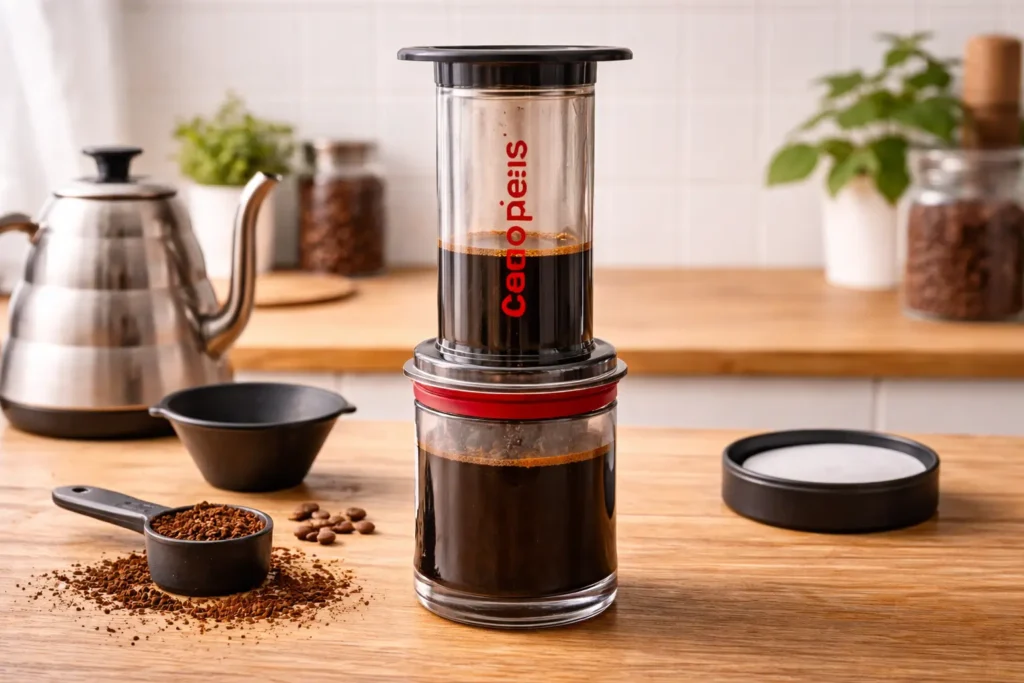
Inverted AeroPress Latte Concentrate Recipe
- Coffee: 18g, fine grind
- Water: 60g at 93°C / 200°F
- Filter: 1 paper filter, rinsed
- Set up inverted (0:00): Push the plunger approximately 2cm into the chamber. Flip the AeroPress upside down so the plunger sits on your counter and the open chamber faces upward.
- Add coffee (0:00): Add 18g of fine-ground coffee into the upward-facing chamber opening.
- Pour and stir (0:00–0:20): Start your timer. Pour 60g of 93°C water in a slow spiral. Stir gently for 8–10 seconds to fully saturate all grounds. No seal is needed — the inverted position prevents any drip-through.
- Steep (0:20–1:15): Let the coffee steep undisturbed. Target total steep time is 60–75 seconds from the start of the pour.
- Attach cap (at ~0:55): Wet your rinsed paper filter and attach the cap firmly to the chamber. Press the filter into the cap so it seats flat.
- Flip and press (1:00–1:40): In one smooth, confident motion, flip the AeroPress onto your preheated cup. Begin pressing immediately with slow, steady pressure. Target 30–40 seconds press time. Stop at the first hiss.
💡 Standard vs inverted for concentrate: Standard is simpler and works well. Inverted gives truer immersion control and tends to produce more consistent results batch to batch — particularly important at the tight 1:3 ratio where small variations have outsized impact. If your standard concentrates taste inconsistent brew to brew, switch to inverted before adjusting anything else.
Dial-In System for AeroPress Latte Concentrate
Dialing in AeroPress espresso-style concentrate for lattes is slightly different from dialing in a standard AeroPress cup — because you’re evaluating the concentrate in milk, not black. A concentrate that tastes too strong or slightly bitter on its own will often be perfect in a latte. The calibration target is different.
Control Recipe (Baseline)
- Coffee: 18g (weighed)
- Water: 60g
- Temperature: 93°C / 200°F
- Filter: paper
- Steep: 60 seconds
- Agitation: 1 gentle stir (8 seconds)
- Press: 30–40 seconds, steady
- Milk: 160g, 145°F
Evaluate the latte, not the concentrate black.
Taste → Fix Order
- Latte tastes sour or thin: grind finer
- Latte tastes bitter or drying: grind coarser
- Almost right: steep ±15 seconds
- Dark roast harsh: lower temp 3–5°C
- Good flavor but latte weak: tighten ratio, not grind
Rule: change one variable per brew.
The 3-Brew Dial-In Protocol
Goal: find the grind setting where the finished latte has integrated sweetness, present coffee flavor, and a clean finish with no sourness or drying aftertaste. Keep everything fixed except grind. Evaluate the latte with the same amount of milk each time.
- Brew #1 — baseline: Use the control recipe at medium-fine grind. Make the latte. Log three things: press time, press effort (easy / moderate / hard), and a one-word latte finish (sweet / sour / bitter / thin / balanced).
- Adjust grind: If sour or thin → go finer (2–4 clicks on hand grinder, 1–2 steps on electric). If bitter or press was too hard → go coarser. Change nothing else.
- Brew #2 — adjusted grind: Repeat the control recipe exactly. Make the same latte. Compare sweetness and finish to Brew #1.
- Brew #3 (if needed): Make a smaller move in the same direction, or reverse slightly if you overshot. Most coffees dial in within two brews once you’re in the fine range.
Stop when: the latte has a clean, sweet finish, the coffee flavor is clearly present against the milk, and you’re not tasting sourness or a drying aftertaste.
Milk Texturing and Latte Ratios
The best AeroPress espresso-style concentrate in the world becomes a mediocre latte if the milk isn’t right. Milk texturing is where home latte brewing most commonly falls short — not because it’s technically difficult, but because most guides skip the detail.
Latte Ratios
| Drink | Concentrate | Steamed milk | Character |
|---|---|---|---|
| Cortado | 45g | 45g | Strong, coffee-forward, small |
| Cappuccino-style | 45g | 80–100g (more foam) | Drier, foamier, shorter drink |
| Small latte | 45g | 130–150g | Balanced, café piccolo size |
| Standard latte | 45g | 150–180g | Classic home latte |
| Large latte | 50g | 200–220g | Increase dose slightly to compensate |
Milk Texturing Equipment
🥇 Steam Wand
Produces true microfoam. Best results. Target temperature: 140–155°F / 60–68°C. Requires espresso machine or dedicated steam device.
🥈 Nanofoamer / Electric Whisk
Best no-steam-wand option. Heat milk to 140–150°F first, then froth 20–30 seconds just below the surface. Spoonlight Nanofoamer produces noticeably finer foam than standard frothers.
🥉 Handheld Frother
Produces larger, coarser bubbles. Usable but milk won’t integrate as smoothly. Heat separately to 145°F, froth vigorously in a narrow container for best results.
Milk Temperature and What Good Microfoam Looks Like
Target 140–155°F (60–68°C). Below 140°F the milk tastes flat and barely warm in the finished drink. Above 160°F you scald the milk proteins, producing a slightly cooked or sweet aftertaste that competes with the coffee. Use a thermometer until you can judge by feel — properly heated milk is hot but you can hold your palm against the pitcher for 3–4 seconds before pulling away.
Properly textured microfoam looks glossy and paint-like — no visible bubbles, a smooth liquid surface that flows rather than sits. It should integrate seamlessly into the concentrate rather than floating on top. If you’re seeing large bubbles or foam that separates within 10 seconds of pouring, the frothing technique or tool needs adjustment, not the AeroPress recipe.
Milk Type Comparison
| Milk type | Frothing performance | Flavor with coffee | Notes |
|---|---|---|---|
| Whole dairy milk | Excellent | Creamy, rich, neutral — best baseline | Recommended for beginners |
| 2% dairy milk | Good | Slightly lighter body than whole | Good everyday choice |
| Oat milk (barista) | Very good | Slightly sweet, complements medium roast well | Must use barista-formulated oat milk |
| Almond milk (barista) | Fair | Nutty, can separate under heat | Barista versions help significantly |
| Soy milk (barista) | Good | Neutral to slightly beany | Can curdle with high-acid light roasts |
Paper vs Metal Filters for Latte Concentrate
Filter choice changes the physical character of AeroPress espresso-style concentrate in ways that are noticeable in milk drinks.
Paper Filter
- Catches fines and most coffee oils
- Cleaner, brighter concentrate
- Easier to dial in (less silt interference)
- Best for beginners and light roast lattes
- Double paper = maximum clarity
Metal Filter
- Allows oils and some fines through
- Heavier body — more espresso-like texture
- Go 1–2 steps coarser than paper baseline
- Reduce agitation; stop before the hiss
- Fellow Prismo valve builds slightly more pressure

Fellow Prismo or Able Disk Fine
For AeroPress espresso-style concentrate, the Fellow Prismo is the most relevant accessory. Its pressure-actuated valve holds all liquid in the chamber until you press — eliminating the drip-through problem that affects standard position concentrate brewing and building slightly more back-pressure during pressing. The result is a denser, more consistent concentrate with a heavier mouthfeel in milk. The Able Disk Fine is a simpler option: less sediment than generic metal mesh, richer body than paper, no valve mechanism.
- Prismo: pressure valve, best for concentrate-style brewing
- Able Disk Fine: lower sediment, richer body than paper
- Both reusable indefinitely
Disclosure: CoffeeGearHub may earn from qualifying purchases.
Latte Variations: Iced, Oat Milk, Cappuccino, Cortado, Dirty Chai
Once you’ve dialed in your base AeroPress espresso-style concentrate, these variations require minimal additional work and cover most of the café-style milk drinks you’d want to make at home.
Iced AeroPress Latte
AeroPress concentrate is ideal for iced lattes — far better than chilled filter coffee because the concentration holds up against ice dilution. Brew the standard recipe (18g / 60g), but tighten the ratio slightly to 18g / 50g if you’re using a lot of ice. Let the concentrate cool for 60 seconds, then pour directly over a glass filled with ice. Top with cold whole milk or barista oat milk — no heating or frothing required for iced drinks. Stir gently and serve immediately.
Oat Milk AeroPress Latte
Oat milk lattes work exceptionally well with AeroPress concentrate. The key detail: use barista-formulated oat milk (Oatly Barista, Minor Figures, or equivalent). Regular oat milk lacks the added fat and stabilizers that allow proper frothing — it will froth poorly and separate quickly in a hot drink. Barista oat milk produces foam quality close to whole milk and pairs particularly well with medium roast concentrate, where the oat milk’s natural sweetness complements caramel and chocolate notes without clashing.
AeroPress Cappuccino-Style
A cappuccino uses the same espresso base as a latte but with less milk and more foam. Use the same 45g concentrate but reduce the milk to 80–100g and froth longer to create a drier, thicker foam layer. The key difference from a latte is texture: cappuccino foam should be stiff enough to hold its shape briefly on a spoon rather than flowing immediately. With a nanofoamer or steam wand, this is achievable at home. Pour the concentrate first, then spoon the foam on top.
Cortado
Equal parts concentrate and warm (not heavily frothed) milk — typically 45g of each. The cortado is the most unforgiving of the milk drink variations because the small milk volume doesn’t mask flavors. If your concentrate is slightly bitter or sour, it will be obvious in a cortado in a way it might not be in a full latte. Dial in your concentrate first with the latte recipe before moving to cortado ratios.
Dirty Chai AeroPress Latte
Add 45g of AeroPress concentrate to a chai latte (spiced tea with steamed milk) instead of espresso. Medium or medium-dark roast concentrate works best here — the chocolate and spice notes complement chai’s cinnamon, cardamom, and ginger character. Use 100–120g of steamed milk mixed with 60–80ml of strong-brewed masala chai. A surprisingly easy and excellent home drink.
Troubleshooting Matrix: Concentrate and Latte Problems
Work through problems in this order: fix the concentrate first, then evaluate the latte, then adjust ratio if needed. Don’t reach for ratio changes to solve flavor problems — those require extraction fixes.
| Symptom | What it means | Fix (in order) |
|---|---|---|
| Latte sour or sharp | Under-extraction: too coarse, too cool, or too short | Grind finer → steep +15s → raise temp to 95°C |
| Latte bitter or drying aftertaste | Over-extraction: too fine, too hot, or too long | Grind coarser → shorten steep → lower temp to 89°C |
| Latte tastes watery — no coffee presence | Concentrate too weak or too much milk | Reduce water to 50g OR add 1–2g dose; don’t touch grind |
| Concentrate looks pale and thin | Ratio too high or grind too coarse | Tighten to 18g / 50g → then grind finer |
| Press stalls or won’t move | Grind too fine / clogged bed | Grind 1–2 steps coarser → reduce agitation → paper filter |
| Muddy or silty concentrate | Fines + metal filter or aggressive agitation | Switch to paper → swirl instead of stir → slightly coarser |
| Sour AND bitter simultaneously | Inconsistent particle distribution (blade grinder) | Burr grinder upgrade — this cannot be fixed by recipe |
| Inconsistent batch to batch | Standard method drip-through variation | Switch to inverted method |
| Foam separates immediately in latte | Milk too hot or under-textured | Lower temp to 145°F → froth longer with smaller motion |
| Latte cools too fast | Cup not preheated | Rinse cup with hot water before pouring concentrate |
Recommended Brewing Gear
These are the pieces of equipment that make the most meaningful difference when brewing AeroPress espresso-style concentrate for lattes consistently.
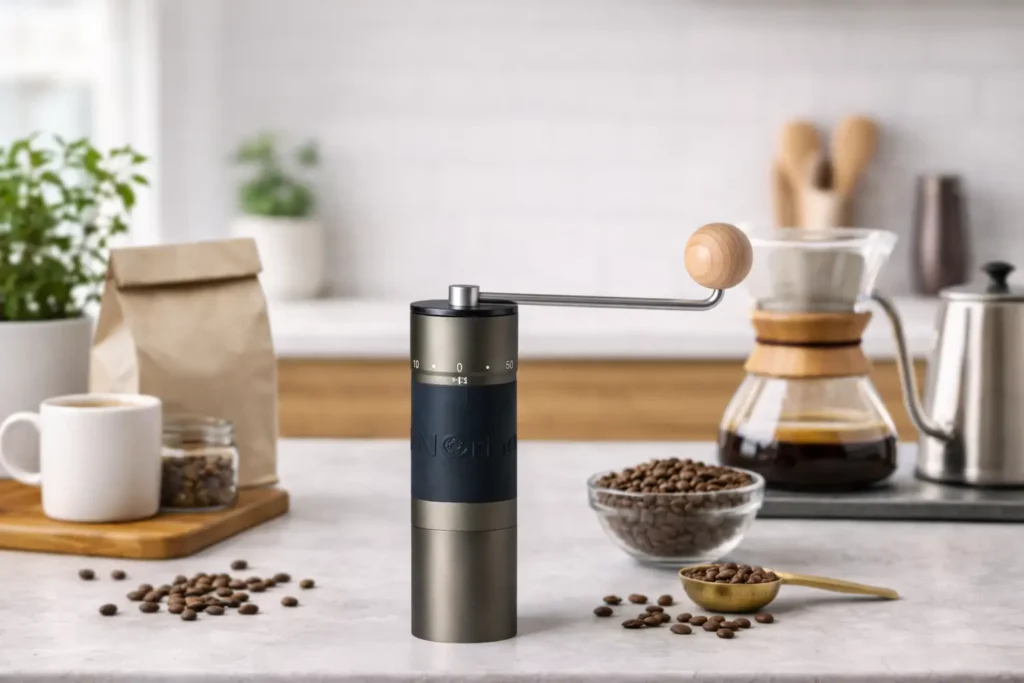
Burr Grinder — KINGrinder K6 (Best Value Manual)
A burr grinder is the single highest-impact upgrade for anyone brewing AeroPress espresso-style concentrate. Blade grinders produce a chaotic mix of boulder-sized and dust-fine particles — grounds that simultaneously under-extract and over-extract, creating the sour-and-bitter problem that no recipe adjustment can solve. Burr grinders produce a uniform particle distribution, meaning your grind adjustments translate directly to taste changes in a predictable, controllable way. The KINGrinder K6 delivers electric-grinder-level consistency in a compact manual form at a fraction of the cost, with micro-adjustment resolution that makes fine-tuning concentrate settings straightforward.
- High-quality steel burrs with excellent particle uniformity
- Precise click-adjustment steps for dialing in concentrate
- Compact, travel-friendly, low retention
Disclosure: CoffeeGearHub may earn from qualifying purchases.
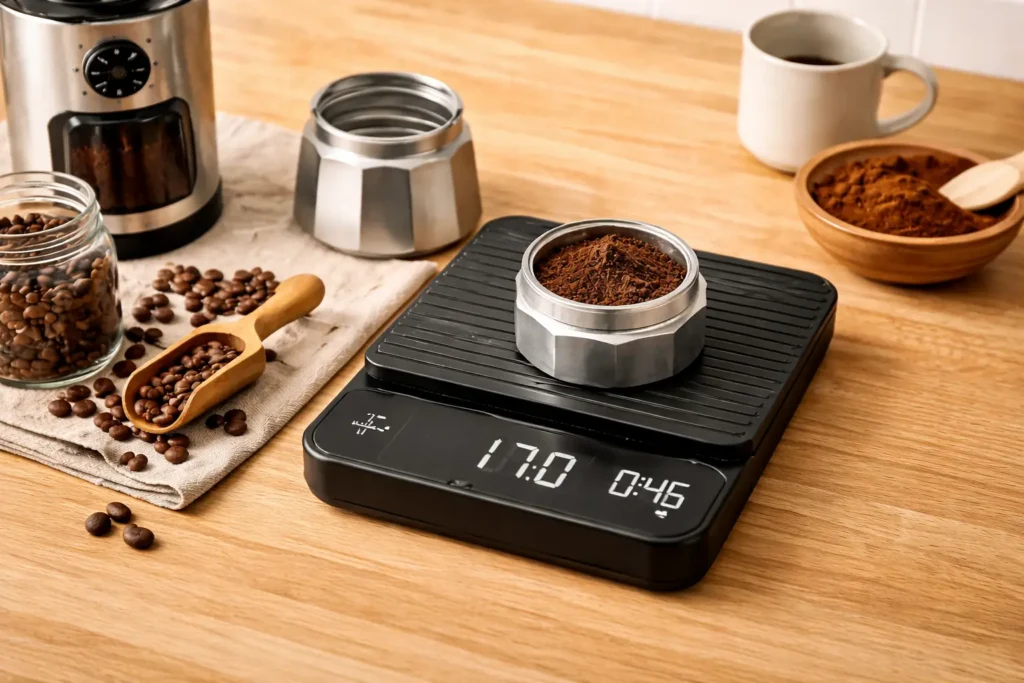
Digital Coffee Scale with Timer
Precise ratios are non-negotiable for AeroPress latte concentrate. At a 1:3.3 ratio, a 5g water error represents an 8% variance — enough to noticeably change the character of the finished latte. Trying to eyeball 60g of water into an AeroPress chamber is genuinely unreliable. A scale with 0.1g resolution and a built-in timer removes both dose and time guesswork simultaneously, so when you adjust the grind you’re isolating exactly one variable.
- 0.1g resolution eliminates dose and water variability
- Built-in timer removes one additional variable
- Essential for repeatable dial-in
Disclosure: CoffeeGearHub may earn from qualifying purchases.
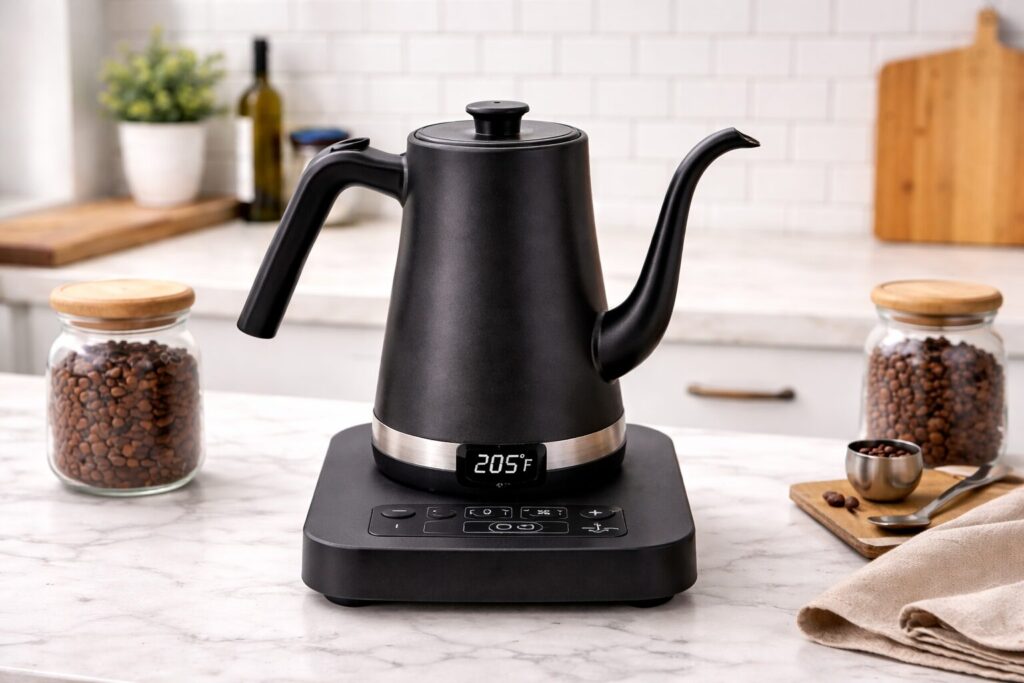
Temperature-Controlled Gooseneck Kettle
Water temperature is a meaningful extraction lever at concentrate ratios. Boiling water at 1:3.3 pushes dark roasts into harsh bitterness — the kind of bitterness that remains noticeable even diluted in a full latte. A kettle that holds a precise temperature lets you use temperature as a deliberate variable for roast-level tuning rather than a source of variation. The gooseneck spout also allows controlled, spiral pouring that ensures even ground saturation — critical at 60g total water where uneven wetting causes extraction dead spots.
- Light roast: 96–100°C maximizes sweetness
- Medium roast: 91–94°C baseline
- Dark roast: 85–91°C reduces harshness
Disclosure: CoffeeGearHub may earn from qualifying purchases.
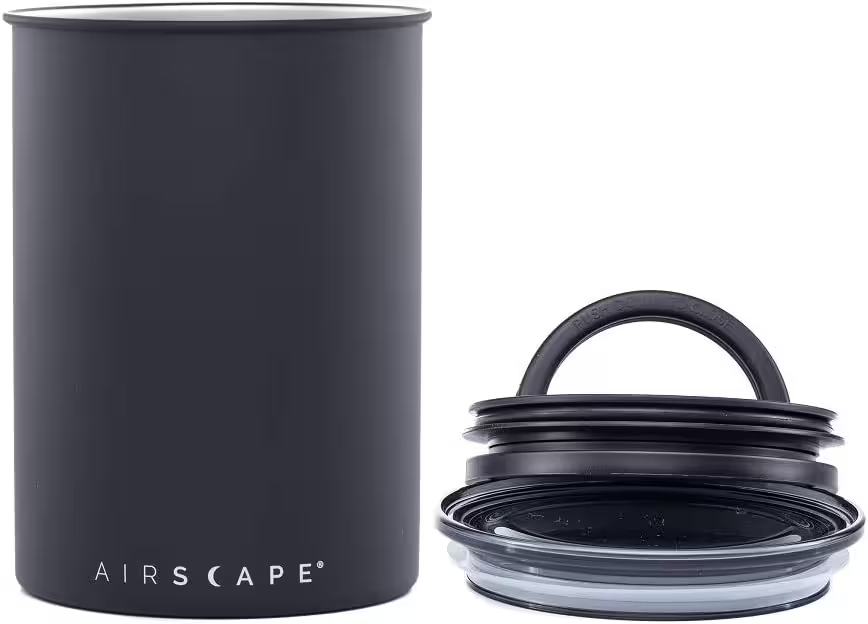
Airtight Coffee Storage Canister
At the concentrated ratios used for latte brewing, bean freshness problems are dramatically amplified. Stale beans in a normal cup are tolerable; stale beans in a 1:3 concentrate produce a flat, papery drink that no technique can rescue. An airtight canister with a CO₂ valve preserves the aromatics and oils that make concentrate worth making. Store at room temperature, away from heat and light, and use within 2–3 weeks of roast date.
Disclosure: CoffeeGearHub may earn from qualifying purchases.
FAQs: AeroPress Espresso
Can AeroPress make espresso-style concentrate for lattes?
Yes — AeroPress espresso-style concentrate for lattes is one of the most practical applications for the brewer. Using an 18g / 60g ratio (1:3.3), fine grind, and 60–75 second steep, you can produce 40–50g of dense concentrate that behaves like espresso in milk drinks. It won’t have real crema (that requires 9-bar machine pressure), but the flavor intensity and body are sufficient to produce genuine café-quality lattes at home.
What grind size should I use for AeroPress latte concentrate?
Fine — the texture of fine sand, not table salt and not powder. This is one to two steps finer than your standard AeroPress daily cup because the compressed 1:3 ratio needs more surface area to extract sufficient flavor in a short steep. If pressing stalls, go slightly coarser. If the latte tastes thin or sour, go slightly finer. Change one variable per brew.
What ratio of coffee to water for AeroPress latte concentrate?
18g of coffee to 60g of water — a 1:3.3 ratio — is the standard starting point. This produces approximately 40–50g of concentrate. For iced lattes, tighten to 18g / 50g to account for ice dilution. If the latte tastes watery despite correct grind, reduce water by 5–10g rather than adjusting grind.
Standard or inverted method for AeroPress latte concentrate?
Both work. Standard is easier for beginners. Inverted is generally preferred for concentrate because it eliminates drip-through during the steep, giving you true immersion control and more consistent results batch to batch. If your concentrates taste inconsistent using the standard method, switching to inverted usually fixes it without any recipe changes.
What roast works best for an AeroPress latte?
Medium to medium-dark roast. These produce the chocolate, caramel, and nutty notes that integrate best with milk. Light roasts can taste sharp or sour in milk — their bright acidity clashes with dairy particularly. Very dark roasts risk tasting harsh when concentrated at a 1:3 ratio. If using dark roast, lower water temperature to 85–91°C and grind 1–2 steps coarser than your medium roast baseline.
Can I make an iced AeroPress latte?
Yes — AeroPress concentrate is excellent for iced lattes. Use 18g / 50g (slightly tighter ratio) to account for ice dilution. Brew the concentrate, let it cool 60 seconds, then pour directly over a glass filled with ice. Top with cold whole milk or barista oat milk. The concentrate is strong enough to hold its flavor even as the ice melts.
Does AeroPress work with oat milk for lattes?
Yes, very well — but you must use barista-formulated oat milk. Regular oat milk lacks the fat content and stabilizers needed for proper frothing and will separate quickly in a hot drink. Barista oat milk (Oatly Barista, Minor Figures, etc.) froths close to whole milk quality and pairs especially well with medium roast AeroPress concentrate.
Why does my AeroPress latte taste watery?
Almost always a ratio problem, not a grind problem. If the flavor is balanced but weak, you either have too much milk or the concentrate wasn’t strong enough. Try reducing water from 60g to 50g with the same 18g dose, or reduce the milk volume to 130–150g. Don’t chase a weak latte by grinding finer — that changes flavor balance, not strength.
What’s the difference between AeroPress concentrate and real espresso for lattes?
Real espresso is brewed at 9 bars of pressure, producing a 1:2 to 1:2.5 ratio concentrate with genuine crema and a specific flavor profile shaped by high-pressure extraction. AeroPress concentrate uses 1:3 to 1:4 ratio at roughly 1 bar — it lacks crema and achieves slightly less intensity, but the flavor difference in a finished latte is smaller than the pressure difference suggests. The extraction chemistry is meaningfully different; the drinking experience in milk is surprisingly similar.
Can I make an AeroPress cappuccino?
Yes. Use the same 45g of concentrate but reduce the milk to 80–100g and froth it drier and stiffer than latte foam. A cappuccino has more foam relative to liquid milk — the foam should hold its shape briefly on a spoon rather than flowing immediately. Pour the concentrate into the cup, then spoon or pour the foam on top. The result is a shorter, drier, more intense drink than a latte.
Continue Learning
AEROPRESS CLUSTER
Need help choosing a grinder for AeroPress latte concentrate? Our full grinder guide covers every budget from $35 hand grinders to precision electric burrs — with specific grind settings for concentrate brewing.
☕
Written by the CoffeeGearHub Editorial Team
CoffeeGearHub is a specialty coffee equipment resource run by home brewers and coffee enthusiasts. Our guides are researched using published brewing science, manufacturer specifications, and established specialty-coffee community knowledge. We review and update our pillar content regularly to reflect current equipment and technique standards. About CoffeeGearHub →