Last Updated: March 2026 · 12–15 min read · CoffeeGearHub Brewing Science
✍️ Editorial note: This guide is written by the CoffeeGearHub editorial team using published brewing science, specialty-coffee community consensus, and hands-on AeroPress testing across multiple roast levels and methods. All product links are affiliate links; we may earn a commission at no extra cost to you. See our editorial policy.
The 30-Second Answer
CoffeeGearHub Verdict You don’t need a $1,000 espresso machine to make a café-quality latte at home. With the right ratio, grind, and milk texture, the AeroPress can brew a bold concentrate that stands up to milk — sweet, smooth, and repeatably excellent. Start with an 18g dose / 60g water (1:3 ratio) at 195–200°F, grind fine (table salt texture), and press slowly over 20–30 seconds. Then froth milk to 130–150°F for glossy microfoam. That’s the whole system.
- Best ratio for latte concentrate: 1:3 by weight — 18–20g coffee to 55–65g water
- Best grind: Fine (similar to fine table salt) — slightly coarser than true espresso
- Best water temperature: 195–200°F for medium-dark roasts; 185–195°F for dark roasts
- Best milk temperature: 130–150°F — where microfoam is most stable and sweetest
- Fastest fix for a watery latte: reduce water to 55g OR grind finer
- Fastest fix for a bitter latte: drop temp 5–10°F and reduce stir count
Who This Guide Is For — Jump to What You Need
☕ New to AeroPress lattes
Start at What “Espresso-Style” Means, then go straight to the Core Recipe.
🎯 Dialling in your concentrate
Jump to Strength vs Extraction or the Grind Dial-In table.
🔧 Fixing a bad latte
Go straight to Troubleshooting — 10 failure modes with single fixes.
🥛 Milk texture problems
See the Microfoam Guide — most home lattes fail here, not the coffee.
Table of Contents
What “Espresso-Style” AeroPress Concentrate Means (and Doesn’t)
Let’s be precise from the start, because the word “espresso” gets misused constantly in home coffee content. True espresso is defined by a specific pressure range (around 9 bars), a very fine grind packed into a portafilter basket, and a short, forced extraction — typically 25–35 seconds. It produces a dense, emulsified beverage with crema caused by dissolved CO₂ and emulsified oils under pressure.
The AeroPress generates nowhere near 9 bars of pressure. At best, a hard press produces 0.35–0.75 bar. So it cannot make true espresso, and it will not produce espresso-style crema. Anyone telling you otherwise is marketing to you.
So what does it produce? A high-TDS (total dissolved solids) coffee concentrate — a small-volume, intensely flavored brew with significantly more dissolved coffee compounds than a standard cup. And for milk drinks, that’s the only thing that actually matters.
💡 The honest benchmark: A well-brewed AeroPress concentrate won’t taste identical to a double espresso. But it will be bold enough, sweet enough, and concentrated enough to build a latte, flat white, or cappuccino that most people — including experienced café drinkers — will find genuinely excellent. That’s the real goal, and it’s absolutely achievable.
Why AeroPress Concentrate Works in Milk Drinks
The AeroPress has structural advantages that make it well-suited for concentrate. Understanding them helps you dial in with intention rather than guesswork.
It’s an immersion brewer first. Unlike pour-over, where water passes through grounds only once, immersion brewing keeps coffee and water in full contact for the entire brew window. This produces even, controlled extraction — critical when you’re working with a small water dose, because every second of contact time has an outsized impact on flavor.
The press adds body. The plunger creates a positive pressure differential that forces water through the coffee bed and filter, carrying oils and dissolved solids into the cup. It won’t rival espresso machine pressure, but it contributes the heavy mouthfeel that makes concentrate feel substantive in milk rather than watery.
Milk is a dilution event. When you add 150–180g of milk to a 30–40g concentrate, you’re diluting coffee by roughly 5:1 to 6:1. This means your concentrate needs to be significantly more intense than your target flavor — the milk will soften acidity, reduce perceived bitterness, add sweetness, and lower the overall coffee concentration. Your job during brewing is to build enough dissolved-solid intensity to survive that dilution and still taste complete.
💡 AeroPress vs espresso machine — why it’s more forgiving than you think: AeroPress is significantly more forgiving of variable changes than an espresso machine. The sealed chamber and short brew time create a buffer — a 5°F temperature shift or a single grind click still produces a usable cup. This doesn’t mean variables don’t matter; it means your first brew at the approximate right setting will already be good, and dialling in tightens it from there.
Strength vs Extraction: The Most Important Concept in This Guide
Most failed home lattes come down to confusing two separate variables: strength and extraction. They sound similar but they’re controlled differently and produce different failure modes.
Strength refers to how concentrated your brew is — the ratio of dissolved coffee solids to total liquid volume. It’s primarily controlled by your brew ratio (how much coffee relative to water). Use less water for a given dose = stronger brew.
Extraction refers to how much of the coffee’s soluble mass you’ve actually dissolved — expressed as a percentage of the dry coffee weight. It’s controlled by grind size, water temperature, agitation, and contact time. Low extraction = sour, thin, underdeveloped. High extraction = bitter, dry, harsh. The target for balanced concentrate is roughly 18–22% extraction yield.
Under-extraction (too coarse, too cool, too little agitation) → tastes sour, sharp, thin, or hollow
Over-extraction (too fine, too hot, too long, too much agitation) → tastes bitter, dry, harsh, or astringent
Correct extraction at high strength → tastes bold, sweet, full-bodied — and holds up in milk
Here’s how this plays out in practice with AeroPress concentrate:
| Scenario | Strength | Extraction | Latte result |
|---|---|---|---|
| 18g coffee / 100g water / coarse grind | Low | Low | Watery, hollow — milk completely dominates |
| 18g coffee / 55g water / coarse grind | High | Low | Strong but sour — under-extracted intensity |
| 18g coffee / 60g water / fine grind / 197°F ✓ | High | Balanced | Sweet, bold, café-correct — this is your target |
| 18g coffee / 55g water / very fine grind / 205°F | High | Over | Bitter, drying, harsh even under milk |
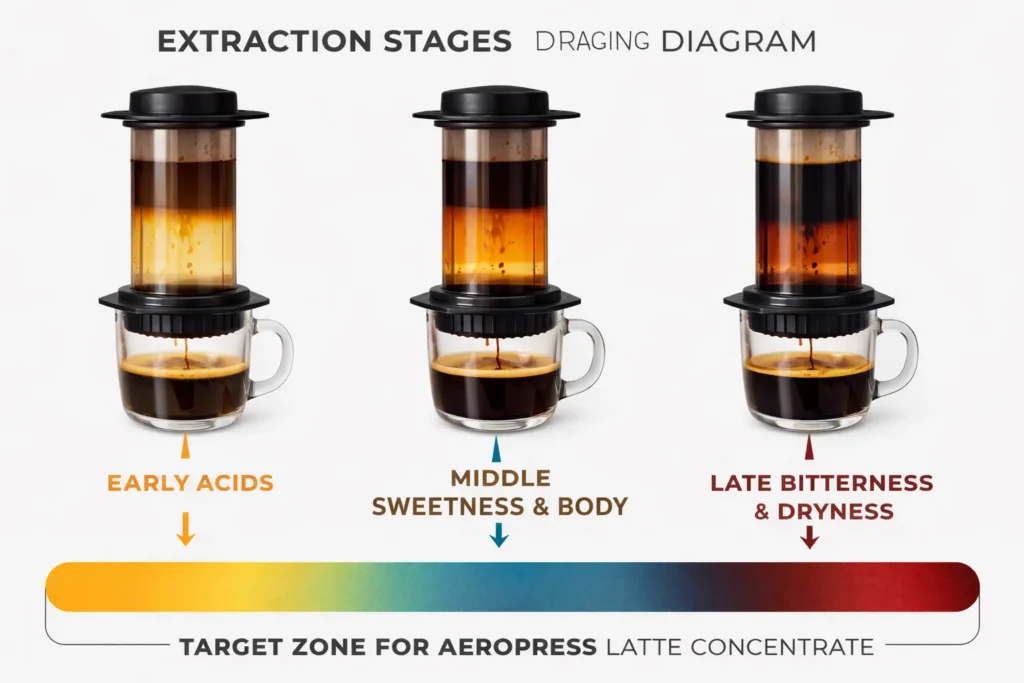
💡 The key rule: This is why the recipe below pairs a tight ratio (for strength) with a fine-leaning grind and controlled temperature (for balanced extraction). You need both high strength and correct extraction to land in the sweet spot. Chasing strength alone without fixing extraction produces strong-but-sour concentrate that still tastes wrong in milk.
Roast Selection: Which Coffee to Use for Lattes
Roast level dramatically affects how your concentrate performs in milk — yet most AeroPress latte articles skip this entirely. Here’s what actually happens at each roast level:
| Roast Level | Flavor in milk | Challenges | Best for |
|---|---|---|---|
| Light roast | Fruity, bright, tea-like | High acidity gets lost or turns sharp in milk; low body; needs higher temp (200–205°F) | Cortado or black only; not ideal for full lattes |
| Medium roast | Balanced, nutty, caramel, mild fruit | Requires precise brewing to avoid thin concentrate | Flat whites, smaller milk ratios |
| Medium-dark ✓ Recommended | Chocolate, brown sugar, low acidity, full body | Can turn bitter if brewed too hot — keep to 195–200°F | Lattes, cappuccinos — best all-round choice |
| Dark roast | Smoky, bold, bitter-sweet | Very narrow temp window; drop to 185–195°F to avoid harshness | Works well; requires temp control |
Start here for your first latte: Use a medium-dark roast with a roast date within the last 3–4 weeks. The flavor profile is forgiving (chocolate, brown sugar, caramel), the body is natural, and the lower acidity won’t fight the milk. Once your process is dialled in, experiment with other roast levels.
AeroPress Latte Concentrate Recipe: The Core 1:3 Method
This recipe is designed to produce a double-espresso equivalent in terms of functional strength and flavor intensity. It will taste too strong on its own — that’s intentional. Milk will soften and balance it.
CoffeeGearHub Core Recipe: 18g / 60g / 197°F / Fine grind / 60–75 sec total
This 1:3 ratio is where most medium-dark roasts produce their best latte concentrate. Adjust water to 55g for a stronger base, or 65g for a slightly softer one.
Recipe Parameters
| Coffee dose | 18–20g (start at 18g) |
| Water | 55–65g (start at 60g) |
| Ratio | ~1:3 by weight |
| Water temp | 195–200°F / 90–93°C |
| Grind | Fine (fine table salt) |
| Total brew time | 60–75 seconds |
| Press time | 20–30 seconds (slow, steady) |
| Roast | Medium-dark recommended |
What Good Concentrate Looks Like
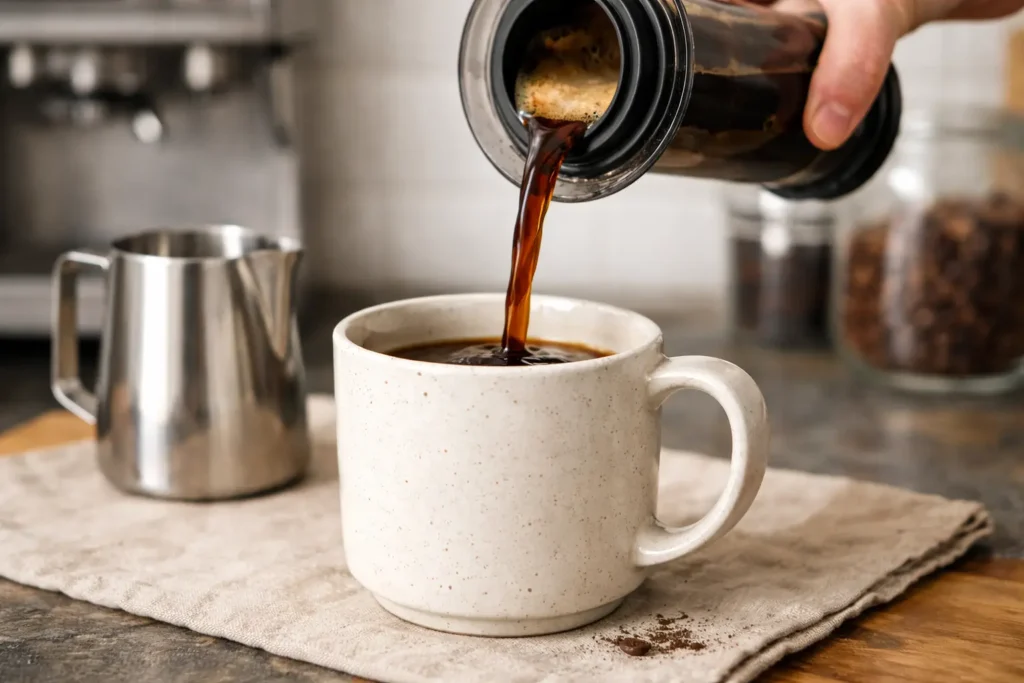
Your concentrate should pour thick and dark — noticeably more viscous than standard drip coffee. The aroma should be intense. On its own, it should taste slightly overwhelming — bold and strong with a caramel-bitter edge. That’s correct.
If it looks like strong black coffee, your ratio is off. If the press stalls or requires real effort, your grind is too fine or your dose too high. If it pours thin and light, grind finer immediately.
Dial-in: Watery / milk dominates → reduce water to 55g OR grind finer. Sour and thin → grind finer OR stir more firmly. Bitter or drying → drop temp to 190–195°F OR grind 2 clicks coarser. Press stalls → coarsen by 2 clicks and reduce dose 1g.
Step-by-Step AeroPress Concentrate Method
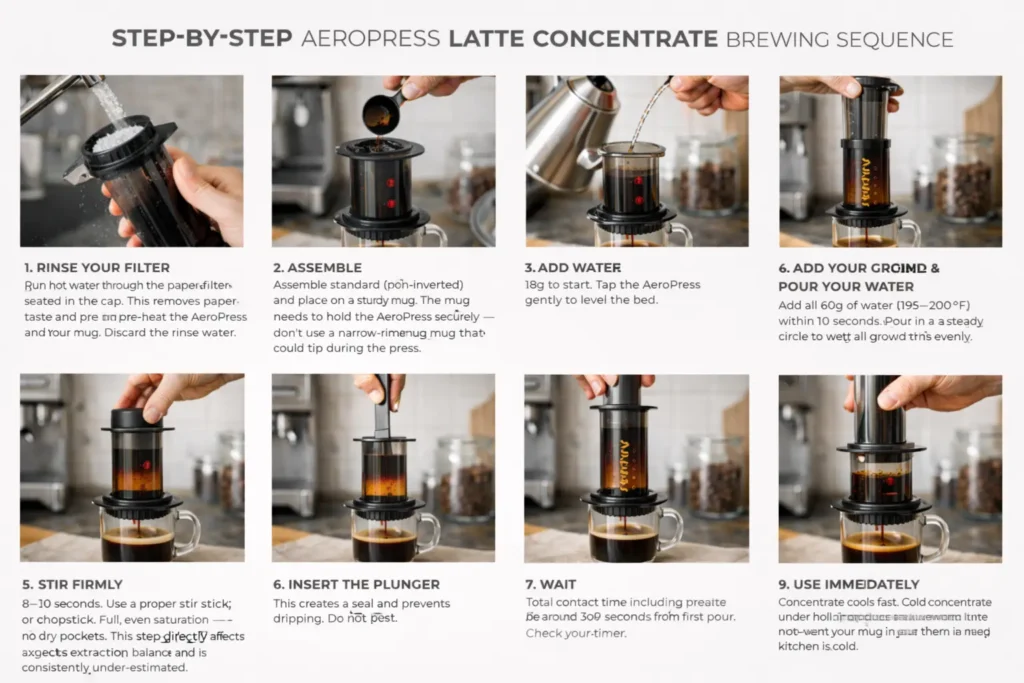
Follow each step exactly until you’ve produced a batch you’re happy with. Only then start experimenting with adjustments.
- Rinse your filter. Run hot water through the paper filter seated in the cap. This removes paper taste and pre-heats the AeroPress and your mug. Discard the rinse water.
- Assemble standard (non-inverted) and place on a sturdy mug. The mug needs to hold the AeroPress securely — don’t use a narrow-rimmed mug that could tip during the press.
- Add your ground coffee. 18g to start. Tap the AeroPress gently to level the bed.
- Start your timer and pour your water. Add all 60g of water (195–200°F) within 10 seconds. Pour in a steady circle to wet all grounds evenly.
- Stir firmly for 8–10 seconds. Use a proper stir stick or chopstick. Full, even saturation — no dry pockets. This step directly affects extraction balance and is consistently under-estimated.
- Insert the plunger 1–2cm. This creates a seal and prevents dripping. Do not press yet.
- Wait. Total contact time including the stir should be around 30–40 seconds from first pour. Check your timer.
- Press slowly. Apply even, steady pressure. The press should take 20–30 seconds. You should feel moderate resistance — not effortless, not a struggle. A soft “hiss” at the end means you’ve reached the grounds; stop there, don’t force it.
- Use immediately. Concentrate cools fast. Cold concentrate under hot milk produces a lukewarm latte. Pre-warm your mug if your kitchen is cold.
🟢 Inverted method note: Some brewers prefer inverting the AeroPress (plunger-down) to eliminate dripping during the brew phase. The flavor difference is minor, but it gives more control over contact time. If you try it, be confident during the flip — the mug goes on top and needs to happen quickly. See our full inverted method guide for a step-by-step walkthrough.
AeroPress Latte Concentrate: Grind Size Dial-In Guide
Grind size is the most powerful lever in your AeroPress latte system — more so than recipe ratios or temperature — because it simultaneously controls extraction efficiency, press resistance, and the physical structure of the coffee bed. For concentrate, you want a grind that is fine enough to extract fully in a short contact window but not so fine that it over-extracts, clogs the filter, or makes pressing impossible.
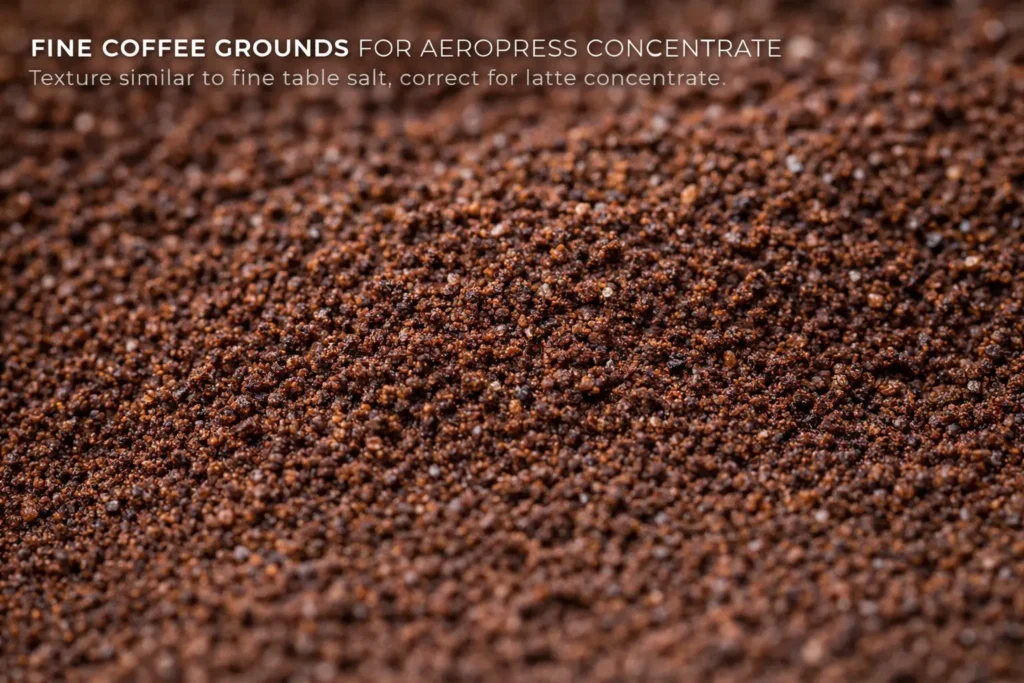
Target grind: fine table salt — slightly coarser than true espresso. If you’re using a click-based grinder, here are starting points by model:
| Grinder | Starting clicks for concentrate | Notes |
|---|---|---|
| Timemore C2 / C3 | 12–14 clicks from zero | Very consistent at this range; a strong starting point |
| Kingrinder K6 | 20–24 clicks from zero | Excellent uniformity; adjust 2 clicks at a time |
| Comandante C40 | 18–22 clicks (red clix) | Low fines output; may need slightly finer than expected |
| Baratza Encore | Settings 4–7 | Grind fresh; consistent at this range with low fines |
| 1Zpresso JX / JX-Pro | 2–3 rotations from zero (~30–36 clicks) | Very predictable; consistent batch-to-batch |
These are starting points — every coffee behaves differently. Use one reference batch, taste the result, then adjust by the smallest increment your grinder allows. Change only one variable per brew.
Grind Adjustment: Read the Taste, Fix the Variable
| What your latte tastes like | Most likely cause | Single fix |
|---|---|---|
| Weak, watery — milk completely dominates | Grind too coarse OR too much water | Grind finer by 2 clicks, OR reduce water to 55g |
| Sour, sharp, thin | Under-extracted | Grind finer, OR increase stir to 12–15 sec, OR raise temp to 200°F |
| Bitter, drying, harsh aftertaste | Over-extracted or too hot | Drop temp 5°F, OR grind 2 clicks coarser |
| Flat, no sweetness — milk tastes better than coffee | Under-extracted AND under-strength | Finer grind + increase dose to 20g + reduce water to 55g |
| Press stalls, requires real force | Grind too fine or dose too high | Coarsen 2 clicks OR reduce dose to 17g; check filter is flat |
| Press too easy, concentrate looks pale | Grind too coarse | Go finer by 2–3 clicks |
⚠️ Blade grinder warning: If your latte tastes confusingly both sour and bitter at the same time, grind inconsistency is almost certainly the cause. A blade grinder produces coarse boulders that under-extract alongside fine dust that over-extracts — no single temperature or grind setting can optimize for both simultaneously. A burr grinder resolves this in one step. See our best AeroPress grinder guide.
Temperature & Contact Time: Controlling Sweetness vs Bitterness
Water temperature is your most accessible quality lever for AeroPress lattes — especially for controlling how the concentrate tastes in milk. Higher temperatures extract faster and bring forward bitter, drying compounds. Lower temperatures preserve sweetness and reduce harshness but risk under-extraction if they drop too far.
| Roast level | Target temp | Why |
|---|---|---|
| Light roast | 200–205°F / 93–96°C | Dense beans need more heat to extract sweetness and body |
| Medium roast | 195–200°F / 90–93°C | Sweet spot for balance; full development without harsh extraction |
| Medium-dark roast | 192–198°F / 89–92°C | Slightly lower preserves chocolate sweetness and body |
| Dark roast | 185–195°F / 85–90°C | Lower heat prevents bitter peaks; dark roasts over-extract easily |
Lower temps (185–195°F): what you get
- Softer, rounder cup — less bitterness
- Chocolate and caramel notes more prominent
- Best for dark and medium-dark roasts
- Risk of sourness if grind is coarse
Higher temps (195–205°F): what you get
- More sweetness, body, and extraction yield
- Essential for light roasts and concentrates
- Fruit and floral notes more accessible
- Risk of bitterness if grind is fine or agitation high
💡 No temperature kettle? Boil water and rest before pouring. Approximate cooling times: 30 sec ≈ 205°F · 60 sec ≈ 200°F · 90 sec ≈ 195°F · 2 min ≈ 190°F · 3 min ≈ 185°F. For dark roasts, wait a full 90 seconds minimum before pouring. A $20–50 instant-read thermometer eliminates the guesswork entirely with any kettle you already own.
Contact time: The total brew window (from first pour to end of press) for concentrate should be 60–90 seconds. Beyond 90 seconds, even at lower temps, you risk over-extracting fines at the bottom of the bed. If your recipe consistently takes longer than 90 seconds to press, your grind is too fine.
Latte Ratio Chart: Build Any Milk Drink From One Concentrate
Your concentrate is the foundation. The milk-to-concentrate ratio defines what drink you’re building. The concentrate should taste too intense on its own — that’s correct. Adjust these ratios after your first batch once you’ve assessed actual concentrate strength.
| Drink | AeroPress Concentrate | Milk Volume | Milk Temp | Texture Target |
|---|---|---|---|---|
| Latte | 30–40g | 150–180g | 140–150°F | Thin, glossy microfoam |
| Flat White | 35–45g | 110–130g | 135–145°F | Very thin microfoam, velvety |
| Cappuccino | 25–35g | 90–120g | 140–150°F | Thicker foam cap, 1cm+ |
| Cortado | 40–50g | 50–60g | 135–145°F | Minimal foam, thin texture |
| Iced Latte | 35–45g | 150–200g cold | Cold / room temp | No foam needed |
| Oat Milk Latte | 30–40g | 150–180g | 130–140°F | Thin microfoam (oat foams easily) |
🟢 Milk alternatives note: Oat milk foams best and performs closest to whole dairy — always use barista-edition (Oatly, Minor Figures). Almond milk foams poorly and can break under heat. Soy milk foams well but has a stronger flavour. Standard (non-barista) versions of any alt-milk perform significantly worse than barista editions.
Milk Texture: The Microfoam Guide That Fixes Most Home Lattes
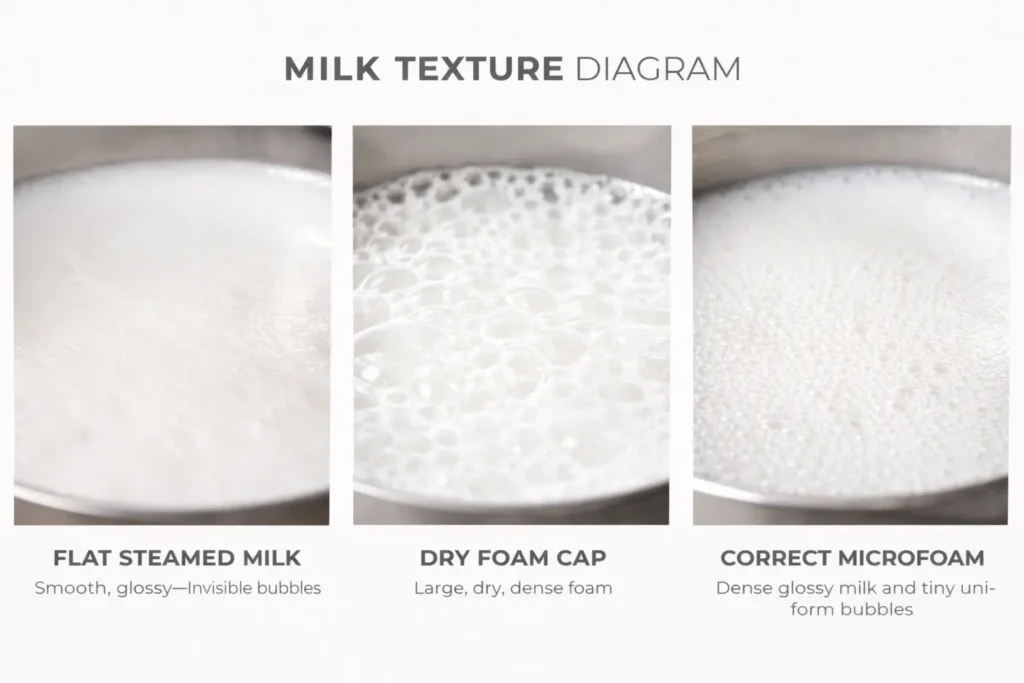
Here’s an honest statement: most home lattes fail at the milk step, not the coffee step. Once the concentrate is dialled in, the single biggest upgrade you can make to your latte is learning to produce real microfoam — not the dry, bubbly froth that comes from pumping a hand frother for 30 seconds, and not flat hot milk with a few bubbles on top.
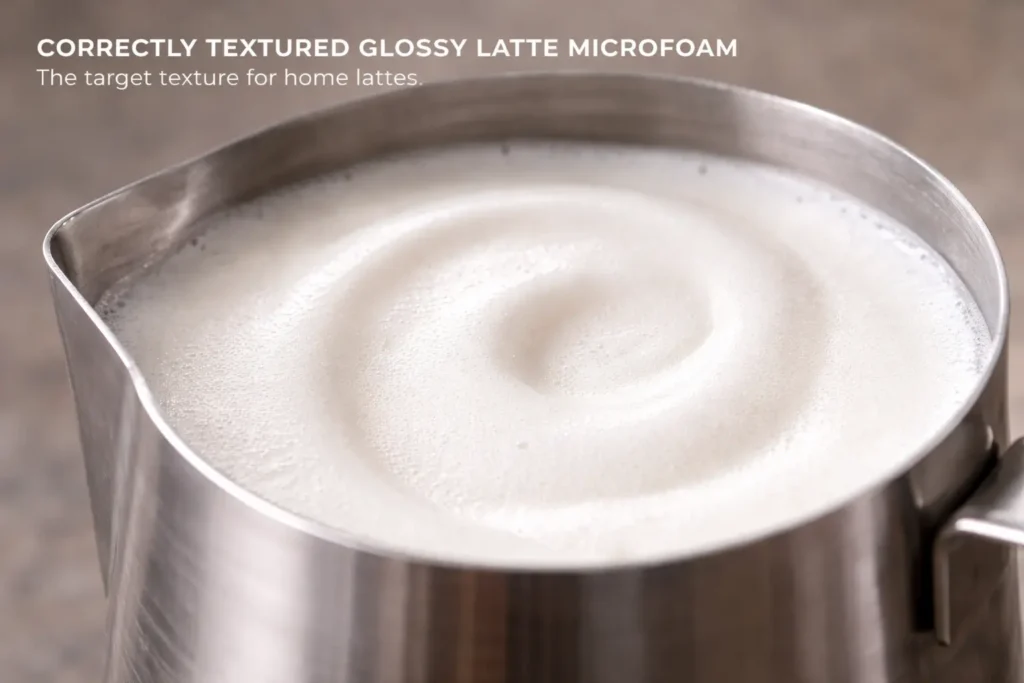
Microfoam is milk that has been texturized into thousands of tiny, glossy bubbles — so small and uniform that the milk takes on a silky, paint-like consistency that integrates seamlessly with coffee. It’s what makes the mouthfeel of a café latte feel correct.
Milk Temperature Targets
| Temp range | What happens to milk | Result in latte |
|---|---|---|
| Under 120°F | Not hot enough to integrate; foam unstable | Latte cools quickly; foam separates |
| 130–150°F ✓ Target | Proteins texturize correctly; natural sweetness peaks | Glossy microfoam, sweet, silky latte |
| 150–160°F | Texture stable but sweetness starting to drop | Still acceptable; slightly less sweet |
| Above 165°F | Proteins denature; sweetness falls sharply | “Scalded” flavour; foam breaks and separates |
Microfoam Technique by Tool
Steam wand (if you have one): Submerge the tip just below the surface to introduce air (the “stretching” phase — 5–7 seconds), then tilt the pitcher and sink the tip deeper to create a vortex (the “texturizing” phase). Stop at 140–150°F. Tap and swirl the pitcher before pouring.
Electric frother (Aeroccino-style): Use the flat whisk attachment — not the spring coil — for microfoam. Fill to the minimum line only; overfilling prevents proper texture formation. Run one cycle and use a thermometer until you know how your frother behaves by temperature.
Hand frother / French press method: Heat milk to 130–140°F first, then froth. Pump vigorously for 20–25 seconds, then tap the vessel on the counter to collapse large bubbles. Results are inconsistent but functional. For regular latte drinkers, the step up to an electric frother is meaningful.
Gear That Actually Improves AeroPress Lattes
The AeroPress itself costs around $35–45 and is your starting point. The gear below targets the specific variables that control latte quality. This isn’t a list of nice-to-haves — each item controls a measurable variable that affects the cup.
| Gear | What it controls | Without it | With it |
|---|---|---|---|
| Burr Grinder | Grind uniformity → extraction balance | Blade grinder fines cause bitter/sour mix; no repeatability | Consistent grind = reliable, sweet concentrate every time |
| Scale (0.1g) | Dose and ratio precision | Scoops and eyeballing make each shot different | 1:3 ratio locked in every brew; adjustments show up clearly |
| Temp Kettle | Water temp → sweetness vs bitterness | Boiling water risks over-extraction; no precision | Dial in roast-specific temps; consistent extraction |
| Electric Milk Frother | Milk texture → latte mouthfeel | Hand frothing is inconsistent; foam is dry or flat | Repeatable microfoam at correct temp every morning |
💡 Upgrade priority for AeroPress lattes: burr grinder → scale → temperature kettle → electric frother. The grinder is the prerequisite for effective dial-in — temperature and ratio adjustments only show up cleanly when grind consistency is already under control. If you’re adding one upgrade today, make it the grinder.
CoffeeGearHub Tested Picks
The Foundation
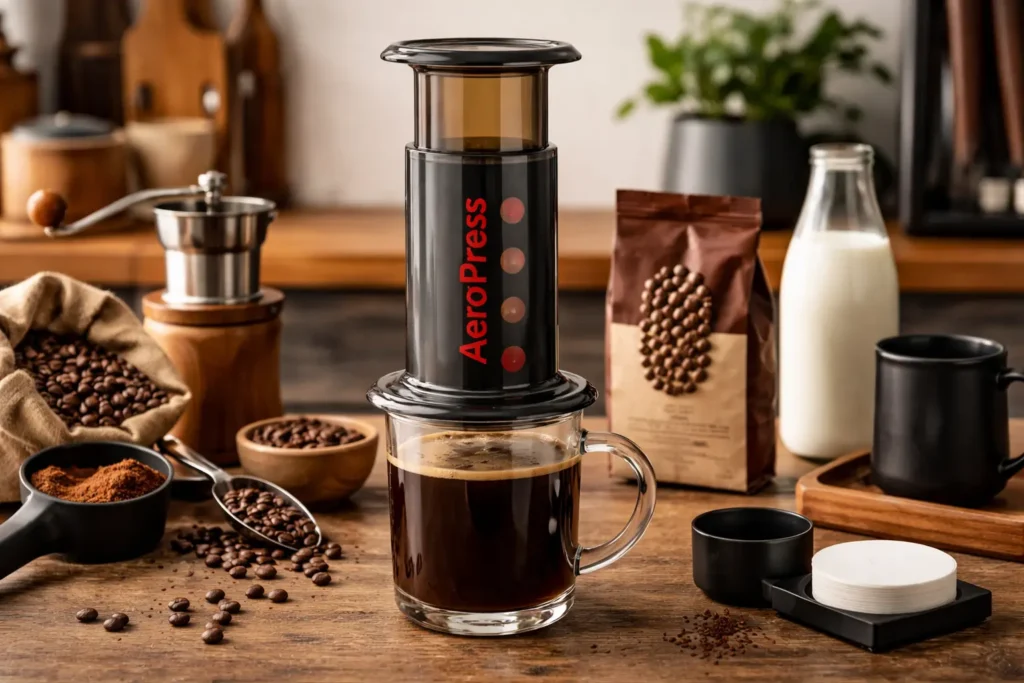
AeroPress Original
Fast, consistent immersion brewing with a gentle press. The sealed chamber and short brew time make it significantly more forgiving than espresso equipment. Get the Original for home; Go if you travel frequently. Both use the same brewing principles — the Go just runs 3–5°F cooler due to its smaller thermal mass.
Disclosure: CoffeeGearHub may earn from qualifying purchases.

Best Entry Burr Grinder
Baratza Encore
Reliable, consistent grind quality at the fine range required for AeroPress concentrate. The Encore produces low fines at settings 4–7 — which directly translates to sweeter, cleaner concentrate. Excellent first burr grinder for anyone upgrading from blade or pre-ground. See our full AeroPress grinder guide for more options including manual grinders.
Disclosure: CoffeeGearHub may earn from qualifying purchases.
Best Value Scale
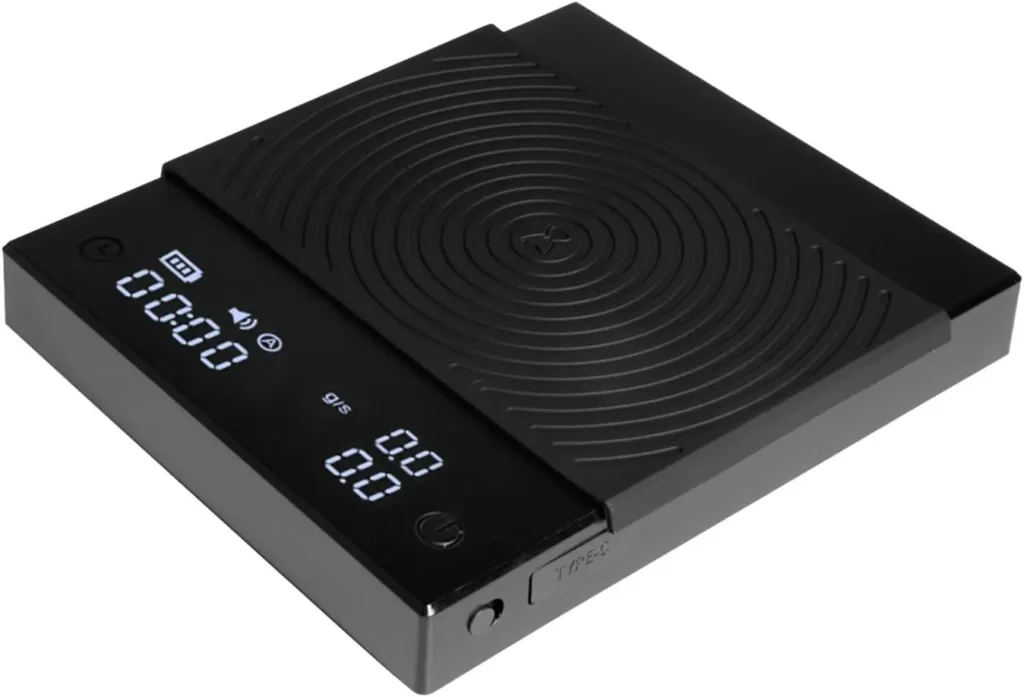
Timemore Black Mirror
0.1g precision plus a built-in timer. For AeroPress concentrate, the timer is as important as the weight accuracy — it’s how you control contact time consistently. Fast response, slim profile, fits under the AeroPress without issue. The single piece of gear most brewers skip and most regret skipping — without it, temperature adjustments are impossible to evaluate cleanly.
Disclosure: CoffeeGearHub may earn from qualifying purchases.
Temperature Control Kettle
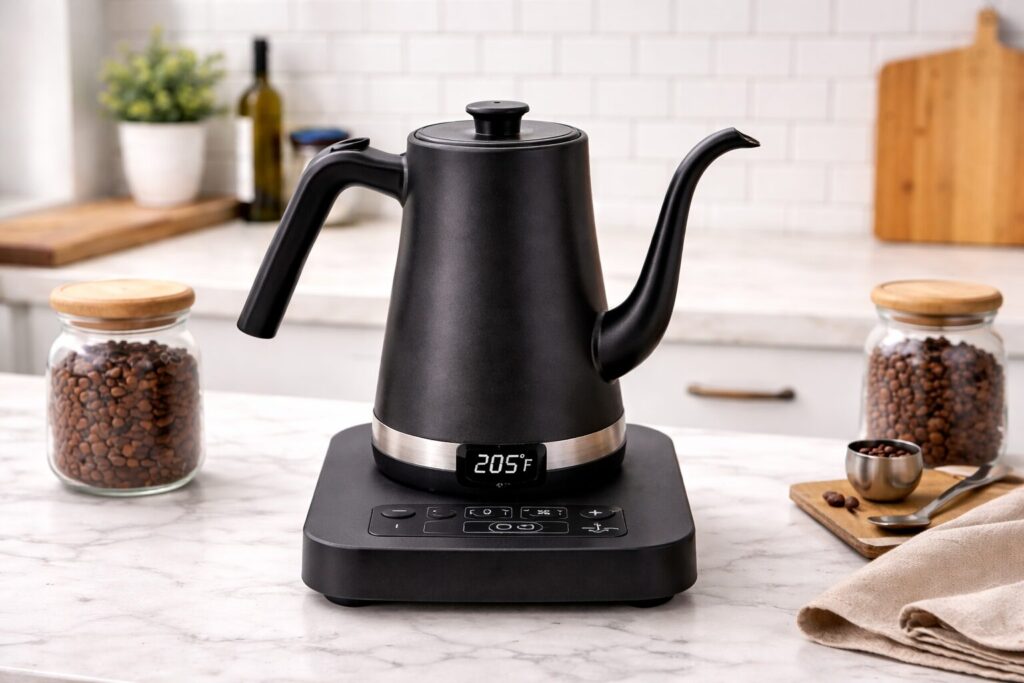
Fellow Stagg EKG
1°F precision temperature control with a 60-minute hold function. The difference between a sweet latte and a bitter one with dark roasts is often just 5–10°F — the Stagg eliminates that variable entirely. The precision gooseneck also gives fine control over pour rate, which matters when you’re pouring just 55–65g evenly. The top upgrade for brewers who have already sorted grinder and scale.
Disclosure: CoffeeGearHub may earn from qualifying purchases.
Best Electric Milk Frother
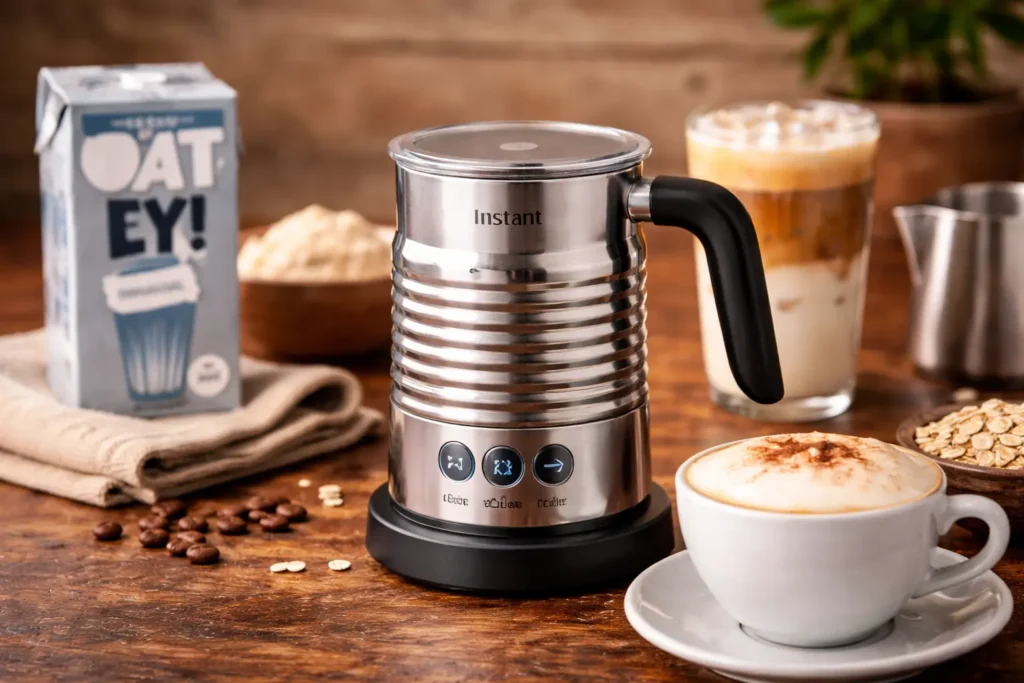
Nespresso Aeroccino 4
Consistent microfoam at the touch of a button. Temperature is automatic (around 140–145°F with the flat whisk) — well within the target range. Use the flat whisk attachment, not the spring coil, for microfoam. The most impactful single upgrade for home latte quality for most people — because most home lattes fail at the milk step, not the coffee step.
Disclosure: CoffeeGearHub may earn from qualifying purchases.
The Two Upgrades That Close the Gap With Cafés
For consistently great AeroPress lattes, the highest-impact combination is: burr grinder + electric frother. The grinder gives you sweet, balanced concentrate. The frother gives you proper microfoam. Together, they close 90% of the quality gap between your home latte and a café latte.
Troubleshooting AeroPress Lattes: 10 Failure Modes Fixed
Identify the symptom, make the single suggested change, and brew again before changing anything else. Most problems resolve in one or two iterations. If a problem persists despite the steps below, the root cause is usually grind inconsistency (blade grinder) or water quality — not recipe.
| Symptom | What’s happening | Single fix to try first |
|---|---|---|
| Milk dominates / latte tastes watery | Concentrate not strong enough | Reduce water to 55g OR grind 2 clicks finer OR increase dose to 20g |
| Sour, sharp, thin even with good strength | Under-extracted | Grind 2 clicks finer OR stir more firmly (12+ seconds) |
| Bitter, drying, harsh aftertaste | Over-extracted or too hot | Drop temp 5°F OR grind 2 clicks coarser |
| Flat, no sweetness — milk tastes better than coffee | Under-extracted AND under-strength | Finer grind + 20g dose + reduce water to 55g (all three) |
| Press requires real effort / stalls | Grind too fine or dose too high | Coarsen 2 clicks OR reduce dose 1g; check filter is flat and sealed |
| Press too fast, concentrate looks pale | Grind too coarse | Finer by 3 clicks |
| Latte is lukewarm | Concentrate cooled before milk, or milk too cool | Use concentrate immediately; pre-warm mug; froth milk to 145–150°F |
| Foam separates from milk immediately | Over-frothed (dry foam) or milk overheated | Use flat whisk attachment; keep milk under 150°F; tap and swirl before pouring |
| Oat / almond latte tastes odd | Not barista-edition alt-milk | Switch to barista-edition oat milk; froth at lower temp (130–138°F) |
| Tastes sour one day, fine the next | Inconsistent grind (blade grinder) or stale beans | Upgrade to burr grinder; use beans within 4 weeks of roast date |
“My latte is always watery no matter how much coffee I use”
High dose alone doesn’t create concentrate strength — the water volume matters equally. If you’re using 20g of coffee but 200g of water, your TDS is still low regardless of dose. Reduce the water volume to 55–65g. Also check your grind: coarse grinds under-extract and produce weak concentrate even with high doses. The ratio is the fix, not more coffee.
“I lowered temperature but the bitterness is still there”
Agitation is the next variable to reduce. Cut your stir count by half. Also check press speed: pressing very slowly — longer than 40–45 seconds total — keeps wet grounds in contact with already-brewed coffee and adds bitterness independently of water temperature. A 20–30 second press is the standard. For dark roasts that remain harsh after both steps, switch from metal filter to paper for a cleaner, drier extraction.
“My concentrate is inconsistent despite following the same recipe”
Inconsistency when the recipe is constant points to dose variation (eyeballing coffee weight) or grind inconsistency (blade grinder or worn burrs). A scale with 0.1g resolution removes dose as a variable in one purchase — a 1–2g difference in dose produces an obvious flavor shift. After that, a burr grinder removes grind inconsistency. Temperature and ratio control are only fully effective when these two are also under control.
Iced AeroPress Latte: Two Methods That Actually Work

Iced lattes have one additional challenge: dilution from ice on top of dilution from milk. Your concentrate needs to be stronger than usual — or your iced latte will taste thin within minutes of the ice starting to melt.
Method 1: Hot Concentrate Over Ice (Easiest)
Best for: beginners | Ready in 3 minutes
Brew your standard concentrate but tighten the ratio slightly — 20g coffee to 55g water. Press directly over a glass filled with ice. The ice chills the concentrate instantly. Add 150–200g cold milk and stir. No foam needed.
If iced latte tastes muted or thin: tighten ratio to 1:2.5 (20g / 50g water).
Method 2: Flash Brew (Brighter, More Complex)
Best for: experienced brewers | Specialty coffee approach
Use 200–205°F water and press directly onto a bed of pre-weighed ice. The ice acts as part of your total water volume and chills the concentrate mid-brew, locking in volatile aromatics. The result is noticeably brighter and more complex.
Recipe: 20g coffee / 40g hot water (205°F) pressed onto 55g ice. Add 150–180g cold milk.
6 Common AeroPress Latte Mistakes (And How to Fix Them)
- Using too much water by default: The most common reason home lattes are watery. A standard AeroPress cup uses 200–250g of water. Concentrate uses 55–65g. If you haven’t actively reduced your water volume, your latte will always be weak regardless of how much coffee you use.
- Not adjusting agitation when you raise temperature: Agitation and temperature multiply each other’s extraction effect. If you raise temp to fix sourness, cut stirs by 2–3 simultaneously. Failing to do this trades sourness for bitterness without actually improving the cup.
- Frothing milk wrong: Using a spring-coil frother attachment produces dry, bubbly foam that sits on top of the latte rather than integrating with it. Switch to the flat whisk for any electric frother, and never overheat past 150°F — both changes are immediate and obvious.
- Changing two variables at once: Adjusting temperature and grind simultaneously makes it impossible to know which one fixed (or broke) the cup. Temperature first — one brew — then grind if needed.
- Using wrong roast for milk drinks: Light roasts lose their character in milk. If your lattes always taste flat or hollow, try a medium-dark roast — the chocolate and brown sugar notes are designed for milk.
- Expecting temperature to fix grind inconsistency: A blade grinder produces particle distribution so wide that no single temperature can optimise for all of it. The fine particles over-extract at any temperature that fully extracts the coarse particles. A burr grinder is the prerequisite for effective dial-in — not an optional upgrade.
Complete AeroPress Latte Reference
Everything in this guide condensed into one reference table. Bookmark this for quick access when brewing a new coffee or troubleshooting a problem:
| Variable | Range | Target for most lattes | Notes |
|---|---|---|---|
| Coffee dose | 16–22g | 18–20g | Start at 18g; increase for stronger concentrate |
| Water volume | 45–70g | 55–65g | 1:3 ratio is the standard; tighten to 1:2.5 for stronger base |
| Water temp (medium-dark) | 192–200°F | 195–198°F | Drop to 185–195°F for dark; raise to 200–205°F for light |
| Grind size | Fine–medium-fine | Fine table salt | The single highest-impact variable for latte quality |
| Stir count | 4–12 stirs | 8–10 stirs | Reduce stirs as temperature increases |
| Total brew time | 50–90 sec | 60–75 sec | Beyond 90 sec = grind too fine |
| Press time | 15–40 sec | 20–30 sec | Slow and steady; stop at the hiss |
| Milk temp | 120–160°F | 130–150°F | Peak sweetness and microfoam stability window |
| Concentrate volume | 25–50g | 30–45g | Adjust for drink type — see ratio chart |
FAQs: AeroPress Latte Concentrate
Can the AeroPress make real espresso?
No. Real espresso requires around 9 bars of pressure. The AeroPress generates less than 1 bar and cannot produce true espresso or crema. However, it produces a high-TDS concentrate that performs the same functional role as espresso in lattes, flat whites, and cappuccinos — bold enough, sweet enough, and concentrated enough to build a genuinely excellent milk drink.
What is the best AeroPress ratio for latte concentrate?
Start with a 1:3 ratio by weight — 18g coffee to 55–65g water. This produces concentrate strong enough to survive milk dilution and still taste complete. For a stronger base or with light roasts, tighten to 1:2.5 by reducing water to 45–50g.
What grind size should I use for AeroPress latte concentrate?
Use a fine grind similar to fine table salt — slightly coarser than espresso grind. If pressing feels effortless and the latte is weak, go finer by 2 clicks. If the press stalls or the latte is bitter, go 2 clicks coarser. Adjust by the smallest increment your grinder allows, one change at a time.
What water temperature is best for AeroPress latte concentrate?
195–200°F (90–93°C) for medium and medium-dark roasts. Drop to 185–195°F for dark roasts to prevent bitterness. Raise to 200–205°F for light roasts, which need more heat to extract sweetness from dense beans. Without a temperature kettle, rest boiling water for 60–90 seconds for medium roasts, or 90–120 seconds for dark roasts.
What milk temperature is best for lattes?
130–150°F (54–65°C). This is where milk tastes naturally sweetest and microfoam texture is most stable. Above 165°F, milk proteins denature, sweetness drops sharply, and foam breaks apart. Use a thermometer until you know how your frother behaves by temperature.
Which roast is best for AeroPress lattes?
Medium-dark roast is the best starting point for lattes. It has natural body and low acidity that complements milk, and a flavor profile (chocolate, brown sugar, caramel) that survives the dilution of milk. Light roasts lose their character in milk and can taste sharp or hollow. Dark roasts work well but require a lower brew temperature (185–195°F) to avoid bitterness.
Paper or metal filter for AeroPress lattes?
Paper filters produce a cleaner, brighter concentrate — better if lattes taste muddy or overly heavy. Metal filters allow more oils and solids through, adding body and richness — better if lattes taste thin or flat. Both are valid; the best choice depends on your grinder’s fines production and your taste preference. If using a grinder with high fines output, paper is usually the better default.
Why does my AeroPress latte taste watery even when I use lots of coffee?
High coffee dose alone doesn’t create concentrate strength — the water volume matters equally. If you’re using 20g of coffee in 200g of water, your TDS is still low regardless of how much coffee you used. Reduce your water volume to 55–65g regardless of dose. Also check grind: coarse grinds under-extract and produce weak concentrate even at high doses.
How do I make microfoam without a steam wand?
Use an electric frother with a flat whisk attachment (not the spring coil). Fill to the minimum line only — overfilling prevents proper texture. Heat milk to 130–150°F maximum. Tap the pitcher on the counter after frothing to collapse large bubbles and swirl before pouring. The flat whisk is the key: it produces much finer bubbles than the spring coil at the same speed.
Can I use oat milk or almond milk for AeroPress lattes?
Yes — but use barista-edition versions of any alt-milk. Standard oat milk, almond milk, and soy milk perform significantly worse for frothing than barista editions. Oat milk (barista) foams best and is the closest alternative to whole dairy. Almond milk foams poorly regardless of edition and tends to break under heat. Soy milk (barista) foams well but has a stronger flavor that not everyone prefers.
What’s the difference between a latte, flat white, and cappuccino with AeroPress concentrate?
The difference is in the milk-to-concentrate ratio and foam texture. A latte uses 150–180g milk per 30–40g concentrate with thin microfoam. A flat white uses 110–130g milk per 35–45g concentrate with very thin, velvety microfoam and a stronger coffee taste. A cappuccino uses 90–120g milk per 25–35g concentrate with a thicker foam cap. All three use the same concentrate — the milk ratio and texture define the drink.
How is AeroPress concentrate different from cold brew?
AeroPress concentrate is hot-brewed at 195–200°F in 60–90 seconds using a 1:3 ratio — it produces a bold, bright, full-flavored base with all the complexity of hot extraction. Cold brew is steeped at room temperature or refrigerator temperature for 8–24 hours using a 1:6–1:8 ratio — it produces a smooth, low-acid, chocolatey concentrate with less brightness and complexity. AeroPress concentrate is significantly faster and more versatile for latte use; cold brew is preferred when you want maximum smoothness and low acidity.
Final Verdict: AeroPress Lattes at Home
The AeroPress latte system works — consistently and repeatably — when the four variables are under control: ratio (1:3), grind (fine table salt), temperature (195–200°F for medium-dark), and milk texture (130–150°F microfoam). The biggest gains come from the grinder (which controls extraction balance) and the milk frother (which controls the mouthfeel that defines a latte). Everything else is refinement.
Diagnose failures one variable at a time — temperature first, then grind, then time — and make one change per brew so each adjustment is clearly interpretable. Most latte problems resolve in two brew iterations once you know which variable to target. For persistent problems that don’t respond to recipe changes, check grind consistency (blade grinder) and water quality (very soft or distilled water) before anything else.
If you want the fastest upgrade path: sort the ratio and grind first, then add a milk frother. Once those are dialled in, a temperature-controlled kettle locks in the last variable and makes the whole system perfectly repeatable morning after morning.
Continue Learning: AeroPress Guides
AEROPRESS BREWING
- Best Grind Size for AeroPress (With Dial-In Chart)
- Best Water Temperature for AeroPress
- AeroPress Inverted Method: Is It Actually Better?
- AeroPress Paper vs Metal Filters: Which to Use When
- How to Make Iced Coffee with AeroPress (Flash Brew)
- AeroPress Troubleshooting: Fix Sour, Bitter, and Weak Cups
Ready to dial in your grind size next? Grind and temperature work together — get both right for the most consistent lattes.
☕
Written by the CoffeeGearHub Editorial Team
CoffeeGearHub is a specialty coffee equipment resource run by home brewers and coffee enthusiasts. Our brewing guides are built from published extraction science, specialty-coffee community consensus, and hands-on testing across roast levels, grind settings, and brew variables. We update pillar content regularly as brewing consensus evolves. About CoffeeGearHub →