Last Updated: March 2026 • 35–45 min read • Cornerstone Guide: AeroPress Temperature Science + Dial-In System + Gear Picks
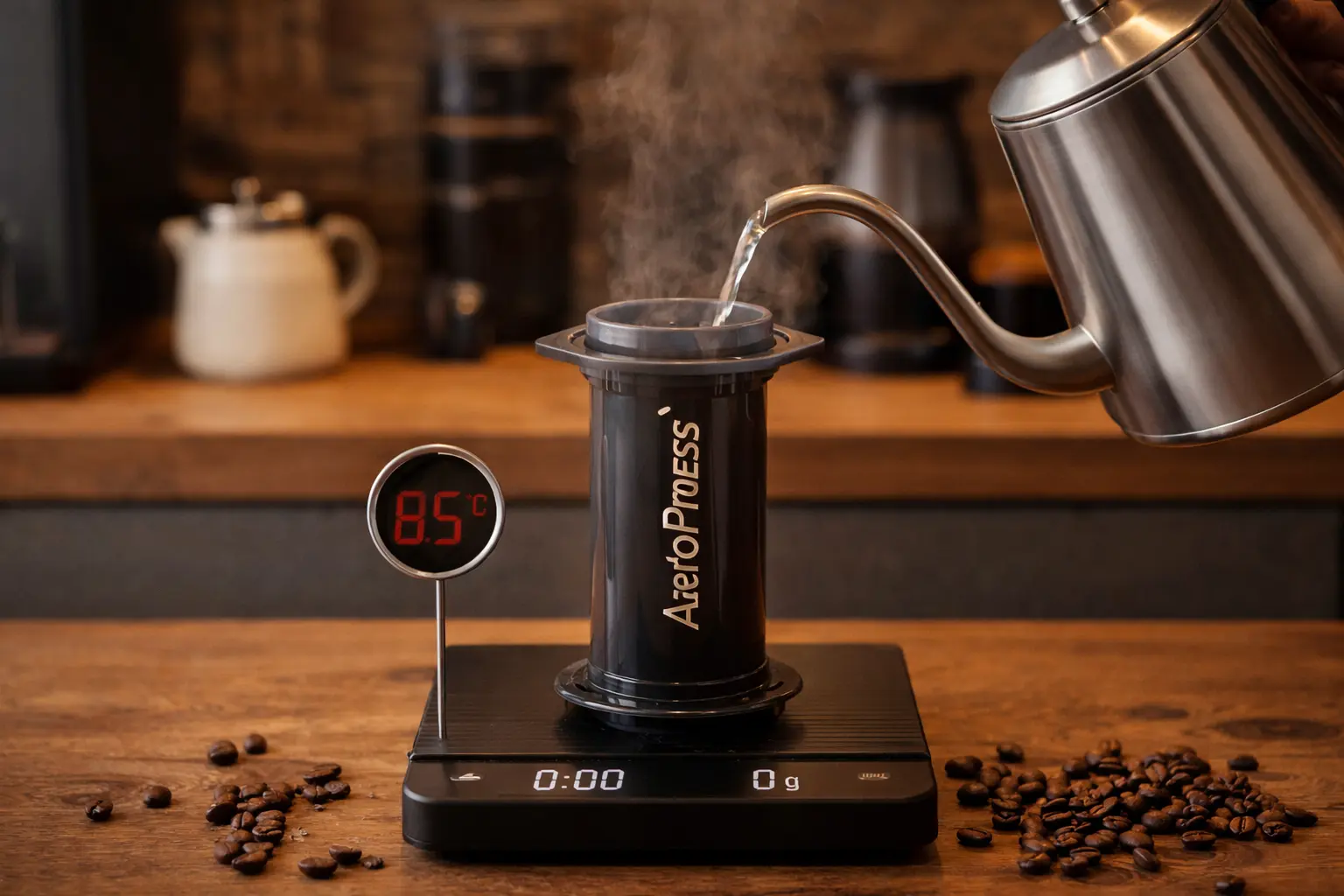
The AeroPress water temperature is the most debated variable in AeroPress brewing — and for good reason. Unlike almost any other brewer, the AeroPress works across a wider temperature range than any conventional brewing guide will tell you: from 60°C cold-steep concentrates all the way up to full-boil 100°C extractions for dense light roasts. Get the temperature right and your AeroPress will produce sweeter, cleaner, more nuanced coffee than you’ve ever tasted from it. Get it wrong and even high-quality beans produce a flat, sour, or harsh result that no ratio or grind adjustment will fix. This complete CoffeeGearHub guide explains exactly how AeroPress temperature works, gives you the right temperature for every roast level and recipe style, and walks you through a practical dial-in system you can execute in 2–3 brews.
✍️ Editorial note: This guide is researched and written by the editors at CoffeeGearHub.com using published brewing science, SCA brewing standards, and established specialty-coffee community knowledge. Recommendations reflect research consensus rather than in-house lab testing. All product links are affiliate links — we may earn a commission at no cost to you.
The 30-Second Answer
Start at 85–90°C (185–194°F) for most AeroPress brews — this is the safe middle ground that works across medium roasts and most recipe styles. For light roasts, push up to 90–96°C to unlock sweetness and clarity. For dark roasts, drop to 75–85°C to prevent harshness. The AeroPress is uniquely forgiving across temperatures precisely because you control pressure, contact time, and grind simultaneously — temperature is just one lever in a multi-variable system.
- Light roast sweet spot: 90–96°C (194–205°F) — higher temp unlocks dense bean solubility
- Medium roast sweet spot: 85–90°C (185–194°F) — the universal AeroPress starting point
- Dark roast sweet spot: 75–85°C (167–185°F) — lower temp prevents bitterness and char notes
Who This Guide Is For — Jump to What You Need
☕ Complete Beginner
Read the Quick Answer, then Why Temperature Matters and the Temperature by Roast Table.
🔧 Troubleshooter
Jump straight to the Troubleshooting Matrix — flat, sour, and bitter fixes are all there.
🧪 Recipe Builder
See Temperature by Recipe Style for concentrate, inverted, and cold-steep settings.
🔬 Extraction Nerd
Read Extraction Science and World AeroPress Championship Temps.
Table of Contents
- Why AeroPress water temperature matters
- Temperature by roast level (master reference table)
- Temperature by AeroPress recipe style
- Light roast AeroPress: high-temp deep dive
- Dark roast AeroPress: low-temp deep dive
- Cold steep and room-temp AeroPress
- Extraction science: how temperature moves flavour
- Temperature vs grind size: which to adjust first
Why AeroPress Water Temperature Matters More Than You Think
Water temperature is the second fastest extraction variable after grind size — but in the AeroPress it has an outsized effect because of how the brewer works. The AeroPress uses a sealed chamber where coffee and water are in full contact for a controlled period before pressure is applied. That means temperature isn’t just influencing extraction rate — it’s setting the ceiling for which flavour compounds even have the chance to dissolve.
Too low and sugars and aromatic compounds never fully dissolve, producing a hollow, sour, or flat cup even at a correct grind. Too high and bitter compounds extract aggressively, overwhelming the sweetness that makes AeroPress coffee distinctive. The window between “underdone” and “overdone” is wider than espresso but narrower than most people assume — roughly 15°C of meaningful variation depending on your roast level.
| Temperature direction | Example | Effect on AeroPress cup | Risk |
|---|---|---|---|
| Very low (cold steep) | Room temp / cold | Smooth, low-acid, sweet concentrate | Requires very fine grind and long steep to extract fully |
| Low range | 75–82°C (167–180°F) | Soft body, low bitterness, suited to dark roasts | Under-extraction sourness if grind too coarse |
| Mid range (balanced) | 83–90°C (181–194°F) | Sweet + balanced — best for medium roasts | Minimal — this is the target zone for most brews |
| High range | 91–96°C (196–205°F) | Increased complexity and sweetness for light roasts | Bitter extraction if grind too fine or steep too long |
| Near boiling | 96–100°C (205–212°F) | Maximum extraction — useful for very dense light roasts | Harsh/bitter if used on medium or dark roasts |
Common mistake: using the same temperature regardless of roast level. The AeroPress manual recommends 80°C — that’s a safe universal suggestion designed to prevent beginners from burning themselves or over-extracting dark roasts. It is not the optimal temperature for light or medium-light specialty coffee. Most specialty roasters target 90–96°C for their recommended brewing temperature.
AeroPress Temperature by Roast Level — Master Reference Table
This is the most important single table in this guide. Roast level is the primary determinant of optimal AeroPress brew temperature — more so than recipe style, grind size, or contact time. Use this as your starting point, then fine-tune within the range based on taste feedback.
| Roast level | Recommended temp range | Sweet spot | Ratio | Grind (K6 clicks) | Why |
|---|---|---|---|---|---|
| Extra light / Nordic | 93–100°C (199–212°F) | 96°C (205°F) | 1:13–1:15 | 22–28 clicks | Dense, resistant beans need near-boil to dissolve sugars fully |
| Light roast ☀️ | 90–96°C (194–205°F) | 92–94°C (198–201°F) | 1:14–1:15 | 20–26 clicks | Higher solubility than Nordic but still benefits from heat boost |
| Medium-light roast | 87–93°C (189–199°F) | 90°C (194°F) | 1:15 | 22–28 clicks | Good balance point — sweetness without extraction edge |
| Medium roast 🌤 | 83–90°C (181–194°F) | 87°C (189°F) | 1:15–1:16 | 24–30 clicks | Classic AeroPress sweet spot — works for most brewing styles |
| Medium-dark roast | 80–87°C (176–189°F) | 83°C (181°F) | 1:15–1:16 | 26–32 clicks | Lower temp prevents roasty bitterness from dominating |
| Dark roast 🌑 | 75–83°C (167–181°F) | 80°C (176°F) | 1:16–1:17 | 28–34 clicks | High solubility means lower temp prevents harsh bitter finish |
| Cold / room temp steep | Room temp (18–22°C) | Room temp | 1:6–1:8 | 12–16 clicks | Extended steep (12–16hr) compensates for cold extraction rate |
🔬 K6 click reference: All KINGrinder K6 click settings in this guide are measured from the zero point (burrs touching). Lower click numbers = finer grind. These are starting points — individual grinders vary slightly. Dial in 2–3 clicks at a time.
AeroPress Temperature by Recipe Style
The AeroPress is unique among home brewers in that recipe style — standard upright, inverted, concentrate, bypass, and cold steep — meaningfully changes the optimal temperature. This is because contact time and pressure both interact with temperature during extraction. The table below gives you a complete starting matrix.
| Recipe style | Temperature range | Typical steep time | Ratio | Why this temp works |
|---|---|---|---|---|
| Standard upright (filter-style) | 85–92°C (185–198°F) | 1:00–2:00 | 1:15–1:16 | Short contact → higher temp needed to extract fully in the window |
| Inverted method | 83–90°C (181–194°F) | 1:30–2:30 | 1:12–1:15 | Longer full-immersion steep → lower temp prevents over-extraction |
| Concentrate (espresso-style) | 88–94°C (190–201°F) | 0:45–1:15 | 1:5–1:8 | Very short contact + high pressure → higher temp for quick extraction |
| Bypass / Americano-style | 88–94°C (190–201°F) | 1:00–1:30 | 1:6–1:8 concentrate, then dilute | Brew strong, then add hot water — temperature of dilution water matters too |
| Iced / flash-chill | 88–93°C (190–199°F) | 0:45–1:15 | 1:7–1:9 (brewed over ice) | Ice dilution means you need higher extraction strength — push temp up |
| Cold steep (overnight) | Room temp or cold | 8–16 hours | 1:6–1:8 | Time replaces temperature; fine grind compensates for low solubility |
Light Roast AeroPress: The High-Temperature Deep Dive
Light roasts are the most misbrewed coffee in home kitchens. The default AeroPress advice — 80°C, quick press — produces a thin, sour, underwhelming cup from light-roasted single-origin beans because those beans are denser, more resistant to extraction, and require more heat energy to unlock their soluble compounds.
World AeroPress Championship finalists consistently push light roast temperatures to 91–96°C, often with extended steeps of 2:00 or more before pressing. The high temperature isn’t about burning — it’s about solubility. The sugars and aromatic compounds that make light roast Ethiopian or Kenyan coffee taste like fruit and flowers simply will not dissolve at 80°C in a 90-second steep.
Light Roast AeroPress Recipe
- Temperature: 92–94°C (198–201°F)
- Coffee: 15g
- Water: 225g (1:15 ratio)
- Grind: medium (K6: 22–26 clicks)
- Method: inverted, 2:00 steep, slow press (30–40s)
If sour at 92°C: try 94°C before adjusting grind. If still sour: grind 2 clicks finer.
Signs Your Light Roast Needs More Heat
- Persistent sourness despite correct ratio
- Hollow or thin body with no sweetness
- Cup improves significantly as it cools — signals low extraction
- Fruity notes present but weak / muted
- Grind adjustments alone never seem to fix the cup
All of these suggest under-extraction from insufficient temperature — raise in 2°C steps before changing anything else.
🔬 Light roast science: Light roast beans retain more moisture and cellular structure. The Maillard reactions that soften cell walls and increase solubility during roasting are less advanced. Higher water temperature accelerates the diffusion rate of soluble compounds through intact cellular walls. At 80°C you’re waiting for a diffusion process that simply never completes in a 90-second steep.
Dark Roast AeroPress: The Low-Temperature Deep Dive
Dark roasts present the opposite problem. Extended roasting breaks down cellular structure, caramelises sugars into bitter compounds, and produces a porous, highly soluble bean that extracts extremely fast at high temperatures. Brewing dark roast AeroPress at 92°C with a two-minute steep is a reliable way to produce a cup that’s all bitterness and no sweetness.
The solution is counterintuitive: brew cooler and faster. Dropping to 78–83°C slows the extraction rate of bitter chlorogenic acids and lactones while still dissolving the sugars and body compounds that make dark roast coffee satisfying. You’re not brewing weak coffee — you’re selectively extracting the pleasant compounds before the harsh ones have a chance to dissolve.
Dark Roast AeroPress Recipe
- Temperature: 79–83°C (174–181°F)
- Coffee: 15g
- Water: 240g (1:16 ratio)
- Grind: medium-coarse (K6: 28–34 clicks)
- Method: standard upright, stir 10s, steep 1:00, gentle press (20–25s)
If bitter: try 78°C and reduce steep to 45s. If weak or flat: try 83°C or grind 2 clicks finer.
Signs Your Dark Roast Needs Less Heat
- Persistent dry, ashy finish despite coarser grind
- Bitterness that hits immediately and doesn’t fade
- Cup tastes harsher hot than warm
- Roasty / smoky notes completely overpower everything else
- Grind adjustments help only slightly before becoming too coarse
These symptoms point to temperature-driven over-extraction. Drop 3–5°C before adjusting grind size.
Cold Steep and Room-Temperature AeroPress
The AeroPress is one of very few brewers capable of producing excellent cold-steep coffee in a matter of hours rather than the overnight steeps required by traditional cold brew setups. Because the sealed chamber creates pressure during the press, you can extract more soluble compounds from cold water than you’d achieve with an open container — making AeroPress cold steep a genuinely different product from Mason jar cold brew.
| Cold steep style | Temp | Ratio | Steep time | Grind (K6) | Result |
|---|---|---|---|---|---|
| Room temp overnight | 18–22°C | 1:6–1:8 | 8–12hr | 12–16 clicks | Smooth, low-acid concentrate — dilute before drinking |
| Fridge overnight | 3–5°C | 1:5–1:7 | 12–20hr | 10–14 clicks | Cleaner, lighter than room temp — less fruity, more neutral |
| Iced AeroPress (quick) | 88–93°C | 1:7–1:9 (brewed over 100g ice) | 45s–1:15 | 16–20 clicks | Flash-chilled concentrate — bright, fruity, clean |
⚠️ Room-temp cold steep note: at 18–22°C extraction is very slow but still active — steep longer than 14 hours at room temperature and you risk over-extraction, especially with medium or dark roasts. Taste at 8 hours and every 2 hours after until the cup is balanced. Move to the fridge if you won’t be awake to taste-check.
Extraction Science: How Temperature Moves Flavour
Coffee extraction follows a predictable sequence: the earliest-extracting compounds are organic acids (bright, sharp, sometimes sour), followed by sugars and aromatic compounds (sweet, fruity, floral), followed by bitter compounds including chlorogenic acids and phenols (dry, harsh, astringent). Water temperature accelerates every stage of this sequence — but not equally.
Bitter compounds require significantly more heat energy and time to dissolve than acids or sugars. This is why low-temperature brewing (cold brew, cool AeroPress) tends to produce smooth, low-bitter results — you’re simply not providing enough thermal energy to efficiently dissolve the compounds responsible for harshness. The sweet spot for AeroPress is a temperature that extracts the middle band of sugars and aromatics before the bitter late-extracting compounds follow.
- Acids extract first (all temperatures): organic acids, citric acid — brightness, sometimes sharp sourness if over-represented
- Sugars and aromatics extract next (requires adequate heat): sweetness, body, fruity and floral notes — this is the flavour target zone
- Bitter compounds extract last (most heat-sensitive): chlorogenic acids, phenols, caffeine — drying, astringent, harsh finish
Your temperature setting determines how quickly you move through stages 1 and 2 before hitting stage 3. With a short AeroPress steep, a higher temperature accelerates the middle stage extraction without necessarily reaching the bitter end stage — which is why experienced brewers use higher temps with shorter steeps rather than lower temps with longer ones for most roast levels.
🔬 Temperature drop during steep: AeroPress plastic retains heat reasonably well, but your brew water will drop approximately 2–5°C over a two-minute steep depending on ambient temperature and whether the plunger cap is in place. Preheat your AeroPress chamber with hot water before brewing — this reduces temperature drop and keeps extraction consistent.
Temperature vs Grind Size: Which to Adjust First?
This is the most practical question home AeroPress brewers ask — and the answer determines whether you dial in efficiently in 2–3 brews or spend weeks chasing your tail. Temperature and grind size both affect extraction rate, but they affect it differently and one should always be moved before the other.
| What you taste | Problem type | Adjust first | Adjust second | Don’t adjust |
|---|---|---|---|---|
| Sour / sharp / hollow at correct ratio | Under-extraction | Temperature up 3–5°C | Grind 2 clicks finer | Ratio — don’t add more coffee |
| Bitter / dry / harsh finish | Over-extraction | Temperature down 3–5°C | Grind 2 clicks coarser | Ratio — don’t reduce coffee |
| Balanced but too weak | Strength (ratio) | Ratio — add more coffee | Nothing else | Temperature — won’t change strength |
| Balanced but too strong | Strength (ratio) | Ratio — use less coffee | Nothing else | Temperature — won’t change strength |
| Both sour AND bitter | Inconsistent grind | Upgrade to burr grinder | Temperature (secondary) | Temperature alone won’t fix this |
| Flat / muted despite correct temp + grind | Stale beans or bad water | Check roast date | Filter your water | Temperature changes are pointless here |
The rule: temperature and grind size are both extraction levers — adjust them one at a time in the same direction. Moving temperature up 5°C has approximately the same extraction effect as grinding 2–3 clicks finer on the K6. Use temperature as your first move because it’s faster to test and doesn’t require re-dosing.
What World AeroPress Championship Recipes Use
The World AeroPress Championship (WAC) is the most data-rich source of high-performance AeroPress recipe information available. Championship finalists publish their recipes each year, and temperature data across the event reveals a consistent pattern that contradicts conventional AeroPress temperature advice.
Analysis of WAC recipes shows the overwhelming majority of finalists brew at 85–96°C — significantly above the 80°C default in the AeroPress manual. The most common temperature band across championship-winning recipes is 88–93°C. Very few top-placing recipes use temperatures below 83°C unless specifically brewing a dark roast entry. This reflects both the specialty-coffee bias of WAC beans (mostly light to medium-light) and the well-established extraction science around higher solubility requirements for modern light roasts.
| Recipe style | Typical WAC temp | Ratio | Steep time | Notes |
|---|---|---|---|---|
| Inverted light roast | 90–96°C | 1:13–1:15 | 1:30–2:30 | Most common championship recipe style |
| Standard upright (modern) | 88–93°C | 1:15–1:16 | 1:00–1:30 | Fast press for clarity and brightness |
| Bypass / Americano | 92–96°C (concentrate) | 1:5–1:7 then diluted | 0:45–1:15 | High temp + short steep + dilution |
| Cold-start recipes | Room temp / ice | 1:6–1:8 | 8–14hr | Used less commonly at WAC |
🔬 Why WAC temps skew high: Championship beans are almost exclusively washed light roasts — Ethiopian, Colombian, Kenyan naturals and washed coffees with high fruit and floral complexity. These require maximum heat energy for full extraction. If you’re brewing supermarket dark roast, WAC temps will over-extract your coffee. Use the roast-level table above as your reference, not championship averages alone.
The CoffeeGearHub AeroPress Dial-In Framework
Dialling in temperature works fastest when you fix it as the first variable and hold everything else constant. The temptation is to adjust grind, temperature, and contact time simultaneously — this makes it impossible to attribute any change in the cup to a specific variable and usually results in more brews, not fewer.
Baseline “Control” Recipe
- Coffee: 15g (weighed)
- Water: 225g at 87°C (189°F)
- Ratio: 1:15
- Grind: medium (K6: 24 clicks)
- Method: inverted — add water, stir 10s, steep 1:30, flip and press 30s
- Preheat: yes — rinse AeroPress and cup with hot water
Brew this exactly, taste, diagnose, then adjust temperature only on the next brew.
Taste → Temp Adjustment Order
- Sour / sharp / hollow: raise temperature 4–5°C → re-brew
- Bitter / dry / harsh: lower temperature 4–5°C → re-brew
- Balanced but weak: adjust ratio (more coffee) — not temperature
- Balanced but strong: adjust ratio (less coffee) — not temperature
- Still sour after temp raise: grind 2 clicks finer
- Still bitter after temp drop: grind 2 clicks coarser
Rule: one variable per brew. Always.
Testing Protocol: Dial In Any Coffee in 2–3 Brews
Goal: isolate temperature as the single variable. Keep grind size, ratio, steep time, and technique identical between brews.
- Brew #1 — baseline at 87°C: taste and log three things: extraction flavour (sour / balanced / bitter), strength (weak / right / strong), and finish (clean / drying / hollow). Write these down — memory is not reliable across brews.
- Diagnose: Is the cup sour? That’s under-extraction — temperature is the first lever. Is it bitter? Over-extraction — temperature is still the first lever. Is it balanced but wrong strength? Ratio problem — don’t touch temperature.
- Brew #2 — temperature adjustment: If sour: brew at 92°C. If bitter: brew at 82°C. Everything else stays identical — same grind, ratio, steep time, pour technique.
- Compare and diagnose again: If the extraction improved (less sour or less bitter), you were right about temperature. Continue moving in the same direction in smaller steps (2–3°C). If nothing changed, the problem is grind — move to step 5.
- Brew #3 (optional): either a small final temperature adjustment, or a first grind adjustment if temperature changes produced no improvement. Keep temperature fixed from the best brew so far.
Stop when: the cup is balanced (no sourness or bitterness), strength feels right, and the finish is clean. Write down that exact temperature, grind, ratio, and steep time — that’s your recipe for this coffee on this brewer.
Brewing Without a Thermometer: The Cooling Method
If you don’t own a temperature-controlled kettle or instant-read thermometer, you can approximate AeroPress temperatures using the cooling method. Boiling water (100°C at sea level) loses approximately 1°C per 10 seconds when poured into a mug and left open — though this varies with cup size, ambient temperature, and altitude.
| Target temp | Approx. wait after boil (poured into mug) | Visual cue | Best for |
|---|---|---|---|
| 96°C (205°F) | 30–40 seconds | Vigorous steam, large bubbles still breaking | Extra light / Nordic light roast |
| 92–94°C (198–201°F) | 45–60 seconds | Strong steam, slowing bubble activity | Light to medium-light roast |
| 87–90°C (189–194°F) | 75–90 seconds | Moderate steady steam, no surface turbulence | Medium roast — the standard starting point |
| 83–86°C (181–187°F) | 2:00–2:30 | Light wisps of steam | Medium-dark roast |
| 78–82°C (172–180°F) | 3:00–4:00 | Very faint steam, mostly still surface | Dark roast |
⚠️ Altitude warning: water boils below 100°C at elevation — approximately 98°C at 600m, 95°C at 1500m, and 90°C at 3000m. If you’re at elevation, the cooling times above don’t apply and a thermometer becomes essentially non-optional for consistent results above 1000m.
Recipe Playbooks with Temperature Targets
These four recipes cover the core AeroPress use cases — a daily medium roast cup, a light roast inverted method, an espresso-style concentrate for milk drinks, and a flash-iced summer recipe. Each includes a specific temperature target and the dial-in adjustment to make if the first brew isn’t right.
Playbook #1 — Everyday Medium Roast
- Temperature: 87°C (189°F)
- Coffee: 15g
- Water: 225g
- Grind: medium (K6: 24 clicks)
- Method: inverted, stir 10s, steep 1:30, press 30s
Sour: raise to 90°C. Bitter: drop to 83°C.
Playbook #2 — Light Roast Inverted
- Temperature: 93°C (199°F)
- Coffee: 15g
- Water: 225g
- Grind: medium (K6: 22 clicks)
- Method: inverted, stir 20s, steep 2:00, slow press 40s
Still sour: try 96°C then grind 2 clicks finer. Bitter: drop to 90°C.
Playbook #3 — Espresso-Style Concentrate
- Temperature: 91°C (196°F)
- Coffee: 18g
- Water: 108g (1:6 ratio)
- Grind: fine (K6: 13–16 clicks)
- Method: standard upright, stir 10s, steep 50s, press 25–35s
Harsh: drop to 88°C and shorten steep 10s. Weak/sour: try 93°C.
Playbook #4 — Flash-Iced AeroPress
- Temperature: 92°C (198°F)
- Coffee: 18g
- Water: 130g brewed + 100g ice in cup
- Grind: medium-fine (K6: 18–20 clicks)
- Method: standard upright into cup with ice, steep 45s, press 20s
Watery/thin: reduce ice to 80g. Too intense: add 20g more ice or reduce coffee 1g.
Troubleshooting Matrix: AeroPress Temperature Symptoms → Fixes
Identify your symptom, confirm whether the primary cause is temperature, grind, ratio, or something else entirely, then apply the fix in order. Always change one variable per brew.
| Symptom | Most likely cause | Fix (in order) |
|---|---|---|
| Sour / sharp even at correct ratio | Temperature too low (under-extraction) | Raise temp 4–5°C → if still sour, grind 2 clicks finer → check roast date |
| Bitter / dry / harsh finish | Temperature too high (over-extraction) | Drop temp 4–5°C → if still bitter, grind 2 clicks coarser → shorten steep 15s |
| Flat / muted / no brightness | Stale beans or low-mineral water | Check roast date (use within 4 weeks) → filter water → try higher temp before changing beans |
| Good light roast recipe tastes hollow | Temperature too low for bean density | Raise to 93–96°C → extend steep to 2:00 → grind 1–2 clicks finer |
| Dark roast always bitter despite coarse grind | Temperature still too high | Drop to 78–82°C → shorten steep to 45–60s → use higher ratio (less coffee) |
| Sour AND bitter in same cup | Inconsistent grind (blade grinder) | Upgrade to burr grinder — temperature adjustments won’t resolve uneven particle distribution |
| Results change day to day | Temperature inconsistency (no thermometer / no controlled kettle) | Add temperature-controlled kettle or instant thermometer — visual cues alone aren’t reliable enough |
| AeroPress concentrate tastes thin | Ratio too high or temperature too low at short steep | Lower ratio (add more coffee) → raise temp 3°C → grind 2 clicks finer |
| Iced AeroPress tastes watery | Too much ice dilution or insufficient extraction | Reduce ice by 20g → raise brew temp 3°C → tighten ratio |
| Good at home, bad on travel | Different water mineral content or altitude | Bring filtered water or mineral water → recalibrate temp for altitude if applicable |
Essential Gear: Temperature-Controlled Kettles, Thermometers + Grinders
You cannot consistently hit a target AeroPress brew temperature without either a temperature-controlled kettle or an instant-read thermometer. The visual cue method works in a pinch but introduces too much variation for meaningful dial-in work. A burr grinder then ensures your grind is consistent enough that temperature changes produce clean, readable results rather than mixed signals.
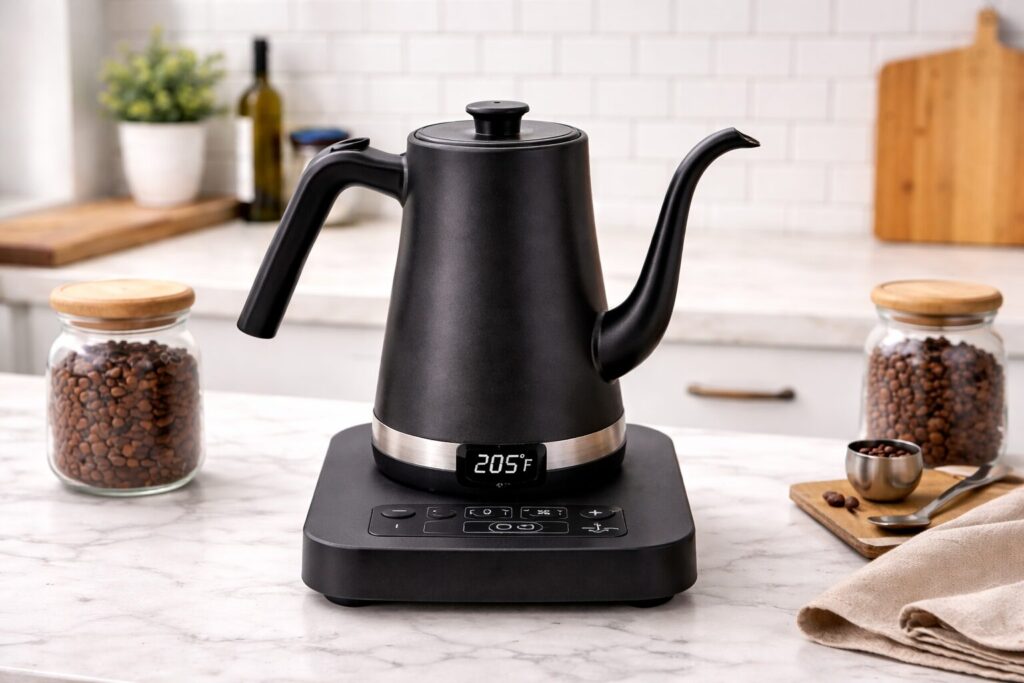
Best Overall: Fellow Stagg EKG Electric Gooseneck Kettle
The single most impactful AeroPress upgrade you can make after buying a burr grinder. The Stagg EKG holds temperature to within ±1°C for 60 minutes, eliminating the largest source of AeroPress-to-AeroPress variability. Set 92°C for your light roast, 87°C for your medium roast, press start, and the temperature is locked until you’re done brewing — no guessing, no waiting, no visual checks.
- Holds temperature ±1°C for 60 minutes — set once, brew all morning
- Variable temperature 40–100°C in 1°C steps — full AeroPress range covered
- Gooseneck spout gives pour control for inverted and slow-pour recipes
Disclosure: CoffeeGearHub may earn from qualifying purchases.
Best Value Kettle: Brewista Artisan Gooseneck
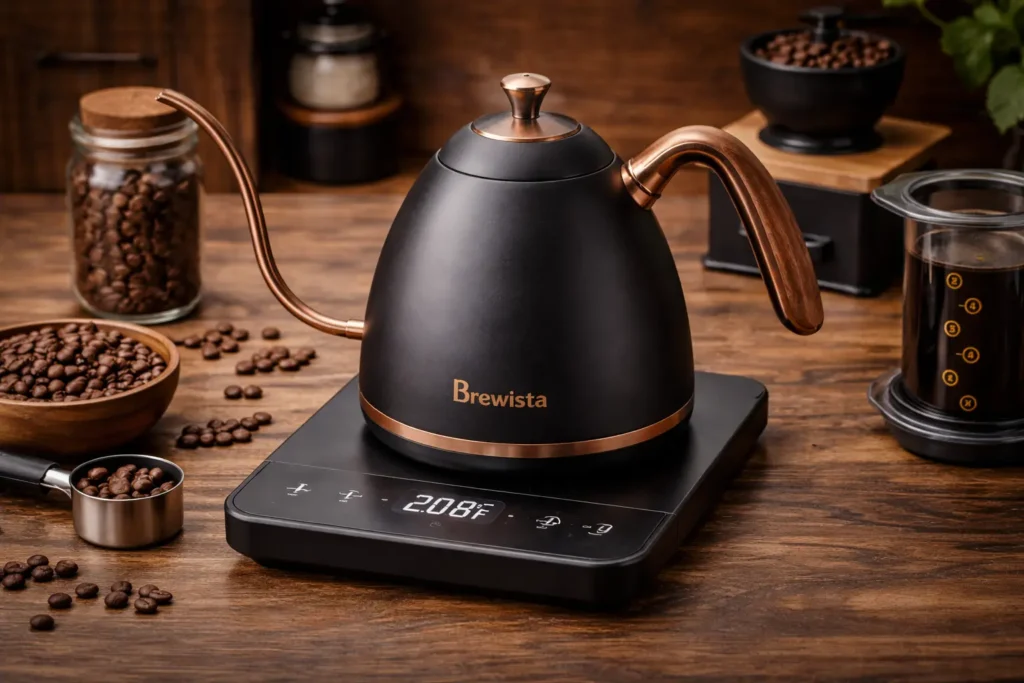
If the Fellow Stagg EKG is over budget, the Brewista Artisan delivers variable temperature control and hold mode at a lower price point. Its 1°C increment dial covers the full AeroPress temperature range and its narrow gooseneck spout provides the pour control you need for inverted and slow-pour recipes. An excellent entry point for anyone stepping up from a standard kettle.
- Variable temperature 60–100°C with 1°C steps
- 30-minute temperature hold mode
- Gooseneck spout — pour-over and AeroPress compatible
Disclosure: CoffeeGearHub may earn from qualifying purchases.
Best Budget Option: Javelin Pro Duo Instant-Read Thermometer
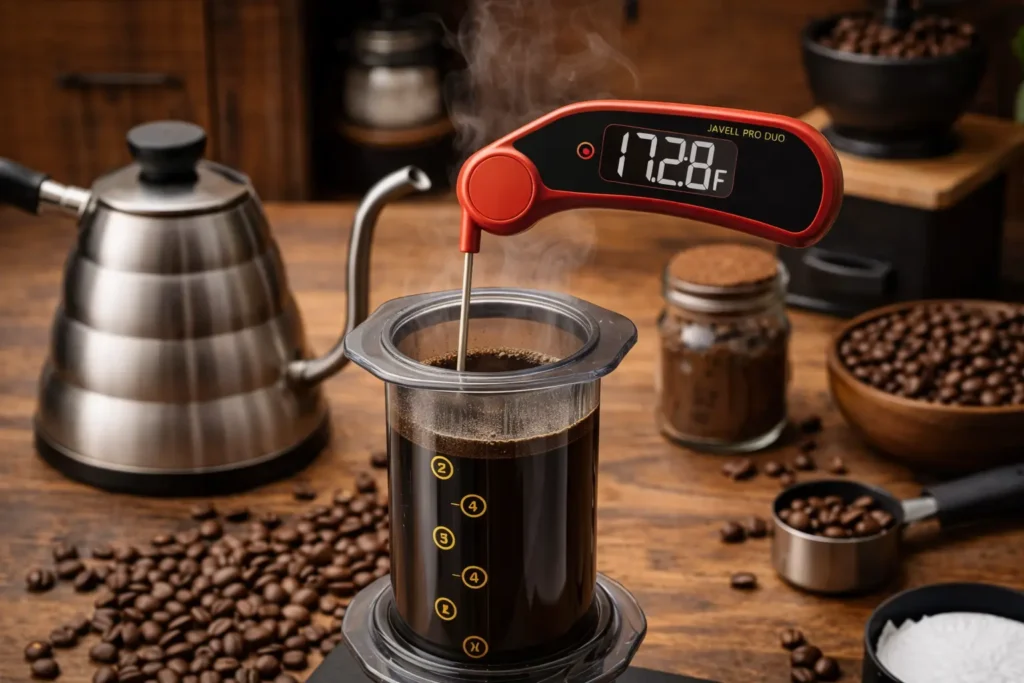
If you already have a standard kettle and don’t want to upgrade immediately, an instant-read thermometer is the lowest-cost way to add temperature precision to your AeroPress workflow. The Javelin Pro Duo reads in under 2 seconds with ±0.9°F accuracy — more than precise enough for coffee brewing. Dip into your kettle or mug before pouring and you’ll know exactly what temperature you’re working with.
- 2-second read time — fast enough to check temperature without losing more than 1°C
- ±0.9°F accuracy — more precise than necessary for AeroPress work
- Foldable probe — safe to store alongside AeroPress kit
Disclosure: CoffeeGearHub may earn from qualifying purchases.
Best Manual Grinder: KINGrinder K6
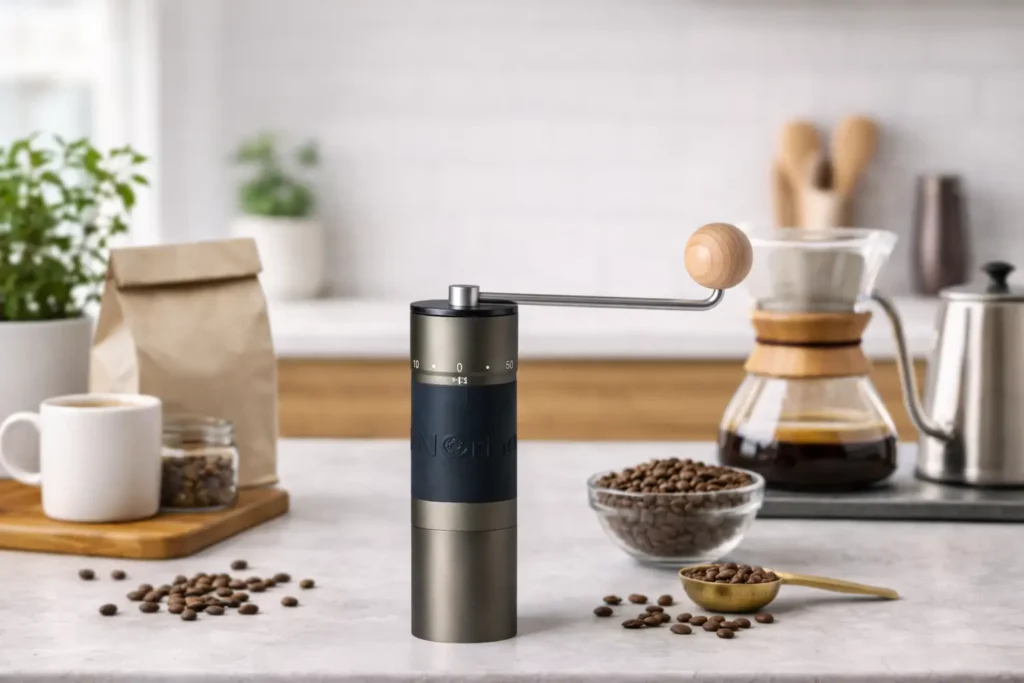
Temperature precision is meaningless if your grind is inconsistent. The K6’s 48mm stainless steel conical burrs produce a tight, predictable particle size distribution across the full AeroPress grind range — from espresso-style concentrate (clicks 12–16) through filter-style (clicks 22–28). When you adjust temperature 5°C and then taste, you need to know the only thing that changed was temperature — and with the K6, it will be.
- 100 click steps — 2-click adjustments produce clean, readable flavour changes
- 48mm stainless burrs — consistent across AeroPress espresso to filter range
- All-metal body — excellent travel companion for AeroPress-on-the-go setups
Disclosure: CoffeeGearHub may earn from qualifying purchases.
Best Scale: Timemore Black Mirror Basic+
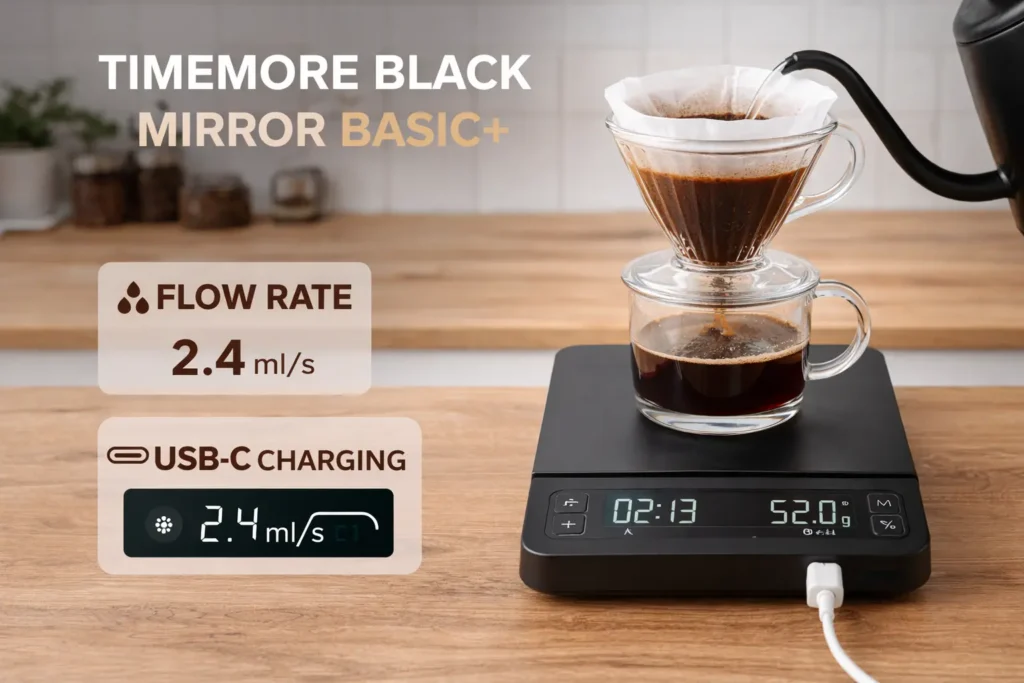
Dialling in AeroPress temperature requires knowing your exact coffee dose and water weight every time. The Timemore Black Mirror Basic+ gives you 0.1g accuracy and a built-in timer — so when you adjust temperature between brews, dose and timing stay identical and the comparison between cups is clean. USB-C charging means it’s always ready when you are.
- 0.1g resolution — precise enough for espresso-style concentrate ratios
- Built-in timer — eliminates one variable during temperature comparison brews
- USB-C charging with good battery life — no AA batteries to replace
Disclosure: CoffeeGearHub may earn from qualifying purchases.
Quick Reference: AeroPress Temperature Cheat Sheet
Bookmark this section or screenshot it for your brew station. All temperatures are starting points — adjust in 3–5°C steps based on taste feedback before moving to grind or time.
| Roast / recipe | Start temp | Range | Steep time | K6 clicks | If sour → | If bitter → |
|---|---|---|---|---|---|---|
| Extra light / Nordic | 96°C (205°F) | 93–100°C | 2:00–2:30 | 22–28 | Try near-boil | Shorten steep |
| Light roast | 93°C (199°F) | 90–96°C | 1:30–2:00 | 20–26 | +3°C → finer | −3°C first |
| Medium-light | 90°C (194°F) | 87–93°C | 1:30–2:00 | 22–28 | +3°C | −3°C |
| Medium roast | 87°C (189°F) | 83–90°C | 1:15–1:45 | 24–30 | +4°C | −4°C |
| Medium-dark | 83°C (181°F) | 80–87°C | 1:00–1:30 | 26–32 | +3°C | −4°C |
| Dark roast | 80°C (176°F) | 75–83°C | 0:45–1:15 | 28–34 | +4°C | −5°C + shorten |
| Concentrate (any) | 91°C (196°F) | 88–94°C | 0:45–1:15 | 13–16 | +3°C | −3°C + shorten |
| Flash-iced | 92°C (198°F) | 89–94°C | 0:45 | 18–20 | +2°C | Less ice/−3°C |
| Room-temp cold steep | Room temp | Room temp | 8–12hr | 12–16 | Steep longer | Steep shorter |
Final Takeaway
87–92°C is your AeroPress baseline. Roast level sets the direction — light roasts need more heat, dark roasts need less. Temperature is the first extraction lever to adjust; grind is the second. Change one at a time, log what you taste, stop when the cup is sweet, balanced, and clean. That temperature + grind + steep time combination, written down, is your recipe for that bean on that brewer — and it’s reproducible every morning with a scale and a temperature-controlled kettle.
FAQs: AeroPress Water Temperature
What is the best water temperature for AeroPress?
For most medium roasts, 85–90°C (185–194°F) is the best starting point. Light roasts benefit from 90–96°C (194–205°F) to overcome their dense, less-soluble structure. Dark roasts do better at 75–83°C (167–181°F) to prevent over-extraction of bitter compounds. There is no single universal AeroPress temperature — roast level is the most important determinant.
Why does the AeroPress manual say 80°C?
The 80°C recommendation in the original AeroPress manual is a conservative, universal safe starting point designed to prevent scalding and reduce the risk of over-extraction for dark-roasted commercial coffee. It predates the specialty coffee movement’s widespread adoption of light roasts. For light to medium roasts — especially specialty single-origins — 80°C consistently produces under-extracted, sour, hollow results. Most specialty-coffee brewers now use 87–96°C.
Does higher temperature always make AeroPress coffee better?
No — higher temperature extracts faster and more aggressively, which is correct for dense light roasts but damaging for dark roasts. For dark roast AeroPress, brewing above 87°C reliably produces excessive bitterness because dark-roasted beans are highly porous and soluble. The relationship between temperature and quality is roast-dependent, not universal.
Can I use boiling water in an AeroPress?
Yes — AeroPress plastic (Tritan co-polyester or polypropylene depending on model) is rated to 100°C and won’t be damaged by boiling water. Whether boiling water produces good coffee depends entirely on your roast. For extra-light or Nordic roasts, near-boiling temperatures (96–100°C) can be appropriate. For anything medium or darker, boiling water over-extracts and produces an unpleasantly bitter cup.
How do I measure AeroPress temperature without a thermometer?
Pour boiling water into a mug and wait: 30–40 seconds ≈ 96°C; 60–75 seconds ≈ 92–94°C; 75–90 seconds ≈ 87–90°C; 2:00–2:30 ≈ 83–86°C; 3:00–4:00 ≈ 78–82°C. These are approximate figures that vary with room temperature, mug size, and altitude. A temperature-controlled kettle or instant-read thermometer produces more consistent results.
Does water temperature matter for AeroPress cold steep?
For true cold steep (room temperature or refrigerator), temperature is replaced by time as the primary extraction variable. Cold water extracts solubles very slowly, so you compensate with a much finer grind (K6: 10–16 clicks), a higher coffee-to-water ratio (1:6–1:8), and a long steep (8–20 hours). The resulting concentrate is smooth and low-bitterness precisely because cold temperatures never provide enough energy to dissolve the harsh bitter compounds.
Should I preheat my AeroPress before brewing?
Yes — preheating with hot water reduces temperature loss during the brew. Unpre-heated AeroPress plastic can drop water temperature by 3–6°C during the first pour, which introduces inconsistency between brews. Simply pour hot water through the cap, flip, and discard before adding your ground coffee. This takes 20 seconds and meaningfully improves temperature consistency across multiple brews.
Is the inverted AeroPress method better at high temperatures?
The inverted method eliminates the drip-through that occurs in the standard upright position during steep time. At higher temperatures (90°C+), this matters more because faster extraction during the steep means any inconsistency in when water starts flowing through the filter changes the cup. Inverted gives you complete control over steep time at high temperatures, making it the preferred method for light roast recipes above 90°C.
Why does my light roast AeroPress always taste sour?
Sourness in light roast AeroPress is almost always under-extraction — you’re not dissolving enough sugars and aromatics to balance the organic acids. The most common cause is temperature that’s too low (below 88°C for most light roasts). Raise your water temperature to 92–96°C, extend your steep to 1:30–2:00, and grind 2–3 clicks finer. If sourness persists after all three adjustments, check your bean’s roast date — very fresh beans (under 5 days off roast) can also produce sour results due to retained CO2.
Does water temperature affect AeroPress at altitude?
Yes — significantly. Water boils at lower temperatures at altitude: approximately 98°C at 600m, 95°C at 1500m, and 90°C at 3000m. If you’re brewing at elevation, your ‘boiling’ water is already several degrees cooler than at sea level. For light roasts in high-altitude environments, you may need to use water right at its boiling point and extend steep time to compensate for the lower maximum achievable temperature.
Continue Learning
AEROPRESS CLUSTER
Want to use your dialled-in AeroPress concentrate for lattes? Pair the concentrate playbook above with a quality milk frother — no espresso machine required.
☕
Written by the CoffeeGearHub Editorial Team
CoffeeGearHub is a specialty coffee equipment resource run by home brewers and coffee enthusiasts. Our guides are researched using published brewing science, SCA standards, grinder manufacturer specifications, and established specialty-coffee community knowledge. We review and update our pillar content regularly. About CoffeeGearHub →