
Last Updated: March 2026 • 25–35 min read • Cornerstone Guide: Siphon Coffee Makers Buyer’s Guide + Vacuum Brewing Science + Step-by-Step Recipe + Top Picks
Best Siphon Coffee Makers (2026): Buyer’s Guide, Top Picks & Brewing Science
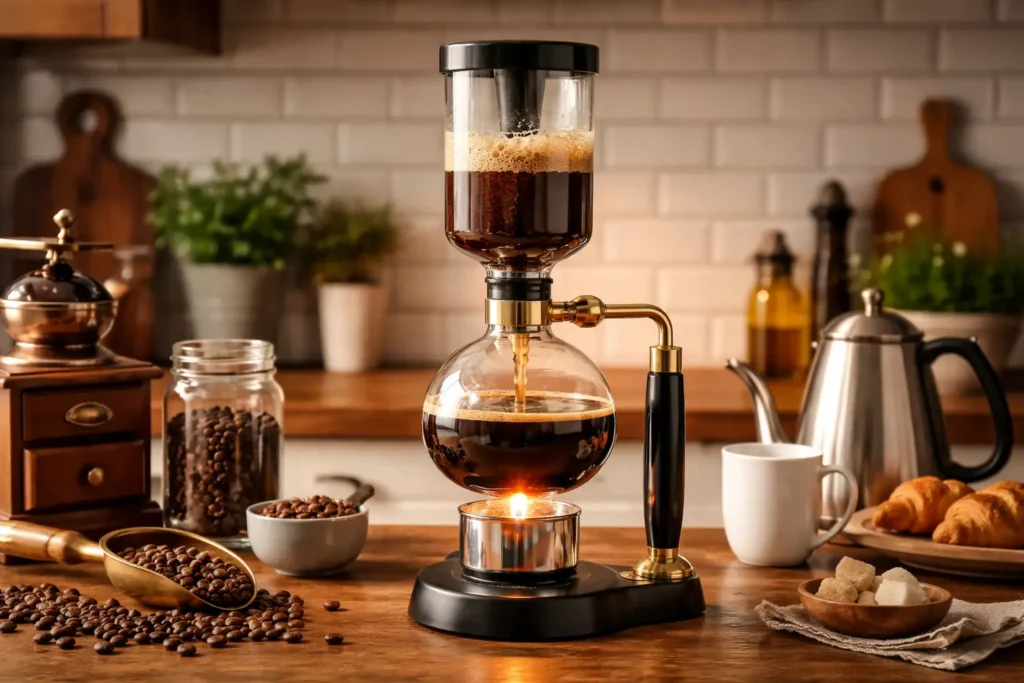
Siphon coffee makers (vacuum brewers) aren’t just coffee theater — they can produce an unusually clean, sweet cup with exceptional aroma and impressive flavour separation. The first time you watch a siphon brew, it doesn’t feel like making coffee: water rises like it has a mission, coffee blooms in the upper globe, and then the best part — the drawdown, where brewed coffee gets pulled back through the filter with a quiet, satisfying whoosh. But the reason siphon brewing sticks with you isn’t the visuals. It’s the taste. The cup is often cleaner than French press, sweet like immersion, and more aromatic than most pour-overs. This complete CoffeeGearHub guide covers everything: how vacuum brewing works, what separates a great siphon from a frustrating one, our verified top picks across every category, the extraction science behind the method, a step-by-step repeatable recipe, and a full troubleshooting matrix for diagnosing bad cups.
✍️ Editorial note: This guide is researched and written by the editors at CoffeeGearHub.com using published brewing science, SCA brewing standards, manufacturer specifications, and established specialty-coffee community knowledge. Recommendations reflect research consensus and community reputation. All product links are affiliate links — we may earn a commission at no cost to you. Affiliate Disclosure: CoffeeGearHub.com participates in the Amazon Services LLC Associates Program. As an Amazon Associate, we earn from qualifying purchases.
The 30-Second Answer
For most home brewers, the Hario Technica is the best siphon coffee maker to buy — reliable seal, consistent drawdown, and the best long-term parts support of any vacuum brewer at its price. If you want zero heat-management variables and repeatable results, the Tiger Siphonysta electric siphon is the premium choice. If budget is the primary constraint, the Yama Glass stovetop siphon produces excellent cups once you dial grind and drawdown. For minimalist kitchens, the Bodum PEBO delivers the vacuum-brewed sweetness with the smallest footprint. The brewer matters less than you think once you understand the method — but the right siphon removes the biggest friction points while you’re learning, and makes great cups genuinely repeatable once you’re dialled in.
- Best Overall: Hario Technica 3–5 Cup — reliable seal, consistent drawdown, best parts support (~$60–$80)
- Best Electric: Tiger Siphonysta — removes heat-management variables entirely, programmable precision (~$200–$250)
- Best Value: Yama Glass Stovetop — high cup quality ceiling at a lower entry cost (~$40–$60)
- Best Minimalist: Bodum PEBO Vacuum Brewer — smallest footprint, simplest daily-driver setup (~$50–$70)
- Best Grinder Pairing: KINGrinder K6 — the CoffeeGearHub standard manual grinder, ideal for siphon’s medium-fine range
Who This Guide Is For — Jump to What You Need
☕ First Siphon Brewer
Start with What Is a Siphon, then jump to Top Picks for a match to your budget and setup.
🔬 Extraction Nerd
Go straight to the Extraction Science section — vapour pressure, immersion dynamics, filtration types, and the drawdown feedback loop.
📋 Recipe Brewer
Jump to the Step-by-Step Recipe — ratio, grind, steep time, and drawdown targets all in one place.
🔧 Troubleshooter
Jump to the Troubleshooting Matrix — bitter, sour, cloudy, won’t rise, drawdown stall, all covered.
Table of Contents
- What is a siphon coffee maker (vacuum brewer)?
- Why siphon coffee tastes different: method comparison
- What makes a great siphon brewer: 5 variables that matter
- Top picks: best siphon coffee makers by category
- Full reviews: what it’s like to live with each brewer
- Roaster pick for siphon
- Best grinder pairing (KINGrinder K6)
What Is a Siphon Coffee Maker (Vacuum Brewer)?
A siphon coffee maker — also called a vacuum coffee brewer or vac pot — uses two chambers, a filter (cloth, paper, or metal), and heat to brew through a cycle of vapour pressure and vacuum drawdown. It’s immersion brewing and filter brewing rolled into one: heat pushes water up into the upper chamber where it steeps with the coffee grounds, then removing the heat creates a partial vacuum that pulls the brewed coffee back down through the filter into the lower chamber. What you’re left with is a clean, filtered cup that was fully immersed during extraction — which is why siphon coffee occupies a unique flavour space that other methods don’t easily replicate.
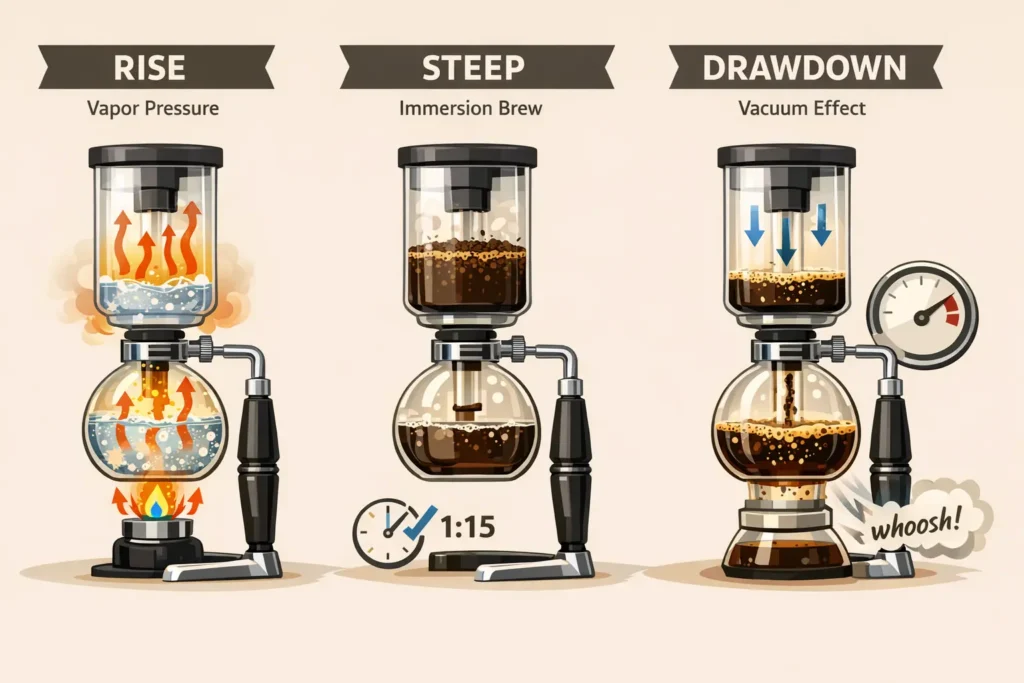
🔬 The brew physics: Heating the lower chamber converts water to steam, increasing pressure and pushing water up through the tube into the upper chamber. When you remove the heat source, the steam condenses rapidly, collapsing the pressure and creating a partial vacuum. That vacuum pulls the brewed coffee back down through the filter at a controlled rate — and the speed of that drawdown is the single most important feedback signal in siphon brewing. Too slow means over-extraction; too fast means under-extraction. The drawdown is your “truth serum.”
Why Siphon Coffee Tastes Different: Method Comparison
Siphon brewing is famous for producing a cup that lands in a distinctive sweet spot: clean like a pour-over but with roundness and sweetness more similar to immersion brewing. Because the brew is filtered during drawdown, you get less sediment than French press. Because the coffee spends time fully immersed, you often get more even extraction than a rushed pour-over. The result is a cup that can make a single-origin taste almost “higher resolution” — more aromatic and more articulate than most other methods at their best.
| Method | Body | Clarity | Aromatics | Consistency | Best for |
|---|---|---|---|---|---|
| Siphon (Vac Pot) | Medium | High | Very High | High (once dialled) | Light/medium roasts, aroma-forward cups |
| Pour-over | Low–Medium | Very High | High | Medium | Tea-like clarity, delicate profiles |
| French press | High | Low | Medium | High | Bold cups, heavy body |
| AeroPress | Medium–High | Medium–High | High | High | Versatile, fast, forgiving |
| Auto drip | Medium | Medium | Medium | High | Convenience, daily volume |
What Makes a Great Siphon Brewer: 5 Variables That Actually Matter
The siphon market spans from $40 stovetop glass brewers to $250+ electric units. Most will produce siphon coffee. What separates genuinely excellent brewers from frustrating ones is a combination of five factors — none of which are about brand name or aesthetic. Understanding what each contributes tells you exactly what to prioritise and what marketing language to ignore.
| Factor | Why it matters | What to look for | What to avoid |
|---|---|---|---|
| Seal quality | The gasket seal between chambers determines whether water rises properly — a poor seal is the #1 source of beginner frustration | Snug-fitting rubber or silicone gasket; consistent seal without excessive force; replacement gaskets available | Loose-fitting gaskets that allow steam to escape rather than driving water upward |
| Glass quality | Borosilicate glass handles thermal shock from repeated heating cycles; lesser glass can crack mid-brew | Borosilicate glass explicitly stated; thick walls; no visual imperfections | Unspecified “heat-resistant glass”; very thin walls; budget sets with no glass-grade information |
| Filter type and fit | The filter’s weave, material, and how it seats determines clarity, body, and drawdown speed — and whether grounds bypass into your cup | Cloth filter with tight weave; proper chain/spring anchor; easy replacement; paper filter option available | Poorly seated filter that can shift during brewing; filters without a reliable anchor mechanism |
| Heat source compatibility | Different siphon brewers are designed for different heat sources — getting this wrong means your water won’t rise or your glass risks thermal stress | Confirm compatibility before buying: butane burner, alcohol lamp, stovetop (gas/electric), or electric base | Using a stovetop siphon on induction without confirming compatibility; electric hobs with poor heat control on thin glass |
| Parts availability | Cloth filters, gaskets, and the upper chamber are all wear items — a brewer with no parts support becomes unusable when one component fails | Brand-supported accessories (Hario is the gold standard); filters and gaskets available on Amazon | Generic/unbranded siphons where replacement parts require searching obscure import sites |
Best Siphon Coffee Makers: Our Top Picks
These picks represent the best siphon coffee maker in each category — verified by community reputation, build quality, and how well each serves its specific use case. All product links use the CoffeeGearHub Amazon Associates tag (coffeegearhub-20).
3–5 Cup
Brewing Machine
Stovetop Siphon
Vacuum Brewer
Full Reviews: What It’s Actually Like to Live With Each Siphon Brewer
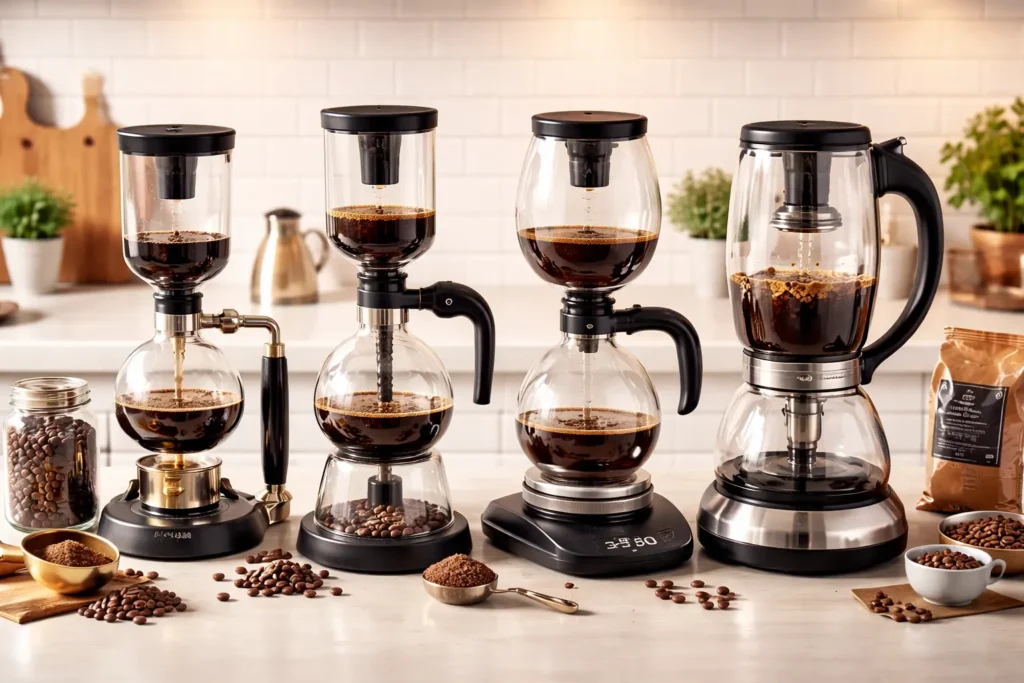
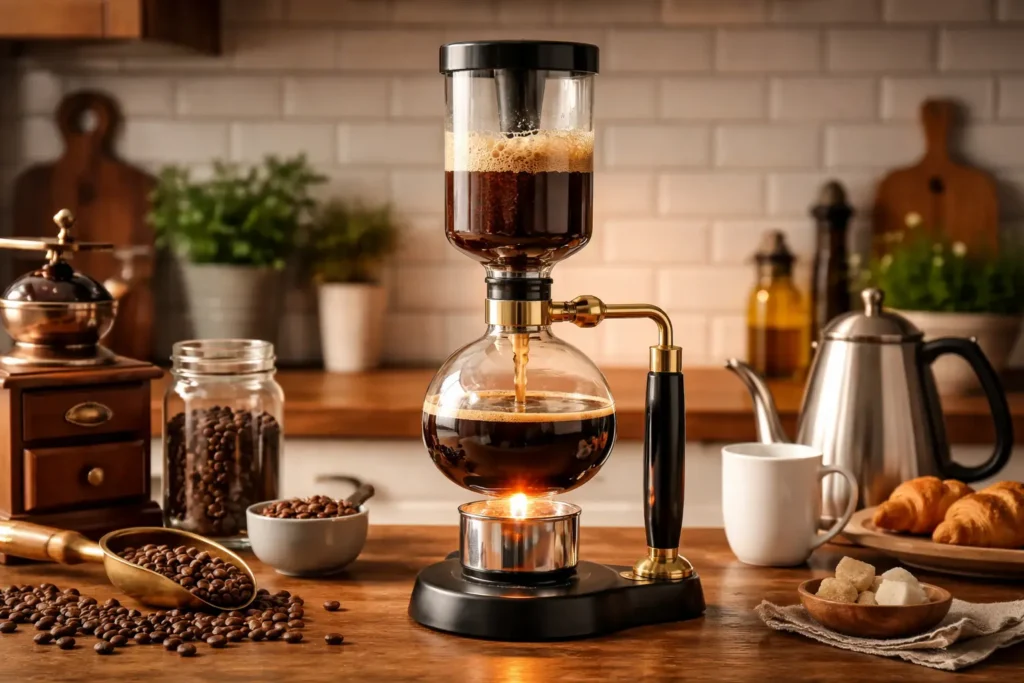
Affiliate link — we may earn a commission at no extra cost to you.
Check Price on Amazon → Replacement filters →🏆 Hario Technica (3–5 Cup) — Best Overall
Here’s the honest truth about the Hario Technica: it’s the siphon brewer that makes you feel like you’re good at siphon coffee sooner. Not because it “cheats,” but because the fundamentals — seal integrity, glass quality, filter fit — are simply more predictable than anything in its price range. When you’re learning vacuum brewing, that predictability matters enormously. The gasket seal is consistently snug, which means fewer “why won’t it rise?” sessions while you’re building the muscle memory for the method.
In day-to-day use, the Technica is a rhythm brewer. Once you find a grind size that produces a 20–35 second drawdown, you’ll start seeing repeatable cups: clean finish, clear aromatics, and a sweetness that’s hard to get from most drip machines. If you brew light or medium roasts — Ethiopia, Kenya, washed Colombia — this is where siphon coffee feels like it’s playing to its strengths. Hario’s parts ecosystem (filters, gaskets, upper chambers) is the best-supported of any siphon brand, which means this brewer can last years with proper care.
Who it’s for
- Home brewers who want a reliable siphon that won’t punish them for small mistakes during learning.
- Anyone who values long-term parts availability (filters, gaskets, accessories are all stocked on Amazon).
- People who love aroma-forward cups and want more separation than French press delivers.
What we like (real-world)
- Consistent gasket seal — the biggest single reducer of beginner frustration.
- Clean drawdown when dialled — great clarity without feeling watery or hollow.
- Easy maintenance loop: rinse immediately, store cloth filter properly, repeat.
- Best learning platform for understanding how grind and steep time affect extraction.
Watch-outs
- Cloth filters need proper care — rinse immediately after each brew and replace every 2–3 months.
- Borosilicate glass is strong but not invincible — treat assembly like lab glassware, not cookware.
Bottom line: If you want a siphon coffee maker that’s easier to master and easier to keep running for years, the Hario Technica is the safest “best overall” bet. The tighter seal and more predictable drawdown get you to “great cups” faster than any competitor at this price.
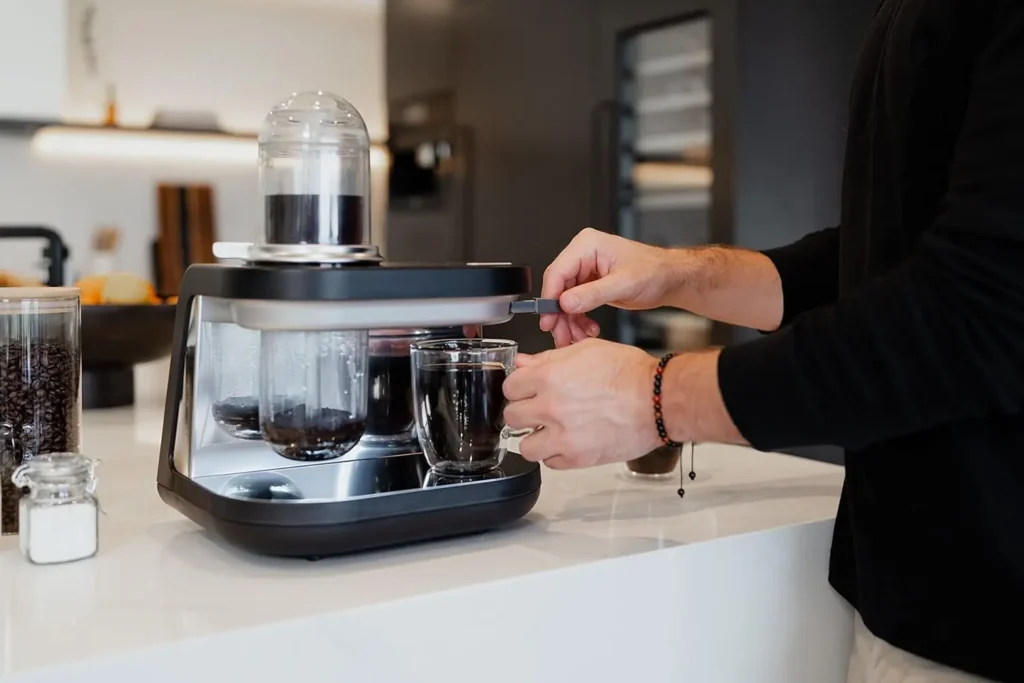
Affiliate link — we may earn a commission at no extra cost to you.
Check Price on Amazon →⚡ Tiger Siphonysta Brewing Machine — Best Electric
An electric siphon brewer is the shortcut that still feels legit. With the Tiger Siphonysta, you’re not adjusting flame height or guessing when to pull heat — the machine controls temperature curves and timing automatically. Your focus shifts entirely away from heat management and toward the variables that actually shape flavour: grind size, brew ratio, steep time, and drawdown behaviour. That’s a meaningful shift, especially when you’re in the early stages of dialling in.
Where traditional siphons feel artisanal, the Siphonysta feels engineered. It keeps the clarity and aromatic structure siphon brewing is known for but adds programmable consistency that removes much of the trial-and-error. The result is repeatable, café-level cups without managing burners or manually timing every phase. You lose some of the old-school drama, but you gain something arguably more valuable: reliable sweetness, stable extraction, and fewer unpredictable cups. For anyone who wants siphon coffee as a precision-driven daily routine rather than an occasional ritual, this is the correct pick.
Who it’s for
- Upgraders who already care about brew variables and want automation without sacrificing quality.
- Tech-forward brewers who appreciate programmable extraction control over open-flame ritual.
- Anyone who loves siphon flavour but prefers the stability of electric heat over a butane burner.
What we like
- Programmable heating removes the biggest learning curve in siphon brewing entirely.
- Consistent temperature control improves sweetness and clarity cup-to-cup.
- Premium stainless-enhanced design feels substantial and long-lasting.
- Authentically siphon-tasting cup — the aromatic profile is preserved, not flattened.
Watch-outs
- Higher price than glass siphons — the premium is for convenience and repeatability, not a fundamentally different cup.
- Less “hands-on theatre” compared to manual burner models — if the ritual matters to you, this feels different.
- Single-serve orientation may not suit anyone brewing for multiple people regularly.
Bottom line: If your goal is repeatable precision with premium build quality, the Tiger Siphonysta is the strongest electric siphon choice. It keeps the essence of vacuum brewing while dramatically reducing the guesswork.
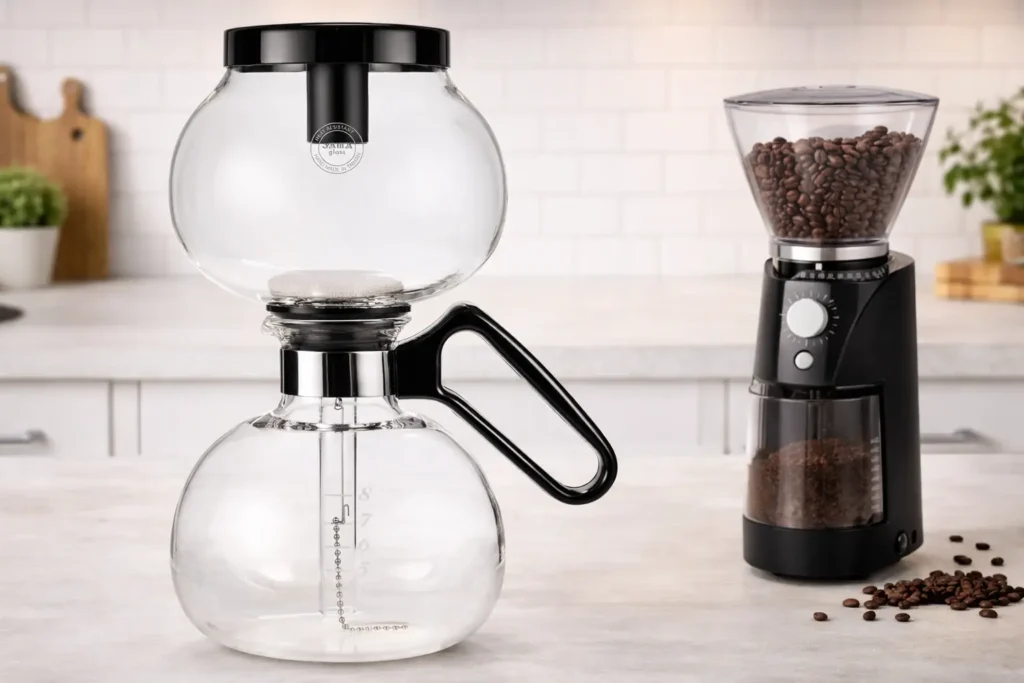
Affiliate link — we may earn a commission at no extra cost to you.
Check Price on Amazon →💰 Yama Glass Stovetop Siphon — Best Value
The Yama Glass siphon is the one to recommend when someone says “I want to try siphon brewing but I’m not ready to go full coffee scientist.” It’s a value pick, not a compromise pick. Once you nail your grind and heat routine, Yama can produce cups that are shockingly close to higher-priced siphons — the cup quality ceiling is genuinely high. The main practical advantage is stovetop compatibility: if you have a gas range, you can keep your entire brew routine contained to your existing cooking setup, with no separate burner to manage or store.
That simplicity matters for habit formation. Siphon gets more fun the more familiar it becomes, and a brewer that fits naturally into your existing kitchen routine is more likely to be used consistently than one that requires a dedicated counter setup. The key dial-in habit: watch drawdown speed and adjust grind accordingly. Get that feedback loop working and Yama produces genuinely excellent cups.
Who it’s for
- First-time siphon buyers who want a lower cost of entry to test the method.
- People with a gas stovetop who prefer fewer dedicated appliances.
- Anyone willing to learn one key habit: watch drawdown, then adjust grind accordingly.
What we like
- Excellent price-to-performance ratio — the cup quality ceiling is comparable to more expensive siphons.
- Stovetop compatibility simplifies setup for gas and electric hob kitchens.
- Strong “training grounds” for understanding how vacuum brewing mechanics work.
Watch-outs
- Seal sensitivity can be slightly less forgiving than Hario — take 10 seconds to seat everything carefully before applying heat.
- Replacement parts availability is less universal than Hario — confirm before buying.
Bottom line: If you want siphon coffee without a premium price tag, Yama is the smartest value play — especially if your stovetop setup is gas-compatible.

Affiliate link — we may earn a commission at no extra cost to you.
Check Price on Amazon →✨ Bodum PEBO Vacuum Brewer — Best Minimalist
The Bodum PEBO is siphon brewing for people who want the flavour but don’t want their kitchen to look like a science fair. It’s cleaner visually, typically simpler to store, and feels more “daily-driver” than the classic stand-mounted siphon style. The compact footprint means it’s more likely to stay out on the counter — and a brewer you reach for daily beats a more impressive one you leave in the cabinet.
In the cup, the PEBO tends to be especially satisfying with medium roasts: chocolaty, caramel-forward, nutty profiles — coffees that taste “complete” without requiring extreme clarity. If your taste leans toward comfort and sweetness more than ultra-bright florals, this is a very happy landing spot. Like all vacuum brewers, it still rewards a good burr grinder and a consistent brew ratio — but the setup ceremony is as minimal as siphon gets.
Who it’s for
- Smaller kitchens and minimalist counter setups.
- Brewers who want vacuum-style cups without managing a full stand-mounted siphon rig.
- People who brew medium roasts most days and want clean, sweet, and uncomplicated.
What we like
- Compact footprint and simpler storage than stand-mounted siphons.
- Approachable daily routine — less setup ceremony, more “make coffee.”
- Great for balanced coffees where sweetness matters more than maximum floral clarity.
Watch-outs
- Not the top pick if you chase ultra-light roasts and want maximum aromatic separation.
- Like all vacuum brewers, it still rewards a good burr grinder and consistent ratio.
Bottom line: The PEBO is the “beautiful and practical” siphon-style brewer — perfect if you want vacuum-brewed sweetness without the stand-mounted rig and without overpaying.
Roaster Pick for Siphon
Siphon brewing is exceptionally sensitive to freshness and roast profile. If you’ve ever had a siphon cup that tasted oddly flat, there’s a good chance it wasn’t the brewer — it was stale coffee or a roast that didn’t match the method’s strengths. Because siphon amplifies aromatics and exposes defects more readily than most brew methods, the quality of your beans matters more here than it does for, say, a milk-based espresso. The guide’s core recommendation throughout is for light to medium roasts — floral, fruity, caramel-forward profiles where siphon’s clarity and sweetness can shine.
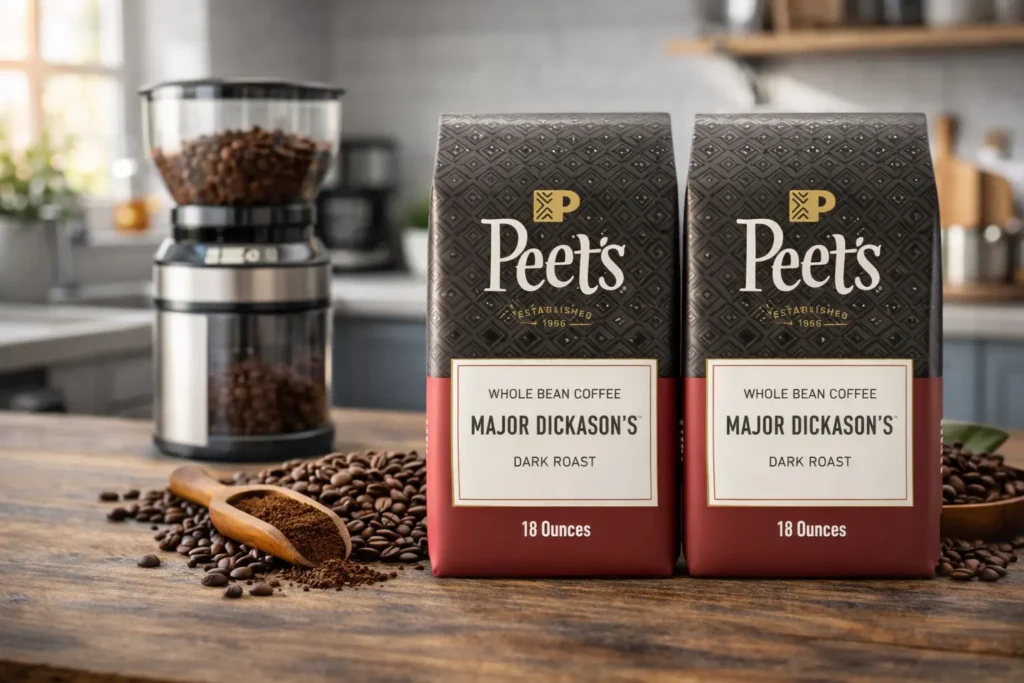
Peet’s Coffee (Roaster Pick — Rich & Sweet Profile)
If you prefer a richer, more structured siphon cup — chocolate, caramel, toasted nut — rather than the bright floral profile that defines the method’s ceiling, a Peet’s-style medium-dark roast can work well. Siphon stays cleaner than French press even with darker roasts, preserving sweetness while keeping sediment out. Note: if you lean toward darker profiles like Major Dickason’s Blend, reduce steep time by 10–15 seconds versus the standard recipe to avoid bitterness.
- Best for: medium-to-dark cups (chocolate, caramel, toasted nut)
- Why it works: siphon stays clean and removes sediment even with darker roast profiles
- Dial-in tip: shorten steep time 10–15 seconds vs the standard recipe to avoid bitterness on darker roasts
- For brighter, floral siphon cups: seek out a light-roast Ethiopia or Kenya from a local specialty roaster
Why freshness matters more for siphon: the method amplifies aroma and exposes defects — better roast consistency means fewer harsh, flat, or papery cups. Aim for beans roasted within the last 2–3 weeks.
Best Grinder for Siphon: KINGrinder K6
Grind consistency is the prerequisite for the siphon’s vacuum mechanics to do their job. Even with a perfect seal and ideal steep time, an uneven grind produces an unpredictable drawdown — partly because the fines clog the filter, and partly because particles of wildly different sizes extract at completely different rates. Grind size is the most direct lever you have over drawdown speed, which is the feedback signal that tells you whether your extraction is on track. The finer the grind, the slower the drawdown (more extraction); the coarser, the faster (less extraction). You need a grinder precise enough to make small, readable adjustments.
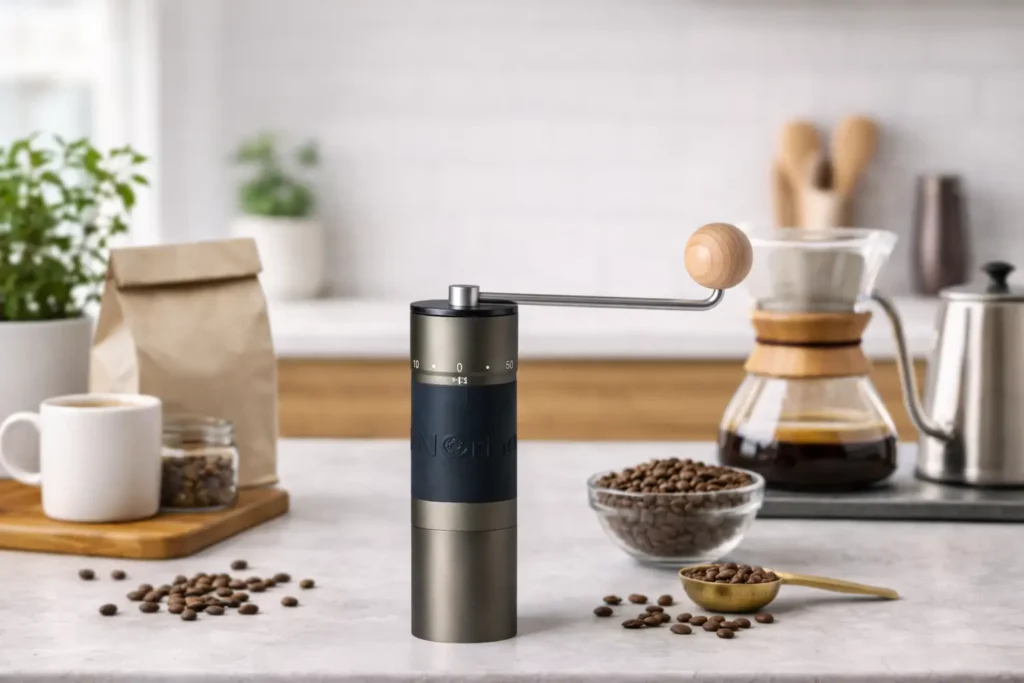
KINGrinder K6 — The CoffeeGearHub Standard Siphon Grinder
The KINGrinder K6 is the CoffeeGearHub standard manual grinder recommendation across all brewing content, and for siphon specifically, its 100-click adjustment system is ideally suited to the medium-fine dial-in that vacuum brewing requires. The 48mm stainless conical burrs produce low fines at siphon settings (clicks 22–30), which is critical for consistent drawdown behaviour — excessive fines at medium-fine settings clog the cloth filter and cause stalling, which continues to over-extract the brew as it sits. A 3–5 click adjustment at siphon settings produces a readable drawdown shift, making the K6 one of the most effective dial-in tools available at its price point. Pair it with the Technica or any siphon brewer on this list and you remove the two largest variables from the method at once.
- Siphon grind starting point: 22–28 clicks from zero for most siphon brewing (medium-fine)
- 100-click adjustment: 3–5 click steps produce clean, measurable drawdown changes — ideal for dialling in
- 48mm conical burrs: low fines at siphon settings — reduces cloth filter clogging and drawdown stalls
- All-metal body: durable for daily 18–22g doses; no plastic components in the grinding path
Disclosure: CoffeeGearHub may earn from qualifying purchases.
For a full comparison of grinder types and how they affect extraction, see our companion guides: Burr vs Blade Grinders and Manual vs Electric Grinders.
Comparison Table: Which Siphon Brewer Fits Your Life?
If you’re stuck between two models, match them to your real routine: time, heat source, parts availability, and how often you’ll actually brew. The right brewer is the one you’ll reach for consistently.
| Brewer | Best For | Price Range | Heat Source | Skill Level | Cup Profile | Parts Support |
|---|---|---|---|---|---|---|
| Hario Technica | Enthusiasts, most households | ~$60–$80 | Butane / alcohol burner | Intermediate | Clean, sweet, aromatic | Excellent |
| Tiger Siphonysta | Precision daily use, tech-forward brewers | ~$200–$250 | Electric base (built-in) | Beginner | Consistent, clean, aromatic | Very Good |
| Yama Glass | Budget-first, stovetop-friendly | ~$40–$60 | Stovetop / burner | Beginner–Intermediate | Clean with a touch more body | Good |
| Bodum PEBO | Small kitchens, simple daily routine | ~$50–$70 | Stovetop | Beginner–Intermediate | Balanced, sweet, approachable | Good |
Siphon Extraction Science (Why the Method Can Taste “Clean + Sweet”)
If you want consistently great siphon coffee, here’s the mindset shift: siphon brewing isn’t mystical. It’s a very visible way to manage the same extraction variables that control every other method — temperature, time, agitation, grind size, and filtration. The reason siphon feels special is because you can see the brew phase and see the drawdown. Understanding what’s actually happening at each stage gives you real levers to pull when the cup isn’t right.
1) Vapour Pressure + Vacuum Drawdown = Built-In Brew Cycle
Water rises into the upper chamber because heating the lower chamber increases pressure. When you remove heat, the vapour cools and condenses, creating a partial vacuum that pulls brewed coffee back down through the filter. That drawdown is doing double duty: it’s a filtration step and a final extraction control step. Too slow, and more compounds extract (often bitterness and dry finish). Too fast, and you risk under-extraction (thin, sour, hollow cups). Drawdown is your feedback loop — the method’s built-in “truth serum.” See our grind size guide for how to read drawdown speed and adjust accordingly.
2) Immersion Extraction: Why Siphon Can Taste Sweeter Than Pour-Over
Immersion brewing tends to extract more evenly because all grounds are exposed to water at similar concentration over time. In pour-over, parts of the bed can see “fresh” water while others see concentrated water — creating uneven extraction if technique isn’t consistent. In siphon, once coffee is added, all grounds share the same thermal environment. That makes it easier to achieve a cup that feels sweet, rounded, and balanced, especially when your ratio and steep time are consistent. This is why siphon often tastes “richer” than a pour-over at equivalent grind and temperature settings.
3) Filtration: Cloth vs Paper vs Metal Changes Clarity, Body, and Aroma
Filters don’t just remove sediment — they change perceived sweetness, body, and aromatics because oils and fine particles carry flavour. Understanding the trade-off helps you choose the right filter for the cup you want:
| Filter | Clarity | Body | Aroma Feel | Best For |
|---|---|---|---|---|
| Cloth | High | Medium | Rich + clean | “Classic siphon” balance — recommended starting point |
| Paper | Highest | Low–Medium | Bright + crisp | Very light roasts, tea-like cups |
| Metal mesh | Medium | High | Bold + heavy | French press fans who want less sediment |
4) The Drawdown “Tells You Everything”
If you only remember one siphon rule, make it this: drawdown behaviour is your feedback loop. It reflects grind distribution, filter condition, and extraction dynamics simultaneously. Use it to diagnose and correct before the next brew rather than guessing randomly at variables.
| Drawdown speed | What it signals | Adjustment |
|---|---|---|
| 20–35 seconds | Ideal — sweet spot for clarity + sweetness | Keep this grind setting |
| 45+ seconds (stalling) | Too fine / too many fines / filter clogging | Coarsen grind 3–5 clicks; rinse/replace filter |
| Under 15 seconds | Too coarse / under-extraction | Fine grind 3–5 clicks; check ratio |
5) Water Chemistry Matters More Than You Think
Siphon coffee’s clarity makes water issues obvious faster than most methods. If your cup tastes flat, chalky, or strangely bitter even with fresh coffee and a correct recipe, water mineral balance can be the culprit. You want enough minerals to extract sweetness, but not so much hardness that the cup tastes dull and lifeless. If you’re serious about siphon brewing, your “next level” upgrade is often better water, not a new brewer — a Brita-filtered water supply removes chloramine compounds that interfere with aroma and significantly slows scale build-up.
Siphon Coffee Recipe (Step-by-Step, Repeatable)
This is a dependable baseline siphon recipe you can scale for any vacuum brewer. Start here, then dial grind and steep time based on drawdown speed and taste. For a deeper look at how ratios affect flavour, see our Coffee Brew Ratio Guide.
Recipe at a Glance
Coffee: 36g (medium-fine)
Water: 540ml filtered
Ratio: 1:15
Water temp: 90–93°C (194–200°F)
Steep: 60–90 sec
K6 grind setting: 22–28 clicks
Filter: cloth (pre-soaked)
Drawdown target: 20–35 sec
Total brew time: ~5–7 min
- Prep your filter. Soak the cloth filter in hot water for 2–3 minutes. This reduces fabric taste and improves flow rate consistency. Seat it properly — a poorly seated filter is the most common cause of cloudy cups and drawdown stalls.
- Preheat your water. Heat water in a gooseneck kettle or saucepan first, then add it to the lower chamber. Preheating shortens total brew time and improves temperature consistency at the brewing stage.
- Start heating the lower chamber. Apply heat and place the upper chamber on top loosely at first. Seal fully once water is ready to rise — not before.
- Watch the rise. Water will move into the upper chamber via vapour pressure. A small amount remaining in the lower chamber is normal and expected.
- Add coffee and stir gently. Add 36g of ground coffee, then stir for 5–10 seconds to fully saturate all grounds. Start your timer.
- Steep for 60–90 seconds. Maintain modest heat — avoid a rolling boil in the upper chamber. A calm, controlled brew gives you cleaner flavour.
- Stir once mid-steep. A gentle stir at ~45 seconds improves even extraction across all grounds. Don’t agitate aggressively or whip air into the brew.
- Remove heat to trigger drawdown. No heat means the vapour cools and contracts, creating the vacuum that pulls coffee through the filter. Wrap a cool damp cloth around the lower chamber to speed drawdown if needed.
- Monitor drawdown: target 20–35 seconds. If it stalls, your grind is too fine or the filter is partially clogged. If it finishes in under 15 seconds, your grind is too coarse. See the troubleshooting matrix for full diagnosis.
- Serve immediately. Siphon coffee is exceptional slightly cooled — allow 1–2 minutes in the cup before tasting for full aroma and flavour expression.
🔬 Dial-in note: If your cup tastes sour or thin despite a 25-second drawdown, try raising steep time by 15 seconds before adjusting grind. If it tastes bitter, reduce steep time before coarsening grind. Change one variable at a time and use drawdown speed as your primary readout. For a full framework on adjusting for taste, see our How to Dial In Coffee at Home guide.
Troubleshooting Matrix: Taste → Cause → Fix
Most siphon problems reduce to four variables: grind, steep time, temperature, and drawdown speed. Confirm the cause before changing equipment — most “brewer problems” are actually technique problems.
| Symptom | Most likely cause | Fix (in order) |
|---|---|---|
| Bitter / dry finish | Over-extraction — steep too long or drawdown too slow | Shorten steep by 15 seconds → coarsen grind 3–5 clicks → speed drawdown with cool cloth on lower chamber |
| Sour / thin | Under-extraction — grind too coarse, steep too short, or water too cool | Fine grind slightly → extend steep 15 seconds → confirm water at 90–93°C |
| Cloudy / gritty cup | Filter seating issue or worn / degraded cloth filter | Re-seat filter and chain carefully; replace cloth filter if older than 2–3 months |
| Water won’t rise | Seal not tight, heat too low, or not enough water volume | Check gasket seating; increase heat; preheat water before adding; brew near full capacity |
| Drawdown stalls | Grind too fine, excessive fines, or clogged cloth filter | Coarsen 3–5 clicks; rinse or replace filter; upgrade grinder if fines are persistent |
| Flat, no aroma | Stale beans — CO₂ depleted, volatile aromatics lost | Use fresher beans (roasted within 2–3 weeks); no recipe fix for stale coffee |
| Inconsistent cups from the same recipe | Heat fluctuating during steep, or variable pour speed adding coffee unevenly | Maintain steady heat during steep; add grounds more consistently; weigh coffee and water |
Cleaning and Maintenance: Keeping Your Siphon Performing
After Every Brew
- Rinse both chambers immediately with warm water while still warm
- Rinse the cloth filter immediately under warm running water — avoid soap on cloth filters
- Store cloth filter submerged in clean water in a small covered container in the fridge
- Disassemble the filter anchor (chain/spring) and rinse it separately
Weekly and Periodic
- Wash both chambers with mild dish soap weekly; rinse thoroughly
- Replace cloth filter every 2–3 months with regular use (sooner if drawdown slows or off-flavours appear)
- Inspect the gasket for wear or deformation; replace if the seal feels less snug than new
- For the Tiger Siphonysta electric base: wipe contacts with a dry cloth only — never submerge
Siphon Coffee Maker Buying Checklist
Use this checklist before purchasing — it covers the questions most buyers don’t ask until after they’ve bought the wrong one.
| Question | What to look for | Red flag |
|---|---|---|
| Electric or stovetop / burner? | Electric if you brew 3×/week or more and want heat managed automatically; burner/stovetop if you prefer the ritual and minimal appliances | Stovetop siphon with no thermometer or heat control plan — temperature inconsistency will undermine your results |
| Is the gasket seal quality sufficient? | Snug-fitting rubber or silicone gasket; community reviews specifically mentioning seal reliability | Numerous reviews mentioning “water won’t rise” or persistent seal failures |
| Are replacement parts available? | Cloth filters, gaskets, and upper chambers available on Amazon or directly from the brand | Generic unbranded siphon with no identifiable parts ecosystem |
| What heat source do I have? | Match before buying: butane burner (most compatible), gas stovetop, electric stovetop, or electric base — induction requires specific compatibility | Buying a stovetop siphon for induction without confirming induction compatibility |
| What capacity do I need? | 3-cup for 1–2 people; 5-cup for 2–3 people or those who want more in one brew | Buying minimum size for the sake of budget — underfilling a large siphon is worse than filling a correctly-sized one |
| Do I have a burr grinder? | A consistent burr grinder (K6 or equivalent) is required for drawdown speed to be a reliable feedback signal | Planning to use pre-ground or blade-ground coffee — grind inconsistency makes drawdown-based adjustment meaningless |
Final Takeaway
The best siphon coffee maker is the one that removes the biggest friction points from your routine while you’re learning — not the most expensive, and not the most impressive on a shelf. For most home brewers, the Hario Technica is the correct answer: reliable seal, consistent drawdown, excellent parts support, and a learning curve that feels rewarding rather than punishing. For brewers who want heat managed automatically, the Tiger Siphonysta delivers repeatable precision at a premium. For value-first buyers, the Yama Glass has a high cup quality ceiling once you’re dialled in. For minimalist kitchens, the Bodum PEBO is the most practical daily-driver option. Pair any of them with a KINGrinder K6 at 22–28 clicks, use beans roasted within the last 2–3 weeks, and let drawdown speed guide your grind adjustments — and siphon coffee stops being a mystery and starts being one of the most satisfying brewing methods in your kitchen.
FAQs: Best Siphon Coffee Makers
What is the best siphon coffee maker for beginners?
If you want the smoothest learning curve with reliable parts support, the Hario Technica is the best place to start. If you prefer fewer heat variables, an electric siphon brewer like the Tiger Siphonysta can be even easier. If price is the main factor, Yama Glass is a strong value option once you dial grind and drawdown.
Is siphon coffee better than pour-over?
It depends on what you value. Siphon coffee often tastes sweeter and more aromatic because of immersion extraction, while pour-over often produces the most transparent clarity. If you love aroma and sweetness, siphon can feel bigger. If you prefer tea-like delicacy, pour-over may win.
What grind size should I use for siphon coffee?
Use a medium-fine grind — finer than drip, coarser than espresso. On the KINGrinder K6, start at 22–28 clicks from zero for most siphon brewing. Your best indicator is drawdown speed: aim for roughly 20–35 seconds. If drawdown stalls, go coarser; if it finishes too fast and tastes thin, go finer.
Why won’t my siphon coffee maker rise?
The most common causes are an imperfect seal between chambers, heat that is too low, or not enough water volume for the brewer size. Make sure the gasket is seated properly, increase heat, and brew near the brewer’s intended capacity.
Why is my siphon coffee bitter?
Bitterness usually means over-extraction: steep time too long, water too hot (hard boiling), or drawdown too slow due to a grind that is too fine or a clogged filter. Reduce steep time, lower heat intensity, coarsen grind slightly, and ensure your filter is clean.
How often should I replace a cloth filter?
A good rule is every 2–3 months with regular use, sooner if it develops persistent odours or drawdown slows. Rinse immediately after brewing and store it submerged in clean water in the fridge to avoid stale flavours.
Can I use a siphon coffee maker on an induction cooktop?
Most traditional glass siphons are not induction-compatible. If you have induction, use a separate butane burner safely, or choose an electric siphon brewer like the Tiger Siphonysta with its own heating base.
What coffee beans work best for siphon brewing?
Light to medium roasts with floral, fruity, or caramel-forward notes often shine in siphon because the method highlights aroma and clarity. Dark roasts can work but the method can also expose harsh roast flavours if the coffee is very dark or stale. Freshness is critical — aim for beans roasted within the last 2–3 weeks.
How do I clean a siphon coffee maker?
Rinse both chambers immediately after each brew. Rinse the cloth filter under warm water right away — avoid soap on cloth filters. Store the filter submerged in clean water in the fridge. Weekly, wash both chambers with mild dish soap. Replace cloth filters every 2–3 months to prevent stale oil flavours.
What is the ideal siphon coffee ratio?
Start at 1:15 (coffee:water) — 36g coffee to 540ml water is a reliable baseline. If the cup tastes thin, increase coffee slightly to 1:14. If it tastes heavy or bitter, reduce to 1:16 and check drawdown speed before adjusting anything else.
Continue Learning
SIPHON & BREWING CLUSTER
Now that you have the right siphon brewer, which beans should you brew with it? Our companion guide covers the best coffee beans for different brewing methods — with freshness guidance, roast-level pairings, and clear recommendations for every budget.
☕
Written by the CoffeeGearHub Editorial Team
CoffeeGearHub is a specialty coffee equipment resource run by home brewers and coffee enthusiasts. Our guides are researched using published brewing science, SCA standards, grinder manufacturer specifications, and established specialty-coffee community knowledge. We review and update our pillar content regularly. About CoffeeGearHub →