
Cold Brew Ratio Chart: Concentrate vs Ready-to-Drink

Editorial standards: the ratios below are CoffeeGearHub starting points based on established immersion-brewing practice and the existing cold-brew recipes used across this site. They are presented as practical dialing-in ranges, not as a single universal standard. Bean density, roast level, grind size, filtration, steep time, and dilution can all change the final cup.
At a glance
The ratio decision comes first
Use about 1:10 coffee to water by weight when you want cold brew that can be poured and drunk directly. Use about 1:5 when you want a concentrate that will be diluted with water, milk, or ice before serving. Deciding between cold brew and hot-brewed iced coffee? See cold brew vs iced coffee.
Editorial analysis
Concentrate and ready-to-drink are different recipes
Most cold-brew ratio confusion comes from comparing recipes that are solving different problems. A 1:5 concentrate is intentionally too strong to drink like a normal cup. A 1:10 batch is designed to land much closer to serving strength.
That distinction matters more than chasing one “perfect” number. Decide how you want to serve the coffee first, then choose the ratio and adjust grind or steep time only after you have tasted a full batch.
The 30-Second Answer
For ready-to-drink cold brew, start at 1:10 coffee to water by weight: 100 g coffee to 1,000 g water. For concentrate, start at 1:5: 100 g coffee to 500 g water, then dilute the finished brew before serving.
If you want a stronger ready-to-drink batch, use 1:8. For a lighter batch, use 1:12. For concentrate, 1:4 is very strong and 1:6 is easier to dilute gently. Measure in grams, keep grind and steep time consistent, and change only one variable per batch.
Compare current options
Choose by the way you want to serve cold brew
For ratio-based brewing, the most useful comparison is workflow: a concentrate-oriented system versus a ready-to-drink pitcher.
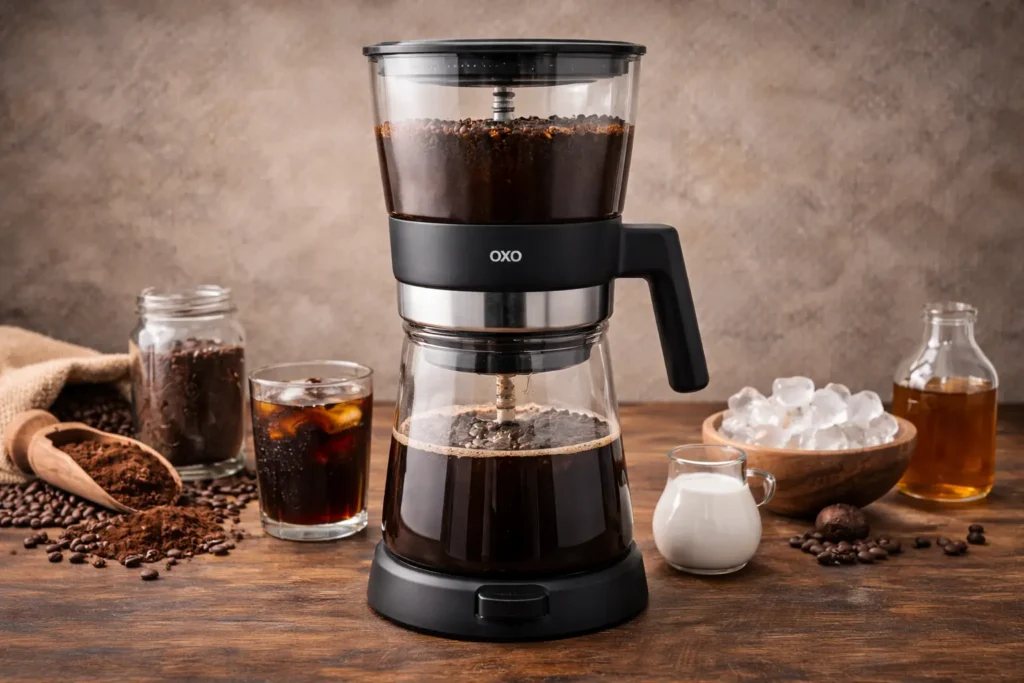 OXO Good Grips A better fit when you want cleaner concentrate, controlled draining, and dilution flexibility. Check Price on Amazon →
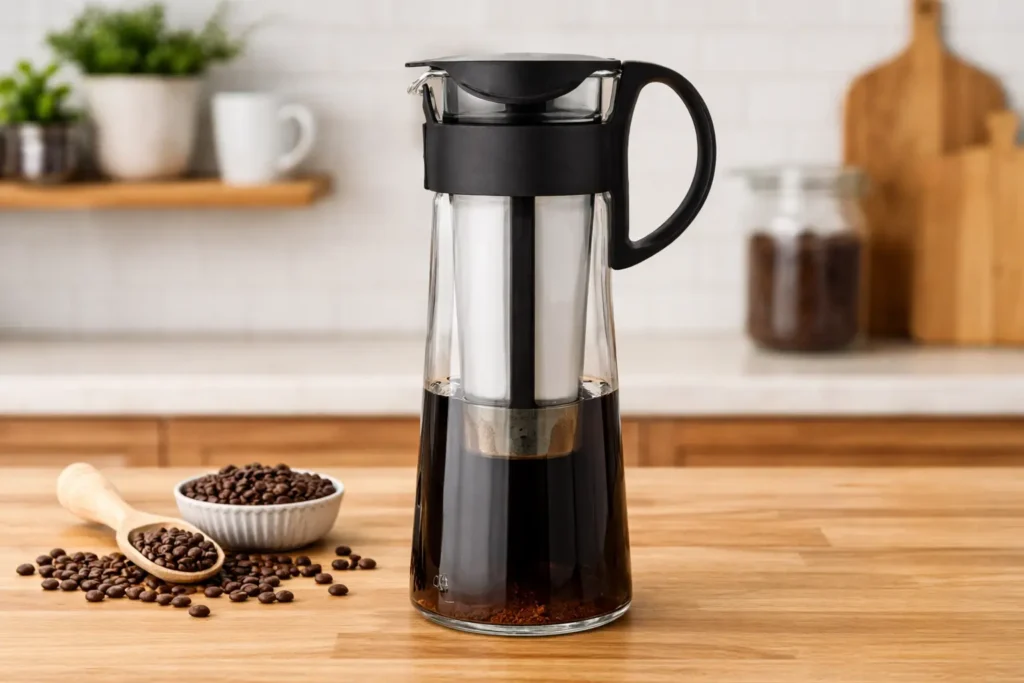 Hario Mizudashi A simpler fit for ready-to-drink batches that can go straight from the refrigerator to the glass. Check Price on Amazon →
Affiliate disclosure: These Amazon links may earn CoffeeGearHub a commission at no additional cost to you. Prices, sellers, and availability can change.
Cold Brew Ratio Chart
Cold brew ratios are easiest to understand when both coffee and water are measured in grams. The first number is coffee; the second is water. A 1:10 ratio means one gram of coffee for every ten grams of water.
| Ratio | Use | 100 g coffee needs | Strength | Serving approach |
|---|---|---|---|---|
| 1:4 | Very strong concentrate | 400 g water | Very strong | Dilute substantially with water or milk |
| 1:5 | Standard concentrate | 500 g water | Strong | Start with roughly equal parts concentrate and diluent |
| 1:6 | Milder concentrate | 600 g water | Strong but easier to drink | Use less dilution or more ice |
| 1:8 | Strong ready-to-drink | 800 g water | Bold | Serve over ice or with a small splash of milk |
| 1:10 | Balanced ready-to-drink | 1,000 g water | Medium | Drink directly or over light ice |
| 1:12 | Lighter ready-to-drink | 1,200 g water | Light-medium | Drink directly with minimal dilution |
Concentrate vs Ready-to-Drink Cold Brew
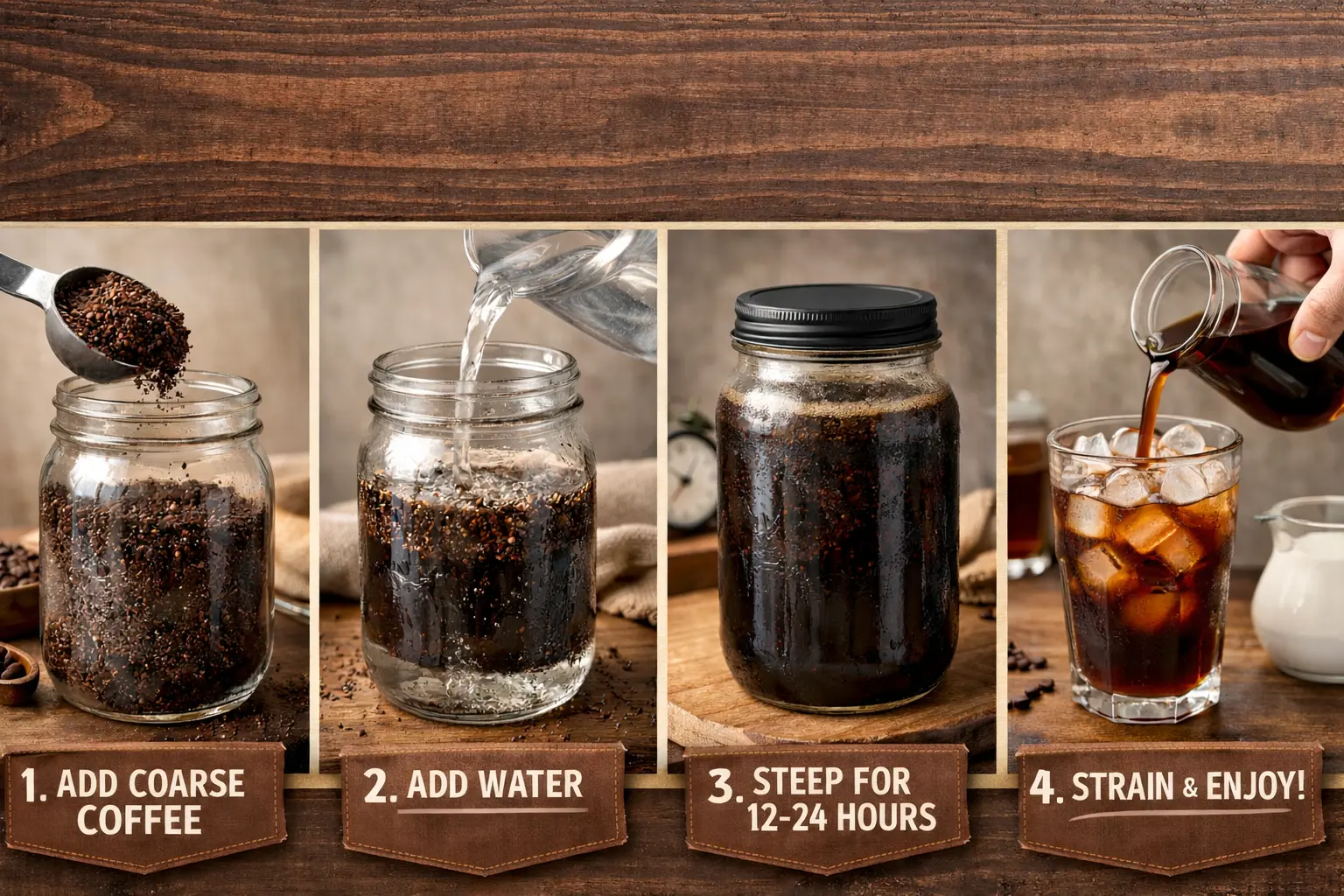
Concentrate is brewed intentionally strong so one batch can be adapted into several drinks. It works well for iced lattes, milk drinks, sweetened cold coffee, and households where different people prefer different strengths.
Ready-to-drink cold brew is simpler. Brew it close to the strength you want in the glass, filter it, refrigerate it, and pour. It is the better choice when you mostly drink black cold brew and do not want to measure dilution every morning.
The tradeoff is flexibility. Concentrate takes more coffee per batch but gives you control at serving time. Ready-to-drink uses coffee more efficiently and removes a step, but you have less room to make one glass substantially stronger or lighter than another.
Best Ratio for Cold Brew Concentrate
Start with 1:5. That means 100 grams of coffee to 500 grams of water, or 200 grams of coffee to 1,000 grams of water. It is strong enough to dilute while remaining manageable to filter in most dedicated cold-brew systems.
If 1:5 produces a concentrate that still tastes weak after dilution, test 1:4 before changing the grind dramatically. If the concentrate is difficult to filter or tastes excessively heavy, 1:6 is often easier to manage.
| Water | 1:4 coffee | 1:5 coffee | 1:6 coffee |
|---|---|---|---|
| 500 g | 125 g | 100 g | 83 g |
| 750 g | 188 g | 150 g | 125 g |
| 1,000 g | 250 g | 200 g | 167 g |
| 1,500 g | 375 g | 300 g | 250 g |
Best Ratio for Ready-to-Drink Cold Brew
Start around 1:10. For a one-liter batch, use 100 grams of coffee and 1,000 grams of water. If you routinely pour over a full glass of ice or add milk, a stronger 1:8 batch may land closer to your preferred final strength.
For black cold brew with little or no ice dilution, 1:10 to 1:12 is usually easier to drink directly. The exact number depends on the beans and steep time, so treat the first batch as a baseline rather than a final answer.
| Water | 1:8 coffee | 1:10 coffee | 1:12 coffee |
|---|---|---|---|
| 500 g | 63 g | 50 g | 42 g |
| 750 g | 94 g | 75 g | 63 g |
| 1,000 g | 125 g | 100 g | 83 g |
| 1,500 g | 188 g | 150 g | 125 g |
How to Dilute Cold Brew Concentrate
The simplest starting point is one part concentrate to one part water or milk. A 1:5 concentrate diluted 1:1 lands near the strength of a 1:10 recipe before accounting for the water retained by the grounds and any ice melt.
| Concentrate brewed at | Starting dilution | Approximate effective ratio | Best for |
|---|---|---|---|
| 1:4 | 1 part concentrate + 1 part water | About 1:8 | Bold black cold brew or milk drinks |
| 1:5 | 1 part concentrate + 1 part water | About 1:10 | Balanced everyday serving |
| 1:6 | 1 part concentrate + 1 part water | About 1:12 | Lighter black cold brew |
Use this as a starting point, not laboratory math. Coffee grounds retain water during brewing, so the liquid yield from the brewer will be lower than the amount of water you poured in. Taste the finished drink and adjust the glass, not the spreadsheet.
How Ice and Milk Change the Ratio

Ice is dilution. If you fill a warm glass with cold brew and a large amount of ice, the drink will become lighter as the ice melts. Starting slightly stronger—around 1:8 or with a 1:5 concentrate—gives you more room for that dilution.
Milk changes both strength and perception. A cold-brew latte usually works better with concentrate because milk can mute coffee intensity. Start with one part 1:5 concentrate and one part milk, then adjust toward more coffee if the drink tastes flat.
For a black drink over only a few cubes, a 1:10 ready-to-drink batch may already be strong enough. The serving method should determine the brew ratio, not the other way around.
Grind Size for Each Ratio
Use a coarse grind as the baseline for most cold brew, but do not assume every ratio needs the same grind. Strong concentrate recipes pack more coffee into the same amount of water and can become difficult to saturate and filter if the grind is too fine.
- 1:4 to 1:6 concentrate: coarse to extra-coarse is the safest starting point.
- 1:8 to 1:10 ready-to-drink: coarse works well for most 12–18 hour immersion recipes.
- 1:12 lighter batches: you can move slightly finer if the cup tastes hollow, but keep filtration in mind.
If you use a KINGrinder K6, the new KINGrinder K6 Grind Settings Chart starts cold brew around 150 clicks and explains how to adjust for shorter or longer steeps.
Ratio and Steep Time Work Together
Ratio controls how much coffee is available relative to water. Steep time controls how long extraction continues. If a 1:10 batch tastes weak, extending an already-long 18-hour steep may not be the best fix; the recipe may simply need more coffee or a slightly finer grind.
For refrigerator brewing, a practical starting window is roughly 14–18 hours. Strong concentrate can often remain in that same window. Once you have a repeatable baseline, change ratio before making extreme steep-time changes. Our guide to how long to steep cold brew covers fridge and counter timing, grind, and roast in more detail.
For the full workflow—grind, saturation, steeping, filtering, storage, and serving—use How to Make Cold Brew Coffee at Home.
Do Different Beans Need a Different Ratio?
Sometimes, but usually not by much. Ratio is a better first control than trying to create a separate formula for every roast. Start with the same 1:5 concentrate or 1:10 ready-to-drink baseline, then adjust after tasting.
Dark roasts can taste intense at the same ratio, so moving slightly lighter—say from 1:8 to 1:10—may be enough. Dense light roasts may need a little more extraction from grind or time rather than simply adding more coffee.
For bean selection, see Best Coffee Beans for Cold Brew. That guide covers roast level, origin, processing style, and current bean options.
Common Cold Brew Ratio Mistakes
Measuring coffee with scoops
A scoop of coarse coffee can weigh very differently from a scoop of finer coffee. Use grams if you want to reproduce the batch.
Confusing concentrate with ready-to-drink
A 1:5 recipe is not “better” because it uses more coffee. It is a different product designed to be diluted later.
Ignoring water retained by the grounds
Your final liquid yield will be lower than the starting water weight. This is normal. Do not add random extra water during the steep to compensate.
Changing ratio, grind, and steep time at once
If the batch is wrong, change one variable. Otherwise you will not know which adjustment improved the cup.
Brewing weak coffee and expecting ice to fix it
Ice only dilutes. If you serve over a lot of ice, brew stronger from the start or use concentrate.
Which Cold Brew Ratio Should You Use?
| If you usually… | Start with | Why |
|---|---|---|
| Drink cold brew black from the fridge | 1:10 | Balanced and easy to serve directly |
| Prefer a lighter black cup | 1:12 | Less intense with little dilution needed |
| Pour over a lot of ice | 1:8 | Leaves room for ice melt |
| Make iced lattes | 1:5 concentrate | Stands up better to milk |
| Want one batch for several drink styles | 1:5 concentrate | Most flexible at serving time |
| Want the simplest morning routine | 1:10 ready-to-drink | No dilution math required |
Ratio also affects how long a batch keeps: concentrate generally holds up longer in the fridge than ready-to-drink cold brew. Our guide to how long cold brew lasts explains fridge life, storage, and how much to brew for a week.
Frequently Asked Questions
What is the best cold brew ratio?
Start at 1:10 coffee to water by weight for ready-to-drink cold brew, or 1:5 for concentrate that will be diluted before serving.
What ratio should I use for cold brew concentrate?
Start at 1:5. That is 100 grams of coffee to 500 grams of water. Move toward 1:4 for a stronger concentrate or 1:6 for something easier to dilute gently.
What ratio should I use for ready-to-drink cold brew?
Start at 1:10. Use 1:8 if you want a stronger cup or expect substantial ice dilution; use 1:12 for a lighter drink.
How much coffee do I need for 1 liter of cold brew?
At 1:10, use about 100 grams of coffee for 1,000 grams of water. At 1:5 concentrate strength, use about 200 grams of coffee for 1,000 grams of water.
Should I measure cold brew by weight or volume?
Weight is much more repeatable. Measure coffee and water in grams when possible.
Does adding ice change the cold brew ratio?
Yes. Ice melts and dilutes the drink, so cold brew served over a large amount of ice can start slightly stronger than the final strength you want.
CoffeeGearHub product shortlist
Continue with cold-brew products on CoffeeGearHub
Review specifications and current verified merchant offers on CoffeeGearHub before leaving the site.