Last Updated: March 2026 • 35–45 min read • Coffee Troubleshooting: Extraction, Ratio & Freshness
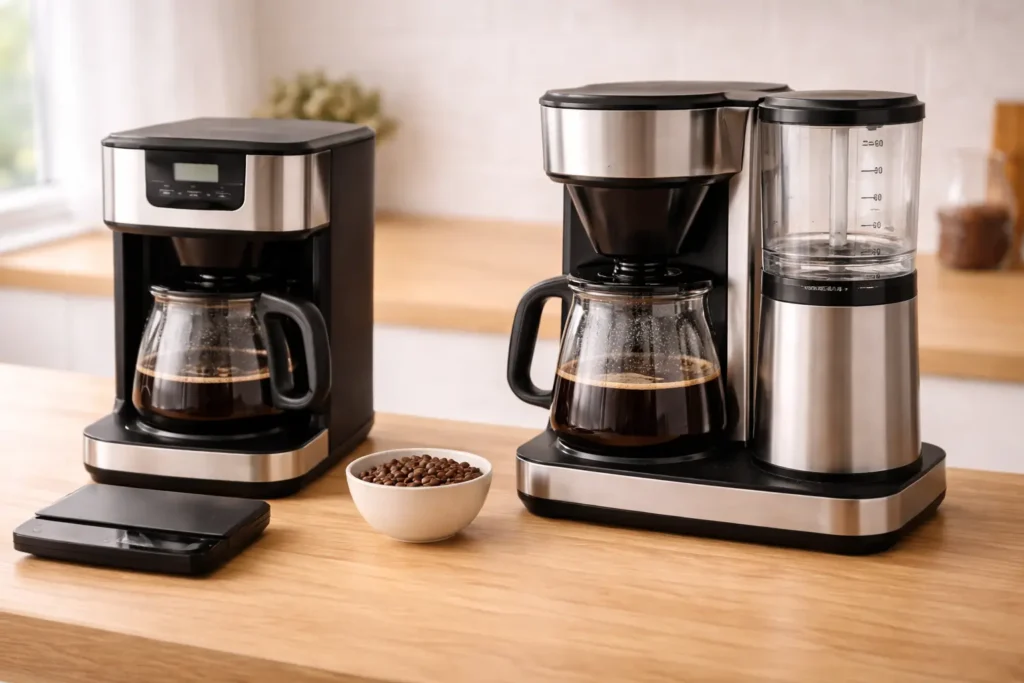
Why does my coffee taste bad? If your coffee tastes bad — sour, bitter, weak, flat, or some unpleasant combination of all four — the problem is almost certainly not your coffee maker. After years of testing brewers, grinders, beans, ratios, and water setups, the answer is almost always the same: bad coffee at home is an extraction problem, a ratio problem, a freshness problem, or a water problem. Usually one of the first two. This guide gives you the systematic approach to diagnose exactly which problem you have, understand why it is happening at the chemistry level, fix it with the minimum number of changes, and prevent it from recurring. If you have five minutes, start with the diagnosis table. If you want to understand every variable and stop guessing, read the whole guide.
✍️ Editorial note: This guide is researched and written by the editors at CoffeeGearHub.com using published brewing science, SCA Brewing Standards, and established specialty-coffee community knowledge. All product links are affiliate links — we may earn a commission at no cost to you. Affiliate Disclosure: CoffeeGearHub.com participates in the Amazon Services LLC Associates Program. As an Amazon Associate, we earn from qualifying purchases.
The 30-Second Answer
Bad coffee at home has four root causes and four corresponding fixes. Sour coffee is under-extraction: grind finer. Bitter coffee is over-extraction or dirty equipment: grind coarser and clean everything. Weak or watery coffee is a dose ratio problem: weigh your coffee and water at 1:16. Flat or dull coffee is stale beans or bad water: buy fresher beans with a roast date and brew with filtered water. The single most impactful upgrade for all four problems is a consistent burr grinder — it is the variable that affects every other variable. Below is the complete guide to diagnosing, fixing, and understanding every common bad-coffee problem.
- Sour / sharp / lemony: Under-extraction — grind 1–2 steps finer; confirm water is 92–96°C
- Bitter / harsh / drying: Over-extraction or dirty gear — grind coarser; clean every contact surface before changing anything else
- Weak / watery / thin: Under-dosed — start at 1:16 coffee-to-water by weight; stop scooping by volume
- Flat / dull / cardboard: Stale beans or chlorinated water — buy beans with a roast date under 4 weeks; switch to filtered water
- Best single upgrade: A consistent burr grinder solves sour, bitter, and muddy simultaneously — it is the root-cause fix for most bad coffee
Who This Guide Is For — Jump to What You Need
🔍 Know How It Tastes
Jump to Quick Diagnosis Table for the direct taste → cause → fix mapping.
☕ Drip or Pour-Over Brewer
Start at Problem #1 and work through in order — most drip problems are grind or ratio.
🔥 Already Tried Everything
Jump to the Troubleshooting Matrix for symptom-by-symptom root cause analysis.
🔧 Ready to Upgrade Gear
Jump to Top Gear Picks for the specific upgrades that solve each category of problem.
Table of Contents
- The one concept that explains almost every bad cup
- Quick diagnosis table: what you taste → what to fix
- Problem #1: Why does my coffee taste sour?
- Problem #2: Why does my coffee taste bitter?
- Problem #3: Why does my coffee taste weak or watery?
- Problem #4: Why does my coffee taste flat or dull?
- Why the grinder is the root-cause fix for most bad coffee
- Water quality and coffee taste
The One Concept That Explains Almost Every Bad Cup of Coffee
Before diagnosing your specific problem, it helps to understand the single framework that explains sour, bitter, and most other bad-coffee outcomes: extraction. When hot water contacts coffee grounds, it dissolves soluble compounds from the grounds in a specific sequence. The compounds that dissolve first are acids — bright, clean, and pleasant in the right amount, but sharp and sour in excess. The compounds that dissolve next are sugars and melanoidins — sweetness, body, and complexity. The compounds that dissolve last are bitter polyphenols and harsh, drying tannins.
Great coffee lives in the middle of this sequence. Extraction that stops too early is sour: you got the acids but not enough sweetness to balance them. Extraction that goes too far is bitter: you went past the sweet zone into harsh polyphenols. Most bad coffee at home is one or the other — and the fix is almost always grind size, because grind size is the primary variable that controls how fast water dissolves compounds from coffee. Finer grind exposes more surface area, speeding extraction. Coarser grind exposes less, slowing it. Everything else — brew time, water temperature, dose — adjusts this same extraction dial, but grind is the biggest lever and the first one to reach for when something is wrong.
⚠️ The most important rule in coffee troubleshooting: Change one variable at a time. If a shot or brew is bad, changing grind, dose, water, and temperature simultaneously means you cannot know which change fixed (or further broke) it. Fix grind first, taste the result, then adjust the next variable if needed.
Quick Diagnosis Table: What You Taste → What to Fix First
Use the taste description that matches your coffee most closely. Start with the first fix listed. If it does not resolve the problem after one or two brews, move to the secondary causes.
| What Your Coffee Tastes Like | Root Cause | First Fix | Secondary Causes |
|---|---|---|---|
| Sour / sharp / lemony / bright-aggressive | Under-extraction — acids extracted, sweetness not reached | Grind 1–2 steps finer; re-brew at same dose and water | Water temperature below 90°C; contact time too short; very light roast |
| Bitter / harsh / drying / ashy aftertaste | Over-extraction or dirty equipment | Clean all equipment thoroughly first; if still bitter, grind 1–2 steps coarser | Water temperature above 96°C; contact time too long; very dark roast |
| Weak / thin / watery / almost no flavour | Under-dosed — too little coffee for the water volume | Weigh dose at 1:16 coffee-to-water ratio; do not scoop by volume | Grind too coarse; water bypassing grounds (channeling in pour-over) |
| Flat / dull / cardboard / no aroma | Stale beans or bad water quality | Buy beans with a roast date under 3–4 weeks; brew with filtered water | Beans stored in direct light or heat; bag opened too long ago |
| Muddy / confused / simultaneously sour and bitter | Inconsistent grind — usually a blade grinder | Replace blade grinder with a burr grinder; this cannot be fixed with ratio or dose adjustments | Worn or dirty burrs in older grinders |
| Salty / mineral / metallic | Water quality — excessive mineral content or pipe contamination | Switch to filtered water; check if taste changes with bottled water as a test | New or old pipes contributing metallic ions; water softener malfunction |
| Chemical / chlorine / plastic aftertaste | Unfiltered municipal water; dirty brewer; new equipment off-gassing | Filtered water; run 2–3 water-only brew cycles in a new machine before first coffee use | Old carafe with cracked lid seal; plastic components in water path |
| Inconsistent — different every day at same settings | Not weighing dose or water; grinder producing inconsistent output | Weigh coffee and water every brew; upgrade from blade grinder to burr grinder | Bean hopper static; stale retained grounds in grinder pathway |
Problem #1: Why Does My Coffee Taste Sour?
Sour coffee is the most fixable problem in home brewing because it has a single, clear cause: under-extraction. The water has pulled the acidic compounds out of the grounds but has not continued long enough, at high enough temperature, or through fine enough grounds to reach the sweeter, more complex compounds underneath. What you taste is all acid and no balance.
The confusion for many home brewers is that sourness can feel like it might be a bean quality problem — especially with light roasts, which are naturally higher in acidity. But there is a meaningful difference between pleasant acidity (brightness, clarity, fruit notes) and sourness (sharp, aggressive, almost vinegary). Pleasant acidity is the goal in a well-extracted light roast. Sourness is under-extraction at any roast level. If your coffee tastes sour even with darker beans that should have low acidity, under-extraction is the answer.
| Sour Coffee Cause | Why It Happens | Fix |
|---|---|---|
| Grind too coarse | Large particles have less surface area for water to contact; extraction stops in the acid phase before reaching sweetness | Grind 1–2 steps finer; re-brew at identical dose and water; taste; repeat if still sour |
| Water temperature too low | Below 90°C, water extracts acids efficiently but struggles to dissolve sugars and heavier aromatic compounds | Target 92–96°C; if no thermometer, let boiling water rest 30–45 seconds before brewing |
| Contact time too short | In drip machines, sour coffee from a correct-temp machine is almost never contact time — it is grind; in pour-over, a fast-draining bed is usually too coarse or unevenly distributed | For pour-over: grind slightly finer and ensure even saturation in bloom; for drip: grind finer first |
| Very light roast at standard settings | Light roasts are denser and less soluble than dark roasts; they require higher temperature and finer grind than your current settings may be calibrated for | Grind slightly finer than you would for a medium roast; increase water temperature 1–2°C |
| Under-dosed | Too little coffee for the water volume produces under-extracted results because there is not enough coffee to saturate fully at the given contact time | Check ratio: start at 1:16 by weight; if ratio is correct, move to grind first |
Problem #2: Why Does My Coffee Taste Bitter?
Bitter coffee has two completely different causes that require different fixes, and confusing them is the most common troubleshooting mistake beginners make. The first cause is over-extraction: the water has dissolved past the sweet zone into bitter polyphenols. The fix is to grind coarser. The second cause is dirty equipment: rancid coffee oil residue that has built up on every surface water touches — inside the brewer, on the carafe walls, in the showerhead, in the filter basket. The fix is cleaning. The key diagnostic question is: when did the bitterness start? If it is new bitterness that appeared gradually, dirty equipment is the most likely cause. If it has always been bitter from a new setup or new beans, over-extraction is more likely.
⚠️ Clean before you adjust: If your coffee has become progressively more bitter over weeks without a recipe change, clean the machine before touching grind or dose. Rancid oil bitterness is persistent and cannot be fixed by grinding coarser — you will end up with under-extracted sour-bitter, which is worse. Clean first, then re-evaluate.
| Bitter Coffee Cause | Why It Happens | Fix |
|---|---|---|
| Over-extraction (grind too fine) | Water extracts past the sweet compounds into bitter polyphenols; more surface area = faster extraction into bitter territory | Grind 1–2 steps coarser; re-brew at same dose and water |
| Dirty equipment — rancid coffee oil | Coffee oil oxidises on all contact surfaces within days; it tastes bitter and stale and contaminates every subsequent brew | Full descale and clean of brewer, carafe, showerhead, filter basket, grinder chute; see Cleaning section |
| Water temperature too high | Above 96°C, water is aggressive enough to extract bitter compounds rapidly even at correct grind sizes | If machine allows temperature adjustment, lower by 1–2°C; if not, let water rest 20–30 seconds after boiling |
| Very dark roast over-extracted | Dark roasts are already more soluble and have more bitter compounds developed in roasting; they require shorter contact time and coarser grind than medium roasts | Grind 1–2 steps coarser than you would for the same bean at medium roast; lower water temperature slightly |
| Contact time too long | In French press, leaving coffee in contact with grounds for more than 4–5 minutes at standard temperatures extracts heavily into bitter territory | For French press: grind coarser and reduce steep time; for drip: fix is grind, not time |
Problem #3: Why Does My Coffee Taste Weak or Watery?
Weak coffee is the problem with the most reliable fix: dose ratio. In the vast majority of cases, weak or watery coffee is not a grind problem or a machine problem — it is simply too little coffee for the amount of water. Most home brewers significantly under-dose because they scoop by volume, and a scoop of coarsely ground coffee contains meaningfully less mass than a scoop of finely ground coffee. The solution is to weigh your dose every time and to use a ratio that matches your strength preference.
The SCA Golden Cup Standard targets a brew ratio of approximately 1:16 to 1:18 by weight for drip coffee. For most home brewers, 1:16 is a good starting point: one gram of coffee for every sixteen grams (millilitres) of water. For a 300ml cup, that is approximately 19g of coffee. For a standard 500ml batch, 31g. For a full 1L carafe, 63g. Most home brewers using volume scoops are hitting something closer to 1:20 or 1:22, which consistently produces thin, under-flavoured results regardless of grind or water quality. A basic kitchen scale solves this permanently at minimal cost. For the full ratio guide, see our Coffee Brew Ratio Guide.
| Brew Volume | Coffee at 1:16 (standard) | Coffee at 1:15 (stronger) | Coffee at 1:17 (lighter) |
|---|---|---|---|
| 240ml (1 cup) | 15g | 16g | 14g |
| 360ml (1.5 cups) | 22.5g | 24g | 21g |
| 500ml (approx 2 cups) | 31g | 33g | 29g |
| 750ml (3 cups) | 47g | 50g | 44g |
| 1,000ml (1L / 4 cups) | 63g | 67g | 59g |
| 1,500ml (6 cups) | 94g | 100g | 88g |
Problem #4: Why Does My Coffee Taste Flat, Dull, or Like Cardboard?
Flat, dull, or papery coffee that lacks aroma and any interesting flavour complexity is almost always a freshness or water quality problem — not a technique problem. You can have perfect grind, perfect ratio, perfect temperature, and still produce flat coffee if the beans are stale or the water is wrong. This is the hardest category of bad coffee to diagnose by taste alone because it does not taste wrong in a specifically sour or bitter direction — it just tastes like nothing.
Coffee begins degrading immediately after roasting as CO2 escapes (degassing) and aromatic compounds oxidise. The volatile molecules responsible for the complex aroma and flavour that make specialty coffee interesting — fruity esters, floral aldehydes, aromatic alcohols — are precisely the compounds that disappear fastest after roasting and after grinding. Beans more than 3–4 weeks post-roast have lost most of these volatile compounds regardless of storage conditions. Beans that have been ground and stored for even a few hours have lost most of the remaining freshness. Brewing with filtered water removes chlorine and other compounds that suppress what little flavour is left. For more on bean storage, see our How to Store Coffee Beans guide.
| Flat Coffee Cause | Why It Happens | Fix |
|---|---|---|
| Stale beans (past peak) | Volatile aromatic compounds oxidise and dissipate after roasting; beans more than 3–4 weeks post-roast taste flat regardless of technique | Buy whole beans with a roast date printed on the bag; use within 3–4 weeks of roast date; avoid any bag without a roast date |
| Pre-ground coffee | Grinding dramatically accelerates oxidation by exposing the interior of the bean to air; pre-ground coffee is flat within hours | Buy whole beans and grind immediately before brewing; a burr grinder is required |
| Poor storage | Light, heat, and oxygen all accelerate staling; beans stored in clear containers on a sunny counter degrade in days | Store in an opaque, airtight container at room temperature away from heat and light; do not refrigerate or freeze unless for long-term storage of an unopened bag |
| Chlorinated tap water | Chlorine in municipal water suppresses aromatic compounds and adds a faint chemical taste that mutes the coffee | Use filtered water — a basic pitcher filter removes most chlorine and improves cup brightness noticeably |
| Distilled or softened water | Coffee extraction requires minerals in the water to bind to aromatic compounds; zero-mineral water extracts poorly and tastes flat | Target filtered water between 75–150ppm TDS; avoid distilled water for coffee |
Why the Grinder Is the Root-Cause Fix for Most Bad Coffee
The single most impactful equipment upgrade for home coffee quality — more than the brewer, more than the kettle, more than the carafe — is a consistent burr grinder. This is true even if your coffee is not obviously tasting sour or bitter. Here is why: a blade grinder or a worn cheap grinder produces a chaotic mix of particle sizes in every batch. The very fine particles (called fines) over-extract into bitter territory within seconds. The very coarse particles (called boulders) barely extract at all and taste sour and thin. Both are present in every cup simultaneously. The result is a muddy, confused flavour that cannot be fixed by adjusting any other variable — because you are not dealing with a single extraction problem. You are dealing with simultaneous over- and under-extraction from the same dose.
A burr grinder crushes beans between two abrasive surfaces set at a fixed distance, producing particles of approximately uniform size at the selected setting. When you grind finer, all particles get finer together. When you grind coarser, all particles get coarser together. Extraction is even, the adjustment dial is readable, and every change you make to fix sour or bitter produces a clear result you can taste and act on. This is why all experienced home brewers — across every brew method — say the same thing: the grinder is the upgrade that unlocks every other improvement. For the full grinder guide, see our Best Coffee Grinders for Home Brewing.
Water Quality and Coffee Taste
Water is 98–99% of every cup of coffee. Most home brewers treat water as a neutral carrier and focus all attention on beans, grind, and ratio — but water chemistry has a meaningful and often overlooked effect on the final cup. The SCA recommends brewing water with total dissolved solids (TDS) between 75–150ppm, a pH of 6.5–7.5, and no detectable chlorine or chloramine. Most filtered tap water in decent municipal systems lands within this range after filtering. The two water problems most likely to affect home brewers are excessive chlorine (produces chemical, muted flavour) and excessive hardness (produces chalky, harsh extraction and deposits scale in equipment).
| Water Type | TDS Range | Effect on Coffee | Verdict |
|---|---|---|---|
| Distilled / deionised | 0–10ppm | Flat, lifeless extraction; minerals needed to bind coffee compounds are absent; physically possible to brew but results are poor | ✗ Do not use for coffee |
| Filtered tap (standard pitcher) | 50–150ppm | Removes chlorine and most of the compounds that suppress flavour; excellent for home coffee at low cost | ✓ Best everyday option |
| Standard unfiltered tap | 50–300ppm | Varies widely by location; chlorine suppresses aroma; high hardness causes scale; may taste chemical or chalky | ⚠ Acceptable if TDS under 100; filter if possible |
| Very hard tap water | 200ppm+ | Over-extracts heavy mineral compounds; chalky, harsh aftertaste; accelerates scale buildup in machine | ✗ Filter or use bottled water |
| Bottled spring water | 50–200ppm | Consistent; removes variables from water quality; expensive for daily use but useful as a diagnostic test | ✓ Good for diagnosing whether water is the problem |
| Softened water | Varies | Ion exchange softeners replace calcium/magnesium with sodium; sodium inhibits extraction; coffee tastes flat and sometimes slightly salty | ✗ Avoid for coffee; use filtered pre-softener tap |
Top Gear Picks: The Specific Upgrades That Fix Each Problem Category
These four picks target the most common bad-coffee problem categories in order of impact. All affiliate links use the CoffeeGearHub Amazon Associates tag. ⚠️ Verify all ASINs against current Amazon listings before publishing.

Best Electric Grinder Upgrade: Baratza Encore — Fixes Sour + Bitter + Muddy
The Baratza Encore is the correct first burr grinder upgrade for home drip and pour-over brewers, and it is the single equipment change most likely to produce the biggest improvement in cup quality from a single purchase. If you are currently using a blade grinder or cheap supermarket burr grinder, replacing it with the Encore will fix the simultaneous sour-and-bitter muddy flavour that no other adjustment can address — because that flavour is caused by inconsistent particle size, and consistent particle size is exactly what the Encore delivers. Its 40 grind settings cover the full range from French press (coarse) through drip (medium) through pour-over (medium-fine), and adjacent settings are close enough together to make meaningful, readable extraction adjustments. It is repairable, with replacement burrs and parts available directly from Baratza.
- Burr type: 40mm conical stainless steel burrs
- Settings: 40 stepped grind settings covering French press through pour-over
- Problems it fixes: Sour coffee (grind finer), bitter coffee (grind coarser), muddy/confused flavour (consistent particle size replaces blade grinder chaos)
- Best for: drip, pour-over, French press, AeroPress; any home brewer currently using a blade grinder
- Note: Also covers pressurized portafilter espresso at its fine end — see our Best Coffee Grinders for Espresso guide for espresso-specific grinder guidance
Disclosure: CoffeeGearHub may earn from qualifying purchases.
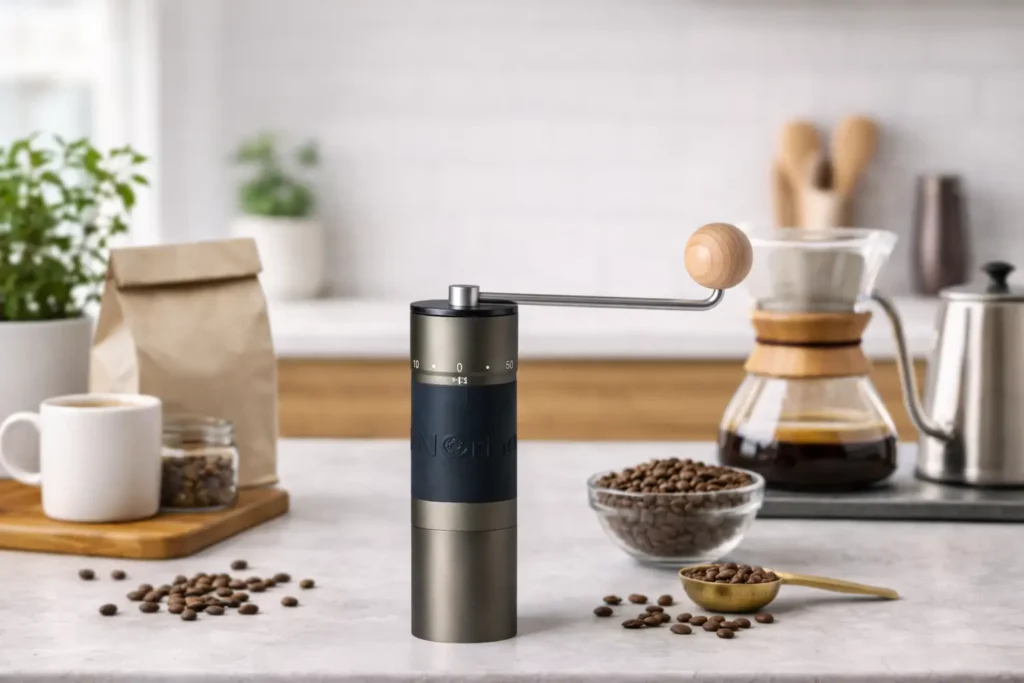
Best Manual Grinder Upgrade: KINGrinder K6 — Fixes Sour + Bitter + Muddy Without a Power Outlet
The KINGrinder K6 is the CoffeeGearHub standard manual grinder recommendation for drip, pour-over, French press, and AeroPress — and it delivers burr-grinder consistency at a price point that makes it the correct upgrade for any home brewer who wants to eliminate blade-grinder problems without spending at the Baratza Encore level. The 48mm conical burrs produce the uniform particle size distribution that drip and pour-over brewing requires, and the click-adjustment system gives 90 settings across the full grind range, with enough resolution to make meaningful extraction changes in small increments. The straight handle design is stable and efficient for manual grinding. It also makes an excellent travel grinder for brewers who want consistent coffee away from home. One important note: the K6 is not an espresso grinder — do not use it for espresso. See our Best Espresso Grinders guide for espresso-specific recommendations.
- Burr type: 48mm conical stainless steel burrs
- Settings: 90 click settings across full grind range
- Problems it fixes: Sour, bitter, and muddy coffee from inconsistent grind; enables one-step-at-a-time extraction adjustments
- Best for: pour-over, drip, French press, AeroPress; travel use; home brewers who prefer manual grinding
- Not for: Espresso — the K6 does not reach espresso-fine range; use a dedicated espresso grinder for espresso
Disclosure: CoffeeGearHub may earn from qualifying purchases.
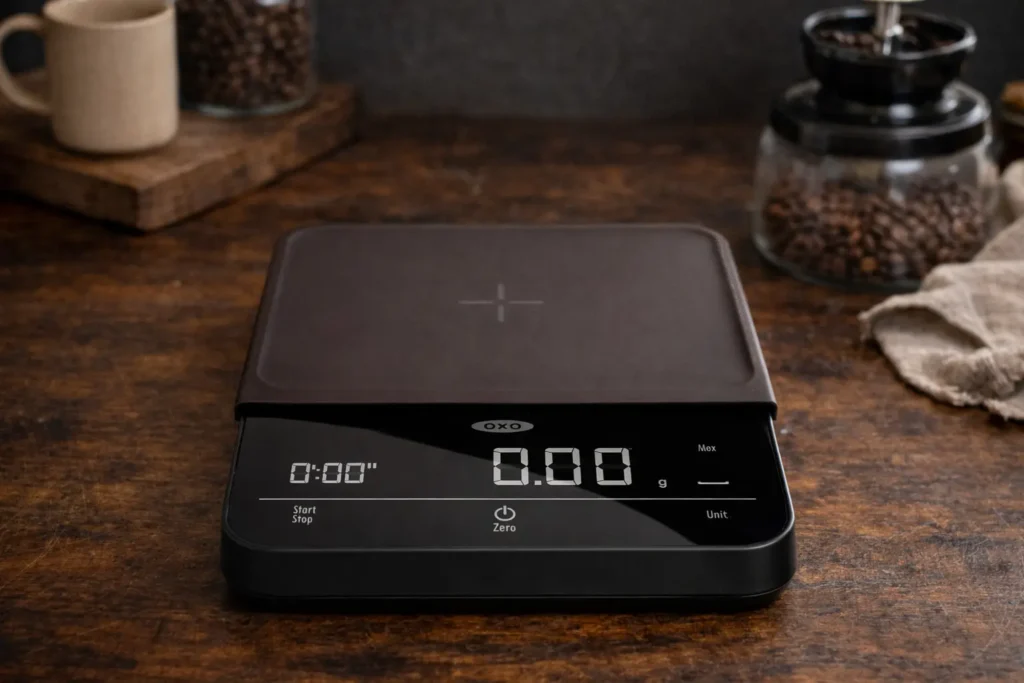
Best Coffee Scale: OXO Brew 6-lb Coffee & Food Scale — Fixes Weak + Inconsistent Coffee
A kitchen scale solves the most common cause of consistently weak, inconsistent coffee: scooping by volume instead of weighing by mass. The OXO Brew 6-lb Coffee and Food Scale is the standard recommendation for home brewers who want a scale accurate enough to improve their coffee without the cost of a dedicated barista-grade precision scale. It reads to 0.1g accuracy, which is sufficient for drip and pour-over dose measurement, and it includes a built-in timer that is useful for pour-over techniques where pour timing matters. The large platform holds a full carafe and a drip brewer simultaneously. A scale at this level replaces the single most variable element in most home brewing setups in one purchase. Once you start weighing coffee and water at a consistent ratio, weak-coffee complaints resolve immediately and cup quality becomes reproducible.
- Accuracy: 0.1g — sufficient for drip and pour-over dose measurement
- Capacity: 6lb / 2.7kg — holds carafe and brewer on platform simultaneously
- Timer: Built-in timer — useful for pour-over and French press timing
- Problems it fixes: Weak coffee from under-dosing; day-to-day inconsistency from volume scooping; inability to reproduce a good cup
- Best for: drip, pour-over, French press, AeroPress; any brewer who doses by scoop and struggles with weak or inconsistent results
Disclosure: CoffeeGearHub may earn from qualifying purchases.
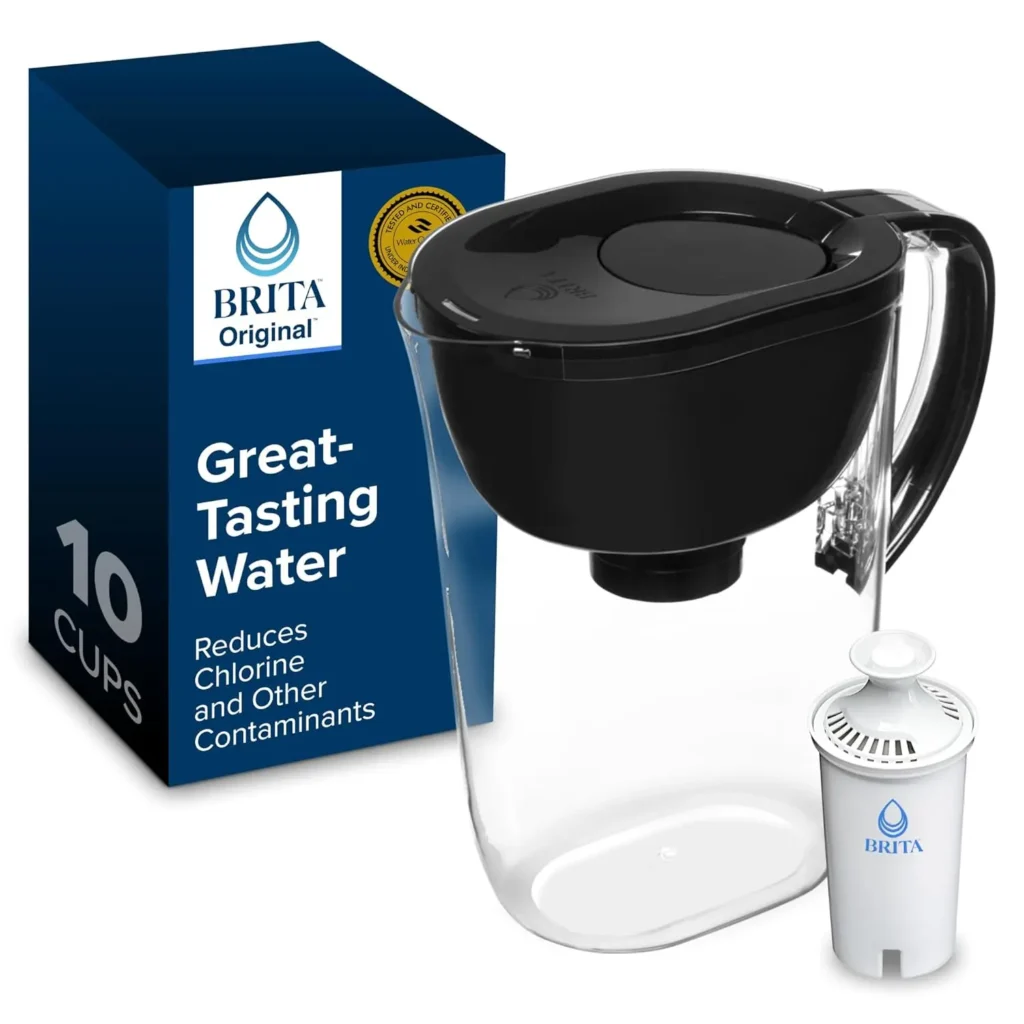
Best Water Filter: Brita Large 10-Cup Pitcher — Fixes Flat + Chemical + Muted Coffee
If your coffee tastes flat, muted, chemical, or slightly off in a way that does not improve with grind or ratio changes, water quality is almost certainly the problem — and a basic pitcher filter is the lowest-effort, lowest-cost fix available. The Brita Large 10-Cup Pitcher removes chlorine, chloramine, and most of the compounds that suppress aromatic extraction and add off-flavours to coffee. The difference between chlorinated tap water and Brita-filtered water in a cup of coffee is immediately noticeable as increased brightness, more defined aroma, and a cleaner, sweeter finish. The 10-cup capacity holds enough water for two or three full brew cycles, making it practical for daily use without constant refilling. Replace the filter every 40 gallons (approximately two months of regular coffee use) to maintain effectiveness.
- Capacity: 10 cups (2.4L) — holds enough for 2–3 full drip brew cycles
- Filter type: Standard Brita filter — removes chlorine, chloramine, and most off-flavour compounds
- Filter replacement: Every 40 gallons or approximately every 2 months for daily coffee use
- Problems it fixes: Flat, muted, chemical-tasting, or chlorine-flavoured coffee; improves brightness and aroma clarity
- Best for: any brewer using unfiltered municipal tap water; particularly effective in areas with heavily chlorinated water
Disclosure: CoffeeGearHub may earn from qualifying purchases.
Extraction Science: The Chemistry Behind Bad Coffee
Understanding the chemistry behind extraction is what separates systematic coffee troubleshooting from guessing. Three principles explain almost every bad cup.
- Extraction is sequential, not simultaneous. When hot water contacts coffee, it dissolves compounds in a defined order determined by molecular weight and solubility. Acids (citric, malic, acetic) dissolve first — they are small, light molecules that dissolve rapidly in hot water. Sugars and melanoidins (the sweet, complex compounds that create body and roundness) dissolve in the middle phase. Bitter polyphenols and chlorogenic acid degradation products dissolve last, requiring sustained contact at high temperature to fully extract. This sequence is why extraction percentage matters: 18–22% extraction by mass is the SCA target range where all three phases are represented in balance. Under that range, the cup is dominated by the first phase. Over it, the third phase takes over.
- Grind size controls extraction rate, not extraction ceiling. A common misconception is that a finer grind extracts more total compounds. It does not — given enough time and the right temperature, any grind size will eventually reach full extraction. What grind size controls is how fast extraction happens. A finer grind has more surface area exposed to water, so the rate of dissolution accelerates. A coarser grind has less surface area, so extraction slows. In a drip machine with a fixed brew time, finer grind produces higher extraction in the same cycle; coarser produces lower extraction. This is why grind size is the primary adjustment dial for sour and bitter: it directly controls whether extraction lands in the target window within the fixed parameters of your brewer.
- Consistency of particle size determines whether extraction can be dialled in at all. A grinder that produces particles of wildly varying sizes — a blade grinder being the extreme case — produces a cup where different parts of the dose are at completely different extraction stages simultaneously. The fines are over-extracted and bitter; the boulders are under-extracted and sour; the mid-range particles are somewhere in between. Adjusting grind setting does not fix this — it just shifts the distribution of over- and under-extracted particles. Only a consistent burr grinder produces the uniform particle size that makes extraction controllable and predictable.
Dial-In System: How to Fix Home Coffee Systematically
Systematic dial-in is the process of finding the combination of grind, dose, and water that produces a cup you want to repeat — and then recording it so you can reproduce it. The key rule is the same as laboratory troubleshooting: one variable at a time. Changing two variables simultaneously means you cannot know which change produced the result you tasted. For the full dial-in guide, see our How to Dial In Coffee at Home guide.
The Systematic Fix Order
- Clean all equipment first. Dirty equipment causes bitterness that no recipe change fixes. Descale, scrub, and clean before beginning any dial-in
- Set a fixed ratio. Start at 1:16 by weight. Weigh every dose and every water volume. Do not change ratio during grind dial-in
- Set water to correct temperature. Target 92–96°C. If using a drip machine, confirm it reaches this range (many under-spec machines do not)
- Brew and taste. What does the problem taste like? Sour = too coarse or too cool. Bitter = too fine or dirty equipment already ruled out. Weak = ratio. Flat = freshness or water
- Adjust grind one step at a time. Finer for sour; coarser for bitter. One step. Re-brew. Taste. Repeat
- Once grind is correct, record the setting. Log which grind number or click position produces a good result. This becomes your starting point for every new bag of beans
- Re-dial with each new bag. Different beans extract differently — expect to move 1–2 steps on the grinder with each new bag or roast profile
Taste → Variable → Direction
- Sour / sharp: Grind finer → 1–2 steps; or raise water temperature 2°C
- Bitter / harsh: Grind coarser → 1–2 steps; or clean equipment; or lower temperature 2°C
- Weak / thin: Increase dose → check ratio is 1:16 by weight; do not scoop by volume
- Too strong: Decrease dose → adjust to 1:17 or 1:18; do not grind coarser to fix strength (coarser = sour, not lighter)
- Flat / dull: Fresh beans → roast date under 3–4 weeks; filtered water; grind immediately before brewing
- Inconsistent day to day: Weigh both coffee and water every brew; purge stale grounds if using a hopper grinder
- Good but not excellent: Bean quality — buy from a specialty roaster with a roast date; upgrade grinder if still using blade
Common Mistakes That Cause Bad Coffee at Home
| Mistake | Why it causes bad coffee | Correct approach |
|---|---|---|
| Using a blade grinder | Produces random particle sizes that cause simultaneous over- and under-extraction; produces muddy, confused flavour that no other variable can fix | Replace with a burr grinder; this is the single highest-impact equipment change for home coffee quality |
| Scooping coffee by volume | Grind size changes how densely coffee packs into a scoop; a scoop of coarse-ground coffee contains significantly less mass than a scoop of fine-ground coffee; produces inconsistent, usually weak results | Weigh dose on a kitchen scale at 1:16 ratio every brew; a £15 scale eliminates this variable permanently |
| Ignoring roast dates | Coffee older than 3–4 weeks post-roast has lost most of its aromatic volatile compounds; tastes flat and dull regardless of grind, ratio, or water quality | Buy beans with a printed roast date; use within 3–4 weeks; reject any bag without a roast date |
| Using pre-ground coffee | Ground coffee begins oxidising immediately; by the time pre-ground reaches the consumer, most aromatic complexity has been lost; extraction profile also cannot be adjusted | Buy whole beans and grind immediately before brewing; the flavour difference is significant |
| Never cleaning the brewer or carafe | Coffee oil builds up on all contact surfaces and oxidises into rancid, bitter residue that contaminates every subsequent brew; produces a persistent stale bitterness that no freshness change fixes | Clean brewer, carafe, and all removable parts weekly; descale every 4–8 weeks depending on water hardness |
| Changing multiple variables at once | If you change grind, dose, and water temperature simultaneously when coffee is bad, you cannot identify which change fixed it or made it worse; produces random results rather than systematic improvement | Change one variable per brew; taste; record; adjust the next variable only if the problem persists |
| Using tap water without filtering | Chlorine suppresses aroma; excessive minerals cause harsh extraction; the water quality problem shows up as flat, chemical, or muted flavour that grind and ratio changes cannot fix | Use filtered water — a basic pitcher filter removes chlorine and most off-flavour compounds at minimal cost |
| Storing beans in the freezer (opened bag) | Condensation forms on beans every time they are removed from the freezer; moisture accelerates staling; beans absorb freezer odours through the bag; produces flat and sometimes off-tasting cups | Store in an opaque, airtight container at room temperature; freeze only sealed, unopened bags for long-term storage; never refreeze |
Troubleshooting Matrix: Specific Symptoms → Root Causes → Fixes
| Symptom | Most likely root cause | Fix (in order) |
|---|---|---|
| Sour with fresh beans and correct ratio | Grind too coarse for the brew method; or water temperature below 90°C | Grind 1–2 steps finer → confirm water reaches 92–96°C → if light roast, grind finer still and raise temperature 1°C |
| Bitter with freshly cleaned equipment and correct ratio | Grind too fine for the brew method; or water temperature above 96°C | Grind 1–2 steps coarser → confirm water is not over-boiling before use → for very dark roast, lower temperature slightly |
| Bitter that appeared gradually without recipe changes | Equipment dirty — rancid coffee oil accumulation | Full descale and clean of brewer, carafe, showerhead, filter basket → re-brew with same recipe before adjusting grind |
| Weak despite correct ratio | Grind too coarse (under-extraction makes the same dose taste weaker even at correct weight) | Confirm you are weighing, not scooping → grind 1 step finer → confirm brew temperature reaches 92°C+ |
| Flat / no aroma despite fresh beans | Bad water quality; or beans stored incorrectly; or container not airtight | Switch to filtered water for one brew as a test → if improved, water is the problem; if not, check storage and bean age |
| Muddy / sour and bitter simultaneously | Inconsistent grind — almost certainly a blade grinder | Replace blade grinder with a burr grinder; this specific symptom cannot be fixed by any recipe adjustment |
| Chemical / chlorine taste | Unfiltered tap water; or new equipment off-gassing plastic components | Switch to filtered water → if new machine, run 3–4 water-only cycles before first coffee brew |
| Inconsistent cup quality day to day at same settings | Volume scooping instead of weighing; or stale retained grounds in grinder | Weigh coffee and water every brew → purge 3–5g from grinder before each session to clear retained grounds |
| Coffee worsens over the week from the same bag | Bag opened; beans degassing and oxidising after opening; pre-ground beans going stale | Transfer opened whole beans to airtight opaque container → buy smaller quantities and use within 2 weeks of opening; if pre-ground, switch to whole bean |
| Good first cup, bad subsequent cups from same brew | Coffee sitting on a hot plate or in a carafe oxidising; thermal carafe seal failing | Transfer brewed coffee to a pre-heated insulated flask immediately after brewing; never leave coffee on a hot plate; consume within 20–30 minutes of brewing |
Cleaning and Maintenance: The Fix Most Home Brewers Skip
Dirty equipment is the second most common cause of bad coffee after grind inconsistency — and the most overlooked. Coffee oil is a natural byproduct of brewing: every contact surface accumulates a thin layer of oil after each brew. Within days, that oil begins to oxidise and turn rancid. Rancid coffee oil tastes bitter and stale, and it contaminates every subsequent brew regardless of bean freshness or grind quality. If your coffee has gradually become worse over weeks without any recipe change, clean the equipment before changing anything else.
After Every Brew
- Rinse the carafe and filter basket immediately after emptying with hot water — coffee oil is easiest to remove when fresh
- Leave the carafe lid off to air-dry completely — a sealed damp carafe grows stale oil films rapidly
- Discard used filter and grounds immediately — old grounds left in the basket add off-flavours to the next brew
- Wipe the showerhead (the water dispersal plate above the filter basket) with a damp cloth — oil builds up here faster than anywhere else
Every 4–8 Weeks
- Full descale: fill reservoir with a 1:1 white vinegar and water solution; run a full brew cycle; run two water-only cycles after to clear all vinegar residue. Alternatively use a dedicated descaler (Urnex Dezcal or similar)
- Scrub carafe interior with a bottle brush and dish soap — rinse thoroughly until no soap taste remains
- Soak the filter basket in hot soapy water for 10 minutes; scrub all surfaces
- For burr grinders: run Urnex Grindz cleaning tablets through per instructions; follow with a dose of fresh beans to clear residue before brewing
Home Coffee Upgrade Checklist: What to Fix and in What Order
| Upgrade | Problem it solves | Priority | What to look for |
|---|---|---|---|
| Burr grinder (replacing blade grinder) | Muddy, inconsistent, simultaneously sour-and-bitter coffee that no recipe change fixes | 🔴 Highest — do this first | Conical or flat burrs; 30+ settings; clear adjustment mechanism; Baratza Encore or KINGrinder K6 for home brewing |
| Kitchen scale (0.1g accuracy) | Weak, inconsistent coffee caused by volume scooping | 🟠 High — do this second | 0.1g accuracy; flat weighing platform large enough for a drip brewer; built-in timer is useful for pour-over |
| Fresher beans with a roast date | Flat, dull, no-aroma coffee that grind and ratio changes do not fix | 🟠 High — check this before buying equipment | Roast date printed on bag; use within 3–4 weeks of roast date; buy from specialty roasters or local roasters with fast turnover |
| Water filter pitcher | Chemical, chlorine, or muted flat taste that persists with fresh beans and correct technique | 🟡 Medium — especially important in hard-water or heavily chlorinated areas | Standard activated carbon filter removes chlorine and most off-flavour compounds; replace filter on schedule |
| Equipment cleaning routine | Gradual bitterness that worsened over weeks without recipe changes | 🟠 High — check this before changing any recipe variable | Descale every 4–8 weeks; clean carafe and showerhead after every brew; use dedicated coffee equipment cleaner for deep descales |
| Airtight storage container | Beans going stale faster than the bag suggests; flat coffee within days of opening a fresh bag | 🟡 Medium — particularly useful for large bags consumed over 2+ weeks | Opaque; airtight seal; avoid clear glass or open bowls; do not refrigerate opened beans |
Final Takeaway: Why Does My Coffee Taste Bad?
Bad home coffee almost always has one of four root causes: under-extraction (sour), over-extraction or dirty equipment (bitter), under-dosing (weak), or stale beans and bad water (flat). In the majority of cases, the fix is grind adjustment — finer for sour, coarser for bitter — because grind is the primary lever that controls extraction rate within the fixed parameters of most home brewers. If grind adjustment does not fix it, clean the equipment before changing anything else. If it is still flat after cleaning and grind adjustment, address bean freshness and water quality.
The one upgrade that makes every other fix more effective is a consistent burr grinder. A blade grinder produces simultaneous over- and under-extraction that looks like a complex, multi-variable problem but is actually one equipment problem with one solution. The Baratza Encore is the correct electric upgrade for most home drip and pour-over brewers; the KINGrinder K6 is the correct manual option. Pair either with a kitchen scale for consistent dosing, filtered water, and fresh beans with a roast date — and you have addressed every variable that produces bad coffee at home. From there, the only remaining work is dialling in your specific grind setting for your specific beans, which this guide’s extraction science and dial-in system give you the tools to do systematically.
FAQs: Why Does My Coffee Taste Bad?
Why does my coffee taste sour?
Sour coffee is almost always under-extraction. The water has dissolved acids from the grounds but not reached the sweeter, more complex compounds underneath. Fix in order: grind 1–2 steps finer, confirm water temperature is 92–96°C, and ensure contact time is sufficient. For drip machines with fixed brew cycles, grind adjustment is almost always the correct and only fix needed.
Why does my coffee taste bitter?
Bitter coffee is over-extraction or dirty equipment. If bitterness appeared gradually without recipe changes, clean all equipment before adjusting anything else — rancid coffee oil produces persistent bitterness that no grind change fixes. If equipment is clean and bitterness is consistent from a new setup, grind 1–2 steps coarser.
Why does my coffee taste weak or watery?
Weak coffee is almost always a dose ratio problem. Start at 1:16 coffee-to-water by weight — 1 gram of coffee for every 16 grams of water. Weigh both every brew; do not scoop by volume. Most home brewers using volume scoops are hitting ratios of 1:20 or weaker without realising it.
Why does my coffee taste flat or like cardboard?
Flat, dull, or papery coffee is caused by stale beans or bad water. Buy whole beans with a printed roast date and use within 3–4 weeks of roasting. Brew with filtered water to remove chlorine and other compounds that suppress aroma. Grind immediately before brewing — pre-ground coffee goes flat within hours.
Does the grinder really make that much difference to taste?
Yes — more than almost any other variable. A blade grinder produces a chaotic mix of fine and coarse particles in every batch. Fine particles over-extract into bitter territory; coarse particles under-extract into sour territory. Both are present in the same cup. This produces muddy, confused flavour that no ratio or temperature adjustment can fix. A consistent burr grinder resolves this at the root cause.
What coffee-to-water ratio should I use?
Start at 1:16 by weight — 1 gram of coffee for every 16 grams (ml) of water. For a 300ml cup: 19g coffee. For a 500ml brew: 31g. For a 1L batch: 63g. Adjust to 1:15 for stronger or 1:17 for lighter. Always weigh both coffee and water — never dose by scoop.
Can bad water make coffee taste bad?
Yes, significantly. Heavily chlorinated tap water suppresses aromatic compounds and adds a chemical aftertaste. Excessively hard water (200ppm+ TDS) causes chalky, harsh extraction. Distilled or softened water under-extracts because minerals needed to bind coffee compounds are absent. The SCA recommends filtered water between 75–150ppm TDS for optimal extraction.
How old is too old for coffee beans?
Whole beans are best within 3–4 weeks of the roast date for drip and pour-over. After opening a bag, aim to use within 2 weeks. Ground coffee degrades dramatically faster — within hours for drip methods. If a bag has no roast date, treat it as stale regardless of best-before date.
Why does my coffee taste different every morning at the same settings?
Day-to-day inconsistency is almost always caused by not weighing dose and water. Scooping by volume varies by 1–2g per scoop depending on grind size. Weighing both coffee and water every brew eliminates this. If you are already weighing, check that your grinder produces consistent output — blade grinders and worn burrs drift even at the same setting.
My drip machine makes bitter coffee no matter what I change. What should I do?
If grind adjustment has not fixed bitterness, clean the machine thoroughly before changing anything else. Run a full descale with white vinegar or a dedicated descaler, scrub the carafe, showerhead, and filter basket, and re-brew with fresh beans at a coarser grind. If bitterness persists after cleaning, check water temperature — under-spec drip machines sometimes overshoot 96°C, which extracts bitter compounds aggressively.
Continue Learning
GRINDER GUIDES
Ready to fix the root cause? Our full grinder guide covers every electric and manual option for home brewing — with grind settings for every method, a full comparison table, and the single recommendation for each brewer type.
☕
Written by the CoffeeGearHub Editorial Team
CoffeeGearHub is a specialty coffee equipment resource run by home brewers and coffee enthusiasts. Our guides are researched using published brewing science, SCA Brewing Standards, manufacturer specifications, and established specialty-coffee community knowledge. We review and update our content regularly. About CoffeeGearHub →