
Last Updated: March 16, 2026 • 18–22 min read • Covers: Grind Size + Water Temperature + Coffee-to-Water Ratio + Step-by-Step Technique + Gear Picks + Maintenance + Troubleshooting
✍️ Editorial note: This guide is researched and written by the editors at CoffeeGearHub.com using manufacturer specifications, specialty-coffee brewing principles, and established home-brewing guidance. Product links are affiliate links — we may earn a commission at no cost to you. Affiliate Disclosure: CoffeeGearHub.com participates in the Amazon Services LLC Associates Program. As an Amazon Associate, we earn from qualifying purchases.
🛒 New to Amazon? Try Prime free for fast, free shipping on every pick in this guide — or try Audible free if you’d rather listen while your coffee brews.
The 30-Second Answer
Need to learn how to brew drip coffee? Most drip coffee tastes mediocre not because of the method — but because of three fixable problems: the machine runs too cold, the grind is wrong, and the coffee isn’t fresh. Fix those three things and you’ll brew café-quality coffee every morning. The full guide below shows you exactly how, but here’s what matters most: use whole-bean coffee ground fresh, measure by weight at a 1:15–1:16 ratio, use filtered water, and if you’re still getting flat results, your machine isn’t reaching brewing temperature — the single most common cause of bad drip coffee in home kitchens.
- Biggest single upgrade: switch to a burr grinder and grind fresh — more impactful than any machine upgrade
- Best ratio to start: 1:15 by weight (20g coffee to 300ml water for a 10 oz mug)
- Temperature rule: 195–205°F is the SCA standard; most budget machines don’t reach it
- Don’t ignore the warming plate: coffee degrades in 20–30 minutes on a glass-carafe heater — use a thermal carafe or pour immediately
- Descale regularly: scale buildup on the boiler is the silent killer of drip machine performance
Who This Guide Is For — Jump to What You Need
☕ The Frustrated Daily Brewer
Your drip coffee is consistently meh. You want a concrete fix. Jump to Root Causes →
📐 The Precision Brewer
You want the numbers: ratio, temperature, grind setting. Jump to Ratios →
🛠️ The Gear Upgrader
You’re ready to invest in equipment that makes a real difference. Jump to Gear →
🔧 The Troubleshooter
Something specific is wrong with your brew right now. Jump to Fix It →
Table of Contents
Why Most Drip Coffee Falls Short (and How to Fix It)
Drip coffee has an undeserved reputation as the boring, baseline option — the method you choose when you’ve given up. That reputation comes almost entirely from bad machines and bad inputs. The drip method itself is sound: hot water through evenly ground coffee and a paper filter, under gravity, into a clean vessel. When all the variables are right, a well-brewed drip coffee rivals a pour over in clarity and balance.
The problem is that most people have never experienced a properly brewed drip coffee. Here’s why:
| Root Cause | What It Produces | How Common |
|---|---|---|
| Machine doesn’t reach 195°F | Flat, weak, under-extracted coffee — tastes like brown water | Very common in machines under $60 |
| Uneven water distribution | Channeling — some grounds over-extracted, some barely touched | Most budget machines; wide showerheads improve this |
| Pre-ground or stale coffee | Flat, papery, one-dimensional flavor — missing brightness entirely | Extremely common in non-specialty households |
| Wrong grind size | Too fine = bitter; too coarse = sour and weak | Common when switching roasts or bean origins |
| Wrong ratio | Too little coffee = watery; too much = harsh and muddy | Very common when using volume scoops |
| Coffee left on warming plate | Cooked, bitter, progressively worse over 30+ minutes | Standard behavior in households with glass carafes |
| Scale buildup on boiler | Reduced temperature, slower flow, degraded flavor over time | Virtually universal in machines that aren’t descaled regularly |
💡 The most important thing to understand: if your drip coffee tastes bad, the machine is almost certainly not the first thing to fix. A bag of freshly roasted whole-bean coffee, a burr grinder, and a kitchen scale will produce a dramatically better result in your existing machine before you spend a dollar on new equipment.
The Five Variables That Control Drip Coffee Quality
Every drip coffee decision traces back to five variables. Master these and no cup will surprise you — in a bad way.
1. Freshness — The Variable That Matters Before Anything Else
Roasted coffee beans are at peak flavor in the 5–21 days after roast. After 4–6 weeks, the volatile aromatic compounds — the ones that create floral, fruit, chocolate, and caramel notes — have largely oxidized away. Ground coffee loses most of these aromatics within 15–30 minutes of grinding. This is why the café down the street tastes better than your home drip: it’s fresher, not because they have better equipment.
Buy coffee with a roast date on the bag (not a “best by” date — that’s a different and less useful metric). Store it in an airtight container at room temperature, away from light. Grind immediately before brewing. This single habit change is responsible for more dramatic flavor improvements than any equipment upgrade.
2. Grind Size — The Extraction Rate Controller
Grind size controls how fast water passes through the coffee bed and how much surface area is exposed for extraction. Medium grind — the texture of coarse beach sand — is the target for drip. Finer grinds slow flow and increase extraction (risking bitterness); coarser grinds speed flow and decrease extraction (risking sourness and weakness). The single most important grinder improvement is switching from a blade grinder to a burr grinder: blade grinders produce a mix of fine dust and coarse chunks in the same batch, causing simultaneous over- and under-extraction. See the full grind section below.
3. Coffee-to-Water Ratio — The Strength Controller
Ratio is the simplest variable to dial in, and the most frequently neglected. Most people use volume scoops — which are inaccurate because coffee density varies by roast level, origin, and grind size. Use a kitchen scale. Start at 1:15 (grams of coffee per grams of water) for a full-flavored cup, or 1:17 for something slightly lighter. The SCA Golden Cup standard recommends approximately 1:18, which many specialty coffee drinkers find a touch light. See the full ratio table in the section below.
4. Water Temperature — The Extraction Efficiency Controller
Hot water dissolves soluble coffee compounds. Too cool and it can’t extract the full range of flavors (under-extraction). Too hot and it extracts harsh, astringent compounds along with the desirable ones (over-extraction). The SCA-certified window is 195°F–205°F (90°C–96°C). Most budget drip machines peak well below this range — often at 175°F–185°F — which is the primary reason they produce flat, underwhelming coffee. Temperature is the only variable that requires a machine upgrade to fix completely.
5. Water Quality — The Silent Flavor Carrier
Water is 98–99% of your finished cup. Chlorinated tap water introduces chemical off-flavors. Extremely hard tap water deposits minerals on the boiler element and can produce a chalky, dry mouthfeel in the cup. Distilled water is too pure — it lacks the mineral content needed to extract coffee flavor effectively. The practical answer for most households is a simple carbon pitcher filter. It removes chlorine, moderates minerals, and requires no installation. Good water costs nothing extra and immediately improves every cup.
Step-by-Step: How to Brew Better Drip Coffee at Home
This is the complete technique walkthrough. Follow it as written and you’ll immediately notice a difference — particularly if you’ve been using pre-ground coffee or eyeballing scoops.
What You Need
| Item | Minimum | Recommended |
|---|---|---|
| Coffee maker | Any functional drip machine | SCA-certified (Breville Precision Brewer or Technivorm Moccamaster) |
| Grinder | Blade grinder (suboptimal) | Burr grinder — manual (KINGrinder K6) or electric |
| Scale | Not strictly required but strongly recommended | Digital kitchen scale accurate to 1g |
| Water | Clean tap water | Filtered or third-wave water |
| Coffee | Any whole-bean coffee | Freshly roasted whole-bean, within 3 weeks of roast date |
| Filters | Basket paper filters sized to your machine | Same — rinse before every brew |
The Technique
- Grind your coffee fresh. Set your burr grinder to medium — aim for a texture like coarse beach sand. Grind immediately before you’re ready to brew. For a 12-cup pot (approximately 60 oz / 1775 ml), use 105–118g of coffee. For a single large mug (12 oz / 340 ml), use 20–22g.
- Fill the reservoir with filtered water. Measure by weight or use the machine’s markings as a starting point. If you’re using a scale, match your water volume to your target ratio (1:15 to 1:17 by weight).
- Insert and rinse your paper filter. Place a basket paper filter in the brew basket. Pour a small amount of hot water from the tap or kettle through the filter to rinse it — this removes the papery taste and preheats the basket. Discard the rinse water from the carafe.
- Add your grounds and level the bed. Pour the freshly ground coffee into the rinsed filter. Give the basket a gentle tap or use your finger to level the grounds into a flat, even bed. An even bed promotes uniform water distribution — one of the biggest differences between good and great drip.
- Activate Bloom or Specialty mode if available. If your machine has a Bloom, Specialty, or Pre-Infusion setting, select it. This adds a brief pause at the start of the brew cycle — a small amount of water saturates the grounds and allows CO₂ to off-gas before full extraction begins. Fresh coffee produces significant bloom; stale coffee produces very little. If your machine doesn’t have bloom mode, this limitation is a quality ceiling you can’t fully work around without upgrading.
- Brew and don’t walk away for the wrong reason. Start the machine. Drip is hands-free, but you should still plan to pour and drink within 20–30 minutes of the brew completing. Set a reminder if you have to.
- Pour immediately and serve. As soon as the cycle completes, pour coffee into your cup or transfer to a thermal server. Remove the basket and discard the grounds and filter. Do not leave the carafe on a warming plate to sit.
🔬 The warming plate problem explained: A glass-carafe warming plate holds coffee at approximately 175°F — hot enough to drive off aromatics, concentrate bitterness, and accelerate oxidation, but not hot enough to re-brew or pasteurize anything. Coffee sitting on a warming plate for 30 minutes is a different, worse beverage than the coffee that came out of the machine 30 minutes earlier. A thermal carafe solves this completely at no ongoing cost — it’s the single best passive upgrade for households that don’t drink an entire pot immediately.
Choosing the Right Beans for Drip Coffee
Drip coffee is forgiving enough to work well with a wide range of beans and roast levels — which is one of its genuine advantages over more sensitive methods like espresso or pour over. That said, bean choice still matters, and some selections play to drip’s strengths better than others.
Roast Level
Drip handles all roast levels well, but medium roasts tend to produce the most balanced, satisfying cups — enough body to fill out the automatic extraction, plus enough acidity and sweetness to stay interesting. Dark roasts produce a fuller-bodied, more chocolatey and smoky cup with reduced acidity; if you drink your coffee black and prefer a bold, smooth flavor without much brightness, a medium-dark to dark roast in a quality drip machine is hard to beat. Light roasts work well in drip when the machine reaches proper temperature — they’re particularly good in SCA-certified machines with a bloom cycle, which handles their higher CO₂ content from fresh roasting.
Freshness Over Origin
For drip brewing, freshness consistently matters more than origin or price. A $14/lb medium roast sourced from a quality local roaster and consumed within two weeks of roasting will produce a dramatically better cup than a $22/lb single-origin Ethiopian in a bag that’s been sitting on a supermarket shelf for six months. Look for roast dates. If a bag doesn’t have one, it was packaged to obscure that information.
Single-Origin vs. Blends in Drip
Drip’s fuller body and less-transparent extraction makes it better suited to blends than pour over is. Blends are designed to balance sweetness, body, and acidity across a consistent roast window — exactly the kind of profile that produces a reliably satisfying automatic drip cup. Single-origins work well too, but the flavor clarity and terroir nuance that makes them special in pour over is somewhat muted in drip extraction. If you’re spending $20+ on a natural-process Ethiopian or a Kenyan with distinctive fruit notes and you want to taste all of them, consider brewing it pour over at least occasionally.
Grind Size for Drip Coffee
Medium grind is the standard for drip. But “medium” is a relative term that means different things on different grinders. Here’s how to dial it in precisely and how to adjust when something tastes off.
The Medium Grind Reference
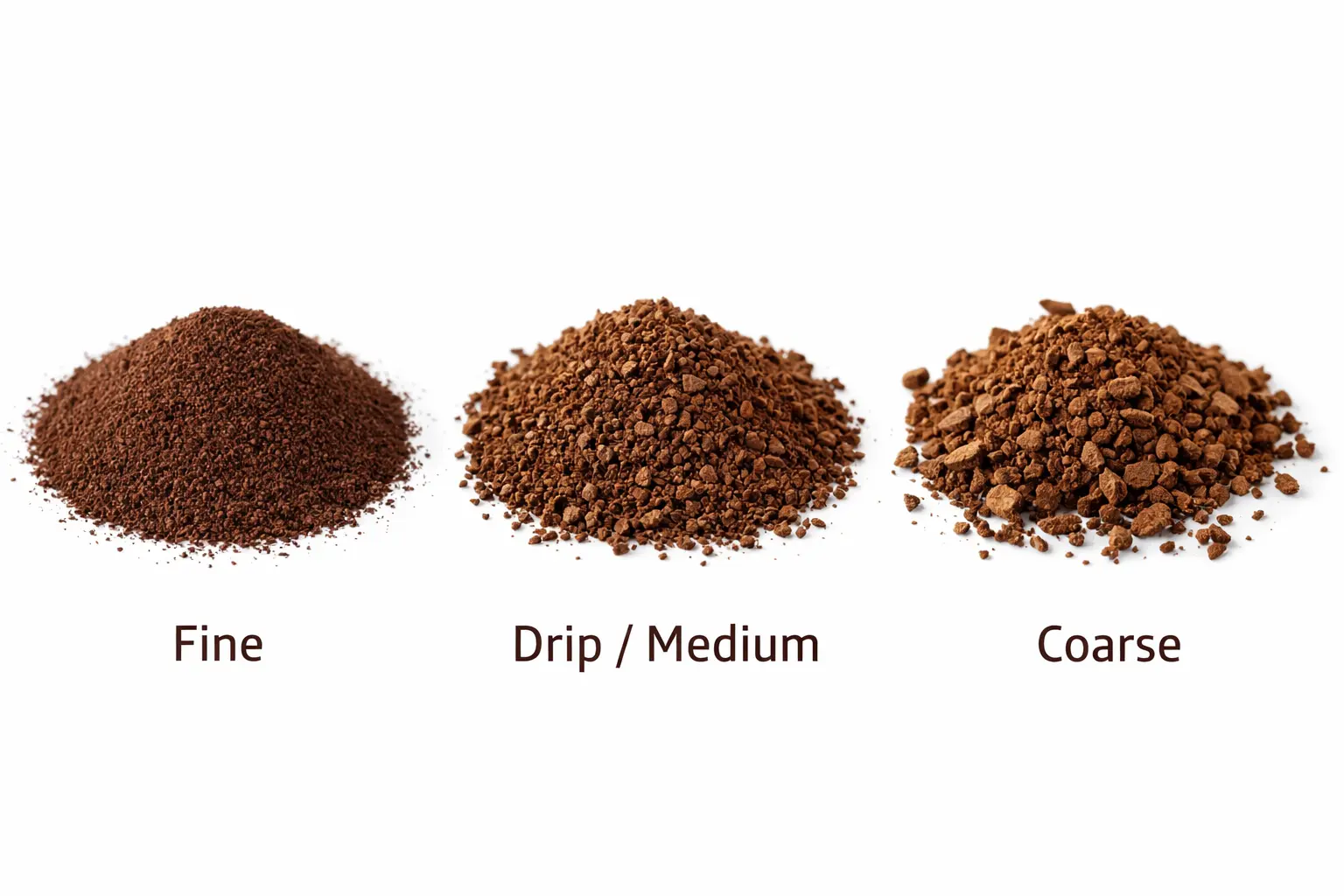
Correct drip grind should look and feel like coarse beach sand or granulated sugar. It should have a rough, slightly gritty texture between your fingers. If it feels like fine powder or clumps together — it’s too fine. If it looks like small irregular pebbles — it’s too coarse. On a KINGrinder K6 (click-stop scale 1–90), medium drip falls in the range of approximately steps 24–30, depending on the bean density and roast level. Light roasts are denser and may need a step or two finer; dark roasts are more porous and may run slightly coarser.
| Grind Setting | Result | What to Do |
|---|---|---|
| Too fine (powder-like, clumping) | Bitter, harsh, over-extracted — may also clog filter and slow flow significantly | Increase grind size 2–3 steps coarser |
| Slightly too fine | Bitter finish, dry mouthfeel, darker color than expected | Increase 1–2 steps coarser |
| Medium (target) | Balanced sweetness and acidity, clean finish, 6–8 minute full-pot brew | You’re there — hold this setting |
| Slightly too coarse | Weaker than expected, faint sour note, lighter color | Decrease 1–2 steps finer |
| Too coarse (pebble-like) | Watery, sour, under-extracted — fast flow, short brew time | Decrease 3–4 steps finer |
Burr Grinder vs. Blade Grinder for Drip
A blade grinder chops coffee randomly — the result is a mix of fine powder and coarse chunks in the same batch. When this uneven mix hits the brew basket, the fine particles over-extract and turn bitter while the coarse chunks under-extract and stay sour. Both extractions end up in the same cup. This is why blade-ground coffee so often tastes simultaneously bitter and sour — it is both at once. A burr grinder crushes beans between two abrasive surfaces set at a fixed distance, producing a narrow, consistent particle size distribution. This means your entire grounds bed extracts at roughly the same rate — which is the foundation of a balanced cup.
💡 The grinder rule: If you have a $200 drip machine and a blade grinder, you are wasting most of your machine’s capability. A $70–$80 manual burr grinder paired with a $50 drip machine will produce a better cup than a premium machine with a blade grinder. Grind quality is foundational — it’s not an accessory.
Coffee-to-Water Ratio Guide
Ratio is the most direct control over strength and intensity. The numbers below assume medium-roast drip coffee brewed in an SCA-range machine. Adjust coarser or finer as needed based on taste — these are starting points, not absolutes.
| Ratio | Style | Coffee (g) | Water (ml) | Yield |
|---|---|---|---|---|
| 1:13 | Very strong / concentrate | 23g | 300ml | ~10 oz mug |
| 1:15 | Strong — recommended starting point | 20g | 300ml | ~10 oz mug |
| 1:16 | Standard specialty | 19g | 300ml | ~10 oz mug |
| 1:17 | Moderate — approachable, slightly lighter | 18g | 300ml | ~10 oz mug |
| 1:18 | SCA Golden Cup standard | 17g | 300ml | ~10 oz mug |
The Scoop Problem
The standard “1 scoop per 6 oz of water” recommendation printed on most coffee bags is calibrated for the SCA golden ratio — but it assumes a standard 10g scoop and a consistent coffee density. In practice, a light-roast whole-bean ground medium may pack at 7g per scoop, while a very dark oily roast ground the same way may pack at 12g per scoop. The range makes volume measurement unreliable enough that two consecutive brews with “2 scoops” can produce meaningfully different cups. Weighing takes five seconds and removes this variable entirely.
Water Quality and Temperature
Water Quality
The SCA recommends water with total dissolved solids (TDS) between 75–250 ppm, no chlorine or chloramine, and a pH of 6.5–7.5 for optimal extraction. In practice, this translates to: use a carbon-filtered pitcher, avoid tap water with strong chlorine smell, and don’t use distilled water. This is sufficient for the vast majority of home brewers. If you’re using a very hard water supply (common in many Southern and Midwestern US cities), a water softener or third-wave water products (like Third Wave Water mineral packets) will additionally protect your machine’s boiler from scale accumulation — which degrades temperature performance faster in hard-water areas.
Water Temperature
Brew temperature is the single variable that separates SCA-certified drip machines from budget machines — and it’s the one variable you cannot fix through technique. If your machine’s boiler maxes out at 180°F, there’s nothing you can do on the input side to compensate for the resulting under-extraction. The fix is a machine upgrade. For those not ready to upgrade: some brewers partially compensate by pre-running a hot water-only cycle to pre-heat the boiler before the actual brew cycle. This reduces temperature loss to the cold boiler during the real brew and can raise the effective brewing temperature by 5–10°F — a marginal but real improvement on budget machines.
| Temperature Range | Machine Type | Expected Result |
|---|---|---|
| Below 185°F | Most budget machines under $40 | Under-extracted: flat, weak, faintly sour, thin body |
| 185°F–195°F | Mid-range machines $60–$120 | Acceptable but below optimal — slightly muted flavor, inconsistent batch to batch |
| 195°F–205°F | SCA-certified machines — Breville Precision Brewer, Technivorm Moccamaster | Full extraction: balanced, bright, clean finish — the full potential of your coffee |
| Above 205°F | Rare; possible in some espresso preheating cycles | Over-extraction risk: harsh, dry, astringent finish |
Gear Picks: Drip Coffee Makers and Grinder
The machine and grinder combination you use sets the performance ceiling for everything else. Here are the three pieces of gear we recommend across CoffeeGearHub for drip brewing — two machines at different price tiers and the manual grinder we recommend site-wide.
Top Drip Coffee Makers
⭐ COFFEEGEARHUB TOP PICK — BEST DRIP MACHINE FOR MOST BREWERS
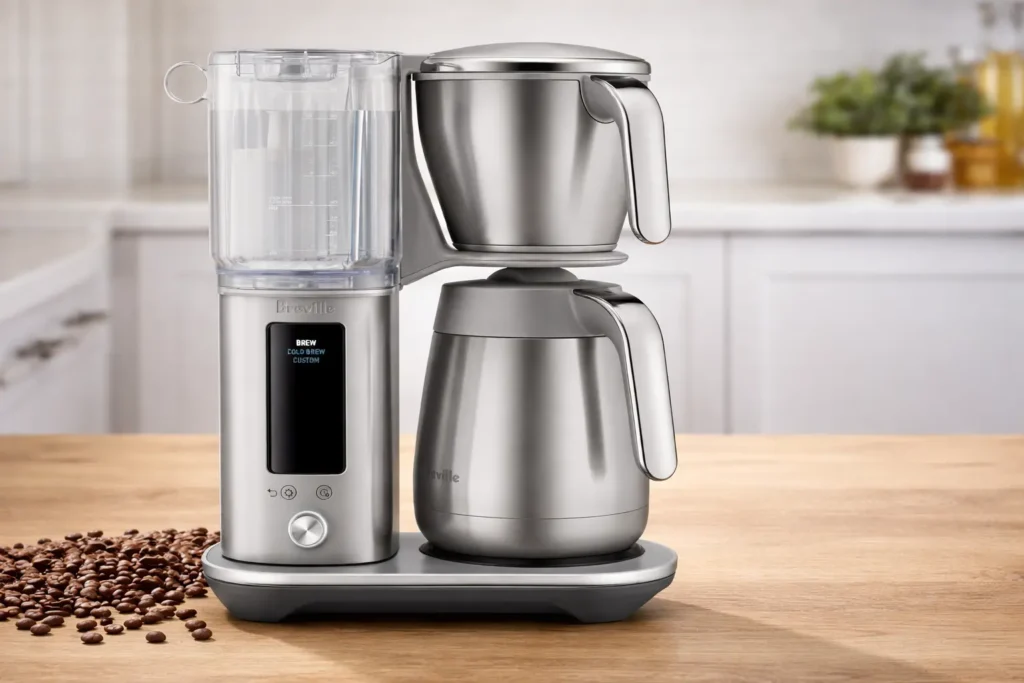
Breville Precision Brewer Thermal — Best Drip Machine for Most Brewers
The Precision Brewer is the drip machine we recommend for most households upgrading from a budget machine. It’s SCA-certified, which means it’s independently verified to brew at 197°F–204°F throughout the entire cycle — not just at the start. The Specialty mode adds a proper bloom cycle that pre-saturates grounds and allows CO₂ to escape before full extraction begins, replicating the technique-driven advantage of pour over automatically. The stainless thermal carafe keeps coffee at serving temperature for hours without a warming plate degrading flavor. Six brew modes including a single-cup setting make it versatile for all household sizes.
- SCA-certified — independently verified 197°F–204°F throughout full brew cycle
- Specialty mode — automated bloom cycle for even saturation from the first pour
- Thermal carafe — no warming plate, no flavor degradation over time
- Six brew modes — single cup, 8-cup, 12-cup full carafe, over ice, and more
- Programmable 24-hour auto-start — coffee ready before you’re awake
Affiliate link — we may earn a commission at no cost to you.
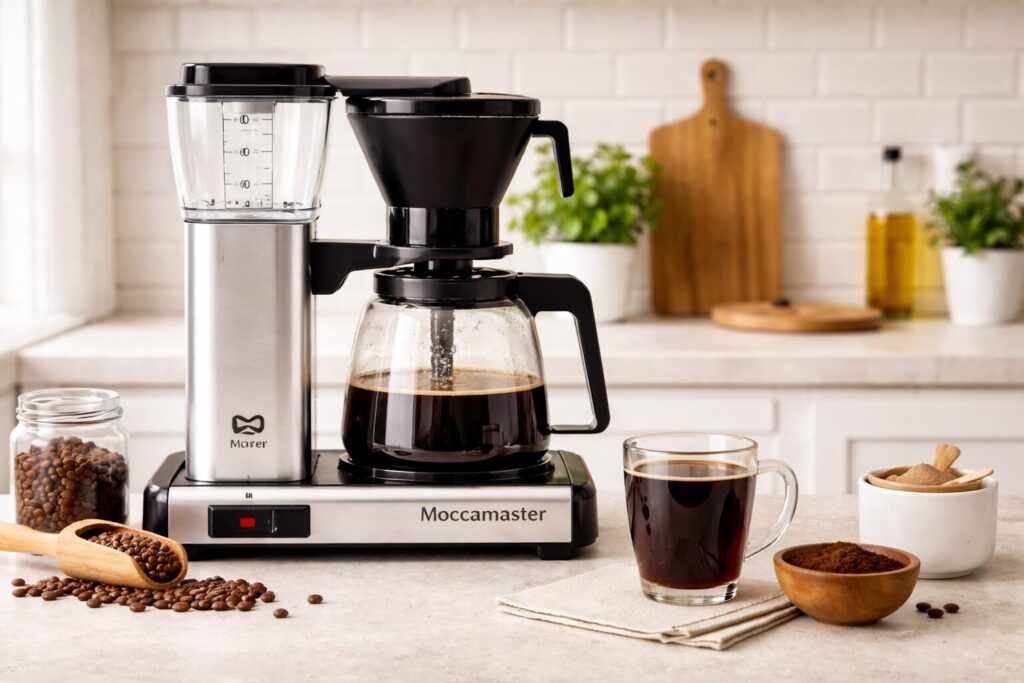
Technivorm Moccamaster KBG — Premium Pick, Built to Last Decades
The Moccamaster is the benchmark of home drip brewing — handmade in the Netherlands, SCA-certified, and built with a copper boiler and component-level construction that makes it fully repairable and genuinely designed to last 10–20 years. It brews a full 10-cup pot in under six minutes by running water through the copper element at high speed — a short brew contact time that preserves bright notes and prevents bitterness from over-extraction. The manual brew basket lever lets you adjust flow rate for lighter or darker roasts. For the brewer who wants the last drip machine they’ll ever buy, this is it.
- SCA-certified — copper boiler, verified 196°F–205°F throughout full cycle
- Full 10-cup (40 oz) brew in under 6 minutes — faster than most competitors
- Handmade in Amerongen, Netherlands — fully repairable with a five-year warranty
- Manual brew basket lever — adjust flow rate for light vs. dark roast extraction
- Available in glass or thermal carafe versions — thermal recommended
Affiliate link — we may earn a commission at no cost to you.
The Grinder: The Most Impactful Upgrade for Drip Coffee
A burr grinder is the single most impactful equipment upgrade you can make for drip brewing. Pre-ground coffee goes stale rapidly and produces inconsistent particle sizes that cause uneven extraction no matter how good your machine is. Grinding fresh immediately before each brew — to a consistent medium grind — is the foundation of every quality drip cup. For drip, set your burr grinder to medium (steps 24–28 on the KINGrinder K6) and adjust a step at a time until the cup tastes balanced.
⭐ COFFEEGEARHUB SITE STANDARD MANUAL GRINDER RECOMMENDATION
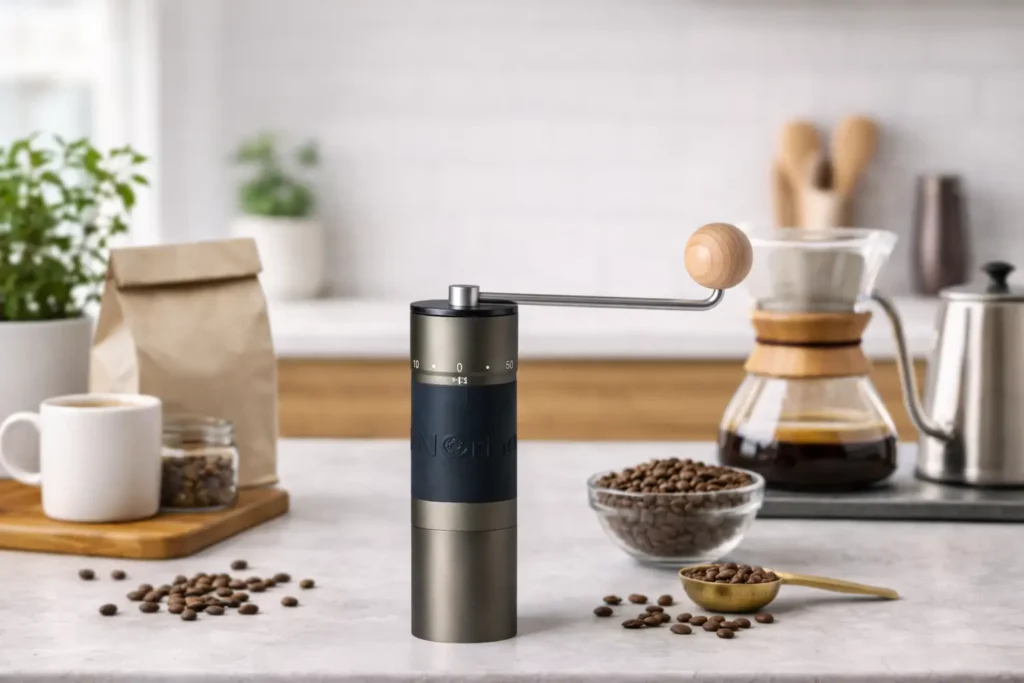
KINGrinder K6 — Best Manual Grinder for Drip Coffee
The KINGrinder K6 is the manual grinder we recommend across CoffeeGearHub, and it performs exceptionally well for drip brewing. Its 48mm stainless steel burrs produce a remarkably uniform medium grind — the consistent particle size that drip machines need to extract evenly across the full grounds bed. The click-stop adjustment system makes it easy to return to a dialed-in setting after cleaning or switching beans. For drip, target steps 24–28 (medium); adjust a step coarser if the cup tastes bitter, a step finer if it tastes weak or sour. Low retention means no stale grounds carry over from previous brews.
Affiliate link — we may earn a commission at no cost to you.
Maintenance: Keeping Your Drip Machine Performing
A drip machine that isn’t maintained degrades quietly and consistently. Scale builds on the boiler element and reduces effective brewing temperature. Coffee oils coat the carafe, basket, and showerhead and go rancid. Mold can develop in the water reservoir in humid environments. None of this is noticeable on any single brew — it happens over weeks and months — but the result is a machine that is producing progressively worse coffee for no apparent reason. A simple maintenance routine prevents all of it.
Daily (After Every Brew)
- Discard the grounds and paper filter immediately after brewing — don’t let them sit
- Rinse the brew basket and carafe with hot water — coffee oils accumulate and go rancid within hours in a warm environment
- Leave the carafe lid and reservoir lid open after rinsing to allow the interior to dry completely — closed damp environments grow mold
Weekly
- Wash the carafe, basket, and lid with warm soapy water — particularly if you use a glass carafe or permanent mesh filter
- Wipe down the showerhead with a damp cloth — grounds and oils accumulate on and around the spray holes
- Inspect the water reservoir interior and wipe clean if you see any discoloration or residue
Monthly — Descaling
Descaling is the most important maintenance step and the most frequently skipped. Scale (calcium carbonate deposits from hard water) builds up on the heating element and acts as insulation — it raises the energy needed to reach brewing temperature and eventually prevents the machine from reaching it at all. A machine with significant scale buildup may peak at 175°F even if it once reached 200°F. Descaling restores heating efficiency and brewing temperature.
- Mix a descaling solution — either a commercial descaler (follow its instructions) or a DIY solution of 1 tablespoon of citric acid dissolved in 1 liter of water. White vinegar also works (use a 50/50 vinegar-to-water mix) but leaves a stronger residual smell that requires more rinse cycles.
- Pour the descaling solution into the water reservoir in place of your usual brew water. Insert a filter but no coffee grounds.
- Run a full brew cycle. The heated acid solution dissolves calcium deposits on the boiler element and inside the water path.
- Discard the descaling solution from the carafe. Fill the reservoir with fresh filtered water and run a second full cycle — this is a rinse cycle.
- Repeat the rinse cycle a second time with fresh water to ensure no descaling solution residue remains in the machine before brewing coffee again.
🔬 Descaling frequency: In soft water areas (TDS below 100 ppm), every 3 months is sufficient. In hard water areas (TDS above 200 ppm — common in much of the South and Midwest), descale monthly. If your machine has a descale indicator light, don’t wait for it — it typically activates after scale has already affected performance. Proactive monthly descaling in hard water areas prevents the problem rather than reacting to it.
Troubleshooting Matrix: Fix Drip Coffee Problems at the Source
Most drip coffee problems are not machine problems — they’re grind problems, ratio problems, freshness problems, or maintenance problems. Work through the symptom that matches your cup and trace it to the most likely cause before assuming the machine needs replacing.
| Symptom | Most Likely Cause | Fix (in order) |
|---|---|---|
| Weak, watery coffee | Grind too coarse; ratio too low; machine not reaching temperature | Grind finer by 2–3 steps → increase coffee dose (try 1:15 instead of 1:17) → descale machine → consider SCA-certified machine if problem persists |
| Bitter, harsh coffee | Grind too fine; ratio too high; coffee sitting on warming plate | Grind coarser by 2–3 steps → reduce dose slightly → pour and drink immediately — do not leave on warming plate |
| Flat, dull, lifeless flavor | Stale beans; machine below 195°F | Buy fresh whole-bean coffee (check roast date) and grind just before brewing → descale machine → upgrade to SCA-certified machine |
| Sour or sharp finish | Under-extraction — grind too coarse, temperature too low, or ratio too low | Grind 2 steps finer → increase dose → verify machine is reaching temperature (descale if needed) |
| Papery taste | Paper filter not rinsed before brewing | Rinse paper filter thoroughly with hot water before adding grounds on every brew |
| Muddy, gritty cup | Grind too fine; filter not seated properly; permanent filter allowing fines through | Grind coarser → reseat filter carefully in basket → if using a permanent filter, switch to paper |
| Coffee tastes fine fresh but bad after 15 minutes | Warming plate degrading coffee — cooking and oxidizing the brewed coffee | Pour immediately into thermal carafe or individual cups — do not allow glass-carafe coffee to sit on the warming plate |
| Inconsistent results day to day | No scale; inconsistent grind; variable dose | Weigh coffee and water in grams every brew → use a click-step burr grinder and record your setting → buy fresher beans |
| Machine brews slowly or stops mid-cycle | Scale buildup clogging water path; filter clogged (grind too fine) | Run full descale cycle → grind slightly coarser → check that filter is seated flat without folded edges blocking flow |
| Coffee quality declining over weeks without changing anything | Scale buildup reducing brew temperature; beans aging past freshness window | Descale the machine → check roast date on coffee bag — if over 4–6 weeks since roast, buy fresh |
FAQs: How to Brew Better Drip Coffee
What is the best coffee-to-water ratio for drip coffee?
The SCA Golden Cup standard recommends 55 grams of coffee per liter of water — roughly a 1:18 ratio — as a starting point for drip. Most specialty coffee enthusiasts prefer a slightly stronger 1:15 to 1:16 ratio. Use a kitchen scale rather than scoops: a standard coffee scoop is approximately 10 grams, but density varies enough between roasts and grind sizes that volume measurement is unreliable.
What water temperature is best for drip coffee?
The SCA-certified optimal brewing temperature is 195°F–205°F (90°C–96°C). Budget drip machines often top out at 185°F or lower, which causes under-extraction — flat, weak, or sour-tasting coffee. SCA-certified machines like the Breville Precision Brewer and Technivorm Moccamaster are verified to reach and maintain the correct temperature throughout the full brew cycle.
How do I make my drip coffee taste better without buying a new machine?
The fastest improvements without a new machine: (1) switch to freshly roasted whole-bean coffee and grind just before brewing, (2) use filtered water instead of tap, (3) switch to a 1:15 ratio by weight instead of scoops, (4) rinse your paper filter before every brew, and (5) pour and drink immediately — don’t let coffee sit on a warming plate. These five changes often produce a dramatically better cup with the machine you already own.
Should I use filtered water for drip coffee?
Yes. Water is roughly 98–99% of your brewed coffee, so its quality has a direct impact on flavor. Hard tap water introduces minerals that scale up your machine and can contribute chalky or off-flavors. Chlorinated municipal water introduces chemical notes. A simple carbon pitcher filter removes chlorine and moderates mineral content and is sufficient for most households. Avoid distilled water — it has no mineral content and produces flat extraction.
How often should I clean my drip coffee maker?
Rinse the carafe and brew basket after every use — coffee oils accumulate and go rancid within hours. Deep-clean the carafe with warm soapy water weekly. Descale the machine every 1–3 months depending on your water hardness — scale buildup on the boiler element progressively reduces brew temperature and is the most common cause of declining coffee quality in older machines. Use a citric acid solution or a dedicated descaler and follow with two full clear-water rinse cycles.
Does grind size matter for drip coffee?
Yes — grind size is one of the most impactful variables in drip brewing. Medium grind is the standard target: similar in texture to coarse beach sand. Grind too fine and water flows too slowly, causing over-extraction and bitter coffee. Grind too coarse and water passes through too quickly, producing weak and under-extracted coffee. A burr grinder produces consistent particle sizes that a blade grinder cannot — uneven grind particle size causes simultaneous under- and over-extraction in the same brew.
What is the difference between a regular drip machine and an SCA-certified one?
The Specialty Coffee Association certifies drip machines that reach and maintain 195°F–205°F throughout the full brew cycle and distribute water evenly across the coffee bed. Budget machines typically fail both standards — they underheat water and have showerheads that saturate the center of the grounds bed while leaving the edges dry. SCA certification is a meaningful quality threshold, not marketing language, and typically corresponds to a significant jump in cup quality.
Can I use whole beans in a drip coffee maker?
No — whole beans must be ground before brewing. Water cannot extract from intact beans. Some all-in-one drip machines include a built-in grinder that grinds beans directly into the brew basket before each cycle; these eliminate the need for a separate grinder but typically use burr quality that is lower than a dedicated grinder at the same price point. For best results, grind separately with a quality burr grinder immediately before brewing.
How long does brewed drip coffee stay fresh?
Drip coffee in a glass carafe on a warming plate begins to degrade within 20–30 minutes — the heat cooks the coffee and drives off volatile aromatics while accelerating oxidation. In a thermal carafe off heat, brewed coffee stays fresh and palatable for 1–2 hours. After that it begins to taste flat and stale. Never reheat brewed coffee — reheating accelerates the development of harsh, acrid compounds in already-extracted coffee.
Should I use a paper filter or a permanent filter for drip coffee?
Paper filters produce a cleaner, brighter cup by trapping coffee oils and fine particles. Permanent metal mesh filters allow oils and micro-fines through, producing a fuller-bodied, slightly heavier cup. Neither is objectively better — it depends on your taste preference. For flavor clarity and brightness, use paper. For body and richness, use a permanent filter. If using paper, always rinse the filter before brewing to remove papery taste.
Continue Learning
DRIP COFFEE GUIDES
GRIND AND RATIO GUIDES
Still troubleshooting your drip results? The full coffee grind size guide walks through every method from French press to espresso with taste-based dial-in sections — including a dedicated drip coffee segment that explains how to adjust by cup flavor rather than by arbitrary step numbers.
☕
Written by the CoffeeGearHub Editorial Team
CoffeeGearHub is a specialty coffee equipment resource produced by the CoffeeGearHub Editorial Team. Our brewing method guides are researched using published extraction science, SCA certification standards, equipment manufacturer specifications, and established specialty-coffee community knowledge. We review and update our pillar content regularly to reflect current product availability and community consensus. About CoffeeGearHub →