
French Press Cold Brew Guide
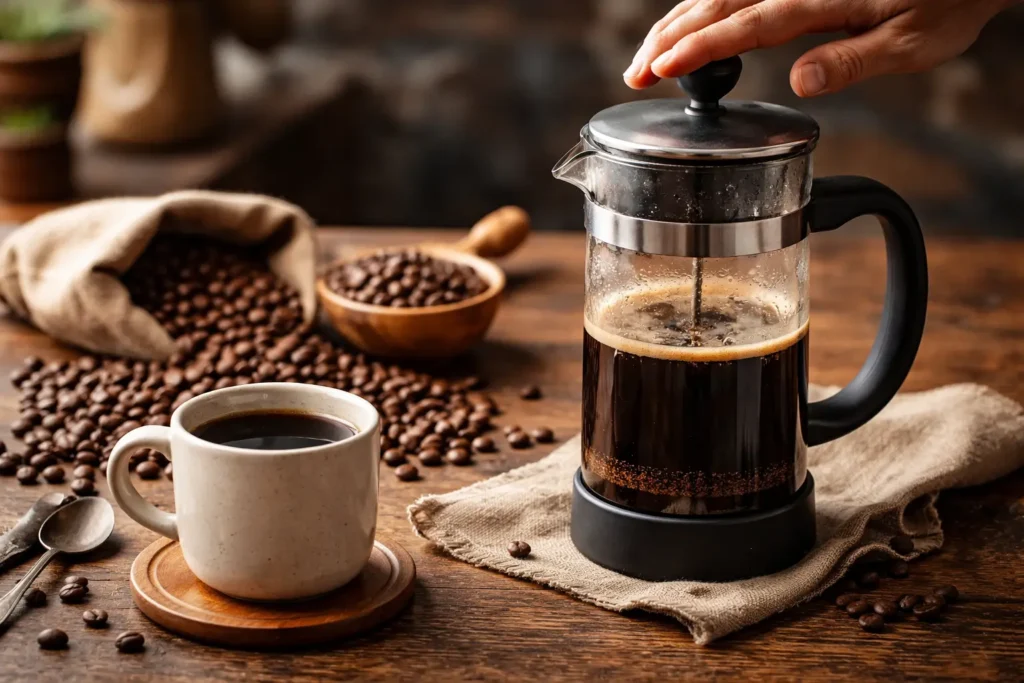
Editorial standards: this guide uses product examples as workflow references and treats ratios, grind settings, and times as starting points that still need to be adjusted for the coffee and brewer.
At a glance
Cold brew changes time and ratio more than it changes the basic French press workflow
A French press is well suited to cold brew because it combines immersion brewing and built-in filtration in one vessel. The main decisions are whether you want concentrate or ready-to-drink coffee, how coarse to grind, and how long to steep.
For concentrate, a stronger ratio such as 1:8 is a useful starting point. For ready-to-drink cold brew, move closer to normal filter-coffee ratios and adjust by taste.
Editorial analysis
Control dilution separately from extraction
A strong concentrate is not automatically over-extracted; it simply contains more coffee relative to water. Brew strength and extraction are related but different, which is why dilution after brewing can be cleaner than trying to force every variable into one recipe.
Very coarse grind and long contact time make cold brew forgiving, but stale coffee, excessive fines, or leaving the finished brew on the grounds can still create dull or harsh flavors.
The 30-Second Answer
For French press cold brew, choose the finished strength first. A 1:8 ratio works as a concentrate starting point, while roughly 1:15 is closer to ready-to-drink strength. Grind very coarse, steep cold for about 12–16 hours, press slowly, and decant the finished brew immediately.
Compare the core setup
Start with these representative choices
These representative products make the workflow concrete while keeping the article focused on technique rather than turning it into a product list.
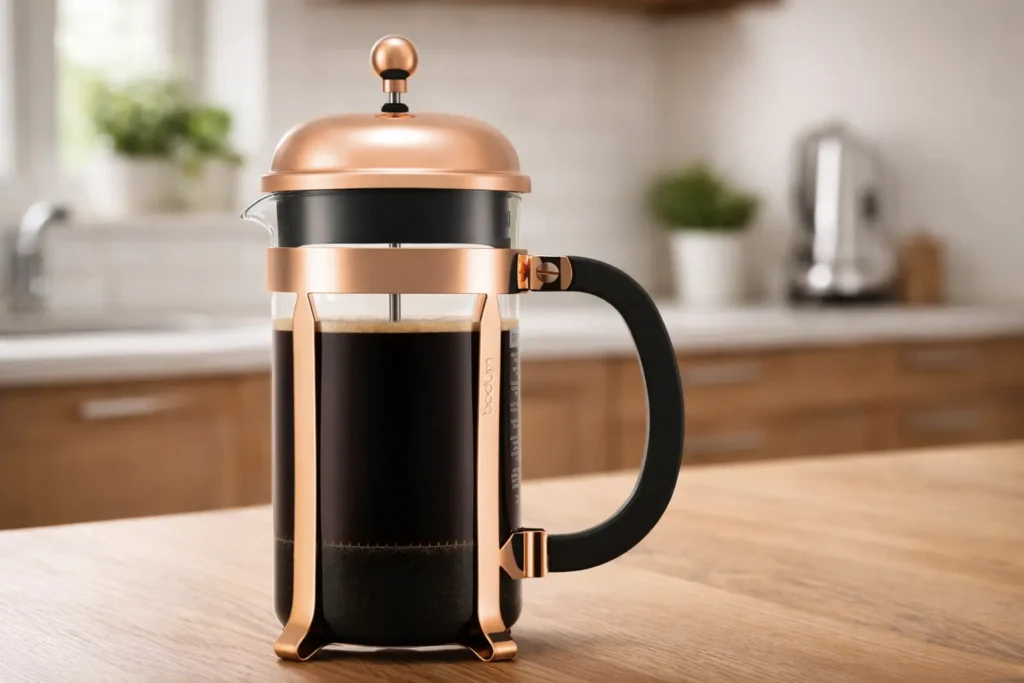
Bodum Chambord — cold-brew vessel reference
The 1L format gives enough working volume for a practical concentrate batch while keeping filtration simple.
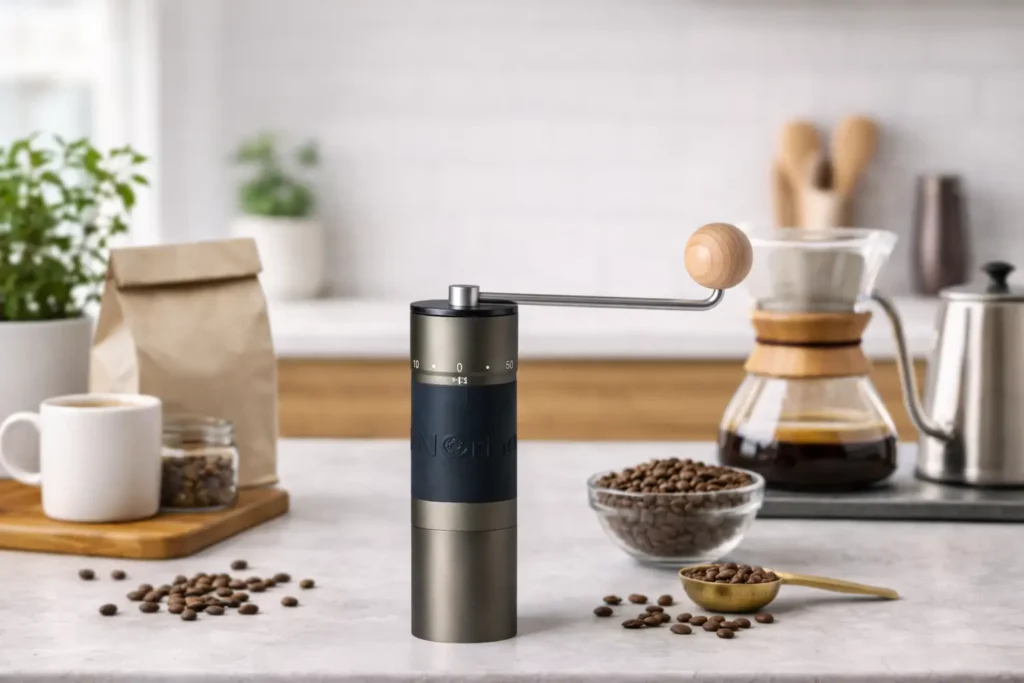
KINGrinder K6 — very-coarse grind control
A repeatable coarse range helps reduce fines and makes long cold-brew steeps easier to reproduce.
Affiliate disclosure: Amazon links may earn CoffeeGearHub a commission at no additional cost to you. Prices and availability can change.
How French Press Cold Brew Works: The Brew Mechanics
Understanding why cold brew tastes different from hot coffee — and why French press handles it so well — explains every decision in this guide. Cold brew is not just hot brew served cold; it is a fundamentally different extraction process with different chemistry and different output.
Cold Extraction vs Hot Extraction
Hot water extracts coffee quickly. A French press brewed near typical hot-coffee temperatures can reach a balanced extraction in minutes.
Cold water works far more slowly, so cold brew stretches the process into hours. The lower temperature usually produces a smoother cup with less perceived acidity and bitterness. It also changes which flavors stand out, often emphasizing chocolate, caramel, and heavier body.
Why French Press Is Ideal for Cold Brew
A French press works well for home cold brew because it is already an immersion brewer with a built-in filter. All of the grounds can stay submerged for the full steep, and the mesh filter lets you separate the finished brew without another device.
The metal filter also keeps more coffee oils in the cup than paper filtration. That gives cold brew extra body. For many households, a 1L press provides a practical batch size without taking up much refrigerator space.
🔬 Why a very coarse grind matters: cold water extracts slowly, so the grounds stay in contact with water for many hours. Fine particles can over-extract during that long steep and add bitterness or excess sediment.
Use a grind that is coarser than your normal hot French press setting. On the K6, the range in this guide is a starting point. Adjust by taste and by the amount of fine material in the finished brew.
Gear Checklist and Recommendations
If you already own a French press and a burr grinder, you have everything you need to make cold brew. The additional equipment is minimal — a digital scale, a glass storage vessel, and refrigerator space. No kettle required, no paper filters, no dedicated cold brew equipment. The two non-negotiable investments are the French press and a burr grinder; everything else is secondary.
Bodum Chambord — practical cold-brew vessel
The 1L Chambord gives a useful batch size for concentrate or ready-to-drink cold brew and keeps the entire steep-and-filter workflow in one vessel.
KINGrinder K6 — very-coarse cold-brew range
Cold brew benefits from a grinder that can stay consistent at very coarse settings. The K6 provides repeatable adjustment so you can reduce fines without guessing.

Peet’s Major Dickason’s Blend — body-forward cold-brew reference
A darker, chocolate-toned blend is a useful reference for the smooth, low-acid profile many people want from cold brew.
Complete Cold Brew Gear Checklist
| Item | Required? | Notes |
|---|---|---|
| French press | ✅ Essential | Bodum Chambord 1L is the recommended option; any glass French press works |
| Burr grinder | ✅ Essential | KINGrinder K6 recommended; blade grinders are incompatible — produce bitter, over-extracted cold brew |
| Digital scale (0.1g accuracy) | ✅ Essential | Weight-based measurement is non-negotiable for consistent batch-to-batch results |
| Glass storage vessel | ✅ Essential | Mason jar, glass pitcher, or any sealed glass container — decant concentrate immediately after pressing |
| Refrigerator | ✅ Essential | Required for safety and flavour — room temperature steeping not recommended |
| Long spoon or chopstick | ✅ Essential | Thorough stirring when adding water ensures all grounds are saturated — dry grounds do not extract |
| Kettle | ❌ Not needed | Cold brew uses cold water — no heating required |
| Thermometer | ❌ Not needed | No temperature control required for cold brew |
Choosing Your Coffee: Roast, Origin, and Freshness for Cold Brew
Coffee choice has a pronounced effect on cold brew flavour — more than in hot French press brewing, because cold extraction does not have temperature as a compensating variable. The roast level, origin, and processing method you choose sets the flavour ceiling for your cold brew batch.
Roast Level for Cold Brew
Medium-dark and dark roasts are forgiving choices for cold brew because their chocolate, caramel, and roast-driven flavors extract well at low temperature. Light roasts can also work, but some of their floral and high-acid character may be less prominent than it is in pour-over.
If you use a light roast, expect to adjust the recipe. A slightly finer grind, longer steep, or higher dose may help. Make one change at a time so the result stays easy to diagnose.
Origin and Processing
Natural-process and honey-process coffees can work very well in cold brew, especially if you enjoy fruit-forward flavors. Ethiopian, Brazilian, and Indonesian coffees can bring dried fruit, chocolate, and fermentation-driven sweetness into the concentrate.
Washed coffees and medium-dark blends are often easier to repeat from batch to batch. Brazilian coffees are especially forgiving because their lower acidity and heavier body suit cold extraction well.
Freshness
Buy whole bean when possible and grind just before brewing. Cold brew is somewhat forgiving of bean age, but stale coffee can still taste flat and hollow.
Beans a few weeks from roast are a practical target. Very fresh coffee may release enough CO₂ to form a floating crust during the steep; stir it down at the start. If you use pre-ground coffee, choose a coarse grind intended for cold brew or French press.
Bean Type Reference: Cold Brew Performance by Coffee Type
| Bean type | Cold brew performance | K6 starting point | Steep time | Notes |
|---|---|---|---|---|
| Medium-dark blend | Excellent — smooth, chocolate-forward, very forgiving | 150–154 clicks | 14–16 hrs | Best all-around everyday cold brew choice |
| Dark roast | Very good — bold, bittersweet, intense; narrow window | 152–158 clicks | 12–14 hrs | Go coarser and shorter — dark roasts extract quickly even in cold water |
| Medium roast blend | Good — balanced, approachable, slightly more acidity than dark | 148–152 clicks | 14–16 hrs | Standard parameters; reliable results across roasters |
| Natural Ethiopian | Exceptional — dried fruit, blueberry, dark chocolate; intensely complex | 148–152 clicks | 12–14 hrs | Shorten steep — fermentation esters extract quickly and can overpower |
| Brazilian / Indonesian | Excellent — earthy, nutty, chocolate, low acidity; ideal immersion origin | 152–158 clicks | 14–16 hrs | Very forgiving; consistent batch to batch |
| Light roast washed | Moderate — fruit-forward, tea-like; requires more technique | 144–150 clicks | 16–18 hrs | Grind finer, steep longer, increase dose slightly — less forgiving |
| Honey process medium | Very good — balanced sweetness, stone fruit notes, full body | 148–152 clicks | 14–16 hrs | Consistent results; reliable everyday option |
The Cold Brew Ratio and Concentrate System
Cold brew ratio is the most consequential variable in your recipe — and it determines not just strength but how you use the finished brew. Unlike hot coffee, which is almost always served at brewing strength, cold brew is typically brewed as a concentrate and diluted to taste before serving. Understanding the concentrate system is essential to getting consistent results.
Concentrate (1:8) vs Ready-to-Drink (1:15)
There are two useful ways to approach cold-brew ratio. A concentrate recipe around 1:8 produces a strong brew that is usually diluted before serving. A ready-to-drink recipe around 1:15 produces a lighter batch that can go directly over ice.
Concentrate is efficient and flexible because each serving can be diluted to taste. Ready-to-drink cold brew is simpler at serving time but gives you less room to adjust strength afterward. Choose the approach that fits how you actually drink it.
| French press size | Water volume (1:8 concentrate) | Coffee dose | Approximate concentrate yield | Diluted servings (1:1) |
|---|---|---|---|---|
| 350ml | 240ml | 30g | ~190–210ml | 2–3 servings |
| 1L (recommended) | 480ml | 60g | ~380–420ml | 6–8 servings |
| 1.5L | 760ml | 95g | ~600–660ml | 9–12 servings |
🔬 Why concentrate yield is less than water volume: Ground coffee absorbs water during steeping — approximately 2ml per gram of coffee. A 60g dose absorbs roughly 120ml of your brew water, which is why the concentrate yield is 380–420ml rather than the full 480ml input. This absorption is consistent and predictable once you know your dose. Plan for it when deciding batch size so you have the serving volume you need.
Adjusting Concentrate Strength
A 1:8 concentrate is a starting point, not a rule. Move toward 1:7 if you want a stronger base for milk or heavy ice. Move toward 1:10 for a lighter concentrate.
Keep batch strength and serving dilution separate in your notes. That makes the system easier to repeat. Write down both numbers when you find a combination you like.
Grind Size for Cold Brew: K6 Settings and Dial-In Guide
Grind size is the most important variable in cold brew quality. The long steep time makes fine particles extract aggressively — what is a minor grind error in hot brew becomes a dramatically over-extracted, bitter result in cold brew. Start coarser than you think you need to.
What Very Coarse Grind Looks and Feels Like
Cold-brew grind should be very coarse and visibly chunkier than a typical hot French press grind. Rough breadcrumbs or cracked peppercorns are useful visual references.
You should see very little fine dust in the catch cup. If the grind still looks like ordinary coarse salt, move coarser and compare the next batch. The exact K6 click number is less important than repeatability and taste.
| Roast level | K6 clicks (cold brew) | Ratio | Steep time | Expected result |
|---|---|---|---|---|
| Light roast | 142–148 | 1:7 to 1:8 | 16–18 hrs | Bright, fruit-forward, tea-like — needs careful monitoring to avoid under-extraction |
| Medium roast | 148–152 | 1:8 | 14–16 hrs | Balanced, smooth, approachable — good all-around cold brew character |
| Medium-dark roast | 150–154 | 1:8 | 14–16 hrs | Rich, chocolate, full body — the benchmark cold brew profile |
| Dark roast | 152–158 | 1:8 to 1:9 | 12–14 hrs | Bold, bittersweet, intense — excellent with milk; shorter steep avoids harsh extraction |
| Natural Ethiopian | 148–152 | 1:8 | 12–14 hrs | Dried fruit, blueberry, dark chocolate — exceptional when not over-extracted |
⚠️ Blade grinder warning: a blade grinder creates both fine dust and large chunks in the same dose. During a 12–16 hour cold-brew steep, the fines can become harsh while the largest pieces remain under-extracted.
That combination is hard to fix with ratio alone. A burr grinder gives you a narrower particle range and makes long cold-brew extraction much easier to control.
Step-by-Step French Press Cold Brew Instructions
This is the complete standard recipe for a 1L Bodum Chambord with medium-dark roast at 1:8 concentrate ratio. Active prep time is under 10 minutes; the refrigerator does the rest.
Standard Cold Brew Recipe: Medium-Dark Roast, 1L Chambord
- Coffee: 60g whole bean (medium-dark roast)
- Water: 480ml cold filtered water
- Ratio: 1:8 (concentrate — dilute 1:1 before serving)
- Grind: Very coarse — K6 clicks 80–84
- Steep time: 14–16 hours in the refrigerator
- Active prep time: approximately 8 minutes
- Measure and grind. Weigh 60g of whole bean coffee. Grind at K6 clicks 150–154 — very coarse, resembling cracked peppercorns. Grind immediately before brewing. Do not pre-grind and store; ground coffee degasses and oxidises rapidly, diminishing flavour even before the cold brew steep begins.
- Add grounds to the clean, dry French press. No preheating required — you are brewing cold. Confirm the beaker is clean and odour-free; any residual coffee oils from a previous brew can introduce off-flavours into a 12–16 hour steep. Zero your scale with the press on it so you can weigh water directly.
- Add cold filtered water. Pour 480ml of cold filtered water over the grounds in a slow, even pour from outside to centre. There is no bloom pour for cold brew — add all the water at once. Tap water is usable but filtered water produces noticeably cleaner-tasting cold brew; the mineral content of your water affects the final flavour profile, and filtered water removes chlorine compounds that can introduce off-notes during the long steep.
- Stir thoroughly. Use a long spoon or chopstick to stir the grounds and water together until every particle is fully saturated. Spend 20–30 seconds on this step — it is more important in cold brew than hot brew because there is no heat to assist with initial wetting. Dry grounds floating on the surface will not extract. Ensure the grind is evenly distributed throughout the water column, not sitting in a dense cake at the bottom.
- Place lid on with plunger raised. Place the lid on the French press with the plunger pulled all the way up — do not press yet. The raised plunger creates a partial seal that keeps the beaker closed during refrigerator storage without applying pressure to the grounds.
- Refrigerate for 14–16 hours. Place the French press in the refrigerator and steep for 14–16 hours. Set a phone reminder if you tend to forget — the difference between 14 hours and 20 hours in the same batch is significant. Do not steep at room temperature; the warmer environment accelerates extraction unpredictably and creates food safety risk. Leave the press undisturbed — no stirring, no checking, no agitation during the steep.
- Remove and press slowly. At the end of the steep, remove the French press from the refrigerator. Apply slow, steady downward pressure to the plunger — the full press should take 30–45 seconds. Cold concentrate is denser than hot brew and may offer more resistance; do not force the plunger. If you feel strong resistance, stop and hold position for a few seconds, then continue with lighter pressure. If the plunger drops without resistance, your grind is too coarse or the concentrate did not develop fully.
- Decant immediately. Pour all the pressed concentrate into a sealed glass storage vessel immediately. Do not leave concentrate in the French press — the grounds continue extracting even after pressing, and cold brew left in the press overnight will be noticeably over-extracted and harsh by morning. A mason jar or sealed glass pitcher works perfectly. Seal and refrigerate.
- Serve diluted over ice. Pour approximately 120ml of concentrate over a glass of ice, then add 120ml of cold water, milk, or oat milk. Stir briefly and taste; adjust dilution to your preference. The concentrate is flexible — straight over ice for a strong cold brew, 1:2 with oat milk for a cold brew latte, or 1:3 with sparkling water for a cold brew soda.
Quick reference:
- Grind very coarse; on the K6, start around the range used in this guide.
- Add the grounds to a dry press and pour in 480ml of cold filtered water.
- Stir thoroughly, then refrigerate with the plunger raised for roughly 14–16 hours.
- Press slowly and decant the concentrate immediately.
- Refrigerate the finished brew and dilute to taste when serving.
Steep Time Variations
14–16 hours is the standard cold brew steep range for medium-dark roast at 1:8 ratio and K6 clicks 150–154. But roast level, grind size, and ambient refrigerator temperature all affect the extraction rate. The table below shows how to adjust steep time for different scenarios.
| Steep time | Best for | Expected flavour impact | When to use |
|---|---|---|---|
| 10–12 hours | Dark roast; very fresh natural-process beans | Lighter body, brighter, less concentrated — subtle sweetness, lower intensity | If your dark roast concentrate is consistently too bitter at 14 hours |
| 12–14 hours | Dark roast; natural Ethiopian; room-temperature fridge | Full body, smooth, rich — chocolate and caramel forward | Good default for dark roasts and natural-process coffees |
| 14–16 hours (standard) | Medium-dark and medium roast blends | Optimal balance of sweetness, body, and complexity — benchmark cold brew character | The default starting point for most beans and most brewers |
| 16–18 hours | Light roast; washed single-origin; very coarse grind | Fuller extraction, more body, deeper flavour from dense light-roast beans | Light roast consistently tastes thin or flat at 14–16 hours |
| 18–20 hours (maximum) | Light roast at very coarse K6 setting only | Maximum cold extraction — risk of astringency if grind is wrong | Only for light roast where 16–18 hrs is still underdeveloped; adjust grind before adding more time |
🔬 Refrigerator temperature matters. A colder refrigerator extracts a little more slowly than a warmer one. Even shelf position can create a small temperature difference.
If a batch repeatedly tastes under-extracted at the same steep time, keep the press on the same shelf and note your refrigerator setting. Consistency matters more than chasing a single exact temperature.
Serving Guide and Cold Brew Recipes
Cold brew concentrate is one of the most versatile coffee bases available — it adapts to more serving styles and recipes than any other brew format. Once you have a quality concentrate in the refrigerator, these are the best ways to use it.
Dilution Reference Chart
| Serving style | Concentrate | Dilutant | Notes |
|---|---|---|---|
| Classic cold brew over ice | 120ml | 120ml cold water | Standard 1:1 dilution — clean, strong, smooth |
| Strong cold brew | 150ml | 90ml cold water | 2:1 ratio — for those who prefer intense cold brew |
| Cold brew latte | 120ml | 180ml whole milk or oat milk | Oat milk amplifies sweetness and pairs especially well with dark roast concentrate |
| Iced macchiato style | 90ml | 150ml oat milk + ice | Lighter, sweeter — excellent afternoon drink |
| Cold brew soda | 90ml | 150ml sparkling water + ice | Bright, effervescent — medium-dark roast works best; natural Ethiopian is outstanding |
| Cold brew tonic | 60ml | 150ml tonic water over ice | Floral, bitter, complex — best with lighter concentrate; a specialty coffee favourite |
| Overnight oat milk cold brew | 90ml concentrate | Steep overnight directly in 180ml oat milk instead of water | Rich, naturally sweet, no ice needed — very smooth texture |
Tips for Serving Cold Brew Over Ice
Ice will dilute cold brew as it melts. Start with slightly less added water if you expect the drink to sit over ice for a while.
Large cubes melt more slowly than crushed ice. Coffee ice cubes are another option if you want to preserve strength. For a group, pre-diluting a carafe to a known ratio is easier than mixing every glass from scratch.
Storage and Shelf Life
Cold brew generally keeps its flavor longer in the refrigerator than hot brewed coffee. Store it in a clean, sealed container and keep it cold.
Flavor will change over time, so use smell and taste as practical checks. If the brew develops an off aroma or flavor, discard it.
| Storage method | Shelf life | Flavour quality | Notes |
|---|---|---|---|
| Sealed glass container, refrigerator | Up to 10 days | Best at days 2–6 | Recommended — glass does not absorb odours or flavours |
| Plastic container, refrigerator | Up to 7 days | May pick up fridge odours | Usable but glass is strongly preferred for flavour fidelity |
| Undiluted concentrate, freezer | Up to 3 months | Good after thawing | Freeze in 120ml portions for single-serve convenience |
| Pre-diluted cold brew, refrigerator | 3–5 days | Good at days 1–3 | Shorter shelf life once diluted — dilute per serving when possible |
⚠️ Never store concentrate in the French press beaker. Decanting into a separate vessel immediately after pressing is essential. The grounds sitting at the bottom of the beaker continue extracting the concentrate for as long as they remain in contact with the liquid. Cold brew left in the press overnight extracts for an additional 8–10 hours beyond your intended steep endpoint and becomes harsh and over-extracted. Always pour all the concentrate into a separate sealed container before refrigerating.
Cold Brew vs Iced Coffee: What Is the Difference?
Cold brew and iced coffee are often used interchangeably but they are produced by completely different processes and taste distinctly different. Understanding the distinction helps you choose the right method for your preference and situational needs.
| Attribute | Cold brew (French press) | Iced coffee (hot brew over ice) | Japanese iced pour-over |
|---|---|---|---|
| Brew method | Cold water, 12–16 hrs in fridge | Hot brew at double strength, poured over ice | Pour-over brewed directly onto ice cubes |
| Brew time | 12–16 hours + prep | Under 10 minutes | Under 10 minutes |
| Flavour profile | Smooth, low-acid, chocolatey, full body | Brighter, more acidic, similar to hot coffee | Clean, bright, fruit-forward, tea-like body |
| Acidity | Low — cold extraction produces fewer acidic compounds | High — hot extraction preserves all acidity | Medium — paper filter reduces body; acidity preserved |
| Best for | Batch production; anyone sensitive to coffee acidity; milk drinks | When you need iced coffee quickly; single servings | Light roast; origin-forward cup; clarity preferred |
| Shelf life | Up to 10 days refrigerated | Best same day; 24 hrs max | Best same day; 24 hrs max |
Troubleshooting Matrix: French Press Cold Brew Problems and Fixes
Identify your symptom below. Adjust one variable at a time — changing multiple things simultaneously makes it impossible to identify what changed your result. Write down each change and note the outcome so you can repeat or refine it.
| Symptom | Most likely cause | Fix (in priority order) |
|---|---|---|
| Bitter / harsh concentrate | Over-extraction — grind too fine, steep too long, or concentrate left on grounds after pressing | 1. Grind 5+ clicks coarser on K6 → 2. Shorten steep by 2 hours → 3. Decant immediately after pressing (never leave in press) |
| Weak / watery / thin | Under-extraction — grind too coarse, steep too short, or ratio too high (too much water) | 1. Reduce water by 30–50ml (increase concentration) → 2. Grind 4 clicks finer → 3. Extend steep by 2 hours |
| Sour / sharp / acidic | Under-extraction — not enough compounds dissolved to balance acidity | 1. Grind 4 clicks finer → 2. Extend steep by 2 hours → 3. Increase dose by 5–10g |
| Flat / no aroma / hollow | Stale beans — aromatic volatile compounds depleted before brewing | Buy fresh beans with a visible roast date; no recipe adjustment compensates for stale coffee |
| Muddy / excessive sediment in cup | Grind too fine for metal mesh; blade grinder fines; pressing too fast | 1. Grind 5+ clicks coarser → 2. Press more slowly (30–45 sec) → 3. Switch to burr grinder if using blade grinder → 4. Let poured concentrate sit 2 minutes before serving — sediment settles |
| Overpowering fermented / boozy notes | Over-extraction of natural-process fermentation esters | 1. Shorten steep by 2–3 hours → 2. Grind 4 clicks coarser → 3. Lower dose slightly (55g instead of 60g) |
| Coffee tastes like plastic or rubber | Rancid oil buildup in French press plunger; fridge odour absorbed into concentrate | Deep-clean plunger assembly (Cafiza soak); store concentrate in glass, not plastic; clean French press thoroughly between batches |
| Grounds didn’t fully saturate — dry patches after steeping | Insufficient stirring at the start of brew | Stir for a full 30 seconds at the start of next batch; ensure all grounds are wet before placing in fridge |
| Strong resistance when pressing cold brew | Grind too fine; dense concentrate blocking mesh; grounds migrated into filter area | 1. Stop and apply very slow, gentle pressure → 2. Grind coarser next batch → 3. Let press sit at room temperature for 5 minutes before pressing (concentrate thins slightly) |
| Concentrate tastes great but too strong even diluted 1:1 | Ratio too low (too much coffee per water) or dose too high | Dilute further at serving time (try 1:2 or 1:3) or reduce next batch to 55g coffee per 480ml water |
| Batch-to-batch inconsistency | Inconsistent grind, dose, steep time, or fridge shelf position | Write down exact recipe parameters (grams, clicks, shelf, hours) after each batch; use a scale every time; standardise fridge position |
FAQs: French Press Cold Brew
What is the best coffee-to-water ratio for French press cold brew?
The standard ratio for French press cold brew concentrate is 1:8 — 1g of coffee per 8ml of cold water. For a 1L Bodum Chambord, this means approximately 60g of coffee to 480ml of cold water, which yields a concentrate you dilute 1:1 before serving. For a ready-to-drink cold brew (no dilution required), use a 1:15 ratio but extend steep time to 16–20 hours. The concentrate approach is more efficient: one batch produces 6–8 servings and keeps refrigerated for up to 10 days.
How coarse should I grind for French press cold brew?
Cold brew requires a very coarse grind — noticeably coarser than your standard hot French press setting. On the KINGrinder K6, this is approximately clicks 150–160 depending on roast level. The particles should resemble cracked peppercorns or coarse breadcrumbs. A grind that is too fine will produce bitter, harsh concentrate during the long 12–16 hour steep; too coarse will produce a weak, underdeveloped result. A consistent burr grinder is essential — blade grinders produce uneven fines that over-extract severely during extended cold steeping.
How long should I steep French press cold brew?
Steep French press cold brew in the refrigerator for 12–16 hours. 12 hours produces a lighter concentrate; 16 hours produces a fuller-bodied, more intense result. Do not steep beyond 18–20 hours — extended steep times produce over-extraction bitterness, particularly with dark roasts or finer grinds. Light roasts benefit from 16–18 hours to compensate for their denser cell structure. After steeping, always decant the concentrate immediately into a sealed glass vessel — do not leave it in the French press.
Can I steep French press cold brew at room temperature instead of the fridge?
Room temperature cold brew is possible but not recommended. At room temperature, the same extraction happens in 8–12 hours, but the warmer environment significantly increases the risk of bacterial growth, particularly if your water is not filtered or equipment is not thoroughly clean. Room temperature cold brew also tends toward more sour, fermented flavour notes compared to the smooth, clean character of refrigerator-steeped cold brew. For safety and consistent cup quality, the refrigerator is the correct steeping environment.
How long does French press cold brew keep in the refrigerator?
French press cold brew concentrate keeps in a sealed glass container in the refrigerator for up to 10 days. Flavour is typically best at days 2–5 as the concentrate settles and mellow compounds develop. After day 7, you may notice flatness as volatile aromatics dissipate. Always store in sealed glass — plastic absorbs odours and flavours over time. Pre-diluted cold brew should be consumed within 3–5 days. Never store concentrate in the French press beaker — decant immediately after pressing to stop extraction.
Why is my French press cold brew too weak?
Weak cold brew is almost always caused by one of these in order of likelihood: ratio too high (too much water per gram of coffee), grind too coarse for the steep time, or steep time too short. Fix in this order: reduce your water dose by 30–50ml to increase concentration, check that your grind is actually very coarse (K6: 148–158 clicks) and not merely medium-coarse, or extend steep by 2–3 hours. Also verify that you stirred the grounds thoroughly when adding water — dry grounds floating on the surface will not extract.
Why is my French press cold brew bitter?
Bitterness in cold brew is caused by over-extraction — grind too fine, steep time too long, or concentrate left in the French press after pressing. Fix in this order: grind 5+ clicks coarser on the K6, reduce steep time by 2 hours, and always decant all concentrate immediately after pressing into a separate sealed container. Leaving pressed concentrate in the French press overnight is the most common single cause of bitter cold brew — the grounds continue extracting through the mesh filter even after pressing.
Can I make cold brew with light roast coffee?
Yes — light roast cold brew produces a distinctive, fruit-forward, tea-like concentrate with bright acidity and floral or citrus notes. Adjust for light roast: grind slightly finer (K6: 142–148 clicks instead of 78–88), extend steep time to 16–18 hours to compensate for the denser cell structure, and use a slightly higher dose (try 1:7 ratio). The result is less body-forward than dark roast cold brew but complex and interesting for specialty coffee drinkers who want origin-expressive cold brew.
Does French press cold brew have more caffeine than hot coffee?
Cold brew concentrate has significantly more caffeine per millilitre than hot brew because it is designed to be diluted before serving. Before dilution, a 1:8 concentrate contains roughly double the caffeine per millilitre of a standard hot French press brew at 1:15. After diluting 1:1, the caffeine per serving is comparable to a strong hot brew. If you are drinking cold brew concentrate undiluted, you are consuming concentrated caffeine. Dose — grams of coffee per millilitre of liquid — is the primary driver of caffeine, not roast level or brew method.
Do I need to bloom the grounds when making cold brew?
No — the bloom step essential for hot brew methods is unnecessary for cold brew. Blooming serves to degas CO2 from freshly roasted beans so hot water can make full contact with grounds; this rapid degassing does not occur meaningfully in cold water. For cold brew, simply pour all the cold water over the grounds in one pour and stir thoroughly for 30 seconds to ensure every particle is saturated. If your beans are very fresh (within a week of roast date), a brief surface crust may form as CO2 slowly degasses — stir it back down at the start.
CoffeeGearHub product shortlist
Keep the French press workflow together
Use these CoffeeGearHub pages for the next comparison or brewing step.
Continue Learning
Build the cold-brew recipe
In this guide
- The 30-Second Answer
- How French Press Cold Brew Works
- Gear Checklist and Recommendations
- Choosing Your Coffee
- The Cold Brew Ratio and Concentrate System
- Grind Size for Cold Brew
- Step-by-Step French Press Cold Brew Instructions
- Steep Time Variations
- Serving Guide and Cold Brew Recipes
- Storage and Shelf Life
- Cold Brew vs Iced Coffee
- Troubleshooting Matrix
- FAQs
- Continue Learning