Last Updated: March 2026 • 40–50 min read • Cornerstone Guide: AeroPress Bean Selection + Roast Science + Brew Method Pairings + Gear Picks
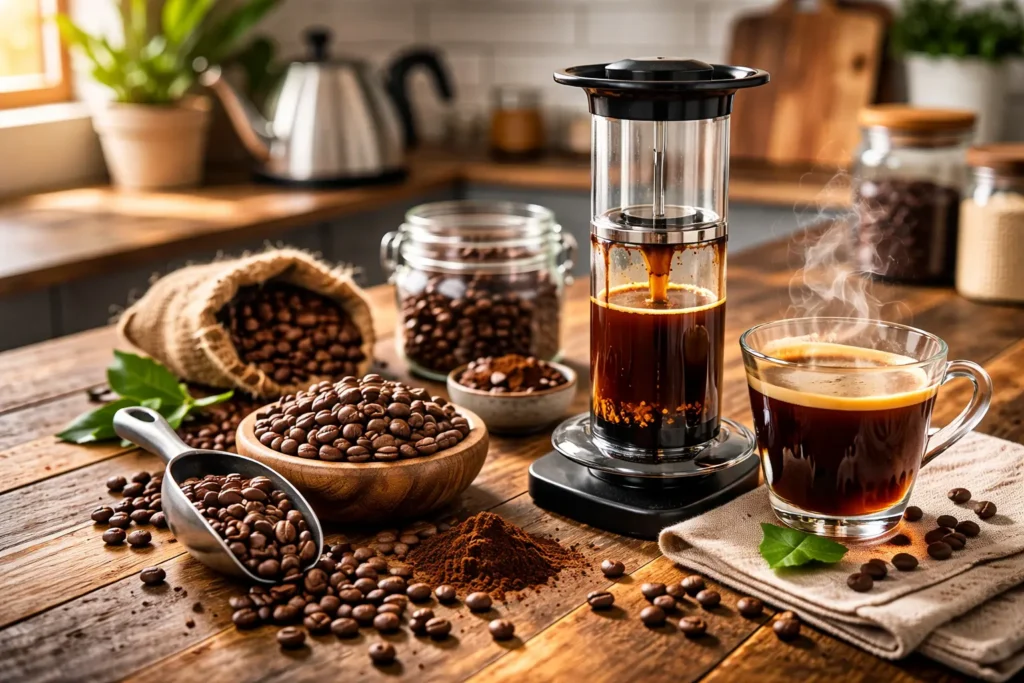

The best coffee beans for AeroPress aren’t necessarily the same beans that perform best in your espresso machine or pour-over — and understanding why is the key to unlocking what makes the AeroPress one of the most genuinely exciting brewing methods available. AeroPress is uniquely versatile: it produces a clean, filter-style cup or a concentrated espresso-like shot from the same device, handles light roast complexity that defeats most home brewers, and is more forgiving of grind and temperature variation than any high-pressure method. But that versatility means bean selection isn’t one-size-fits-all. The beans that produce a spectacular bright, fruit-forward standard AeroPress are different from the ones that produce a rich, intense concentrate for your morning oat milk latte. This complete CoffeeGearHub guide walks through every variable — roast level, origin, processing, freshness, and brew method pairing — and gives you our verified top picks across every AeroPress brewing style, with full grind settings, water temperatures, and recipe parameters for each.
✍️ Editorial note: This guide is researched and written by the editors at CoffeeGearHub.com using published brewing science, SCA brewing standards, roaster tasting notes, and established specialty-coffee community knowledge. Recommendations reflect research consensus and community reputation rather than in-house lab testing. All product links are affiliate links — we may earn a commission at no cost to you.
The 30-Second Answer
For most AeroPress setups, a medium roast whole bean coffee with a visible roast date is the best starting point — it produces a balanced, smooth, full-bodied cup across all AeroPress recipes and roast levels without demanding the tight technique that light roast espresso requires. Unlike espresso, AeroPress is genuinely versatile across roast levels: light roasts produce stunning fruit-forward clarity, medium roasts deliver balanced sweetness, and dark roasts produce the intensity needed for concentrate recipes. Single-origin beans shine in AeroPress more than in any other method because the shorter extraction time preserves delicate origin character. Start with a medium roast blend if you’re new to AeroPress; move to single origins once you’ve dialled in your preferred recipe.
- Best Overall: Stumptown Hair Bender — medium-light blend that produces exceptional clarity and complexity in standard and inverted AeroPress recipes
- Best Light Roast Single Origin: Volcanica Ethiopian Yirgacheffe — the benchmark for AeroPress light roast; blueberry, jasmine, citrus zest in a clean cup
- Best for Beginners: Intelligentsia Black Cat Classic Espresso — wide extraction window, roast-dated, performs beautifully across standard and concentrate AeroPress recipes
- Best for Concentrate / Espresso-Style: Lavazza Super Crema — medium-dark Arabica/Robusta blend that produces a thick, intense, crema-adjacent concentrate at fine grind settings
- Best Budget: Kicking Horse Cliff Hanger Espresso — Fairtrade, roast-dated, whole bean, reliable medium-dark that performs well across all AeroPress recipes at a grocery-store price
Who This Guide Is For — Jump to What You Need
☕ Just Starting Out
Read What Makes a Good AeroPress Bean, then jump to Top Picks for our immediate recommendations.
🧪 Exploring Roast Levels
See Roast Level Deep Dives for light, medium, and dark AeroPress parameters with full recipes and grind tables.
🔧 Troubleshooter
Jump straight to the Troubleshooting Matrix — sour, bitter, flat, weak, and over-extraction fixes are all mapped out.
🥃 Concentrate / Espresso-Style
Go to AeroPress Concentrate Guide for the fine-grind espresso-style recipe and the best beans for intense extraction.
Table of Contents
- What makes a good AeroPress bean
- Roast level master reference table
- Top picks: best AeroPress beans by category
- Roast level deep dives (light, medium, dark)
- Single origin vs blends for AeroPress
- Processing method: washed, natural, honey
- Freshness and roast date
- AeroPress brew method pairings: standard, inverted, concentrate, cold brew
What Makes a Good AeroPress Bean? Why the Method Changes Everything
AeroPress is unlike every other brewing method in one critical respect: it is simultaneously a pressure brewer, an immersion brewer, and a filter brewer — and which of those it resembles most depends entirely on your recipe. A standard 1-minute steep produces something close to a strong filter coffee. An inverted 90-second steep with a fine grind produces something closer to a French press. A 20-second press with a fine grind and 88°C water produces something resembling espresso concentrate. This versatility means “what’s the best AeroPress bean?” has more than one correct answer — and understanding which answer applies to you requires knowing which style of AeroPress brewing you prefer.
Four variables determine whether a bean performs well in your AeroPress style: roast level (which affects how much pressure and heat the bean needs to extract properly), freshness (which affects aromatic complexity in the cup), processing method (which shapes the sweetness, body, and acidity of the base material), and origin (which determines the flavour compounds available to extract). The AeroPress’s short contact time and mild pressure make it more sensitive to origin character and less sensitive to technique errors than espresso — which is why single-origin beans that would frustrate a beginner at the espresso machine produce outstanding results in an AeroPress with minimal adjustment.
| Variable | Why it matters for AeroPress | What to look for | Common mistake |
|---|---|---|---|
| Roast level | Determines extraction speed, flavour character, and optimal temperature and steep time | Medium roast for most recipes; light roast for origin-forward cups; medium-dark for concentrate | Using the same grind and temp for every roast level — light and dark roasts need different parameters |
| Freshness (roast date) | Aromatic volatiles and CO2 peak within the first 28 days; AeroPress is less pressure-sensitive to CO2 than espresso but freshness still determines complexity | Roast date visible on bag; use within 4 weeks of roast date | Buying bags with only a best-before date — these can be 6–12+ months post-roast at purchase |
| Processing method | Natural process adds heavy fruit sweetness; washed adds clarity and acidity; honey is balanced — all three produce distinctive AeroPress cups | Match to your flavour preference; natural processes produce exceptional AeroPress cold brew | Ignoring processing entirely — it’s the biggest flavour differentiator between otherwise similar beans |
| Origin | AeroPress’s short extraction preserves delicate origin character better than most methods — Ethiopian florals, Kenyan brightness, Colombian sweetness all come through clearly | Match origin to your preferred flavour profile; Ethiopian for floral/fruit, Colombian for balance, Brazilian for chocolate/nut | Staying with the same reliable blend and never exploring the single-origin range that makes AeroPress special |
🔬 Why AeroPress unlocks single-origin beans for beginners: Espresso requires a tight 25–30 second extraction window at 9 bars — delicate single-origin beans have a narrow sweet spot that’s difficult to hit without precise grind calibration. AeroPress operates at a fraction of that pressure over 60–120 seconds, giving extraction much more room to develop without channelling or temperature instability. A light Ethiopian single origin that would require 30+ practice shots to dial in on an espresso machine produces a remarkable cup in an AeroPress on the first attempt, with only basic grind and temperature adjustment.
AeroPress Roast Level — Master Reference Table
AeroPress is more accommodating of different roast levels than espresso, but each roast still benefits from different parameters. Use this table as your starting point when selecting beans and setting up your recipe. All K6 click settings and temperatures are for a standard 1:12 to 1:15 ratio AeroPress recipe; the concentrate section below covers finer grind settings for espresso-style recipes.
| Roast level | Water temp | Steep time | Press time | K6 clicks | Flavour profile | Best AeroPress style |
|---|---|---|---|---|---|---|
| Light roast ☀️ | 85–92°C | 90–120s | 20–30s | 18–24 | Fruit, floral, jasmine, citrus, tea-like, bright acidity | Standard or inverted — preserve clarity and origin character |
| Medium-light roast | 82–88°C | 75–105s | 20–30s | 20–26 | Stone fruit, chocolate, balanced acidity, round sweetness | Standard or inverted; excellent for clean single-origin cups |
| Medium roast 🌤 | 80–85°C | 60–90s | 20–30s | 22–30 | Caramel, nuts, mild citrus, smooth body — the universal sweet spot | All AeroPress styles — most versatile roast level for the method |
| Medium-dark roast | 78–83°C | 45–75s | 20–30s | 24–32 | Dark chocolate, brown sugar, low acidity, heavy body | Standard, concentrate, and cold brew — excellent for milk-based drinks |
| Dark roast 🌑 | 75–82°C | 30–60s | 20–30s | 26–35 | Roasted nuts, bittersweet chocolate, smoky, low acidity | Concentrate and cold brew — short steep avoids harsh extraction at standard temp |
🔬 K6 click reference: All KINGrinder K6 click settings in this guide are measured from zero (burrs touching). Lower clicks = finer grind. The AeroPress operates across a much wider grind range than espresso — from fine concentrate settings (~15 clicks) through medium filter (28–35 clicks). Adjust 2–3 clicks at a time for AeroPress; the changes are more gradual than at espresso settings. These are starting points — individual grinders and bean densities vary.
Best Coffee Beans for AeroPress: Our Top Picks
These five picks represent the best AeroPress beans across every brewing style and budget — from the benchmark specialty blend for standard and inverted brewing to the intense medium-dark concentrate bean for espresso-style AeroPress. Each includes full recipe parameters, K6 grind settings, flavour notes, and honest guidance on who will get the most from it. All recommendations are for whole bean — pre-ground coffee degrades too quickly for any AeroPress recipe that rewards freshness, which is all of them.
Disclosure: CoffeeGearHub may earn a commission on qualifying purchases through affiliate links on this page, at no cost to you. Our recommendations are editorially independent.
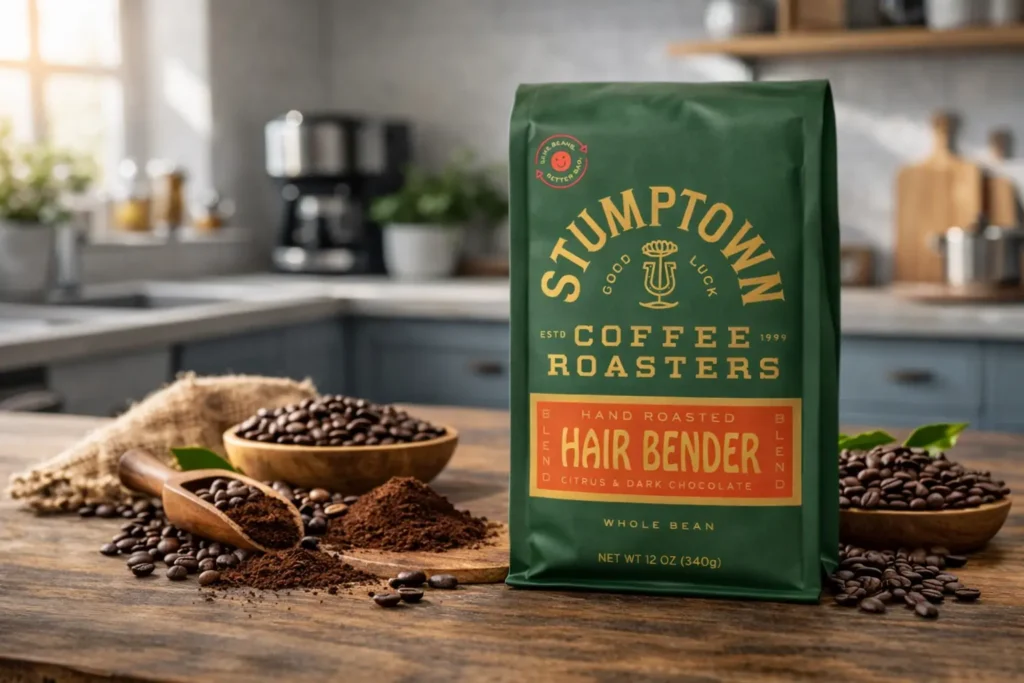
Best Overall: Stumptown Hair Bender
Hair Bender is the best all-around AeroPress bean on this list — and the benchmark against which most third-wave espresso blends are measured, precisely because it was designed to perform beautifully across multiple brew methods. In an AeroPress, the medium-light multi-origin blend produces something more nuanced than almost anything you can achieve from a dark-roasted blend: a citrus-forward opening with a dark chocolate and stone fruit mid-palate and a clean, lingering finish that reveals the layered origin components (Latin America, East Africa, Indonesia) as the cup cools. For standard and inverted AeroPress at 84–87°C, Hair Bender produces a clarity and complexity that demonstrates exactly what the AeroPress is uniquely capable of. Stumptown roast-dates every bag and ships to order — freshness is guaranteed.
- Roast: Medium-light — dark chocolate, caramel, citrus zest, stone fruit
- Blend: Multi-origin Latin America + East Africa + Indonesia
- Standard AeroPress recipe: 15g / 225ml / 85°C / K6: 22–26 clicks / 75s steep / 30s press
- Inverted recipe: 17g / 200ml / 87°C / K6: 20–24 clicks / 90s steep / flip and press 30s
- Best for: standard and inverted AeroPress, black coffee drinkers, experienced home brewers
- Note: roast-dated; best used 10–21 days off-roast for AeroPress
Disclosure: CoffeeGearHub may earn from qualifying purchases.
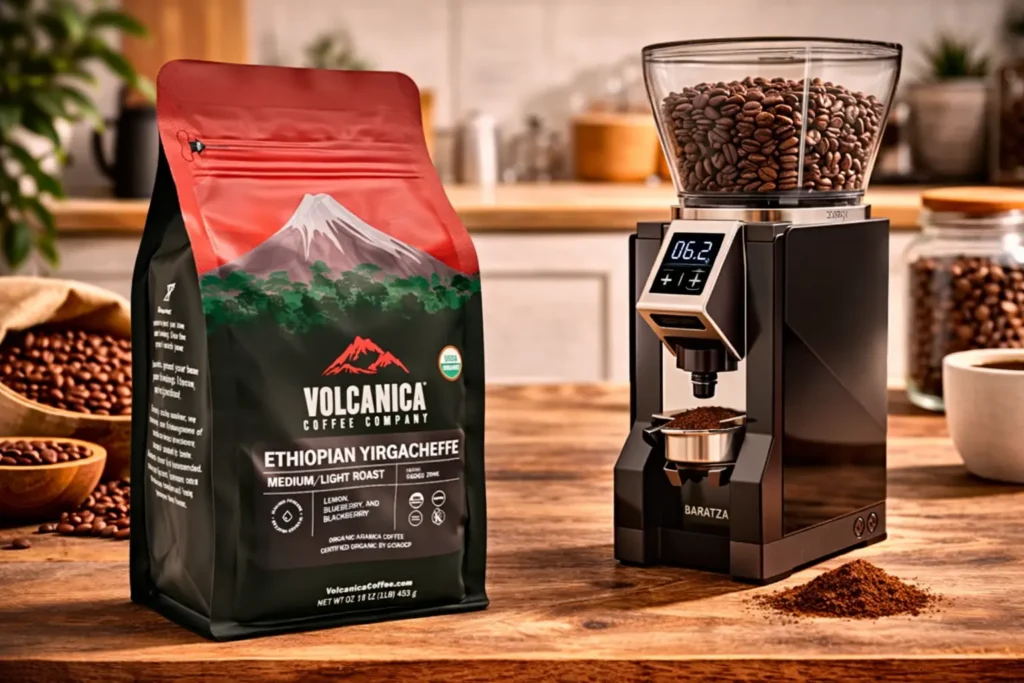
Best Light Roast Single Origin: Volcanica Ethiopian Yirgacheffe
Ethiopian Yirgacheffe is the single best origin for light roast AeroPress brewing — and Volcanica’s version is consistently fresh, roast-dated, and sourced from the Gedeo Zone in southern Ethiopia where the variety’s characteristic blueberry, jasmine, and lemon verbena notes reach their peak expression. In an AeroPress at 88–90°C with a 90–105 second steep, the cup produces a clarity and complexity that no filter brewer can match at this price point: a floral opening, fresh blueberry sweetness, and a clean, citrus-tinged finish with the tea-like body that defines great Ethiopian light roast. This is the bean that demonstrates what AeroPress does uniquely well — short, precise extraction that captures delicate origin character without the heat stress of longer filter brewing. A mandatory exploration for anyone who hasn’t yet tried a washed Ethiopian in an AeroPress.
- Roast: Light — blueberry, jasmine, lemon verbena, bergamot, tea-like body
- Origin: Yirgacheffe, Gedeo Zone, Ethiopia — washed process, 100% Arabica heirloom varieties
- Standard AeroPress recipe: 16g / 220ml / 90°C / K6: 18–22 clicks / 90–105s steep / 25s press
- Inverted recipe: 17g / 200ml / 92°C / K6: 18–20 clicks / 100s steep / flip and press 25s
- Best for: black AeroPress, exploring light roast origin complexity, experienced home brewers
- Note: roast-dated by Volcanica; use 10–21 days off-roast; raise temperature if cup tastes flat or grassy
⚠️ Verify ASIN before publishing. Disclosure: CoffeeGearHub may earn from qualifying purchases.
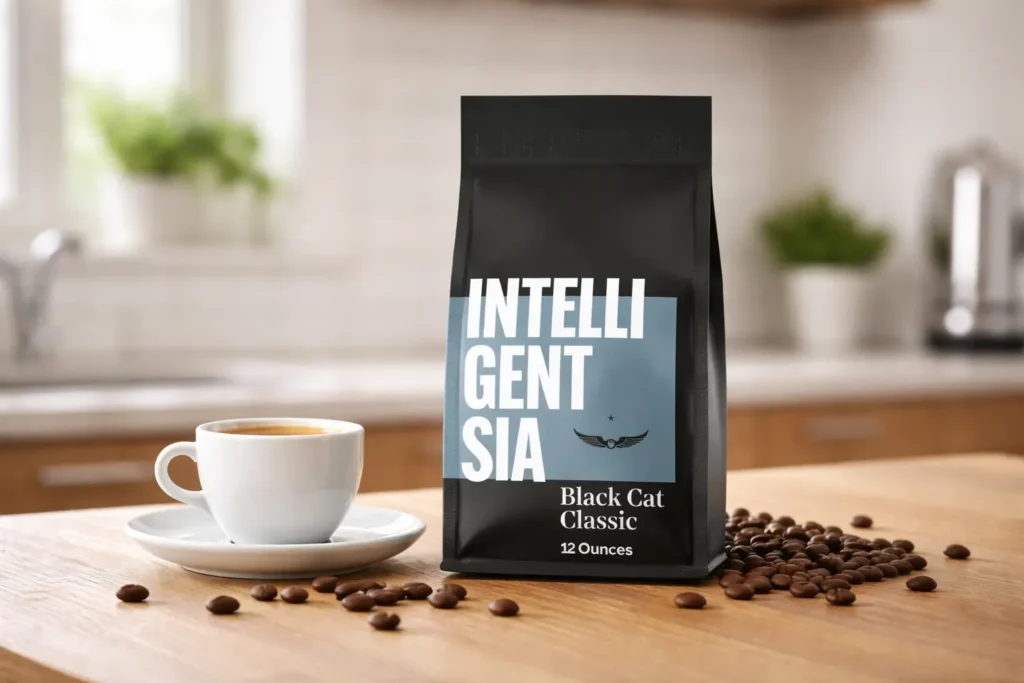
Best for Beginners: Intelligentsia Black Cat Classic Espresso
Black Cat Classic is our standard beginner espresso recommendation — and it earns a place on this list because it’s equally beginner-friendly in an AeroPress. The medium roast Brazil and Central America blend has a wide extraction window that performs well across temperature ranges from 80–88°C and steep times from 60–120 seconds, making it nearly impossible to produce a bad AeroPress cup regardless of which recipe you’re using. It produces a smooth, chocolatey, low-acid cup with enough sweetness and body to be satisfying black or with milk, and it scales naturally to concentrate recipes at finer grind settings without the bitter edge that darker roasts can develop. Every bag ships with a roast date directly from Intelligentsia. For any beginner who wants to explore what AeroPress can do without wrestling with a demanding single origin, Black Cat Classic is the ideal starting bean.
- Roast: Medium — milk chocolate, almond, brown sugar, mild fruit sweetness
- Blend: Brazil + Central America Arabica — wide extraction window, highly forgiving
- Standard AeroPress recipe: 16g / 220ml / 83°C / K6: 24–28 clicks / 75s steep / 25s press
- Concentrate recipe: 18g / 90ml / 88°C / K6: 18–22 clicks / 45s steep / 25s press
- Best for: beginners, all AeroPress recipes, black and milk-based drinks
- Note: roast-dated; best used 10–21 days off-roast
Disclosure: CoffeeGearHub may earn from qualifying purchases.

Best for Concentrate / Espresso-Style: Lavazza Super Crema
Lavazza Super Crema is our standard everyday espresso recommendation, and it doubles as the best AeroPress concentrate bean on this list — specifically because the Arabica/Robusta blend is engineered to produce body, intensity, and crema under pressure, which are exactly the qualities that make a great AeroPress espresso-style shot. At a fine grind setting (K6: 16–20 clicks), 88–90°C, and a 1:5 ratio, the Robusta component adds body and persistence that a 100% Arabica bean can’t match in a concentrate recipe; the medium-dark roast provides the chocolatey, low-acid intensity that holds up when you add steamed oat milk or dilute with hot water. It’s an accessible, widely available bean that requires no specialty roaster account or advance ordering. For any AeroPress user who primarily makes concentrate for milk drinks, Super Crema is the most practical and consistent option.
- Roast: Medium-dark — hazelnut, brown sugar, dried fruit, dark chocolate, mild bitterness
- Blend: ~60% Arabica (Central America, Brazil) + ~40% Robusta — thick body, intense concentrate
- Concentrate recipe: 18g / 90ml / 89°C / K6: 16–20 clicks / 30–45s steep / firm 25s press
- Standard AeroPress recipe: 15g / 220ml / 82°C / K6: 26–30 clicks / 60s steep / 25s press
- Best for: AeroPress concentrate, milk-based drinks (latte, flat white, cortado), everyday drinkers
- Note: sold in vacuum-sealed bags — check for roast date; freshness varies by retailer
Disclosure: CoffeeGearHub may earn from qualifying purchases.
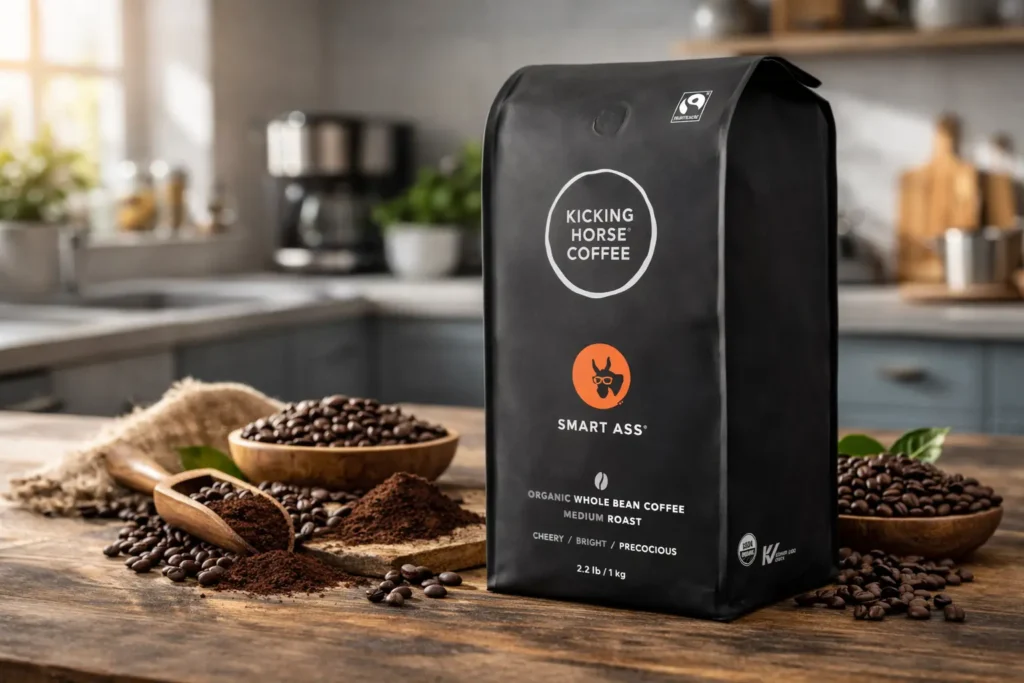
Best Budget: Kicking Horse Cliff Hanger Espresso
Kicking Horse Cliff Hanger is the best budget whole bean option for AeroPress — Fairtrade certified, organic, roast-dated, and available at grocery stores for a fraction of what a specialty roaster charges per bag. The Fairtrade sourcing filters out the lowest-quality commodity lots that make most budget coffee taste flat and harsh; the medium-dark roast sits at an accessible level that performs well across the full AeroPress recipe range from standard filter-style to concentrate. The cocoa and molasses profile holds up beautifully in concentrate recipes and pairs exceptionally well with milk. It won’t compete with Hair Bender or the Volcanica Ethiopian on complexity or origin specificity — but at its price, and with its grocery-store availability, it’s an excellent everyday AeroPress bean for anyone building a brewing habit on a budget.
- Roast: Medium-dark — cocoa, molasses, dark fruit, smooth finish
- Blend: Fairtrade certified Arabica, multi-origin — reliable, approachable
- Standard AeroPress recipe: 15g / 220ml / 82°C / K6: 26–30 clicks / 60s steep / 25s press
- Concentrate recipe: 18g / 90ml / 88°C / K6: 18–22 clicks / 40s steep / 25s press
- Best for: budget home setup, daily drinkers, milk-based AeroPress drinks
- Note: widely available at grocery stores — always check roast date when buying in-store
Disclosure: CoffeeGearHub may earn from qualifying purchases.
Roast Level Deep Dives: Light, Medium, and Dark AeroPress
Each roast level demands a meaningfully different approach to AeroPress brewing. The AeroPress’s adjustable pressure, temperature, and steep time give you more levers to work with than most brewing methods — and understanding how each roast responds to each lever is what separates a great AeroPress cup from a mediocre one made from the same beans.
☀️ Light Roast AeroPress
Light roast beans are dense, retain more moisture, and require more thermal energy to extract fully — but AeroPress handles them better than any other non-espresso method because the mild pressure assists extraction in the final press phase. The key to great light roast AeroPress is temperature: most beginners brew too cool for light roasts, producing hollow, grassy cups. Use 88–92°C, extend your steep to 90–120 seconds, and grind slightly finer than you would for medium roast.
Parameters: 88–92°C, 18–22 K6 clicks, 90–120s steep, 1:12 to 1:14 ratio
- Signs of under-extraction: grassy, hollow, sharp sourness
- Signs of over-extraction: bitter and astringent — unusual for AeroPress light roast
- Fix grassy/hollow: raise temp 3°C + extend steep 20s
- Fix sour: grind 2 clicks finer or raise temp 3°C
- Best origins: Ethiopia (Yirgacheffe, Sidama), Kenya, Colombia
🌤 Medium Roast AeroPress
Medium roast is the universal AeroPress sweet spot — the most forgiving roast level for both recipe and grind adjustment, producing a balanced, full-bodied cup across the widest range of temperatures and steep times. At 80–85°C with a 60–90 second steep, medium roast AeroPress produces a smooth, chocolatey, well-rounded cup that’s clean enough to appreciate black and substantial enough to hold up with milk. This is the ideal starting roast level for any AeroPress beginner because the margin for error is wide and the result is reliably satisfying.
Parameters: 80–85°C, 22–30 K6 clicks, 60–90s steep, 1:12 to 1:15 ratio
- Signs of under-extraction: sour, hollow, thin body
- Signs of over-extraction: bitter, dry finish, astringency
- Fix sour: grind 2 clicks finer or extend steep 20s
- Fix bitter: grind 2 clicks coarser or reduce steep 15s
- Best origins: Colombia, Brazil, Guatemala, Costa Rica
🌑 Dark Roast AeroPress
Dark roast beans are porous, highly soluble, and extract extremely fast at standard brewing temperatures — which is why the most common dark roast AeroPress problem is over-extraction (harsh, ashy bitterness) rather than under-extraction. The solution: lower your brew temperature to 75–82°C and shorten your steep to 30–60 seconds. Lower temperature slows the dissolution of the bitter chlorogenic acid lactones that dark roasting produces, and the shorter steep prevents over-extraction without sacrificing body. Dark roast AeroPress shines as a concentrate base for milk drinks.
Parameters: 75–82°C, 26–35 K6 clicks, 30–60s steep, 1:10 to 1:14 ratio
- Signs of under-extraction: unusual — sourness at these low temps means grind too coarse
- Signs of over-extraction: ashy, flat, harsh — extremely common with standard temps
- Fix harsh/bitter: lower temp 3°C + reduce steep 15s
- Fix flat/hollow: grind 2 clicks finer only — don’t raise temp
- Best origins: Brazil, Sumatra, Vietnam (Robusta blends for concentrate)
🔬 Why AeroPress temperature matters more than most brewers realise: AeroPress World Championship winners consistently use temperatures below 85°C — significantly lower than the 92–95°C used in most filter coffee. Lower temperature slows extraction of harsh bitter compounds and allows the sweet, fruity, and floral volatiles to dominate the cup before the less desirable compounds dissolve. This is especially impactful with darker roasts, which accumulate more bitter compounds during roasting. For light roasts, slightly higher temperature compensates for the denser, less soluble bean structure.
Single Origin vs Blends for AeroPress: The Honest Comparison
AeroPress is the single best brewing method for exploring single-origin beans — and this is one of the method’s most significant advantages over espresso. The short, controlled steep and mild pressure produce extraction that’s precise enough to preserve delicate origin character without the strict technique demands of high-pressure espresso. A first-time AeroPress user can produce a genuinely impressive cup from a complex Ethiopian single origin on their first attempt — the same origin would require 20+ espresso attempts to dial in properly. Blends, meanwhile, are reliable and consistent but sacrifice the exploration opportunity that makes AeroPress such a rewarding method for coffee learning.
| Espresso Blends in AeroPress | Single Origin in AeroPress | |
|---|---|---|
| Flavour profile | Balanced, engineered consistency — reliable, full-bodied, round | Origin-expressive — distinctive fruit, floral, or terroir character |
| Consistency | High — blend components offset seasonal harvest variation | Lower — flavour changes each harvest and crop year |
| Dial-in difficulty | Low — wide extraction window, forgiving across temps and times | Low to moderate in AeroPress — far easier than espresso single origins |
| Beginner friendliness | Excellent — ideal starting point for new AeroPress users | Good — AeroPress makes single origins accessible to beginners unlike espresso |
| Best AeroPress style | All styles — especially concentrate and milk-based drinks | Standard and inverted — black coffee where origin character comes through |
| Best use of the method? | Reliable — but doesn’t showcase AeroPress’s unique advantage | Yes — single origins in AeroPress demonstrate the method’s full potential |
💡 The AeroPress single-origin opportunity: If you own an AeroPress and have only ever brewed blends in it, you are leaving the best part of the method unexplored. Buy a 250g bag of a washed Ethiopian Yirgacheffe, brew it at 90°C for 90 seconds, and compare it to your usual blend at 83°C for 60 seconds. The difference in cup character — from chocolate and caramel to blueberry, jasmine, and citrus zest — from the same device with only temperature and time changes is one of the most compelling demonstrations of what speciality coffee can taste like.
Processing Method: How Washed, Natural, and Honey Affect AeroPress
Processing method — how the coffee cherry is removed from the bean after harvest — shapes body, sweetness, and acidity before any roasting takes place, and its effect is particularly pronounced in AeroPress because the method’s short extraction time preserves the processing character without diluting it through extended contact. Understanding processing helps you choose beans that match both your flavour preferences and your preferred AeroPress brewing style.
Washed (Wet Process)
Cherry pulp removed before drying; bean ferments in contact with water only. The result is clean, transparent, bright flavour with high clarity and pronounced acidity. The bean’s intrinsic origin character dominates — no fruit pulp influence on sweetness or body.
- AeroPress character: bright, clean, high clarity — origin-transparent
- Body: light to medium
- Best AeroPress style: standard and inverted, black coffee
- Best origins: Ethiopia, Kenya, Colombia
- Cold brew: clean but light-bodied — better for hot recipes
Natural (Dry Process)
Cherry dries whole around the bean — fruit sugars ferment directly into the bean structure. The result is heavy body, intense fruit sweetness (blueberry, strawberry, tropical fruit), and lower acidity. In AeroPress this produces one of the most distinctive cups possible: syrupy, fruit-forward, almost dessert-like in its sweetness.
- AeroPress character: fruit-forward, sweet, heavy, complex
- Body: full, syrupy — the heaviest processing option
- Best AeroPress style: standard, cold brew, milk-based concentrate
- Best origins: Ethiopia (natural), Brazil, Yemen
- Cold brew: exceptional — fruit sweetness intensifies at cold temperature
Honey (Pulped Natural)
Pulp removed but varying amounts of mucilage left on the bean during drying. The result sits between washed clarity and natural sweetness — round, balanced, moderately fruity with good body. In AeroPress, honey process beans are the most consistent single-origin option for beginners: they provide more character than washed beans without the extraction sensitivity of natural process.
- AeroPress character: balanced, sweet, approachable complexity
- Body: medium-full — between washed and natural
- Best AeroPress style: all recipes — the most versatile processing type
- Best origins: Costa Rica, El Salvador, Honduras
- Beginners: most consistent single-origin starting point for AeroPress
Freshness and Roast Date: What AeroPress Demands
AeroPress is slightly more forgiving of bean age than espresso — the lower pressure and longer steep time mean CO2 gassing doesn’t disrupt extraction the way it does at 9 bars. But freshness still determines the ceiling of what your AeroPress cup can taste like. Aromatic volatiles (the floral, fruit, and caramel notes that make great AeroPress coffee memorable) are among the first compounds to oxidise after roasting. A stale bean produces a flat, papery, hollow cup regardless of how perfectly you execute the recipe.
| Days post-roast | CO2 level | AeroPress performance | What you’ll taste |
|---|---|---|---|
| 0–5 days | Very high | Slightly inconsistent — CO2 can cause uneven bloom | Grassy, slightly hollow, aggressive bloom — minor issue vs espresso |
| 5–10 days | Elevated | Good and improving | Getting there; minor acidity sharpness; bloom active but not disruptive |
| 10–28 days | Optimal | Peak performance window | Maximum sweetness, aromatic complexity, and clarity — the target brewing window |
| 28–42 days | Declining | Good — minor staling beginning | Still excellent for everyday brewing; slight reduction in aromatic lift |
| 42–60 days | Low | Acceptable — noticeable staling | Flatter aromatics, reduced sweetness, mild cardboard note at finish |
| 60+ days | Depleted | Poor — stale | Flat, hollow, papery — the AeroPress will reveal this clearly; no recipe fix available |
⚠️ Freshness red flags: Any bag with only a best-before date (no roast date) is almost certainly more than 60 days off-roast at time of purchase — supermarket supply chains add weeks between roasting, warehousing, shipping, and shelf time. For AeroPress specifically, stale beans produce cups that taste “fine but flat” — the method is clear-extracting enough to reveal exactly how much aromatic complexity has been lost. Order directly from specialty roasters when possible: most ship within 1–3 days of roasting and include the roast date on every bag.
AeroPress Brew Method Pairings: Standard, Inverted, Concentrate, and Cold Brew
AeroPress’s four main brewing styles each produce a distinctly different cup character — and each rewards different beans. Matching your bean to your preferred brewing style is the single most effective way to improve your AeroPress results without changing anything about your technique.
| Brew style | Best roast | Best processing | Recommended beans | Key parameters |
|---|---|---|---|---|
| Standard AeroPress | Light to medium | Washed or honey | Stumptown Hair Bender, Intelligentsia Black Cat | 80–87°C / 60–90s steep / 1:12–1:15 ratio / medium-fine grind |
| Inverted AeroPress | Light to medium-light | Washed or natural | Volcanica Ethiopian Yirgacheffe, Stumptown Hair Bender | 87–92°C / 90–120s steep / 1:12–1:14 ratio / slightly finer than standard |
| AeroPress concentrate (espresso-style) | Medium-dark | Natural or any | Lavazza Super Crema, Kicking Horse Cliff Hanger | 88–92°C / 30–45s steep / 1:5–1:8 ratio / fine grind (K6: 15–20 clicks) |
| AeroPress cold brew | Medium-dark to dark | Natural | Kicking Horse Cliff Hanger, Lavazza Super Crema | Room temp or cold water / 12–18hr steep / 1:6–1:8 ratio / coarse grind (K6: 35–45 clicks) |
| Iced AeroPress (hot then ice) | Medium to medium-dark | Natural or honey | Intelligentsia Black Cat, Kicking Horse | Brew at 83°C / 1:8 ratio over ice / K6: 22–26 clicks / 60s steep then press over ice |
AeroPress Concentrate: The Espresso-Style Guide
AeroPress concentrate is the method’s closest approach to espresso — a concentrated, intense, low-volume brew that can substitute in milk drinks like lattes, flat whites, and cortados. It is not true espresso (the AeroPress generates approximately 0.5–1 bar of pressure vs espresso’s 9 bars), but at the right grind, temperature, and ratio, it produces a rich, full-bodied shot with enough intensity to hold its own against steamed milk. Understanding the differences between AeroPress concentrate and true espresso helps you choose the right bean and the right expectations.
The Standard Concentrate Recipe
- Dose: 18g whole bean (weighed)
- Water: 90ml at 88–90°C
- Ratio: 1:5 (18g coffee / 90ml water)
- Grind: K6: 16–20 clicks (fine — approaching espresso)
- Method: Inverted position; add water, stir 5 times, steep 30–45s, flip, press firmly in 25–30s
- Output: ~70–80ml intense concentrate
- Use: Add 100–150ml steamed milk for a latte-style drink; drink straight or with a splash of hot water for Americano-style
AeroPress Concentrate vs True Espresso
| AeroPress Concentrate | True Espresso | |
|---|---|---|
| Pressure | ~0.5–1 bar (hand) | 9 bar (pump) |
| Crema | None — no true crema | Yes — CO2 emulsification |
| Body | Full, rich — lower emulsification than espresso | Heavy, syrupy — oils fully emulsified |
| Extraction time | 30–60 seconds | 25–30 seconds |
| Bitterness | Lower — pressure doesn’t amplify extraction | Higher — pressure extracts faster and more completely |
| Best bean | Medium-dark Arabica/Robusta blend | Medium to medium-dark blend or single origin |
| Milk drink suitability | Good — holds up in latte; less intense than espresso | Excellent — designed for milk-based drinks |
AeroPress Grind Settings: KINGrinder K6 Full Reference
The KINGrinder K6’s 100-click adjustment system gives you the control needed for all AeroPress brewing styles — from the fine concentrate settings that approach espresso range through the medium-coarse settings used for cold brew. The table below covers the full AeroPress grind spectrum, organised by brewing style and roast level. These are starting points — adjust 2–3 clicks at a time for AeroPress (unlike 1 click at a time for espresso) since the extraction window is wider and changes are more gradual.
| AeroPress style | Roast | K6 clicks | Temp | Steep time | Ratio | Flavour target |
|---|---|---|---|---|---|---|
| Concentrate (espresso-style) | Med-dark / Dark | 15–20 | 88–90°C | 30–45s | 1:5 to 1:8 | Intense, rich, full body — latte and flat white base |
| Standard — light roast | Light | 18–24 | 88–92°C | 90–120s | 1:12 to 1:14 | Bright, fruit-forward, floral, clean finish |
| Standard — medium roast | Medium | 22–30 | 80–85°C | 60–90s | 1:12 to 1:15 | Caramel, chocolate, balanced — the universal sweet spot |
| Standard — medium-dark | Med-dark | 24–32 | 78–83°C | 45–75s | 1:12 to 1:15 | Dark chocolate, brown sugar, low acidity, heavy body |
| Inverted — light roast | Light | 18–22 | 87–92°C | 90–120s | 1:12 to 1:14 | Maximum clarity and origin character — AeroPress at its best for single origins |
| Inverted — medium roast | Medium | 22–28 | 82–87°C | 75–105s | 1:12 to 1:15 | Rich, round, full-bodied clarity — better extraction uniformity than standard |
| Iced AeroPress (hot brew over ice) | Medium / Med-dark | 22–26 | 83°C | 60s | 1:8 to 1:10 | Sweet, intense — designed to be diluted by ice melt |
| Cold brew (room temp / overnight) | Med-dark / Dark | 35–45 | Room temp / cold | 12–18 hours | 1:6 to 1:8 | Smooth, sweet, low acid — cold extraction removes harsh compounds entirely |
⚠️ K6 AeroPress note: For concentrate (espresso-style) settings at clicks 15–20, the K6 is approaching its finest useful range — grinding 18g takes approximately 2 minutes at these settings. At medium AeroPress settings (22–32 clicks), grinding 15–17g takes 60–90 seconds. These are completely manageable times for a daily AeroPress habit. The K6’s particle consistency at AeroPress settings is excellent — significantly better than blade grinders at any setting, and sufficient for all AeroPress brewing styles including concentrate.
Best Coffee Origins for AeroPress: A Region-by-Region Guide
Origin selection matters more in AeroPress than in almost any other brewing method because the short, controlled extraction preserves origin character with exceptional fidelity. Understanding which regions produce which flavour profiles helps you choose beans that match your palate — and helps you know what to expect when you step outside your usual blend.
| Origin | Typical flavour profile | Best roast for AeroPress | Best processing | Best AeroPress style | Who it’s for |
|---|---|---|---|---|---|
| Ethiopia (Yirgacheffe, Sidama) | Blueberry, jasmine, lemon, bergamot, tea-like body | Light to medium-light | Washed or natural | Standard or inverted — black coffee | Anyone who wants to understand why light roast coffee is worth exploring |
| Kenya (AA, AB grades) | Blackcurrant, tomato, grapefruit, bright high acidity, full body | Light to medium-light | Washed (double-fermented) | Inverted — black coffee at 88–90°C | Experienced brewers who enjoy bold, complex, high-acid cups |
| Colombia | Red apple, caramel, brown sugar, mild citrus, medium body | Medium to medium-light | Washed or honey | Standard or inverted — black or with milk | Beginners exploring single origins; balanced, approachable, crowd-pleasing |
| Guatemala / Honduras | Milk chocolate, brown sugar, stone fruit, smooth finish | Medium to medium-dark | Honey or washed | All styles including concentrate | Everyday drinkers; excellent value single-origin option |
| Costa Rica | Peach, honey, light citrus, clean sweetness, round body | Medium-light to medium | Honey (red or yellow) | Standard — excellent for beginners to honey process | Anyone moving from blends to single origins for the first time |
| Brazil | Milk chocolate, peanut, brown sugar, low acidity, heavy body | Medium to medium-dark | Natural or pulped natural | Concentrate and cold brew — excellent milk drink base | Drinkers who prefer low-acid, chocolate-forward cups and milk-based drinks |
| Sumatra (Mandheling, Gayo) | Dark chocolate, earthy, cedar, full body, low acidity | Medium-dark to dark | Wet-hulled (Giling Basah) | Cold brew and concentrate — best at lower temperatures | Dark roast drinkers who want a distinctive, earthy, intense cup |
Dial-In Guide: How to Dial In Any Bean for AeroPress
AeroPress dial-in is more forgiving than espresso but still benefits from a systematic approach. The method gives you four primary variables — grind size, temperature, steep time, and ratio — and changing all of them at once makes it impossible to understand what changed the cup. The dial-in priority order for AeroPress is: grind first, then temperature, then steep time, then ratio. Most AeroPress problems are solved by grind and temperature adjustment alone.
Starting Baseline Recipe (Medium Roast)
- Dose: 16g (weighed)
- Water: 220ml at 83°C
- Ratio: 1:14
- Grind: K6 at 26 clicks (medium-fine starting point)
- Method: Standard position; add water, stir 5 times, insert plunger, steep 75s, press 25–30s
- Press resistance: Moderate — not effortless, not straining
Taste the cup before adding anything. Identify the dominant problem — sour, bitter, flat, or weak — then adjust only one variable before the next brew.
Taste → Adjustment Order
- Sour / hollow / acidic: grind 2–3 clicks finer → re-brew
- Still sour after grind fix: raise temp 3–4°C → re-brew
- Still sour after temp fix: extend steep by 20–30s → re-brew
- Bitter / harsh / astringent: grind 2–3 clicks coarser → re-brew
- Still bitter after grind fix: lower temp 3–4°C → re-brew
- Still bitter after temp fix: reduce steep by 20s → re-brew
- Balanced but too weak: increase dose 1g or reduce water 20ml
- Balanced but too intense: add 20ml water to finished cup or reduce dose 1g
Rule: one variable per brew. Write down every result. AeroPress dial-in typically takes 3–6 brews with a new bean.
Troubleshooting Matrix: AeroPress Bean + Extraction Symptoms → Fixes
Identify your symptom below. Check whether the cause is a bean issue (freshness, roast level) or a recipe issue (grind, temp, time) before buying different beans — most AeroPress problems are recipe-solvable without replacing the coffee.
| Symptom | Most likely cause | Fix — in order |
|---|---|---|
| Always sour regardless of grind | Temperature too low for roast level, or beans too fresh (<5 days) | Raise temp 5°C → rest beans 3 more days → grind finer 2 clicks |
| Always bitter regardless of grind | Temperature too high for roast level, or beans stale/too dark | Lower temp 5°C → shorten steep 20s → check roast date |
| Flat / no sweetness / hollow | Stale beans — aromatics depleted — or temperature too low for light roast | If beans <60 days: raise temp 3–5°C. If beans 60+ days: buy fresh beans — no recipe fix |
| Grassy, vegetal, unpleasant bitterness | Light roast beans at too low a temperature — under-extraction of dense bean | Raise temperature to 88–92°C → extend steep 30s → grind 2 clicks finer |
| Too much resistance when pressing | Grind too fine, or dose too high for the water volume | Grind 3 clicks coarser → reduce dose 1g → check filter seal |
| No resistance when pressing — watery cup | Grind too coarse or filter not seated correctly | Grind 3 clicks finer → reseat filter carefully → increase dose 1g |
| Dark roast always harsh and ashy | Temperature too high for highly soluble dark roast structure | Brew at 75–80°C → reduce steep to 45s → grind 2–3 clicks coarser |
| Concentrate too weak for milk drinks | Ratio too dilute or grind too coarse for concentrate recipe | Reduce water to 80ml → grind 2 clicks finer → increase dose to 18g |
| Concentrate tastes bitter/harsh | Too fine a grind at high temperature in a short steep — over-extraction | Grind 2 clicks coarser → lower temp to 87°C → reduce steep 10s |
| Sour AND bitter in the same cup | Uneven extraction — channelling from clumped grounds or uneven water pour | Stir more thoroughly after adding water → pour in concentric circles → check filter for holes |
| Ethiopian / light roast always underwhelms | Brewing at medium roast temperature (80–83°C) — too cool for light roast bean density | Raise to 90–92°C → extend steep to 100–120s → grind 2 clicks finer |
| Cold brew always weak or flat | Ratio too dilute, grind too coarse, or steep time too short | Reduce ratio to 1:6 → grind 5 clicks finer → extend steep to 18 hours in fridge |
Essential Gear: Grinder Recommendation for AeroPress
AeroPress requires only two pieces of equipment: the AeroPress itself and a consistent burr grinder. The grinder is the single most important variable in AeroPress consistency — the same bean at the same recipe with a blade grinder vs a burr grinder produces dramatically different cups because blade grinders cannot produce the even particle size distribution that a controlled steep requires. A burr grinder also gives you the adjustability to move between AeroPress brewing styles: from the fine concentrate settings through the medium filter range through the coarse cold brew setting. No blade grinder can span that range meaningfully.
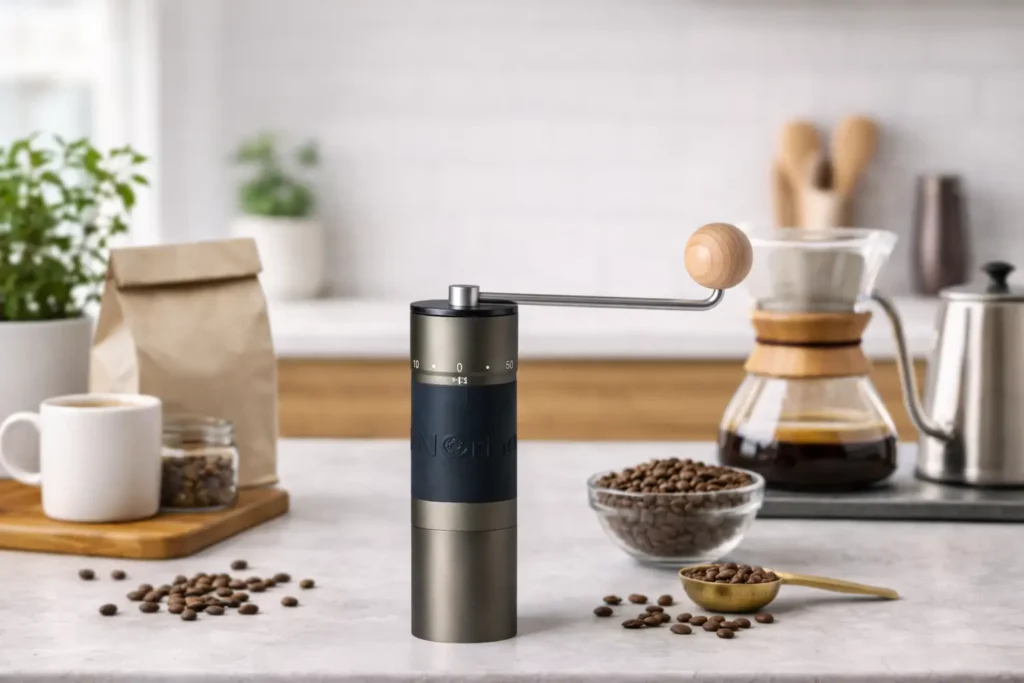
Our Recommended Grinder: KINGrinder K6
The KINGrinder K6 is our standard grinder recommendation across all CoffeeGearHub brewing content — and it earns that recommendation for AeroPress specifically because its 100-click adjustment spans the full AeroPress grind range: from fine concentrate settings at clicks 15–20 all the way through medium filter at 22–32 clicks and coarse cold brew at 35–45 clicks. No other manual grinder in this price class provides that range with meaningful click-by-click resolution at each setting. The 48mm stainless conical burrs produce consistent particles at every AeroPress setting, the all-metal body handles daily use without the wobble that cheaper plastic grinders develop, and at AeroPress grind settings (22–35 clicks), grinding 15–17g takes under 90 seconds — a completely practical time investment for a daily brewing habit. If you own an AeroPress and don’t yet own a burr grinder, the K6 is the single most impactful purchase you can make for your cup quality.
- 100 click steps — spans the full AeroPress range from fine concentrate to coarse cold brew
- 48mm stainless conical burrs — consistent particle distribution at all AeroPress settings
- All-metal body — durable for daily grinding; no wobble at fine settings
- AeroPress grinding time: ~60–90s for 15g at medium settings (22–30 clicks)
Disclosure: CoffeeGearHub may earn from qualifying purchases.
Quick Reference: AeroPress Bean + Recipe Cheat Sheet
Bookmark this table for your brew station. All parameters are starting points — adjust grind first (2–3 clicks at a time), then temperature, then steep time. Write down what works and use it as your base for the next bag.
| Bean | Roast | Recipe | Temp | Dose | Water | Steep | K6 clicks | If sour → | If bitter → |
|---|---|---|---|---|---|---|---|---|---|
| Stumptown Hair Bender | Med-light | Standard | 85°C | 15g | 225ml | 75s | 22–26 | Finer 2 clicks + +2°C | Coarser 2 clicks |
| Volcanica Ethiopian Yirgacheffe | Light | Standard/Inverted | 90°C | 16g | 220ml | 95s | 18–22 | +3°C + extend 20s | Coarser 2 clicks |
| Intelligentsia Black Cat | Medium | Standard | 83°C | 16g | 220ml | 75s | 24–28 | Finer 2 clicks | Coarser 2 + −3°C |
| Lavazza Super Crema | Med-dark | Concentrate | 89°C | 18g | 90ml | 40s | 16–20 | Finer 2 clicks | Coarser + −2°C |
| Kicking Horse Cliff Hanger | Med-dark | Standard | 82°C | 15g | 220ml | 60s | 26–30 | Finer 2 clicks | −3°C + reduce steep 15s |
Final Takeaway
AeroPress rewards the same fundamental habits as every other brewing method — fresh beans with a roast date, a consistent burr grinder, and a systematic approach to adjusting one variable at a time — but it adds a unique opportunity that no other method at this price point provides: the ability to explore the full spectrum of roast levels, origins, and processing methods with dramatic results from small adjustments. Start with Intelligentsia Black Cat or Stumptown Hair Bender if you want a reliable, consistent everyday cup. Then buy a 250g bag of a washed Ethiopian Yirgacheffe and brew it at 90°C for 95 seconds. Then try a natural process Brazilian medium-dark in a concentrate recipe with 90ml of water and a 40-second steep. The same device, the same grinder, three completely different flavour worlds. That’s the AeroPress’s singular advantage — and fresh beans matched to the right recipe are the only thing you need to access it fully.
FAQs: Best Coffee Beans for AeroPress
What are the best coffee beans for AeroPress?
The best AeroPress beans depend on your preferred brewing style. For a balanced standard AeroPress, a medium roast whole bean like Intelligentsia Black Cat Classic or Stumptown Hair Bender delivers excellent clarity and sweetness. For light roast single-origin AeroPress, an Ethiopian Yirgacheffe or Kenyan AA produces outstanding fruit and floral complexity. For AeroPress espresso-style concentrate, a medium-dark blend like Lavazza Super Crema produces the body and intensity the method can achieve at fine grind settings.
What roast level is best for AeroPress?
AeroPress works exceptionally well with light to medium roasts — more so than any other brewing method — because its short steep time and pressure produce enough extraction to unlock light roast complexity without the sourness that plagues light roast filter coffee. Medium to medium-dark roasts are the most forgiving and produce rich, smooth, full-bodied results. Dark roasts work well for AeroPress espresso-style concentrate and cold brew but can produce harsh, flat results with standard recipes. Unlike espresso, AeroPress is genuinely versatile across the roast spectrum.
Can I use any coffee in an AeroPress?
Yes — AeroPress is one of the most forgiving and versatile brewing methods available. Any coffee that works for filter or immersion brewing will work in an AeroPress. The method’s short contact time, pressure, and adjustable recipes mean you can produce anything from a light, filter-style cup to a concentrated espresso-like shot from the same device. The main constraint is grind size control — you need a burr grinder to adjust grind consistently — and freshness, which matters for all brewing methods.
What grind size is best for AeroPress?
AeroPress grind size depends on your recipe and target brew time. For a standard 1–2 minute steep, a medium-fine grind (KINGrinder K6: 20–28 clicks) produces the best balance. For a faster 45-second steep, grind coarser (28–35 clicks). For AeroPress espresso-style concentrate (15–25 second press), grind fine (15–20 clicks). For AeroPress cold brew (overnight steep), grind coarser (35–45 clicks). The most common beginner mistake is grinding too coarse — AeroPress rewards a finer grind than most people start with.
How fresh should AeroPress beans be?
For AeroPress, the optimal freshness window is 7–28 days post-roast — slightly wider than espresso because AeroPress is less sensitive to CO2 degassing than high-pressure extraction. Beans within 5 days of roasting can produce uneven results and an unpleasant grassy note; beans beyond 35–40 days show noticeable staling in aromatic complexity and sweetness. Always buy bags with a visible roast date. AeroPress is more forgiving of slightly older beans than espresso, but fresher is always better.
Are single-origin or blend beans better for AeroPress?
Both work excellently in AeroPress — which is part of what makes it such a great method for coffee exploration. Single-origin beans shine in AeroPress because the method’s clarity and short extraction time preserve delicate origin character that immersion or filter methods can mute. Ethiopian naturals, Kenyan washed, and Colombian honey-process beans all produce distinctive, complex AeroPress cups. Blends are more forgiving and consistent. Unlike espresso, beginners can successfully brew single-origin beans in an AeroPress without a long dial-in process.
What water temperature should I use for AeroPress?
For medium roast AeroPress, 80–85°C (175–185°F) is the most commonly recommended range — significantly lower than espresso or pour-over. Lower temperatures slow extraction of bitter compounds and produce a smoother, sweeter cup. For light roast AeroPress, raise temperature to 85–92°C to extract adequately from the denser, less soluble beans. For AeroPress espresso-style concentrate, use 88–92°C. The AeroPress is uniquely suited to lower temperature brewing — this is one of its key advantages over other methods for sensitive light roasts.
Why does my AeroPress taste sour?
Sour AeroPress is under-extraction. The most common causes are: grind too coarse (water passes through too quickly), water temperature too low, steep time too short, or beans too fresh. Fix by grinding 2–3 clicks finer, raising temperature 3–5°C, or extending steep time by 30 seconds. If using light roast beans, ensure temperature is at least 85°C and steep for at least 90 seconds before pressing.
Can I make espresso with an AeroPress?
AeroPress can produce a concentrated, espresso-style shot — but it is not true espresso. True espresso requires 9 bars of pressure; AeroPress generates approximately 0.5–1 bar of hand pressure. The result is a rich, concentrated, low-acid coffee that resembles espresso in strength and can substitute in milk drinks, but lacks the crema and emulsified oils that pressure extracts. For AeroPress espresso-style concentrate, use a fine grind (K6: 15–20 clicks), 88–92°C water, a 1:5 ratio (15g coffee / 75ml water), and press firmly in 20–30 seconds.
What is the best coffee-to-water ratio for AeroPress?
The most versatile starting ratio for AeroPress is 1:12 to 1:15 — 15–17g of coffee to 180–240ml of water — for a balanced, full-bodied cup. For a more concentrated, espresso-style brew, use 1:5 to 1:8 (15g coffee / 75–120ml water). For a lighter, filter-style cup, use 1:15 to 1:17 and dilute with hot water after pressing. AeroPress World Championship recipes often use unconventional ratios — exploring ratios from 1:5 to 1:18 is one of the method’s greatest strengths.
Continue Learning
AEROPRESS CLUSTER
- AeroPress Grind Size Guide: K6 Reference for Every Recipe
- AeroPress Water Temperature Guide: Roast-by-Roast
- Best AeroPress Recipes: Standard, Inverted, and Concentrate
- AeroPress Inverted Method: Step-by-Step Guide
- AeroPress Iced Coffee: The Best Cold Recipes
- AeroPress Espresso Concentrate: Full Recipe Guide
BEANS & GRINDERS
- Best Coffee Beans for Espresso (2026): Roast-by-Roast Guide
- Best Coffee Beans for French Press (2026)
- Best Manual Coffee Grinders (2026): Full Roundup
- Burr vs Blade Grinder: Full Comparison
- Coffee Brew Ratio Guide (All Methods)
- Best Coffee Beans for Cold Brew (2026): How to Choose
- Best Coffee for Keurig: Top K-Cup Picks for Every Taste (2026)
- Coffee for Beginners: The Complete Starter Guide
Using the same beans for espresso too? Our Best Coffee Beans for Espresso guide covers the same picks at espresso parameters — with full K6 click references and dial-in guidance for every roast level.
☕
Written by the CoffeeGearHub Editorial Team
CoffeeGearHub is a specialty coffee equipment resource run by home brewers and coffee enthusiasts. Our guides are researched using published brewing science, SCA standards, grinder manufacturer specifications, and established specialty-coffee community knowledge. We review and update our pillar content regularly. About CoffeeGearHub →