
French Press Troubleshooting: Fix Bitter, Sour, Muddy, or Weak Coffee
Editorial standards: this guide is built from established brewing principles, Specialty Coffee Association guidance, manufacturer documentation, and practical workflow analysis. CoffeeGearHub does not claim hands-on testing where it has not occurred.
At a glance
What this French press troubleshooting guide covers
A symptom-by-symptom fix list for French press coffee: bitter, sour, weak, muddy, gritty, flat, or stale cups, plus a plunger that sticks or drops straight through, coffee that cools too fast, grinder settings for the KINGrinder K6 and Baratza Encore, adjustments by roast level and press type, coffee and water weights for every press size, four worked diagnosis examples, and the one-variable dial-in method that stops you chasing problems in circles.
Editorial analysis
Most French press problems come from four variables
The French press is simple equipment, which is exactly why problems are easy to misdiagnose. People blame the press when the real cause is almost always one of four things: grind size, coffee-to-water ratio, steep time, or a dirty or worn filter. Water temperature and bean freshness come next.
The fix is to identify the symptom, change one variable, and brew again. This guide maps each common symptom to its most likely cause so you can stop guessing.
The 30-Second Answer
Bitter means over-extracted: grind coarser or shorten the steep. Sour or weak means under-extracted: grind finer, use more coffee, use hotter water, or steep longer. Muddy, gritty coffee usually means the grind is too fine or uneven, or the mesh filter is damaged.
Start from a reliable baseline: a coarse, even grind, about 1:15 coffee to water by weight, water just off the boil, and a four-minute steep. Change one thing at a time. If you still use a blade grinder, a burr grinder is the single upgrade that fixes the most French press problems. Our French press brew guide walks through the full baseline recipe.
Fix it faster
Two upgrades that solve the most common problems
Uneven grounds cause both bitterness and sludge at the same time. A burr grinder fixes the cause; a better filter system reduces sediment that slips past a standard mesh screen.
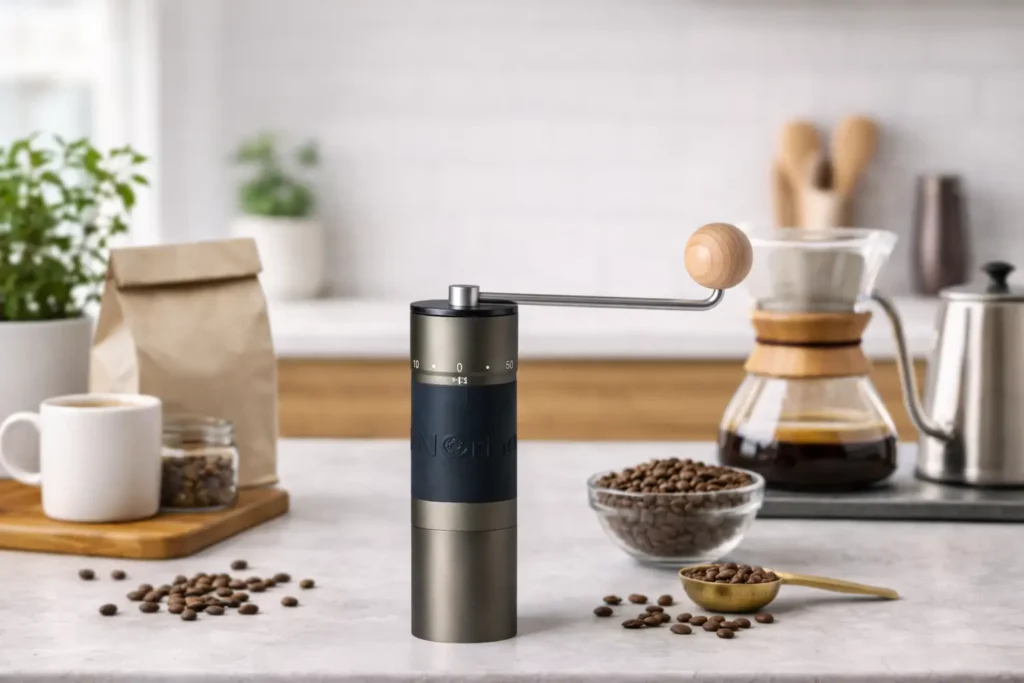
KINGrinder K6 — even coarse grind
A manual burr grinder with fine, repeatable adjustment across the coarse range French press needs. It addresses bitterness and sludge at the source: uneven particles.
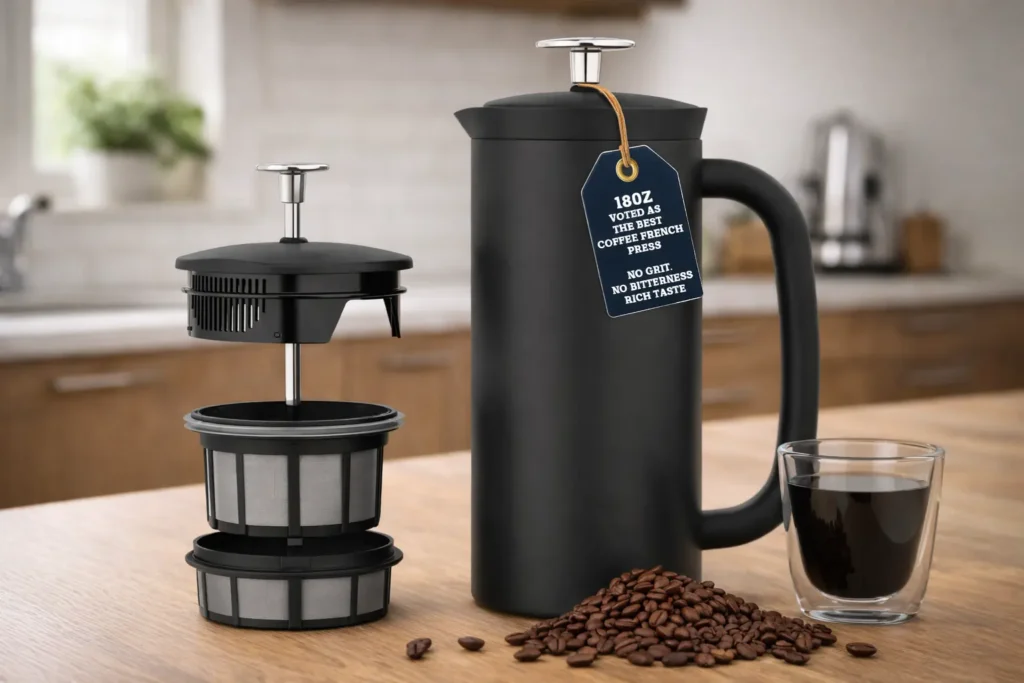
Espro Press P7 — less sediment
A double-walled press with a two-stage micro-filter designed to hold back far more fines than a single mesh screen, for people who like immersion body but not grit.
Affiliate disclosure: Amazon links may earn CoffeeGearHub a commission at no additional cost to you. Prices and availability can change.
French Press Troubleshooting Chart: Symptom, Cause, Fix
Find your symptom, apply the first fix, and brew again before changing anything else.
| Symptom | Most likely cause | First fix | If that doesn’t work |
|---|---|---|---|
| Bitter, harsh, drying | Over-extraction | Grind coarser | Shorten steep by 30–60 seconds; decant immediately |
| Sour, sharp, thin | Under-extraction | Grind finer | Use hotter water; steep 30–60 seconds longer |
| Weak, watery | Too little coffee | Use more coffee (toward 1:14) | Grind slightly finer |
| Too strong, heavy | Too much coffee | Use less coffee (toward 1:16–1:17) | Dilute with hot water after brewing |
| Muddy, gritty, sludgy | Too many fines | Grind coarser with a burr grinder | Check the mesh and seal; pour slowly and leave the last ounce |
| Plunger very hard to push | Grind too fine | Grind coarser | Press slowly; check for a bent or clogged screen |
| Plunger drops with no resistance | Grind too coarse or filter gap | Grind slightly finer | Inspect the filter edge and spring; replace the screen |
| Flat, papery, or rancid notes | Stale beans or old coffee oils | Deep-clean the plunger and screens | Use beans roasted within the last few weeks |
| Coffee goes cold quickly | Heat loss in a glass press | Preheat the press with hot water | Decant to a thermal carafe or use an insulated press |
Why French Press Coffee Goes Wrong: Extraction in Plain Terms
Every French press problem traces back to extraction: how much of the coffee’s soluble material the water dissolves. Hot water pulls out flavors in a rough order. Acids and bright fruit notes come out first, then sugars and body, and finally the heavier, drying, bitter compounds.
- Under-extracted coffee stops too early. It tastes sour, thin, salty, or hollow, with little sweetness.
- Over-extracted coffee goes too far. It tastes bitter, harsh, drying, or ashy.
- Well-extracted coffee lands in between: sweet, balanced, with full body.
Four variables control how far extraction goes: grind size (smaller particles extract faster), contact time, water temperature (hotter extracts faster), and ratio (how much water is available per gram of coffee). Strength is a separate question: a cup can be well extracted but weak if there is too much water for the amount of coffee.
French press adds one complication: it is full immersion. Every particle sits in the water for the whole steep, so particle size matters more than in drip or pour-over. An uneven grind is especially damaging. The fine particles over-extract and turn bitter while the large chunks under-extract and taste sour, so you get bitter and sour in the same cup, plus extra sludge from fines passing the mesh. That is why a consistent burr grinder fixes more French press problems than any other change. Our coffee extraction science guide goes deeper.
Quick Diagnostic Flow: Find Your Fix in Four Questions
Work through these questions in order. Stop at the first “yes” and make that one change before brewing again.
1. Are you using a blade grinder or pre-ground coffee?
Yes → Switch to a burr grinder or buy coffee ground specifically for French press. No other adjustment fully fixes uneven or too-fine grounds. No → go to question 2.
2. Are you weighing coffee and water, and is the ratio between about 1:14 and 1:16?
No → Weigh both and start at 1:15. Weak or overpowering coffee is usually a ratio problem, not a grind problem. Yes → go to question 3.
3. Does the coffee taste bitter or harsh, or sour and thin?
Bitter → grind coarser by one step. Sour → grind finer by one step. Balanced but muddy → go to question 4.
4. Is the cup gritty, cloudy, or stale-tasting despite a good grind?
Gritty → inspect the mesh filter and seal, pour slowly, or try the skim method below. Stale or papery → deep-clean the plunger and check bean freshness.
Why Is My French Press Coffee Bitter?
Bitterness means too much has been extracted from the grounds. Because French press is full immersion, the coffee keeps extracting for as long as grounds and water stay in contact, including after you press.
Grind too fine. Fine particles have more surface area and extract fast. Aim for a coarse, even grind, similar to coarse sea salt. Our French press grind size guide shows what it should look like and includes KINGrinder K6 starting settings.
Steeping too long. Four minutes is a reliable starting point. If cups taste bitter at four minutes with a correct grind, try three and a half.
Leaving coffee in the press. Pressing does not stop extraction. Grounds sit right under the brewed coffee, so the last cups poured get progressively harsher. Pour everything into mugs or a carafe right after pressing.
Dark roast plus very hot water. Dark roasts extract easily. If you brew dark roasts with water straight off a rolling boil, try letting the kettle rest for 30–60 seconds first.
Why Is My French Press Coffee Sour or Weak?
Sour and weak are related but different. Sour usually means under-extraction: the water did not pull enough of the sweeter, heavier compounds out of the grounds. Weak usually means the ratio is off: there simply isn’t enough coffee for the amount of water.
For sour cups: grind a little finer, use water just off the boil, or extend the steep by 30–60 seconds. Light roasts in particular often need the hotter end of the range.
For weak cups: weigh your coffee and water. Scoops vary a lot, and eyeballing “a few tablespoons” is the most common cause of watery French press. A ratio around 1:15 (for example, 30 g of coffee to 450 g of water) is a dependable baseline; move toward 1:14 for more strength. The French press ratio chart scales this for every press size.
Stale or pre-ground coffee can taste both weak and sour, because aromatic compounds have already faded. Grinding fresh just before brewing makes a noticeable difference.
Why Is My French Press Coffee Muddy or Gritty?
Some body and a little sediment are part of French press character, because a metal mesh lets fine particles and oils through. Thick sludge, a gritty texture, or a cloudy cup are signs of a fixable problem.
Too many fines. Blade grinders and very fine settings create dust-sized particles that pass through the screen. A burr grinder set coarse is the most effective fix.
A damaged or misaligned filter. If the mesh is bent, torn, or not sitting flush against the walls, grounds slip around the edges. Disassemble the plunger and check that the screen, cross plate, and spring plate are seated correctly. Replacement screens are inexpensive.
Pouring technique. Pour slowly and stop before the very last ounce, where the finest sediment settles. Letting the cup sit for a minute before drinking also lets fines drop to the bottom.

The skim-and-wait method. Popularized by coffee educator and World Barista Champion James Hoffmann, this technique uses time instead of filtration to get a cleaner cup from any standard press:
- Brew as normal and steep for four minutes.
- Stir the crust gently so most grounds sink.
- Skim off the foam and floating grounds with two spoons.
- Wait another five to eight minutes so the fines settle to the bottom. The coffee does not keep extracting much during this time because the grounds have sunk and are no longer being agitated.
- Lower the plunger only to the surface of the coffee, not all the way down, then pour slowly.
The result is noticeably less sediment with the same press and grind. The trade-off is a longer brew and a slightly cooler cup, so preheating the press matters more with this method.
Plunger Problems: Too Hard or Too Easy
The plunger is hard to push or sprays coffee. The grind is almost always too fine, and the fines are clogging the screen. Never force it, which can crack a glass carafe or send hot coffee out of the spout. Pull the plunger up slightly, then press again slowly and steadily. Grind coarser next time.
The plunger falls straight through. Very coarse or inconsistent grounds offer little resistance, and that usually goes along with weak coffee. Grind a step finer. If the grind is right and the plunger still drops, the filter may not be sealing against the walls: check that the screen edge and spring are intact, and replace a worn screen.
Plunge resistance is a useful dial-in signal. A smooth, gentle push that takes around 15–20 seconds is a good sign your grind is in range.
Flat, Stale, or Off-Tasting Coffee
If your coffee tastes papery, rancid, or “old” even with good beans, look at the press itself. Coffee oils collect in the layers of the mesh filter and slowly turn rancid. A quick rinse does not remove them.
Disassemble the plunger regularly and wash every layer with warm water and a little detergent, then soak it in a coffee-equipment cleaner such as Cafiza every few weeks. Our how to clean a French press guide covers the full routine.
Beyond the press, check bean freshness and water. Beans are best within a few weeks of roasting, and heavily chlorinated or very hard tap water can mute flavor. See our water quality guide for simple fixes.
Coffee Cools Too Quickly
Glass presses lose heat fast, especially in a cold kitchen. Preheat the press with hot water for a minute before brewing, and pour the coffee out promptly into preheated mugs or a thermal carafe. If you regularly brew a full pot and drink it slowly, an insulated stainless press holds temperature much better. Our best French press coffee makers guide compares glass, stainless, and lower-sediment options.
The Grinder Fixes More Problems Than the Press
Bitter and muddy at the same time is the classic sign of an uneven grind: fine particles over-extract and pass through the mesh while coarse chunks under-extract. A burr grinder solves both problems at once.
As an Amazon Associate, CoffeeGearHub earns from qualifying purchases.
Grinder Settings for Fixing French Press Problems
“Grind coarser” only helps if you know where to start and how big a step to take. These are manufacturer-based starting points for the grinders most often paired with a French press. They are references, not guarantees: burr wear, zero point, beans, and roast all shift the ideal setting.
| Grinder | French press starting point | If bitter or muddy | If sour or weak | Step size to use |
|---|---|---|---|---|
| KINGrinder K6 | About 135–150 clicks from zero (KINGrinder’s coarse reference is about 150) | Move 5 clicks coarser | Move 5 clicks finer | 5 clicks; 2–3 to fine-tune |
| Baratza Encore | Setting 28 (Baratza’s published French press start) | Move 2 settings coarser | Move 2 settings finer | 1–2 settings |
| Baratza Encore ESP | Coarse end of the filter range (settings 21–40); start in the low-to-mid 30s | Move 2 settings coarser | Move 2 settings finer | 1–2 settings |
| Baratza Virtuoso+ | Setting 28 (Baratza’s published French press start) | Move 2 settings coarser | Move 2 settings finer | 1–2 settings |
Setting note: KINGrinder specifies 60 clicks per full rotation on the K6, so 150 clicks is two and a half turns from zero. Baratza grinders use 40 numbered settings, and the Encore ESP splits them into an espresso range (1–20) and a filter range (21–40), so its numbers do not match the original Encore’s. Never copy a setting from one grinder model to another. Our KINGrinder K6 grind settings chart covers every brew method.
Use plunge resistance as a second check. If the plunger takes real effort, you are too fine even if the taste seems acceptable. If it falls with almost no resistance and the cup is thin, you are too coarse. A smooth, steady press over roughly 15–30 seconds usually means the grind is in range.
Purge after big changes. When you move a grinder several steps, grind and discard a few grams first so leftover particles from the old setting do not mix into your dose.
Adjusting for Roast Level
Roast level changes how easily coffee extracts, so a recipe that works for one bag can taste wrong with the next. Light roasts are denser and less soluble; dark roasts are more porous and extract quickly.
| Roast | Grind | Water | Steep | Typical problem |
|---|---|---|---|---|
| Light | Slightly finer than baseline (K6 toward 135 clicks) | Just off the boil, about 205°F | 4–5 minutes | Sour, thin, tea-like |
| Medium | Baseline coarse (K6 about 140–145 clicks) | About 200–205°F | 4 minutes | Usually forgiving; adjust grind first |
| Dark | Baseline to slightly coarser (K6 toward 150 clicks) | About 195–200°F (rest the kettle 30–60 seconds) | 3.5–4 minutes | Bitter, ashy, harsh |
If you switch bags often, note the roast level and the setting that worked. When a new bag tastes off, change grind first, then temperature, then time. See our coffee roast levels guide for how roast affects flavor.
Troubleshooting by Press Type
Not every French press fails in the same way. The material and filter design change which problems you are most likely to see.
| Press type | Example | Most common problems | Best fixes |
|---|---|---|---|
| Glass with single mesh | Bodum Chambord | Fast heat loss; some sediment; bent screen edges over time | Preheat; decant promptly; replace the mesh when edges fray or bend |
| Double-wall stainless | Frieling double wall | Coffee stays hot, so leftover coffee keeps extracting and turns bitter; you cannot see the grounds | Pour out right after pressing; time the steep instead of judging by eye |
| Two-stage micro-filter | Espro P7 | Firmer plunge resistance; filters clog faster with fine grounds; more parts to clean | Grind at or slightly coarser than baseline; press slowly; clean both filter baskets after every brew |
| Plastic or budget presses | Generic models | Loose filter fit lets grounds bypass the screen; plastic absorbs coffee oils and odors | Check the filter seal; deep-clean often; consider upgrading if sediment persists |
Glass presses are the most common and the easiest to troubleshoot visually, but they lose heat quickly, which can push extraction toward sour in a cold kitchen. Insulated stainless presses solve heat loss but create the opposite risk: coffee left in the press stays hot and keeps extracting, so the second cup is often bitter. Micro-filter presses such as the Espro P7 are designed to hold back far more fines than a single mesh screen. The trade-off is that they are less tolerant of a too-fine grind, which shows up as a plunger that is hard to push. Our best French press coffee makers guide compares these designs side by side.
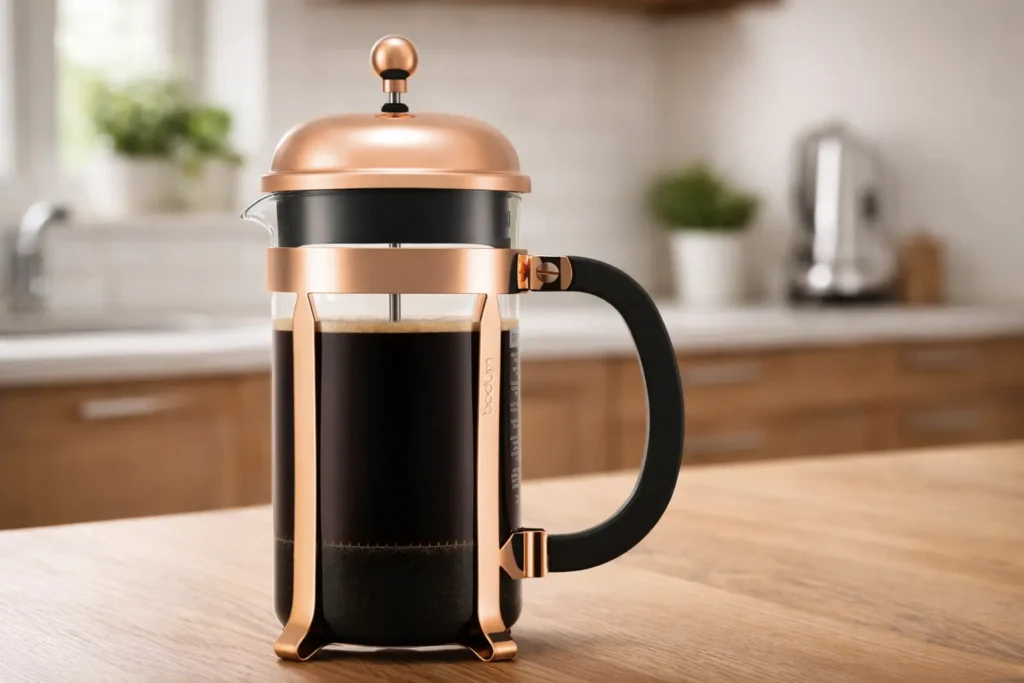
Bodum Chambord — classic glass press
A traditional glass-and-steel press with a replaceable mesh filter. Easy to see the brew; preheat it to limit heat loss.
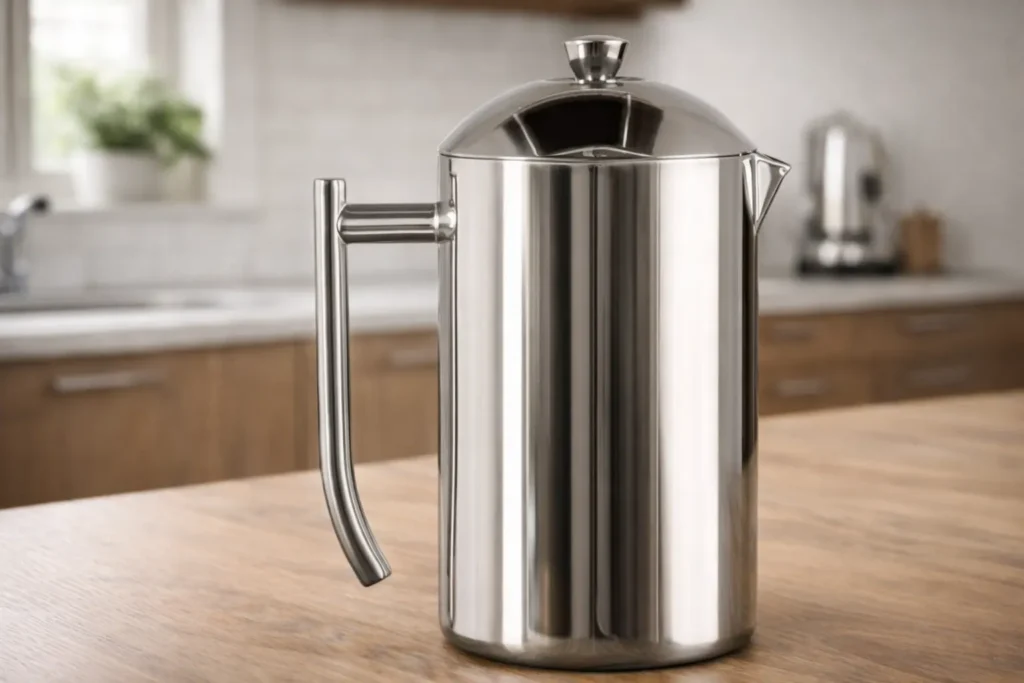
Frieling Double Wall — heat retention
Double-wall stainless construction that keeps coffee hot and is hard to break. Pour out promptly so the coffee does not over-extract.
A Simple French Press Dial-In Method
Troubleshooting works best when you change one variable at a time. Start from this baseline and adjust only the variable that matches your symptom.
| Variable | Baseline | Adjust when |
|---|---|---|
| Grind | Coarse and even, like coarse sea salt (K6 about 140 clicks; Encore setting 28) | Bitter → coarser; sour → finer |
| Ratio | About 1:15 by weight | Weak → more coffee; too strong → less |
| Water | Just off the boil (about 195–205°F) | Sour → hotter; harsh dark roast → slightly cooler |
| Steep time | 4 minutes | Bitter → shorter; sour → longer |
| After pressing | Pour out immediately | Always; never leave coffee on the grounds |
- Weigh your coffee and water, and grind just before brewing.
- Preheat the press, add the grounds, and start a timer.
- Pour all the water, making sure every ground is wet, and stir gently.
- Put the lid on with the plunger raised and steep for four minutes.
- Press slowly and evenly, then pour everything out right away.
- Taste, identify one symptom, and change only one variable next time.
Recipes by Press Size: Coffee and Water Weights
Most “weak” or “too strong” complaints disappear once the dose matches the press. Use the water weight that fills your press to just below the spout, leaving room for the plunger, then pick a ratio.
| Press size | Water | Stronger (1:14) | Baseline (1:15) | Lighter (1:16) |
|---|---|---|---|---|
| 3-cup (12 oz / 350 ml) | 350 g | 25 g coffee | 23 g coffee | 22 g coffee |
| 4-cup (17 oz / 500 ml) | 450 g | 32 g coffee | 30 g coffee | 28 g coffee |
| 8-cup (34 oz / 1 L) | 900 g | 64 g coffee | 60 g coffee | 56 g coffee |
| 12-cup (51 oz / 1.5 L) | 1,300 g | 93 g coffee | 87 g coffee | 81 g coffee |
Note: French press “cups” are about 4 oz each, not a full mug. Water weights are rounded working fills; check your own press’s maximum line. One gram of water equals one milliliter, so a kitchen scale handles both measurements. See the full French press ratio chart for more sizes.
Larger batches change the brew in two ways. More water holds heat better, which can tip a full 12-cup press slightly toward over-extraction, and a deeper bed of grounds makes stirring and pressing less even. If a full press tastes harsher than a half batch with the same recipe, grind one step coarser for big batches.
Worked Examples: Diagnosing Real French Press Problems
These scenarios show how to read a combination of symptoms rather than treating each one separately.
Example 1: Bitter and muddy at the same time
The situation: an 8-cup press, 60 g of coffee, 900 g of water, four-minute steep, beans ground in a blade grinder. The cup is harsh and leaves a thick layer of sludge.
The diagnosis: the ratio and time are fine. Bitterness plus sludge together point to fines: the blade grinder produces a mix of dust and chunks, and the dust over-extracts and passes through the mesh. Grinding coarser with the same blade grinder will make the chunks even larger and the cup sour, while the dust remains.
The fix: switch to a burr grinder at a coarse setting. Until then, the skim-and-wait method and pouring slowly will reduce the sludge.
Example 2: Sour even at four minutes
The situation: a light-roast Ethiopian coffee, 30 g of coffee to 450 g of water, ground at the same coarse setting that works well for a medium-roast blend. The cup is sharp and thin.
The diagnosis: light roasts are denser and less soluble, so the medium-roast setting under-extracts them. The water may also have cooled if it sat after boiling.
The fix: grind one step finer (for example, about 5 clicks on a K6), use water just off the boil, and preheat the press. If it is still sour, extend the steep to four and a half minutes. Change one of these at a time.
Example 3: Great first cup, bitter second cup
The situation: a full insulated stainless press. The first cup tastes balanced, but the refill 20 minutes later is harsh.
The diagnosis: the recipe is right. The coffee left in the press is sitting on the grounds and staying hot, so extraction continues after pressing.
The fix: pour the whole batch into a thermal carafe immediately after pressing, or brew a smaller batch.
Example 4: Plunger barely moves
The situation: an Espro-style micro-filter press with pre-ground coffee labeled for drip machines.
The diagnosis: drip grind is too fine for French press, and a micro-filter is even less tolerant of fines than a standard mesh.
The fix: stop pressing and pull back slightly to avoid a spill, then finish slowly. Next time, use coffee ground coarse for French press.
Common French Press Mistakes to Avoid
Using pre-ground drip coffee. It is ground too fine for French press, which leads to bitterness, sludge, and a hard plunge.
Measuring with scoops. Volume measures vary with roast and grind. A small scale makes results repeatable.
Leaving coffee in the press. It keeps extracting and turns bitter within minutes.
Rinsing instead of cleaning the filter. Trapped oils go rancid and flatten every cup.
Changing several variables at once. You will never know which change fixed or caused the problem. Our Fix My Coffee guide applies the same one-variable method across every brew method.
Frequently Asked Questions
How do I make French press coffee less bitter?
Grind coarser, keep the steep around four minutes or slightly shorter, and pour all the coffee out immediately after pressing. If you brew dark roasts, let boiling water rest briefly before pouring. A burr grinder helps most if your grind is uneven.
Why is there so much sediment in my French press?
Fine particles from a blade grinder or a too-fine setting pass through the metal mesh. Grind coarser with a burr grinder, check that the filter is undamaged and sealing, pour slowly, and leave the last ounce in the press. A press with a micro-filter, such as the Espro P7, reduces sediment further.
What is the right steep time for French press?
Four minutes is a reliable starting point for a coarse grind. Shorten it if coffee tastes bitter and lengthen it if coffee tastes sour, adjusting by 30 seconds at a time.
Why is my French press plunger hard to push down?
The grind is too fine and the fines are clogging the screen. Lift the plunger slightly and press again slowly rather than forcing it. Use a coarser grind next time.
Should I stir French press coffee?
A gentle stir after adding water helps wet all the grounds evenly. Avoid vigorous stirring near the end of the steep, which kicks up fines and can make the cup muddier.
How often should I clean a French press filter?
Rinse it after every brew, disassemble and wash it with detergent at least weekly, and soak it in a coffee-equipment cleaner every few weeks to remove built-up oils.
Why does my French press coffee look oily?
A thin sheen of oil is normal. The metal mesh lets coffee oils through, which is part of why French press has more body than paper-filtered coffee. Heavy oiliness can come from very dark roasts, while a rancid taste alongside the oil usually means old oils trapped in the filter, so deep-clean the plunger.
Can I use a paper filter in a French press?
Some people place a paper filter disc under the mesh or pour the finished coffee through a paper filter to cut sediment and oils. It produces a cleaner, lighter cup but removes some of the body that makes French press distinctive. Try the skim-and-wait method first.
Why does my French press coffee taste burnt?
“Burnt” usually means over-extraction from a dark roast, water straight off a rolling boil, or coffee left sitting on the grounds. Rest the kettle for 30–60 seconds, grind a step coarser, and pour out immediately after pressing. If only one bag tastes burnt, the roast itself may be very dark.
Can I reuse French press grounds for a second batch?
It is not recommended. Most of the desirable flavor is extracted in the first brew, so a second pass mostly pulls out the bitter, woody compounds that remain and produces a weak, harsh cup.
Sources and Further Reading
Extraction principles and brew-temperature ranges reflect the Specialty Coffee Association’s brewing protocols and best practices. KINGrinder K6 settings use KINGrinder’s published specifications (60 clicks per rotation, about 16 microns per click) and its coarse reference of about 150 clicks for French press. Baratza Encore and Virtuoso+ starting settings use Baratza’s published French press recommendation. The skim-and-wait technique is credited to James Hoffmann. Press design details reflect manufacturer documentation from Bodum, Frieling, and Espro. Ratios, temperatures, and steep times are starting points; adjust by taste.
CoffeeGearHub product shortlist
Continue with related products on CoffeeGearHub
Review product categories and current verified merchant offers on CoffeeGearHub before leaving the site.
Continue Learning
French press guides
In this guide
- The 30-Second Answer
- Troubleshooting Chart
- Why It Goes Wrong
- Quick Diagnostic Flow
- Bitter Coffee
- Sour or Weak Coffee
- Muddy or Gritty Coffee
- Plunger Problems
- Flat or Stale Flavors
- Coffee Cools Too Fast
- Grinder Settings
- Adjusting for Roast
- By Press Type
- Dial-In Method
- Recipes by Press Size
- Worked Examples
- Common Mistakes
- Frequently Asked Questions
- Sources and Further Reading
- Continue Learning