
KINGrinder K6 vs 1Zpresso K-Ultra (2026): Which Hand Grinder Should You Buy?
Editorial standards: this comparison is based on manufacturer and retailer specifications, published grind-setting guidance, and CoffeeGearHub’s existing grinder guides. Specifications can vary by production run. CoffeeGearHub does not claim hands-on testing where it has not occurred.
At a glance
What this K6 vs K-Ultra comparison covers
How the two grinders differ where it matters, why the adjustment system is the real decision, how each handles espresso and filter coffee, what they are like to live with, starting settings, the alternatives worth considering, and our verdict.
Editorial analysis
Two 48 mm grinders that differ most in how you adjust them
On paper, the KINGrinder K6 and the 1Zpresso K-Ultra look alike: both use 48 mm heptagonal stainless steel conical burrs, both hold about 35 g of beans, and both cover everything from espresso to French press. That is why they are so often compared.
The real differences are in the adjustment system, the step size, and the small conveniences around them. The K6 gives finer 16-micron steps at a lower price. The K-Ultra gives a large numbered external dial, a magnetic catch cup, a folding handle, and a more premium finish. Which matters more depends on what you brew and how often you change settings.
The 30-Second Answer
Choose the KINGrinder K6 if you want the best value and the finest adjustment steps, especially for espresso. Choose the 1Zpresso K-Ultra if you switch between brew methods often and want a numbered dial you can read at a glance, a magnetic catch cup, and a folding handle for travel.
Both grind well for pour-over, AeroPress, moka pot, and French press. The K6 costs noticeably less; the K-Ultra is the more refined daily-use and travel grinder.
Compare current options
Start with these representative choices
The two grinders in this comparison, plus a budget alternative for filter-only brewers. Our best manual coffee grinders guide compares more options.
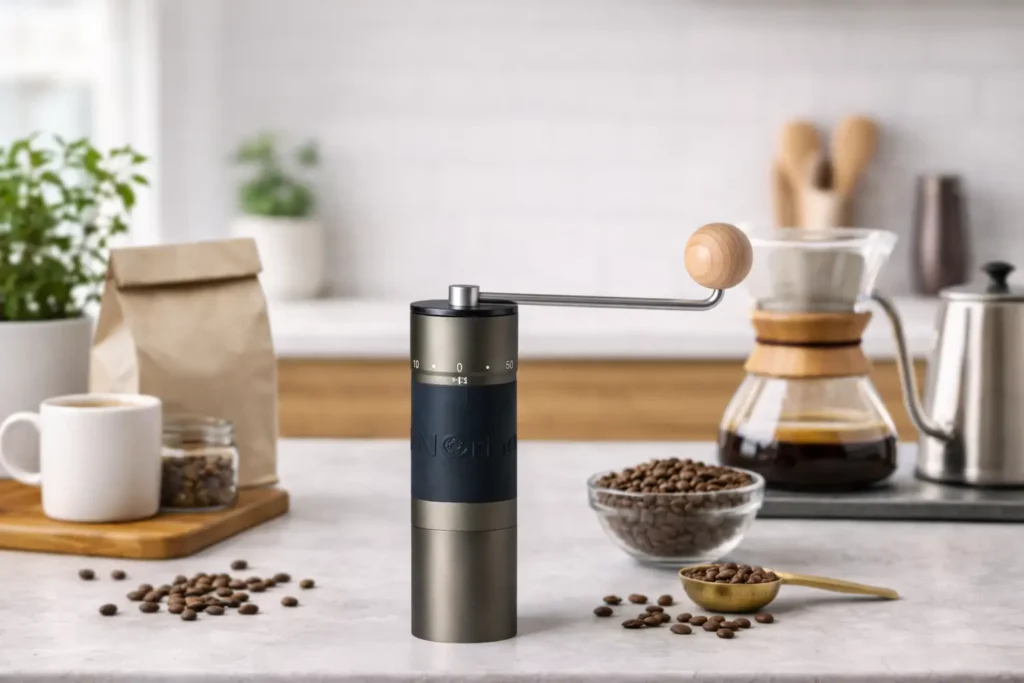
KINGrinder K6 — Best value
48 mm heptagonal steel burrs and fine 16-micron steps at a price well below most premium hand grinders. The pick for espresso-first brewers.
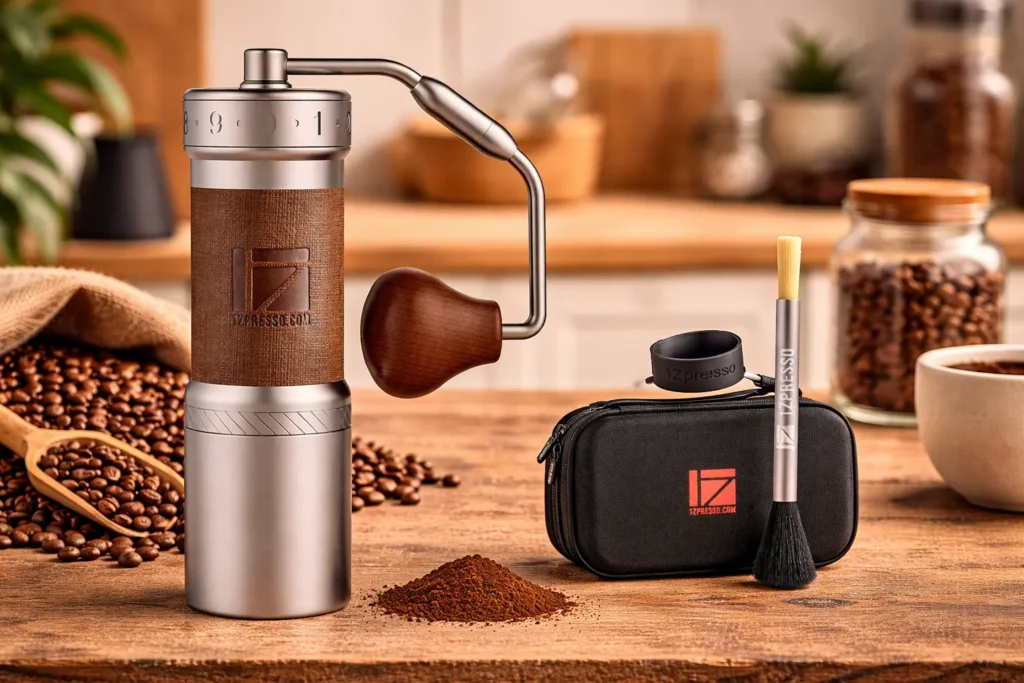
1Zpresso K-Ultra — Best for switching methods
A numbered external dial, magnetic catch cup, and folding handle make it the easiest of the two to live with if you brew several methods.
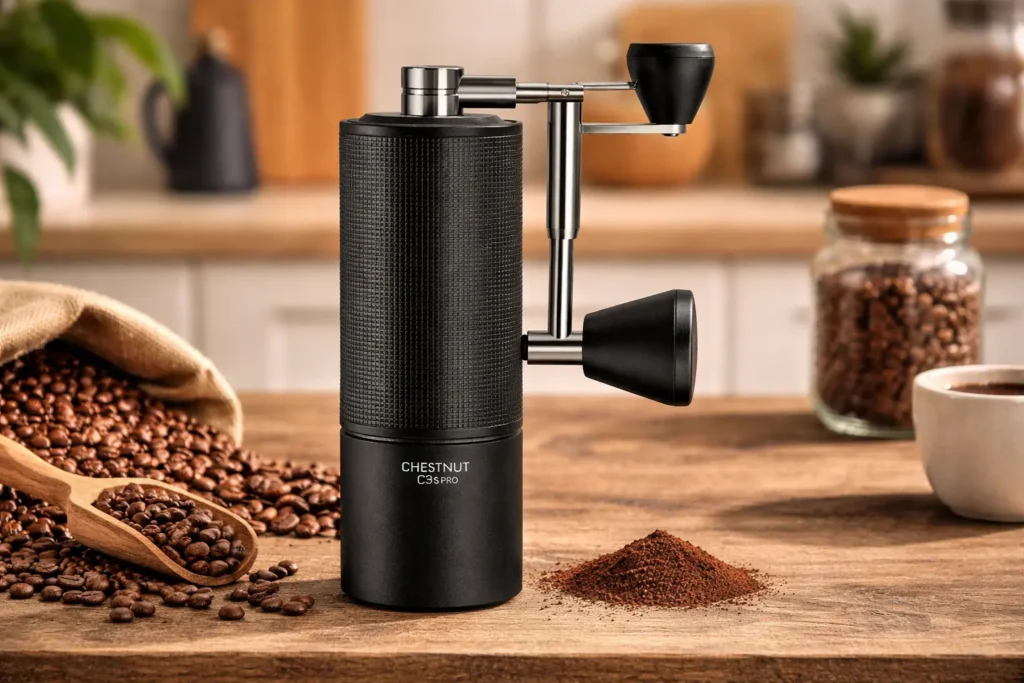
Timemore C3 Pro — Budget alternative
A lower-cost hand grinder for pour-over, AeroPress, and French press. Less suited to espresso than either grinder above.
Affiliate disclosure: Amazon links may earn CoffeeGearHub a commission at no additional cost to you. Prices and availability can change.
The Two Grinders Side by Side
The specification sheets explain why these grinders are cross-shopped so often. The burr class, capacity, and body material are close enough that the table below mostly highlights the handful of places where they part ways: how the grind is adjusted, how large each step is, and the hardware you touch every morning.
| KINGrinder K6 | 1Zpresso K-Ultra | |
|---|---|---|
| Burrs | 48 mm heptagonal conical, SUS420 stainless steel | 48 mm heptagonal conical K burr, stainless steel |
| Adjustment | External collar, counted in clicks | External numbered dial at the top |
| Clicks per rotation | 60 | 100 |
| Step size | About 16 microns per click | About 20 microns per click |
| Capacity | About 35 g | About 35–40 g |
| Weight | About 630 g | About 700 g |
| Catch cup and handle | Threaded cup, fixed crank | Magnetic cup, folding handle |
| Relative price | Lower | Higher |
Specifications come from manufacturer and retailer listings and can change between production runs, so check the current listing before you buy. What the numbers cannot show is how those differences feel in use, which is where the rest of this comparison focuses.
Why the Burrs Are Not the Deciding Factor
It is tempting to start a grinder comparison with the burrs, because burrs are what actually cut the coffee. Here, though, both grinders sit in the same class: 48 mm, seven-sided, stainless steel conical burrs. That size is a real step up from the smaller burrs in entry-level hand grinders. Larger burrs need fewer turns per dose, and when they are well aligned they produce a more even spread of particle sizes with fewer of the dusty fines that make coffee taste muddy or bitter.
The two burr sets are made by different companies and are not identical, and enthusiasts will happily debate their flavor signatures. For most home brewers, though, the honest conclusion is that cup quality is in the same broad tier. A clean, sweet V60 or a balanced AeroPress is well within reach of either grinder. The variables that move your coffee far more are bean freshness, your recipe, water, and getting the grind setting right for the brewer in front of you.
That is good news, because it means you are not choosing between a “better” and a “worse” grinder. You are choosing between two ways of working. Our coffee grind size guide explains why particle consistency matters for each brew method if you want the background.
Adjustment Is the Real Decision
If you take one thing from this comparison, make it this: the K6 and the K-Ultra are adjusted in very different ways, and that difference shapes almost every morning you spend with them.
The K6 uses an external collar with 60 clicks per full rotation. KINGrinder lists about 16 microns of burr movement per click, which is a fine step size for any hand grinder and an unusually fine one at this price. The collar is easy to turn and does not require taking the grinder apart, which is a genuine improvement over older designs that hid the adjustment under the burr. What it does not do is tell you where you are. Settings are tracked by counting clicks from zero, the point where the burrs just touch. Once you know your numbers, that is quick; until then, it rewards keeping notes, and our KINGrinder K6 grind settings chart gives starting points for every method.
The K-Ultra takes the opposite approach. Its headline feature is a large numbered dial on the outside at the top of the grinder, with 100 clicks per rotation divided into ten numbered marks. 1Zpresso lists about 20 microns of movement per click. You can glance at the dial, see that you are on your pour-over setting, turn it to the low 3s for espresso, and land back on the same mark tomorrow without counting anything.
Each K-Ultra click is slightly larger than a K6 click, but 20 microns is still fine enough for most espresso dialing. The trade, then, is a little resolution in exchange for a lot of convenience. If you brew one or two methods and rarely move the setting, the K6’s approach costs you almost nothing. If you jump between espresso, filter, and French press through the week, the K-Ultra’s dial is the feature you will appreciate every single day.
Espresso: Where the K6’s Smaller Steps Earn Their Keep
Espresso is the most demanding thing you can ask of a grinder. Water is pushed through a tightly packed puck in under half a minute, so a small change in particle size has a large effect on flow. One step too coarse and a shot runs fast and tastes sour; one step too fine and it chokes and turns bitter. This is why step size matters, and why the K6’s 16-micron clicks give it a modest but real edge for espresso-first brewers. When you are a click or two away from a great shot, finer steps let you land closer to it.
That does not make the K-Ultra a poor espresso grinder. Both can grind fine enough for a non-pressurized basket, and many K-Ultra owners pull excellent shots. The difference is that the K-Ultra feels optimized for moving between methods, while the K6 feels optimized for living in the espresso range. If espresso is one drink among several, the K-Ultra’s convenience usually outweighs the slightly larger steps. If espresso is the reason you are buying a hand grinder, the K6 is the more natural fit and it costs less.
One practical caveat applies to both. Fine espresso grinding takes the most turns per dose, and doing it by hand every morning is a commitment. If you pull several shots a day, or make drinks for a household, an electric espresso grinder will save real time and effort. The Baratza Encore ESP is a common starting point, and our espresso grinder guide compares more options.
Filter Coffee: A Near Tie, Decided by Convenience
For pour-over, AeroPress, and French press, the gap between these grinders closes almost completely. Filter brewing is far more forgiving of small grind differences than espresso, and both grinders produce the even, clean grounds that make a V60 taste bright and a French press taste rich rather than silty. If filter coffee is all you brew, either grinder will serve you well for years.
What separates them here is, again, the dial. Suppose you brew a V60 on weekday mornings, an AeroPress at the office, and a French press on Sunday. On the K-Ultra, that is three numbers on a dial. On the K6, it is three click counts to remember, or one setting you leave alone and accept as a compromise. Neither is hard, but one is easier, and convenience is what you are paying the K-Ultra’s premium for. Whichever you choose, pair it with a 0.1 g scale and a consistent recipe; our pour-over guide and coffee scale guide walk through both.
Starting Grind Settings for Each Grinder
Settings depend on your grinder’s zero point, your beans, and your recipe, so treat the numbers below as a place to start rather than a destination. K6 ranges come from our K6 chart. Because a K6 click moves about 16 microns and a K-Ultra click about 20, multiplying K6 clicks by roughly 0.8 gives an approximate K-Ultra equivalent. That is a rule of thumb, not a calibration.
| Method | K6 starting clicks | Approximate K-Ultra clicks | Adjust if… |
|---|---|---|---|
| Espresso | 35–45 | About 28–36 (roughly 2.8–3.6 on the dial) | Fast and sour: finer. Slow and bitter: coarser |
| Moka pot | 65–75 | About 52–60 | Sputters early or tastes bitter: coarser |
| AeroPress | About 70–95 | About 56–76 | Hard to press: coarser |
| Pour-over | 90–110 | About 72–88 | Sour: finer. Drains slowly or bitter: coarser |
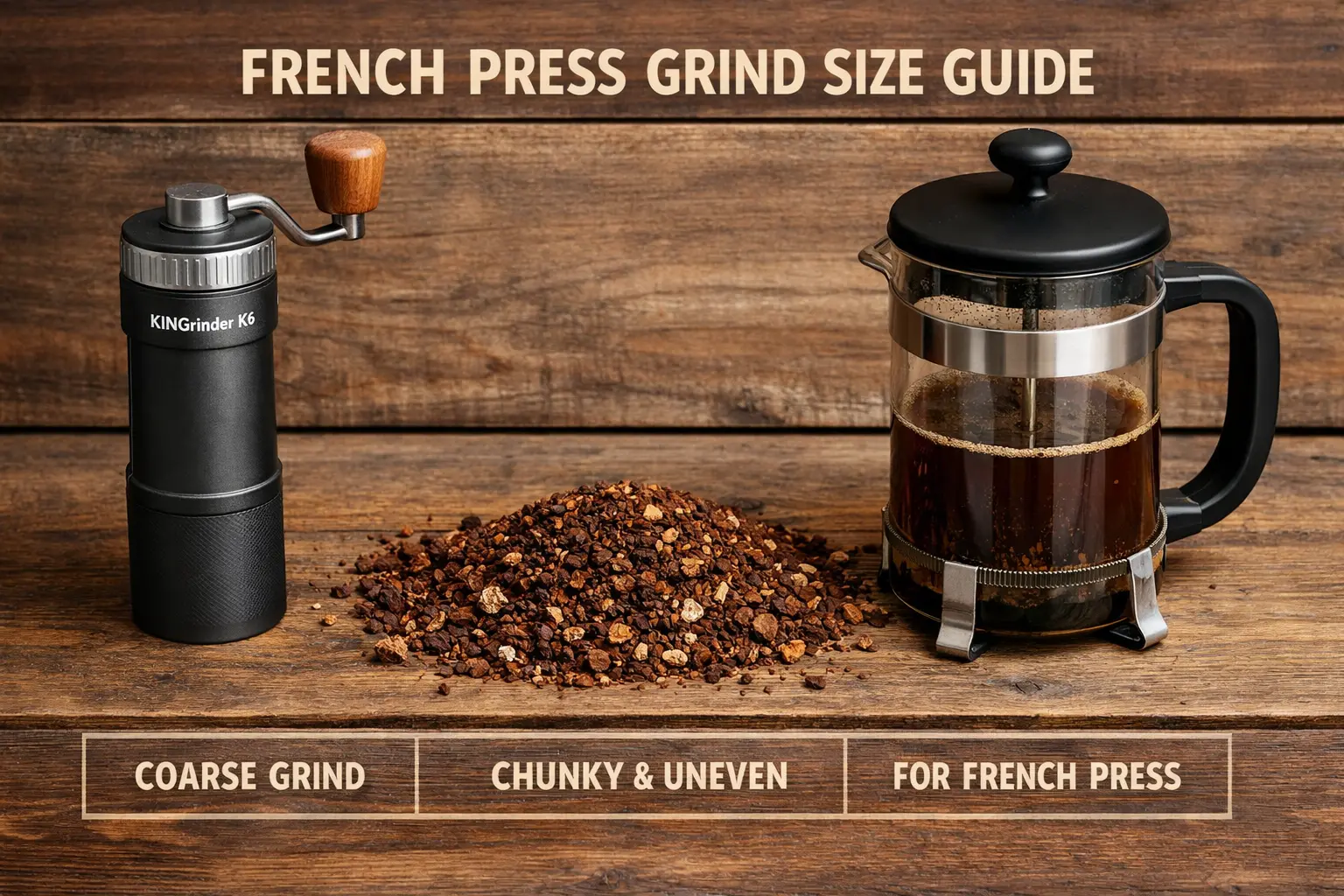
| French press | 135–150 | About 108–120 | Muddy: coarser |
| Cold brew | About 150 | About 120 | Weak: finer or steep longer |
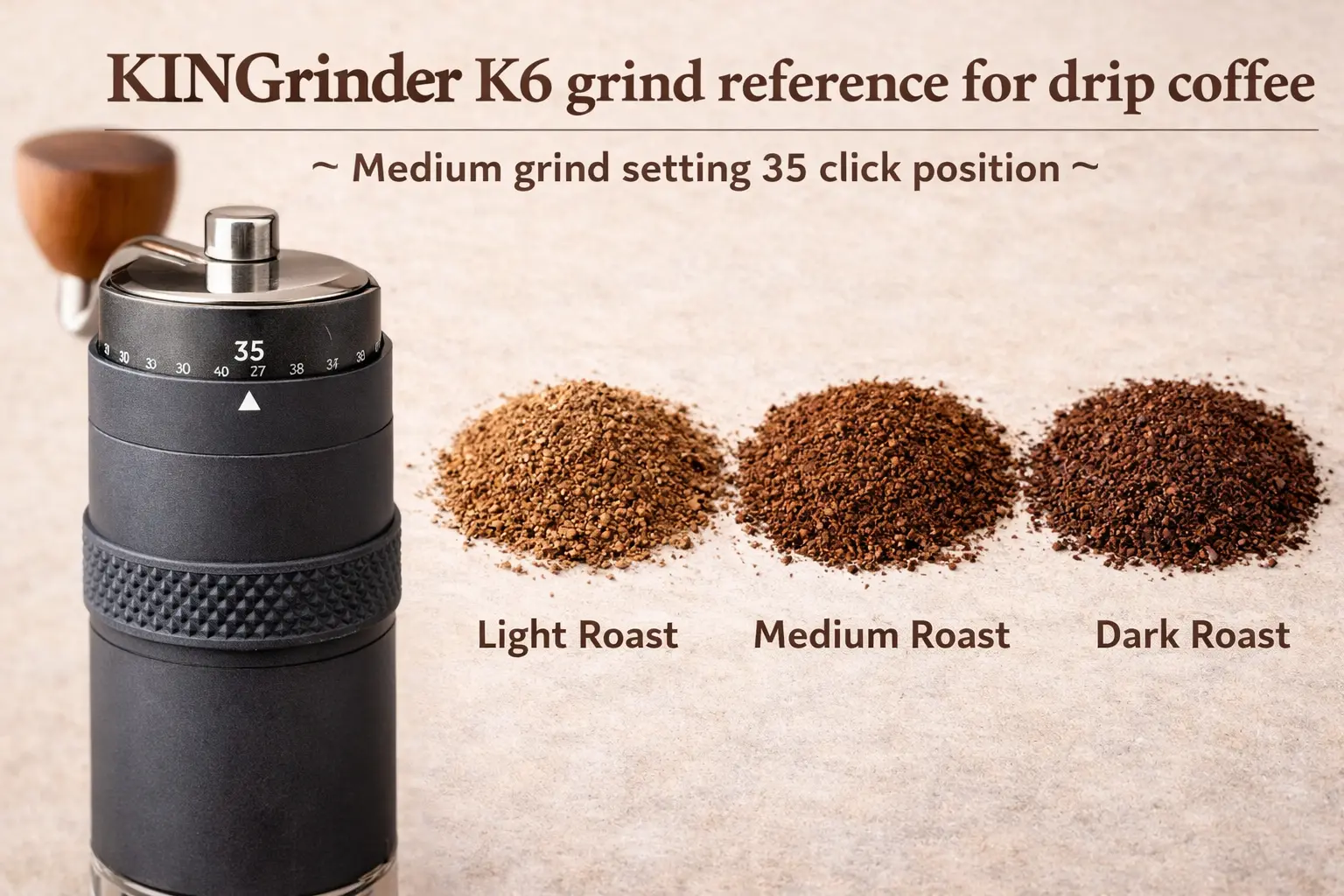
Before using any chart, find your own zero. Turn the grinder finer until the burrs just touch and you feel resistance, then count from there. Individual units vary slightly, which is why two owners can quote different numbers for the same coffee and both be right.
From there, adjust by taste and change one thing at a time. For method-specific ranges in more depth, see our pour-over grind size chart and French press grind size guide.
What Each Grinder Is Like to Live With
Specifications describe a grinder; routine describes ownership. A typical K6 morning goes like this: weigh 20 g of beans, confirm the collar is still on your pour-over setting, grind for something like half a minute, unscrew the catch cup, and brew. If you want an espresso later, you count back to your espresso setting or check the note on your phone. Many K6 owners simply settle on one or two settings and rarely move between them, and for them the routine is as quick as it gets.
The K-Ultra routine is similar, with fewer small frictions. You glance at the dial instead of counting, and the magnetic catch cup pulls straight off and snaps back without threading, which is quicker and tidier when you are half awake. The folding handle tucks against the body, so the grinder slips into a drawer or a travel bag more easily, and it typically ships with a carrying case. None of these features changes how your coffee tastes, but together they make the K-Ultra feel like the more finished product.
Both grinders are solid metal and pleasant to hold. The K-Ultra is a little heavier at about 700 g against roughly 630 g for the K6, which you will notice in a backpack more than on the counter. Grinding time depends far more on the setting and the beans than on the grinder: fine espresso grinds take noticeably longer than coarse French press grinds, and dense light roasts take more effort than dark ones on either model.
Maintenance is the same light routine for both. Tap and brush out loose grounds after grinding, and every few weeks remove the burr according to the manufacturer’s instructions to brush away oils and fines. Avoid water on the burrs unless the manufacturer says it is safe, skip rice and cleaning tablets in hand grinders unless they are approved, and re-check your zero after reassembly so your settings stay accurate. Our grinder cleaning and retention guide covers the details.
Alternatives Worth Considering
Most people reading this comparison will be well served by one of the two grinders above, but three alternatives are worth knowing about because they fit specific kinds of brewers better.
If you only brew filter coffee and want to spend less, the Timemore C3 Pro is a popular entry point. Its burrs are smaller and its steps coarser, so it is not the right tool for espresso, but for pour-over, AeroPress, and French press it is a sensible way to get most of the benefit of a good hand grinder for less.
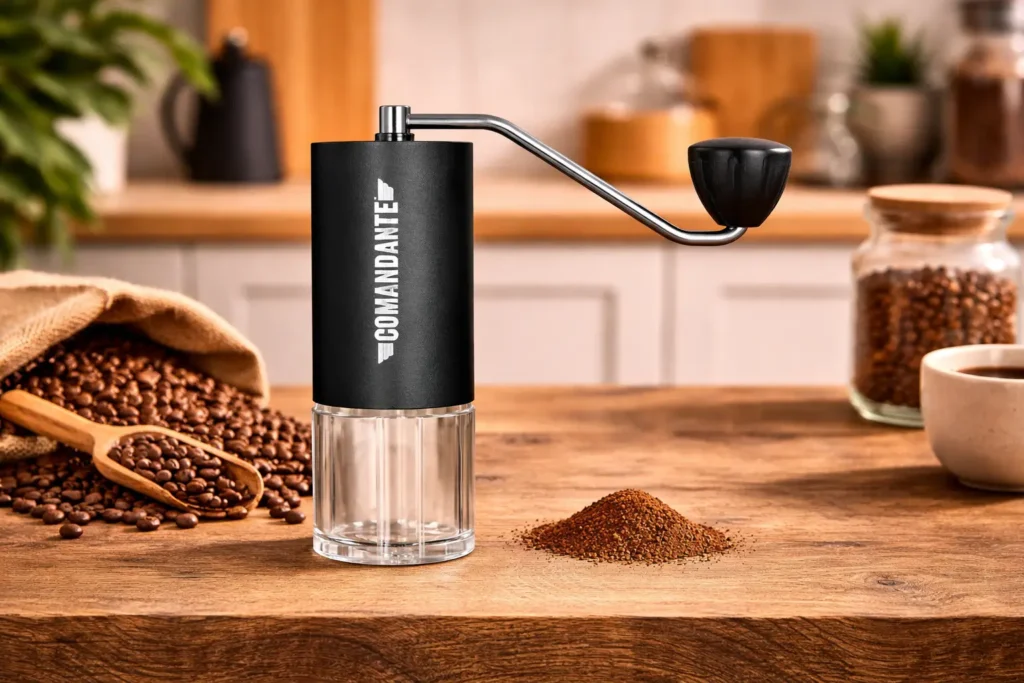
If you want a premium filter grinder, the Comandante C40 has a long-standing reputation for build quality and filter-coffee performance. It costs more than either grinder in this comparison and its internal adjustment is less convenient than an external dial, so it makes the most sense for buyers who value its craftsmanship and long track record.
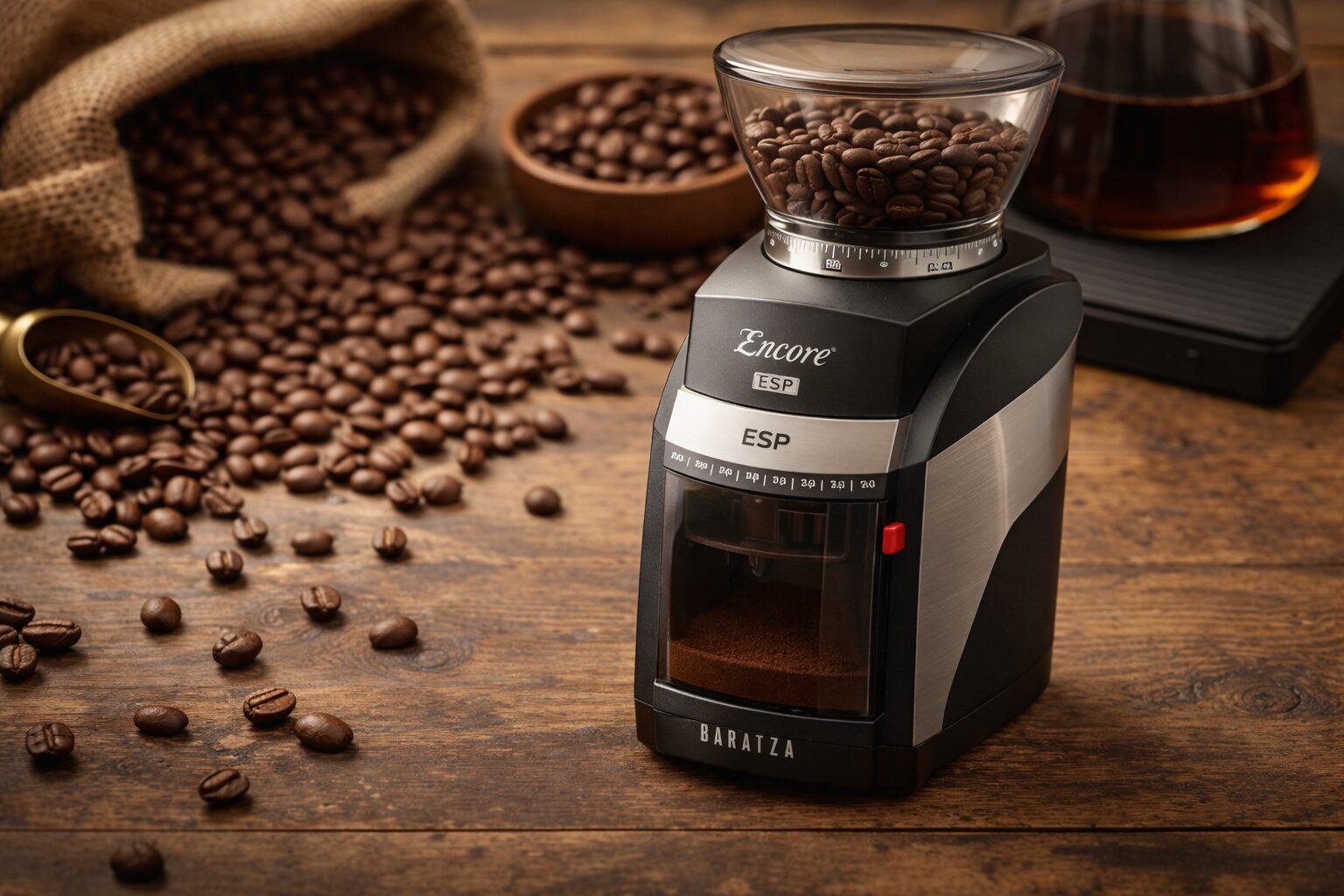
If hand-grinding every dose sounds like a chore, the Baratza Encore ESP is an electric grinder with finer steps in the espresso range that also covers filter grinds. It gives up the portability and quiet of a hand grinder in exchange for pressing a button, which is the right trade for anyone pulling several shots a day.
Our guide to choosing your first coffee grinder walks through the hand-versus-electric decision in more depth.
Our Verdict: Which Should You Buy?
Buy the KINGrinder K6 if value matters most or if espresso is the main reason you want a hand grinder. Its fine 16-micron steps make dialing in shots easier, its grind quality is in the same tier as grinders that cost considerably more, and it is the top overall pick in our best manual coffee grinders guide. The compromises are that you count clicks instead of reading a dial, the catch cup threads on, and the handle does not fold.
Buy the 1Zpresso K-Ultra if you move between brew methods during the week, travel with your grinder, or simply want the more refined everyday experience. The numbered dial makes switching from espresso to pour-over to French press quick and repeatable, and the magnetic catch cup and folding handle remove small frictions you would otherwise notice every morning. You pay more for that convenience and give up a little espresso resolution, but for many brewers it is money well spent.
If you are still undecided, ask yourself one question: how often will you change the grind setting? Rarely points to the K6. Often points to the K-Ultra.
Pick Your Grinder
The K6 is the value pick with finer steps; the K-Ultra is the easier, more refined daily driver.
As an Amazon Associate, CoffeeGearHub earns from qualifying purchases.
Editorial bottom line: Both are excellent 48 mm hand grinders that will improve almost any home coffee. Choose the K6 for value and espresso fine-tuning, and the K-Ultra for a numbered dial, a magnetic catch cup, and a folding handle.
Frequently Asked Questions
Do the K6 and K-Ultra use the same burrs?
Both use 48 mm heptagonal stainless steel conical burrs, but they are made by different companies and are not identical. Cup quality is in the same broad tier.
How many clicks per rotation do the K6 and K-Ultra have?
KINGrinder specifies 60 clicks per rotation on the K6, at about 16 microns per click. 1Zpresso lists 100 clicks per rotation on the K-Ultra, at about 20 microns per click, with ten numbered marks per turn.
Can I convert K6 settings to K-Ultra settings?
Roughly. Multiply K6 clicks by about 0.8 to estimate K-Ultra clicks, based on the step sizes. Zero points vary between units, so adjust by taste.
Which grinder is better for travel?
The K-Ultra, thanks to its folding handle and magnetic catch cup, and it typically ships with a carrying case.
How much coffee do the K6 and K-Ultra hold?
About 35 g for the K6 and about 35–40 g for the K-Ultra, enough for one or two cups.
Is a hand grinder good enough for daily espresso?
For one or two shots a day, yes, if you do not mind the extra turns at fine settings. For several shots a day or a household, an electric espresso grinder is usually more practical.
Sources and Further Reading
Specifications were taken from manufacturer and retailer listings, including a KINGrinder K6 retailer specification sheet (48 mm SUS420 heptagonal burr, 35 g, 630 g, 16 µm per click, 60 clicks per rotation) and a 1Zpresso K-Ultra retailer listing (35–40 g, 700 g, 100 clicks per rotation, 20 µm per click, folding handle). K6 settings follow our K6 grind settings chart. Specifications can change; check current listings.
CoffeeGearHub product shortlist
Continue with related products on CoffeeGearHub
Review product categories and current verified merchant offers on CoffeeGearHub before leaving the site.