Last Updated: March 2026 • 25–35 min read • Cornerstone Guide: French Press Grind Size — Complete K6 Settings, Dial-In System, and Troubleshooting Reference
This is the complete French press grind size guide. Grind size is the single most important variable in French press coffee quality — more than your brew ratio, more than your water temperature, more than your steep time. Get it right and every other variable falls into place. Get it wrong and no amount of recipe tweaking will fix your cup. The problem is that most guides give you one vague instruction — “use a coarse grind” — and leave you guessing what that actually means. This guide gives you something more useful: a complete KINGrinder K6 click reference for every roast level and use case, a visual description of what the correct grind looks like, a step-by-step dial-in system for finding your personal ideal, cold brew and roast-level grind adjustments, and a troubleshooting matrix that maps specific cup problems directly to specific grind fixes. Whether you are brewing your first French press or dialling in a new bag of beans, everything you need is here.
✍️ Editorial note: This guide is researched and written by the editors at CoffeeGearHub.com using published brewing science, SCA brewing standards, grinder manufacturer specifications, and established specialty-coffee community knowledge. Recommendations reflect research consensus and community reputation. All product links are affiliate links — we may earn a commission at no cost to you.
The 30-Second Answer
French press requires a coarse grind — particles should look like coarse sea salt or rough breadcrumbs. On the KINGrinder K6, start at clicks 68–72 for medium roast, 62–68 for light roast, 74–82 for dark roast, and 78–88 for cold brew. If your cup is bitter, go coarser. If it is sour, thin, or weak, go finer. Adjust 3–5 clicks in one direction, brew again, and compare. Blade grinders are incompatible with French press — a consistent burr grinder is not optional. Record your ideal click setting once you find it; the K6’s repeatable click system means you never have to guess again.
- Light roast: K6 clicks 62–68 — finer to compensate for dense cell structure; 95–96°C; 4.5–5 min steep
- Medium roast: K6 clicks 68–72 — the standard French press grind; 93°C; 4 min steep
- Medium-dark roast: K6 clicks 70–76 — slightly coarser to avoid extracting roast bitterness; 92°C
- Dark roast: K6 clicks 74–82 — coarse to prevent over-extraction; 90–92°C; 3.5–4 min steep
- Cold brew: K6 clicks 78–88 — very coarse; cold water; 12–16 hrs fridge steep
- Best grinder: KINGrinder K6 — 48mm conical burrs with consistent coarse-range distribution and 100-click repeatability
Who This Guide Is For — Jump to What You Need
☕ New to French Press
Start with Why Grind Size Matters and What Coarse Grind Looks Like. Then go straight to K6 Settings by Roast Level for your starting point.
⚙️ Dialling In a Problem Cup
Jump directly to the Troubleshooting Matrix — identify your symptom and get the specific grind fix. Then use the Dial-In System to execute it systematically.
🔬 Switching Roast or Bean
See Grind Settings by Roast Level and the Bean Type Grind Reference Table. Different origins and processing methods affect your ideal starting click.
🌱 Upgrading Your Grinder
Go to Why a Burr Grinder Is Non-Negotiable and the KINGrinder K6 section for the full case for upgrading and what to expect from the K6 at French press settings.
Table of Contents
Why Grind Size Is the Most Important French Press Variable
Every brewing variable — ratio, water temperature, steep time — operates within limits set by your grind size. A perfect ratio and temperature cannot fix a grind that is too fine; a longer steep time cannot rescue a grind that is too coarse. Grind size determines how fast compounds extract from coffee into water, and in a full-immersion method like French press, that extraction rate controls everything about your cup’s flavour. Understanding why grind size dominates every other variable removes the guesswork from troubleshooting and makes every subsequent adjustment more precise.
Surface Area and Extraction Rate
When you grind coffee beans, you break them into particles — and the finer you grind, the more surface area those particles expose to water. Surface area is the direct driver of extraction rate: water dissolves soluble compounds from coffee at the particle surface, so more surface area means faster dissolution. In a 4-minute steep, fine particles extract everything — including the bitter, astringent, and harsh compounds that extract last — long before you press. Coarse particles extract more slowly and selectively, releasing sweetness, caramel, and body across the full steep window while leaving the most bitter compounds only partially extracted. The target grind for French press is the setting at which the pleasant compounds are fully extracted and the harsh compounds are not — coarse enough to keep the extraction rate in balance with a 4-minute steep at 93°C.
The Metal Filter Interaction
French press uses a metal mesh filter, not a paper filter — and the mesh openings are large enough to pass fine coffee particles directly into the cup. A grind that is too fine creates two simultaneous problems: over-extraction in the cup (because small particles extract too fast), and a clogged, difficult-to-press filter (because fine particles pack tightly against the mesh). The coarse grind required for French press is not arbitrary tradition; it is a functional requirement of the metal filter system. Coarse particles are large enough to be held back by the mesh, extract at the correct rate for the steep time, and press without resistance. Every filter method has a grind size matched to its filtration system — for French press metal mesh, that is always coarse.
🔬 The immersion extraction window: In a pour-over or drip method, water passes through coffee once and drains away — the extraction window is short and the flowing water constantly refreshes the concentration gradient. In French press, the same water sits in contact with all the grounds for the full steep duration, and extraction continues until you pour. Grind size is the primary dial that controls how much extraction happens within that window. Get it right and the steep time does the rest. Get it wrong and the window closes too early (too fine) or stays open without doing enough work (too coarse).
What the Correct Coarse Grind Looks and Feels Like
The instruction to “use a coarse grind” is only useful if you know what coarse actually means in practice. For most home brewers, the easiest reference is a comparison to familiar textures — and the most reliable physical test is what you feel when you rub a pinch of ground coffee between your fingers.
Visual Reference: What to Look For
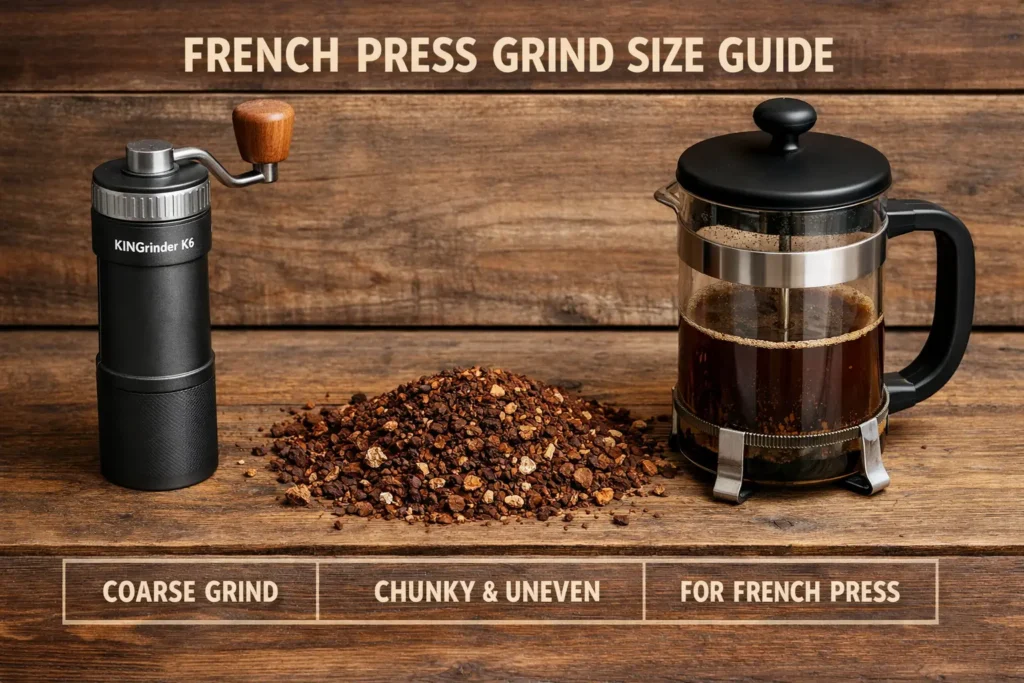
The correct French press grind visually resembles coarse sea salt or rough, irregular breadcrumbs. Individual particles should be large enough to see clearly as distinct pieces — they should have visible texture and irregular edges. There should be minimal fine powder at the bottom of your grind catch; a small amount of fines is normal and unavoidable even with the best burr grinders, but the majority of the grind should be uniformly coarse. If the overall appearance looks like fine beach sand or a uniform powder, the grind is too fine for French press.
Tactile Reference: The Finger Test
Pick up a small pinch of your ground coffee and rub it between your thumb and forefinger. A correct French press grind should feel distinctly gritty — like rubbing fine gravel between your fingers. You should feel individual particles resisting as you rub. If the coffee feels silky, smooth, or chalky, the grind is too fine. If the particles feel like small pebbles and fall apart rather than compress, the grind may be too coarse. The gritty-but-not-powdery tactile middle ground is the French press target.
| Grind appearance | Tactile feel | K6 range (approx.) | French press verdict |
|---|---|---|---|
| Fine powder / uniform dust | Silky, smooth between fingers | Below 45 clicks | ❌ Too fine — espresso range; will produce bitter, muddy cup and difficult press |
| Fine-medium sand, like table salt | Slightly gritty, mostly smooth | 45–60 clicks | ⚠️ Too fine for most French press — will over-extract; pour-over or AeroPress range |
| Medium sand / fine sea salt | Noticeably gritty | 60–66 clicks | ⚠️ Borderline — acceptable for light roast only; will over-extract medium and dark roasts |
| Coarse sea salt / rough breadcrumbs | Distinctly gritty, individual particles visible | 66–76 clicks | ✅ Correct French press range — medium and medium-dark roast sweet spot |
| Very coarse — small pebbles, irregular chunks | Gritty to rocky, pieces visible at a glance | 76–88 clicks | ✅ Dark roast and cold brew range — too coarse for standard hot brew French press |
| Coarse chunks, visibly uneven | Rocky, large irregular pieces | Above 88 clicks | ❌ Too coarse — will under-extract even dark roast; weak, sour, watery cup |
KINGrinder K6 Grind Settings: Complete French Press Reference
The KINGrinder K6’s 100-click adjustment system makes it the most precise and repeatable manual grinder in its class for French press. The table below is the complete reference for K6 click settings across every French press use case. These are starting points — dial in from the midpoint of each range based on your taste preference and the specific bean you are brewing.
How to Read and Use These Settings
The K6 click number increases as the grind becomes coarser — a higher number is a coarser grind. On a freshly zeroed grinder (plates touching = 0), each click represents one consistent step in the adjustment ring. To set your grind: hold the grind chamber body, rotate the adjustment collar to your target click number, and verify by counting clicks from zero. Always grind a small amount (5–10g) and discard before your brew dose when switching settings to clear the burr path of the previous setting’s particles.
| Use case / roast | K6 clicks | Starting point | Water temp | Steep time | Ratio | Cup character |
|---|---|---|---|---|---|---|
| Light roast (hot brew) | 62–68 | 65 | 95–96°C | 4.5–5 min | 1:15–1:16 | Bright, complex, lighter body — origin and terroir forward |
| Medium roast (hot brew) | 68–72 | 70 | 93°C | 4 min | 1:15 | Balanced, full body, caramel and nut — the classic French press cup |
| Medium-dark roast (hot brew) | 70–76 | 73 | 92°C | 4 min | 1:14–1:15 | Dark chocolate, brown sugar, heavy mouthfeel — rich and satisfying |
| Dark roast (hot brew) | 74–82 | 78 | 90–92°C | 3.5–4 min | 1:13–1:14 | Bittersweet, bold, intense — traditional strong press character |
| Natural Ethiopian | 65–70 | 67 | 92–93°C | 4 min | 1:15 | Blueberry, dried cherry amplified through metal filter — extraordinary |
| Cold brew concentrate | 78–88 | 83 | Cold / room temp | 12–16 hrs (fridge) | 1:8 | Sweet, smooth, chocolate-forward concentrate — dilute 1:1 before serving |
⚠️ Grinder variance note: K6 click settings vary slightly between individual units due to manufacturing tolerances. Two K6 grinders set to the same click number may not produce identical particle sizes — treat the ranges above as calibrated starting points, not absolute values. Always confirm by taste and adjust from there. The K6’s value is its repeatability on your own unit, not universal cross-unit precision. Once you find your ideal setting on your specific grinder, it will be consistent every time you return to it.
Grind Adjustments by Roast Level: The Science Explained
The reason grind size changes with roast level is physical, not arbitrary. The roasting process fundamentally alters the cellular structure of the coffee bean — and the degree of that change determines how fast the bean extracts. Understanding this helps you make instinctive, accurate adjustments when you switch beans without having to consult a table every time.
Light Roast: Grind Finer, Brew Hotter, Steep Longer
Light roast beans are roasted to a lower internal temperature, which means their cellular structure remains largely intact — dense, hard, and resistant to water penetration. This density slows extraction significantly. To compensate, you grind slightly finer than medium roast (more surface area), use hotter water (95–96°C accelerates diffusion), and extend the steep (4.5–5 minutes gives more time for full extraction). Brewing a light roast at the same settings as a medium roast typically produces an underdeveloped cup: thin, sour, and flat, with the bean’s brightness and complexity never fully unlocking. K6 starting point for light roast: 65 clicks.
Medium Roast: The French Press Sweet Spot
Medium roast is the most forgiving roast level for French press — and the most widely recommended for the method. The roasting process has opened the bean’s cell structure enough to allow consistent extraction at standard parameters (93°C, 4 minutes, 1:15 ratio) without the fragility of a dark roast. Medium roast at coarse grind produces the classic French press cup: full body, caramel sweetness, low bitterness, chocolate and nut undertones. Most specialty coffee blends designed for French press are medium roast for exactly this reason. K6 starting point: 70 clicks.
Dark Roast: Grind Coarser, Brew Cooler, Steep Shorter
Dark roasting pushes the bean to a high internal temperature, breaking down cell walls significantly and converting many of the bean’s complex flavor compounds into simpler, more rapidly extractable molecules. Dark roast coffee extracts very quickly — and many of the compounds that extract last are also the most bitter and harsh. To prevent over-extraction, you compensate in every direction: coarser grind (reduce surface area), lower water temperature (90–92°C slows extraction), shorter steep (3.5–4 minutes reduces contact time), and sometimes a slightly higher ratio (1:13 to 1:14 gives the extract more body to balance the intensity). K6 starting point for dark roast: 78 clicks.
Medium-Dark Roast: The Overlap Zone
Medium-dark roast sits between medium and dark — it has more body and chocolate character than medium, but retains enough complexity to reward careful brewing. The slightly more open cell structure compared to medium roast means it extracts marginally faster: a small step coarser on the grind (70–76 clicks vs. 68–72) and a modest temperature reduction to 92°C prevents the roast development bitterness from dominating the cup. For many home brewers, medium-dark roast at precise parameters delivers the most consistently satisfying French press experience — rich and full, with enough complexity to reward attention. K6 starting point: 73 clicks.
Bean Type Grind Reference: French Press Grind by Coffee Origin and Process
| Bean type | K6 starting click | Adjust vs. standard | Why | What to watch for |
|---|---|---|---|---|
| Medium roast blend | 70 | Standard baseline | Reference point for all other adjustments | No issues — most forgiving French press grind |
| Natural Ethiopian | 67 | 2–3 clicks finer than medium baseline | Fruit esters extract well; slightly finer grind develops sweetness without over-extracting fermentation notes | Go coarser if fermented or boozy notes dominate |
| Natural Brazilian | 70–72 | Standard or 1–2 clicks coarser | Chocolate and nut notes are robust and forgiving across a wide grind range | Very forgiving — wide window before off-flavours appear |
| Indonesian (Sumatra, Sulawesi) | 70–74 | Standard to slightly coarser | Earthy, herbal notes are forward at standard grind; coarser reduces intensity for those who find them overwhelming | Over-extraction amplifies musty, woody notes unpleasantly |
| Washed Colombian / Central American | 68–72 | Standard | Clean, caramel-forward profiles extract predictably at standard parameters | Fine for medium roast; adjust finer for lighter versions |
| Honey process medium | 68–70 | 1–2 clicks finer than standard | Honey processing preserves sweetness that benefits from slightly more extraction | Most consistent everyday French press bean — very wide acceptable window |
| Washed Ethiopian light roast | 62–65 | 5–7 clicks finer than medium baseline | Dense light-roast cell structure requires finer grind and higher temperature for full extraction of brightness and floral notes | Tea-like thinness if under-extracted; increase temp to 96°C before grinding finer |
Step-by-Step Dial-In System: Finding Your Ideal French Press Grind
Dialling in grind size is a systematic process — not guesswork. The system below isolates grind as the only variable so that any improvement or worsening of the cup can be attributed exclusively to the grind change. This takes two to four brew sessions to complete for a new bean and produces a precise click setting you can return to indefinitely.
Before You Start: Lock Your Recipe
Before adjusting grind, fix every other variable and keep it constant across every brew session during dial-in. Use these as your locked parameters:
- Dose: 30g coffee (medium roast)
- Water: 450ml at 93°C
- Ratio: 1:15
- Steep time: 4 minutes exactly
- Bloom: 60ml at 0:00, stir once, wait to 0:30, then add remaining 390ml
- Press speed: slow and even — 20–30 seconds full travel
- Pour immediately after pressing — never leave coffee on grounds
- Set your starting grind. Use the K6 reference table above — for medium roast, set 70 clicks. This is the midpoint of the medium roast range and gives you room to move in either direction. Grind a small test amount (5–10g), discard, then grind your full brew dose to clear the burr path.
- Brew and record. Brew a full cup using your locked recipe. Write down: the click setting, the brew date, the bean and roast level, and the result when you taste it. A simple note on your phone works fine. Do not rely on memory — you will brew multiple sessions and need to compare results accurately.
- Taste with intention. Evaluate three things: body (is the cup rich and full, or thin and light?), bitterness (is there a harsh or lingering finish?), and sweetness/sourness (is the flavour balanced, or does it taste sharp and underdeveloped?). The goal is a cup that is full-bodied, sweet, and low in bitterness with no sour or sharp edges.
- Identify the direction to adjust. If the cup is bitter, harsh, or astringent → the grind is too fine → adjust coarser (increase click number by 4–5). If the cup is sour, thin, weak, or hollow → the grind is too coarse → adjust finer (decrease click number by 4–5). If the cup is balanced but not quite right → adjust 2–3 clicks in the appropriate direction. If the cup is flat with no aroma → check bean freshness before adjusting grind.
- Make one adjustment, brew again. Change the click setting by 3–5 in the indicated direction. Change nothing else. Brew, taste, record. Compare to your previous result: is the symptom better, worse, or resolved? One adjustment per session.
- Converge on your setting. Continue adjusting in 3–5 click increments until you reach a cup that is balanced — the bitterness and sourness are both absent and the body and sweetness are forward. For most medium roasts on the K6, this lands between clicks 66 and 74. Write down your final setting and the bean it corresponds to. Future bags of the same coffee should land within 2–3 clicks of this setting.
- Fine-tune with micro-adjustments. Once your cup is broadly correct, use 2-click adjustments to refine. Go slightly coarser if bitterness is still present at the edges; go slightly finer if the cup is still thin or lacking body. This level of precision is most valuable when dialling in a bean you plan to buy repeatedly — it produces a reference setting you can rely on indefinitely.
✅ Dial-in shortcut: On your K6, taste your cup at 70 clicks (medium roast baseline). Bitter → try 75. Still bitter → try 80. If sour or thin at 70 → try 65. Still weak → try 62. In most cases, the correct setting for a given medium roast bean is within 5 clicks of 70. You can reach your ideal setting in two brew sessions by bracketing: one cup at 65, one at 75, one at 70. The best-tasting cup narrows the range immediately.
Cold Brew Grind Settings for French Press
French press cold brew uses the same vessel and filter system as hot-brew French press, but the parameters are fundamentally different. Cold water extracts coffee much more slowly than hot water — the rate of molecular diffusion at cold temperatures is a fraction of what it is at 93°C. To compensate for this, you use a drastically coarser grind, a much higher coffee-to-water ratio, and a steep time measured in hours, not minutes. Getting the grind right for cold brew prevents the two most common cold brew problems: bitterness from over-extraction at fine settings, and a watery, weak concentrate from too coarse a grind at extended steep times.
| Cold brew parameter | Value | K6 notes |
|---|---|---|
| Grind setting | K6 clicks 78–88 (very coarse) | Starting point: 83 clicks. Go coarser (85–88) if concentrate is too strong or bitter after 12 hours. Go finer (79–82) if concentrate is too weak or watery. |
| Coffee-to-water ratio | 1:8 (e.g. 60g coffee to 480ml cold filtered water) | This produces a concentrate — dilute 1:1 with cold water or milk before serving |
| Water temperature | Cold filtered water (4–8°C from fridge, or room temp) | Cold steep produces a sweeter, smoother, less acidic concentrate than room-temperature steep |
| Steep time | 12–16 hours in the refrigerator | 12 hours: lighter, brighter concentrate. 16 hours: richer, more chocolatey concentrate. Do not exceed 18 hours — even at coarse grind, over-extraction becomes noticeable. |
| Press speed | Very slow — 30–45 seconds full travel | Cold brew grounds compact more than hot brew grounds; slow pressing reduces sediment in the concentrate |
| Storage | Refrigerated in a sealed container — up to 10 days | Pour all concentrate out of the press immediately after pressing; do not store in the French press beaker |
Why a Burr Grinder Is Non-Negotiable for French Press
The type of grinder you use is not a matter of preference or budget — it is a functional compatibility issue. French press’s metal mesh filter and full-immersion extraction system are specifically incompatible with the output of a blade grinder. Understanding why helps you explain the recommendation to anyone who questions whether the upgrade is worth it.
Why Blade Grinders Fail at French Press
A blade grinder operates by spinning a propeller blade at high speed, chopping coffee beans into fragments of random and highly inconsistent sizes. A single grind produces particles ranging from espresso-fine dust to whole-bean-sized chunks — a range of perhaps 20:1 in particle size within the same dose. In a French press steep, these different particle sizes extract at completely different rates simultaneously: the finest particles over-extract within the first minute, releasing harsh and bitter compounds; the largest chunks remain almost entirely unextracted by the time you press, contributing sourness and thin, underdeveloped flavour. Both problems happen in the same cup at the same time — the result is a cup that tastes muddy, simultaneously bitter and sour, and texturally gritty from the fines that pass through the metal mesh. No recipe adjustment can compensate for this because the problem is distributed extraction, not a consistently wrong extraction rate.
What a Burr Grinder Does Differently
A burr grinder crushes coffee beans between two abrasive surfaces (burrs) set at a fixed distance — the gap between the burrs determines the particle size. Because all particles pass through the same fixed gap, the output is a consistent distribution of particles clustered around the target size. This particle size consistency is what allows extraction to proceed at a predictable and controllable rate. A consistent coarse grind means all particles are extracting at roughly the same rate, within a range the 4-minute steep can accommodate, producing a cup with a coherent flavour profile that responds predictably to grind adjustments. The KINGrinder K6’s 48mm conical burrs are particularly well-suited to French press because they maintain distribution quality throughout the coarse range (65–88 clicks) where many cheaper burr grinders become inconsistent.
⚠️ The “grind longer” myth: A common piece of advice is to grind longer in a blade grinder for a coarser result, or shorter for finer. This is incorrect — grinding longer does not make blade grinder output more consistent; it only shifts the distribution toward finer particles overall while maintaining extreme inconsistency throughout. The fundamental problem (random particle sizes) is intrinsic to the blade mechanism and cannot be corrected by adjusting grind time.
Recommended Grinder: KINGrinder K6
The grind settings throughout this guide are calibrated to the KINGrinder K6 — the CoffeeGearHub standard manual grinder recommendation. Here is a detailed look at why the K6 is specifically well-suited to French press and what to expect from it at coarse settings.
KINGrinder K6 — Best Manual Grinder for French Press
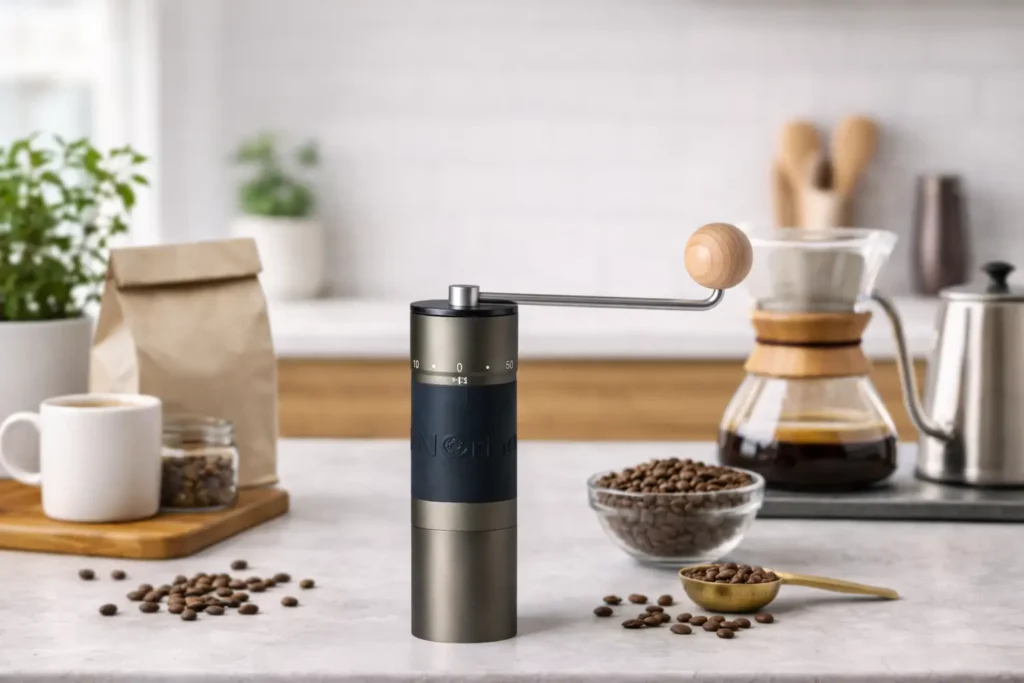
The KINGrinder K6 is the CoffeeGearHub standard recommendation for manual grinding across all brew methods — and at French press settings specifically, it outperforms most competitors at its price point in two critical ways. First, its 48mm stainless conical burrs maintain consistent particle distribution throughout the coarse range (clicks 65–88) where many budget burr grinders become erratic. Second, the 100-click adjustment system is fully repeatable: every click is the same distance, the ring locks at each position, and returning to a saved setting produces an identical grind every time. For French press dial-in, this repeatability means each adjustment produces a meaningful, testable result — not a random variation that makes your session data unreliable. The all-metal construction handles heavy daily doses without degradation, the magnetic catch cup eliminates static-related mess at coarse settings, and the straight-handle design provides comfortable, controlled grinding pressure for larger doses. The K6 covers the full French press grind range — from light roast (62 clicks) through cold brew (88 clicks) — without compromise at any point in that range.
- French press range: K6 clicks 62–88 — covers every hot-brew and cold-brew French press application
- ASIN: B0CY1XFXB8
- Burrs: 48mm stainless conical — consistent distribution at coarse settings; low fines spike
- Adjustment system: 100-click repeatable ring — records your ideal setting with precision
- Construction: All-metal body — no plastic degradation; daily-driver durability
- Capacity: ~30g per grind — standard French press dose in one session
- Why it matters for French press: coarse-range consistency separates the K6 from cheaper burr grinders that work at espresso range but degrade at the settings French press requires
Disclosure: CoffeeGearHub may earn from qualifying purchases.
Common French Press Grind Mistakes and How to Avoid Them
Most French press quality problems trace back to one of five grind-related mistakes. These are the most common across all experience levels — knowing them in advance prevents weeks of frustrating troubleshooting.
Mistake 1: Using a Blade Grinder
Already covered in depth above — but worth repeating as the most impactful single mistake. If your French press coffee has always been disappointing regardless of what you try, a blade grinder is the most likely cause. The upgrade to a burr grinder resolves this category of problem entirely.
Mistake 2: Grinding Too Fine Because “Finer = Stronger”
A very common misconception — grinding finer does not produce a stronger or better French press. It produces a more bitter and over-extracted cup. Strength in French press is controlled by ratio (dose relative to water volume), not grind fineness. If you want a stronger cup, increase your coffee dose or reduce your water slightly. Keep your grind in the correct coarse range.
Mistake 3: Not Adjusting Grind When Switching Roast Levels
Many home brewers find a grind setting that works for their usual medium roast and keep it there permanently — then wonder why a new dark roast tastes bitter or a new light roast tastes thin. Roast level changes require a grind adjustment: always start from the K6 reference table when you open a new bag at a different roast level, and dial in from there. Your medium roast click setting is not a universal French press setting — it is a medium roast setting.
Mistake 4: Inconsistent Grind from Session to Session
If you are not recording your click setting and returning to the same number each brew, you are introducing uncontrolled grind variation that makes dial-in impossible. One of the K6’s most practical advantages is its click-based system: once you find your ideal setting, you write down the number and return to it every time. Skipping this step means every session is effectively a new experiment — you cannot build on previous results.
Mistake 5: Adjusting Multiple Variables Simultaneously
When a cup is off, the instinct is to change everything at once — coarser grind, more coffee, lower temperature, shorter steep. Changing multiple variables at once makes it impossible to identify what caused the improvement or worsening. Adjust one variable per session, starting with grind. If grind adjustments in both directions do not resolve the problem, then move to the next variable (ratio, then temperature, then steep time). Systematic one-variable adjustments reach the solution in three to five brews; simultaneous multi-variable adjustments can take weeks.
Grind Troubleshooting Matrix: Symptoms and Fixes
Each symptom below includes the most likely grind cause and the specific K6 adjustment to make. Adjust one variable at a time, and always note the result before making further changes.
| Symptom | Most likely grind cause | K6 adjustment | Also check |
|---|---|---|---|
| Bitter, harsh, astringent finish | Grind too fine — over-extraction of harsh compounds | Go 4–5 clicks coarser. If still bitter at 80+, check steep time and water temperature. | Steep time (shorten by 30s if grind fix insufficient); water temp (lower by 2°C) |
| Sour, sharp, thin cup | Grind too coarse — under-extraction; sweetness not developed | Go 4–5 clicks finer. If still sour at 62, check water temperature and steep time. | Water temp (raise by 2°C for medium roast); steep time (extend by 30s) |
| Weak, watery, hollow | Grind too coarse, or dose too low | Go 3–4 clicks finer. Also verify dose is correct (30g for 450ml at 1:15). | Increase dose by 3–5g if grind adjustment doesn’t resolve |
| Muddy, gritty, excessive sediment | Grind too fine for metal mesh; or blade grinder producing fines | Go 5+ clicks coarser. If using a blade grinder, upgrade to burr grinder — no K6 adjustment fixes inconsistent particle distribution. | Press speed (slow down to 30s full travel); try K6 at 78–80 if sediment persists at 74 |
| Strong resistance pressing plunger | Grind too fine — particles packing against mesh | Go 5+ clicks coarser. Do not force a resistant plunger — stop, pull back slightly, press very slowly. | Check plunger is centred; ensure grounds have not migrated above the mesh |
| Plunger drops with zero resistance | Grind too coarse — water flowing through without resistance | Go 5+ clicks finer. Target 20–30s of resistance through full plunger travel. | Confirm you are actually at coarse setting, not accidentally at a very high click count |
| Fermented, boozy, overwhelming fruit notes | Natural process beans extracting fermentation esters too aggressively | Go 3 clicks coarser; shorten steep by 30s; lower water temp by 2°C. Natural Ethiopians especially benefit from slightly coarser grind than medium baseline. | Reduce steep time before further grind changes if notes are only slightly too intense |
| Flat, no aroma, dull flavour | Stale beans — not a grind issue | No grind adjustment fixes stale coffee. Buy fresh beans with a visible roast date. | Confirm beans are within 2–4 weeks of roast date; store airtight away from heat and light |
| Cup tastes fine at first, bitter as it cools | Grind slightly too fine, or coffee left on grounds post-press | Go 2–3 clicks coarser. Also confirm you are pouring all coffee immediately after pressing. | Pour into thermal carafe if not serving entire brew immediately |
| Inconsistent results brew to brew | Grind setting varying between sessions; or blade grinder inconsistency | Record and return to the exact same K6 click number each brew. Grind a small test dose before your brew dose to clear the burr path when returning from a different setting. | Confirm dose by weight each time; confirm water temperature is consistent |
| Cold brew concentrate too bitter or harsh | Grind too fine for 12–16 hour steep | Go 4–6 clicks coarser (try K6 85–88). Cold brew requires very coarse grind — do not use hot-brew settings for cold steep. | Shorten steep time to 12 hours before further grind changes |
| Cold brew concentrate too weak or watery | Grind too coarse, or steep time too short | Go 3–4 clicks finer (try K6 79–82). Also ensure full 16-hour steep in refrigerator. | Increase coffee dose — try 1:7 ratio if grind and steep adjustments are insufficient |
FAQs: French Press Grind Size
What grind size should I use for French press?
French press requires a coarse grind — particles should visually resemble coarse sea salt or rough breadcrumbs. On the KINGrinder K6, this is approximately clicks 65–80 depending on roast level: 62–68 for light roast, 68–72 for medium, 70–76 for medium-dark, and 74–82 for dark roast. Grind size is the most impactful variable in French press quality — more so than ratio, temperature, or steep time.
How many clicks on the KINGrinder K6 for French press?
The K6 French press range spans approximately clicks 62–82 depending on roast level. The standard starting point for medium roast is 68–72 clicks (start at 70). Light roast: 62–68 (start at 65). Medium-dark: 70–76 (start at 73). Dark roast: 74–82 (start at 78). Cold brew: 78–88 (start at 83). Always start at the midpoint of each range and adjust toward your taste preference.
Why does grind size matter so much for French press?
French press is a full immersion method — the coffee steeps in direct contact with hot water for the entire brew duration. Fine particles have dramatically more surface area than coarse particles and extract all their soluble compounds within minutes, releasing bitter and astringent compounds before your steep is complete. Coarse particles extract more slowly and evenly across the 4-minute window. Additionally, fine particles clog the metal mesh filter, increase resistance during pressing, and pass more sediment into the cup. No other brew variable has as immediate or as large an effect on French press cup quality as grind size.
Can I use a blade grinder for French press?
No — a blade grinder is incompatible with French press. Blade grinders produce an inconsistent mixture of dust-fine particles and coarse chunks in every batch. The fine particles over-extract and taste bitter; the coarse chunks under-extract and taste sour and weak. Both problems occur simultaneously in the same cup. There is no grind time, no shaking, no recipe change that compensates for a blade grinder’s fundamental inconsistency. A burr grinder like the KINGrinder K6 is the single highest-impact upgrade you can make to your French press setup.
How do I know if my French press grind is too fine?
The clearest symptom of a grind that is too fine is bitterness — a harsh, astringent, or unpleasant finish that lingers. Secondary signs include: strong resistance when pressing the plunger, excessive sediment in the cup, and a muddy or gritty texture. Visually, if your French press grind looks like fine beach sand or powder rather than coarse sea salt, it is too fine. On the K6, move 4–5 clicks coarser if you experience any of these symptoms.
How do I know if my French press grind is too coarse?
A grind that is too coarse produces under-extraction: the cup tastes sour, thin, sharp, or weak. The flavour feels hollow and underdeveloped — the sweetness and body that define good French press are absent. A practical physical indicator: if the plunger drops to the bottom of the press with almost no resistance, the grounds are too coarse. Adjust 4–5 clicks finer on the K6 and re-brew.
Should I grind finer or coarser to make French press stronger?
Neither — grind size controls flavour balance, not brew strength. Grinding finer to increase strength will produce bitterness, not a better-tasting strong cup. The correct way to increase strength is to adjust your brew ratio: add more coffee (use 1:13 or 1:14 instead of 1:15) while keeping grind size the same. Grind finer only if your cup is sour and underdeveloped; grind coarser only if your cup is bitter and harsh.
What grind size should I use for French press cold brew?
Cold brew in a French press requires a very coarse grind — K6 clicks 78–88, significantly coarser than standard hot-brew French press. This compensates for the much longer steep time (12–16 hours) and cold water temperature, both of which slow extraction dramatically. A coarser grind prevents the cold brew from over-extracting into bitterness during the extended steep. Use a 1:8 coffee-to-water ratio and dilute the resulting concentrate 1:1 with cold water or milk before serving.
Does grind size need to change for different roast levels?
Yes — roast level significantly affects the correct grind setting. Light roasts have a denser cellular structure and require a finer grind, higher water temperature, and longer steep to achieve full extraction. Dark roasts are more porous and extract faster, requiring a coarser grind and lower temperature to prevent bitterness. On the K6: light roast 62–68 clicks, medium 68–72, medium-dark 70–76, dark 74–82. These are starting points — dial in from there based on taste.
How do I use the KINGrinder K6 click system for French press?
The K6 has a 100-click adjustment ring. Rotating clockwise (higher click number) makes the grind coarser; counter-clockwise (lower number) makes it finer. For French press, you work in the 62–88 click range. Start at 70 for medium roast, brew, taste, and adjust in 3–5 click increments. The K6’s click system is fully repeatable — once you find your ideal setting, write it down and return to it every brew session. The consistent distribution at coarse settings is what makes the K6 particularly well-suited to French press.
Continue Learning
FRENCH PRESS DEEP DIVES
Want the complete French press recipe alongside these grind settings? Our full French Press Brew Guide covers every variable — ratio, water temperature, step-by-step instructions, and a troubleshooting matrix — with the same K6 grind references used throughout this article.
☕
Written by the CoffeeGearHub Editorial Team
CoffeeGearHub is a specialty coffee equipment resource run by home brewers and coffee enthusiasts. Our guides are researched using published brewing science, SCA standards, grinder manufacturer specifications, and established specialty-coffee community knowledge. We review and update our pillar content regularly. About CoffeeGearHub →