Last Updated: March 2026 • 15–20 min read • Buying Guide: Manual vs Automatic Espresso Machines

✍️ Editorial note: This guide is researched and written by the editors at CoffeeGearHub.com using published brewing science, manufacturer specifications, and established specialty-coffee community knowledge. Recommendations reflect research consensus. All product links are affiliate links — we may earn a commission at no cost to you.
The 30-Second Answer
Choose a manual espresso machine if you enjoy the craft, want the highest flavor ceiling, and are willing to learn to dial in. Choose an automatic (super-automatic) machine if you want great espresso every day with minimal effort, consistent output for multiple users, or simply don’t want to think about grind size and tamping. Neither is “better” — the right machine is the one that matches how you actually want to interact with coffee every morning.
- Manual wins on: flavor ceiling, control, long-term value, repairability
- Automatic wins on: convenience, consistency, speed, ease for multiple users
- Fastest path to good espresso: automatic if beginner; manual if you already enjoy coffee craft
Who This Guide Is For — Jump to What You Need
☕ Complete Beginner
Read the 30-Second Answer, then Decision Framework and Automatic Picks.
🔧 Hands-On Learner
Jump to Manual Machines and Extraction Science.
🏠 Busy Household
See Super-Automatic Picks and the User Type Table.
💰 Value Seeker
Read Long-Term Value and Buyer Mistakes.
Table of Contents
What Is a Manual Espresso Machine?
A manual espresso machine requires you to do the core barista steps yourself: grind coffee, dose it into the portafilter, distribute, tamp, and manage shot timing. Most home manual machines are semi-automatic — the pump and heating are automated, but you control preparation and extraction. Fully manual lever machines go further, letting you apply pressure by hand for complete control over the pressure curve.
The upside is genuine control: you can adjust grind size, dose, yield, pre-infusion time, and extraction length to match a coffee’s roast level and freshness. The tradeoff is a real learning curve — especially dialing in, the iterative process of adjusting variables until the shot tastes balanced. Paired with a capable espresso grinder, a well-operated manual machine produces the highest quality ceiling of any home setup.

Manual Espresso Machines: Pros and Cons
✅ Pros
- Maximum control over extraction variables
- Highest flavor potential with practice
- Better for specialty coffee and experimentation
- Simpler internals — often longer-lasting and easier to service
- Stronger long-term value; many machines last 10–20+ years
❌ Cons
- Steeper learning curve — dialing in takes practice
- Requires a capable separate grinder (significant extra cost)
- More hands-on workflow and cleanup each shot
- Results are skill-dependent, especially early on
What Is an Automatic Espresso Machine?
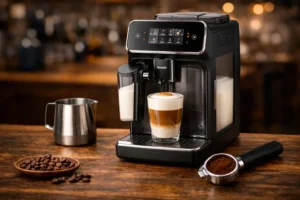
An automatic espresso machine reduces user input by automating some or most of the brewing steps. Fully automatic (super-automatic) machines grind, dose, tamp, brew, and often froth milk with one-touch drink presets. They’re engineered for consistency and speed, making them ideal for busy households, multiple users, and anyone who wants reliable espresso without a learning curve.
The main tradeoff is flexibility. Internal grinders and preset extraction profiles limit how precisely you can tailor shots to different beans. Super-automatics also have more internal complexity — more components that can require service over time. But for most home users, consistent good espresso with minimal effort is exactly the goal, and automatic machines deliver that reliably.

Automatic Espresso Machines: Pros and Cons
✅ Pros
- One-touch convenience — no prep skills required
- Highly consistent output regardless of who operates it
- Great for households with multiple coffee drinkers
- Often includes integrated milk frothing or latte automation
- Fast mornings — no grinding, dosing, or tamping
❌ Cons
- Higher upfront cost (especially for quality super-automatics)
- Less extraction control — limited ability to dial in per-bean
- More internal components can mean more complex servicing
- More electronics may shorten lifespan vs. simpler manual machines
Manual vs Automatic Espresso Machine: Key Differences
Here’s how manual and automatic espresso machines compare across the variables that matter most to home users.
| Category | Manual Espresso Machines | Automatic Espresso Machines |
|---|---|---|
| User involvement | High — you grind, dose, tamp, and time every shot | Low — mostly one-touch brewing from bean to cup |
| Customization | Very high — change dose, ratio, grind, time, temperature | Moderate — limited to machine’s preset adjustments |
| Consistency | Skill-dependent — improves with practice | High — consistent across users and sessions |
| Learning curve | Steep — dialing in takes weeks to master | Minimal — operable immediately out of the box |
| Grinder required? | Yes — a quality separate grinder is essential | No — built-in grinder included |
| Milk drinks | Manual steaming wand — requires technique | Often automated one-touch latte/cappuccino |
| Maintenance | Hands-on but simple — backflush, descale, clean portafilter | Guided cleaning cycles but more complex internal parts |
| Repairability | High — many parts are user-serviceable or widely available | Lower — complex electronics often require professional service |
| Long-term value | Strong — many machines last 10–20+ years | Variable — more electronics may shorten lifespan |
| Price range | $300–$2,000+ (machine only, grinder separate) | $400–$2,500+ (all-in-one) |
How Espresso Quality Actually Works (Beyond Marketing)
Understanding what actually creates great espresso helps you make a smarter machine decision. Espresso quality isn’t a machine spec — it’s the interaction of several variables working together.
The Variables That Make or Break a Shot
Pressure (9 bars) is the defining characteristic of espresso. Both manual and automatic machines deliver this, but how consistently they maintain it across a shot differs. Entry-level machines can fluctuate; better machines hold pressure more steadily, which translates to sweeter, more balanced extraction.
Temperature stability matters at the level of ±1–2°C. Too hot and you over-extract; too cool and shots taste flat and sour. Manual machines at the mid-range and above typically offer better temperature stability than entry-level super-automatics. High-end automatics close this gap with PID temperature control.
Grind consistency is the single biggest flavor variable. A uniform particle size means even extraction — no fines over-extracting and no boulders under-extracting simultaneously. For manual machines, this is why the grinder investment matters as much as the machine itself. For automatics, internal grinder quality sets the quality ceiling — and built-in grinders on entry-level super-automatics are often a limiting factor.
Puck preparation (distribution and tamping) affects how water flows through the coffee bed. Channeling — where water finds easy paths through the puck — ruins shots. Manual machines require you to tamp correctly and distribute evenly; this takes practice. Automatics do this automatically but with less precision than a skilled home barista.
🔬 The key insight: manual machines win on quality ceiling because you can respond to real variables (bean age, roast level, humidity) by adjusting grind size, dose, and yield. Automatic machines win on consistency floor by removing human variation entirely. Both can produce excellent espresso — the difference is in who controls the variables.
Where Each Machine Type Excels
| Quality factor | Manual advantage | Automatic advantage |
|---|---|---|
| Peak espresso quality | Higher ceiling when dialed in correctly | — |
| Day-to-day consistency | — | Higher — same result regardless of who brews |
| Adapting to different beans | Easy — adjust grind, dose, yield per bag | Limited — preset profiles don’t fully adapt |
| Milk drinks | Manual steam — best texture with practice | Automated milk — convenient, consistent |
| Fresh specialty coffee | Fully exploitable with dialing-in | Partially limited by internal grinder and presets |
Which Type Should You Buy? (By User Type)
The best manual vs automatic espresso machine answer depends entirely on your lifestyle, goals, and how much you want to be involved in the brewing process.
| User type | Best choice | Why it fits |
|---|---|---|
| Complete beginner | Automatic or hybrid | Fast results with zero learning curve — build enjoyment before adding complexity |
| Busy household (2+ users) | Super-automatic | One-touch drinks work for everyone; no skill required per shot |
| Espresso enthusiast / craft-oriented | Manual (semi-auto) | Full control over dialing in, brew ratios, and extraction lets you optimize per bean |
| Milk drink focus (lattes, cappuccinos) | Automatic or hybrid | Integrated milk automation reduces daily effort dramatically |
| Long-term value seeker | Manual | Simpler design, easier maintenance, most machines last 15–20+ years with care |
| Specialty coffee explorer | Manual | Built-in presets on automatics limit ability to unlock different single origins |
| Office or shared space | Super-automatic | No training needed; anyone can operate; consistent output throughout the day |
| Traveler / limited counter space | Manual lever (e.g. Flair) | No electricity required for some models; portable; compact footprint |
Decision Framework: Manual or Automatic Espresso Machine?
Work through these questions to arrive at a clear answer.
→ Choose Manual If…
- You enjoy the process of making coffee, not just drinking it
- You’re willing to spend 2–4 weeks learning to dial in
- You want to explore specialty beans and single origins
- You’re comfortable buying a separate grinder ($100–$300+)
- You prioritize long-term value and repairability
- Mostly one or two users with similar taste preferences
→ Choose Automatic If…
- You want espresso at the push of a button, every morning
- Multiple household members will use the machine
- You primarily drink milk-based drinks (lattes, cappuccinos)
- You don’t want to manage a separate grinder
- Speed and consistency matter more than craft control
- You’re new to espresso and want results immediately
💡 Not sure yet? Consider a hybrid machine like the Breville Barista Touch — it has a built-in grinder and guided workflow so you can learn espresso at your own pace without being overwhelmed from day one.
Best Manual Espresso Machines: Top Picks
These picks cover the range of manual espresso machines for home use — from beginner-friendly semi-automatics to fully lever-operated machines for enthusiasts. All are well-supported, popular with home users, and represent strong value for their category.

Breville Bambino — Best Entry-Level Manual Espresso Machine
The Bambino is the strongest entry point for real espresso at home without a large machine. It heats in 3 seconds, produces genuine 9-bar extraction, and has an automatic steam wand for milk. When paired with a capable burr grinder, the Bambino produces café-quality shots and is a genuine learning platform for dialing in espresso fundamentals.
- Best for: beginners who want to learn real espresso without a large machine
- Strength: 3-second heat-up, compact footprint, auto steam wand
- Key tip: invest in the grinder first — it has more flavor impact than the machine upgrade
Disclosure: CoffeeGearHub may earn from qualifying purchases.

Flair Pro 3 — Best Fully Manual Lever Espresso Machine
The Flair Pro 3 is for espresso purists who enjoy hands-on control. You heat water separately and apply pressure manually through a lever, which allows experimentation with pressure profiling — varying pressure across the shot for complex flavor development. Because technique matters completely, the payoff for skilled users is exceptional, and the compact design makes it ideal for travel and small kitchens.
- Best for: enthusiasts who want complete pressure control and portability
- Strength: manual pressure profiling, compact, no electricity required for brewing
- Key tip: use a temperature-controlled kettle for consistent pre-heat water temp
Disclosure: CoffeeGearHub may earn from qualifying purchases.
☕ Remember: for any manual espresso machine, the grinder is often the quality bottleneck. See our guide to best espresso grinders for home use and our comparison of manual vs electric coffee grinders before purchasing.
Best Automatic Espresso Machines: Top Picks
These picks represent the range from beginner-friendly super-automatics to premium one-touch systems. All are reliable starting points for households that prioritize convenience, consistency, and ease of use.

De’Longhi Magnifica Start — Best Beginner Super-Automatic
The Magnifica Start is a dependable bean-to-cup machine with a built-in grinder and simple controls. It’s the most approachable entry point into super-automatic convenience — grind, dose, brew, and serve at one button press. For households that want consistent espresso every day without any puck preparation, this is an excellent starting machine.
- Best for: busy households and beginners who want zero learning curve
- Strength: consistent bean-to-cup results, minimal maintenance complexity
- Key tip: use medium roast beans — dark roasts can clog the grinder and add bitterness
Disclosure: CoffeeGearHub may earn from qualifying purchases.
Breville Barista Touch — Best Hybrid (Convenience + Control)
The Barista Touch is the strongest “best of both worlds” option — it has an integrated grinder, guided on-screen workflow, and adjustable settings that let you actually learn espresso while keeping mornings simple. The touchscreen interface walks you through the process without requiring you to already know what you’re doing. A genuinely useful bridge for people who want to grow into the craft.
- Best for: users who want convenience today and more control as their skills grow
- Strength: guided workflow, adjustable grind and dose, milk temperature control
- Key tip: keep dose fixed and adjust grind first for best dialing-in results
Disclosure: CoffeeGearHub may earn from qualifying purchases.
KitchenAid KF8 — Best Premium Super-Automatic
The KitchenAid KF8 is a premium bean-to-cup machine focused on automated convenience for full drink menus. If you want one-touch espresso, lattes, cappuccinos, and flat whites with minimal input and premium build quality, the KF8 delivers a polished experience. Best for households where speed and repeatability consistently matter more than manual control.
- Best for: premium convenience, full one-touch drink menus, multiple daily users
- Strength: full bean-to-cup automation, integrated milk system, premium finish
- Key tip: clean the milk system after every use to prevent buildup and off-flavors
Disclosure: CoffeeGearHub may earn from qualifying purchases.
Long-Term Value and Maintenance: What to Expect
One of the most underappreciated differences between manual and automatic espresso machines is what ownership actually looks like after year one.
| Ownership factor | Manual | Automatic |
|---|---|---|
| Daily maintenance | Rinse portafilter, wipe group head — 2 minutes | Guided rinse cycle, empty dreg drawer — 3–5 minutes |
| Weekly maintenance | Backflush with cleaner (semi-auto), clean steam wand | Clean milk system, run cleaning tablet cycle |
| Descaling | Every 1–3 months depending on water hardness | Every 1–3 months — machine typically prompts you |
| Expected lifespan | 10–20+ years with basic care; many last longer | 5–12 years depending on brand and maintenance |
| Repair complexity | Low–medium; many parts user-serviceable | Medium–high; electronics and milk systems need pro service |
| Resale value | Strong — quality manual machines hold value well | Lower — electronics depreciate faster |
🔧 Long-term value tip: a $600 semi-automatic machine that lasts 15 years costs roughly $40/year to own (machine cost only). A $1,200 super-automatic that requires a $300 service call at year 5 and replacement at year 10 costs roughly $150/year. Build maintenance expectations into your budget decision.
Buyer Mistakes That Cause Bad Espresso (And How to Avoid Them)
These are the most common errors that lead to buyer disappointment — regardless of machine type.
| Mistake | Why it hurts | How to avoid it |
|---|---|---|
| Buying a manual machine without a grinder budget | The grinder is the quality bottleneck for manual espresso — a mediocre grinder limits even a great machine | Budget $150–$300 for a dedicated burr grinder alongside any manual machine |
| Using stale beans | Espresso is extremely sensitive to CO₂ and freshness — stale beans extract flat and hollow regardless of machine quality | Use beans within 2–4 weeks of roast date; buy from local roasters or dated bags |
| Chasing “30 seconds” blindly | 30 seconds is a guideline, not a rule — bitter espresso at 30s is worse than sweet espresso at 25s | Use taste as the primary feedback signal; adjust grind, dose, and yield for sweetness |
| Skipping descaling and maintenance | Scale buildup on heating elements and dirty groupheads ruin flavor and shorten machine life | Use filtered water, descale every 1–3 months, follow a maintenance schedule |
| Over-buying for your lifestyle | A complex machine that goes unused because it’s too much work becomes a very expensive countertop decoration | Be honest about how much morning effort you’ll realistically commit to |
| Under-buying for your goals | A super-automatic won’t satisfy an espresso enthusiast who wants to explore specialty beans — it limits the ceiling | If you love coffee craft, invest in a manual machine and grinder combination |
Troubleshooting Bad Espresso: Manual vs Automatic
The causes of bad espresso differ depending on your machine type. Use this matrix to diagnose the issue.
| Symptom | Likely cause (manual) | Likely cause (automatic) | Fix |
|---|---|---|---|
| Sour / thin shot | Grind too coarse, under-extracted | Grind setting too coarse, too little dose | Manual: go finer. Auto: adjust grind setting finer, increase dose |
| Bitter / harsh shot | Grind too fine, over-extracted, or water too hot | Grind too fine or stale beans building up | Manual: go coarser, lower temp. Auto: go coarser, run cleaning cycle |
| Flat / no aroma | Stale beans or too low a brew temperature | Stale beans, scale buildup on heating element | Fresh beans within 2–4 weeks of roast; descale machine |
| Shot runs too fast (<20s) | Grind too coarse or under-tamped | Grind setting too coarse | Manual: finer grind, firm tamp. Auto: adjust grind setting |
| Shot runs too slow / stalls | Grind too fine or over-tamped | Grind too fine, needs cleaning | Manual: coarser grind, lighter tamp. Auto: coarser setting, descale |
| Inconsistent results day to day | Inconsistent dose or tamp pressure | Grinder needs calibration, worn burrs | Manual: use a scale, consistent tamp. Auto: recalibrate or service grinder |
| Milky drinks taste off | Steam wand technique, dirty wand | Dirty milk system — residue buildup | Clean steam wand/milk system after every use without exception |
Machine Comparison Summary: Manual vs Automatic Espresso
| Machine | Type | Price tier | Best for | Grinder needed? |
|---|---|---|---|---|
| Breville Bambino | Semi-automatic (manual) | $$ | Beginners learning espresso craft | Yes — budget $150–$250 for a burr grinder |
| Flair Pro 3 | Fully manual lever | $$ | Enthusiasts, travelers, pressure profiling | Yes — hand grinder works well |
| De’Longhi Magnifica Start | Super-automatic | $$ | Beginners, busy households | No — built in |
| Breville Barista Touch | Hybrid (guided semi-auto) | $$$ | Users who want to learn but keep mornings easy | No — built in |
| KitchenAid KF8 | Super-automatic (premium) | $$$$ | Premium one-touch drinks, multiple users | No — built in |
Related Espresso and Coffee Gear Guides
Final Verdict: Manual vs Automatic Espresso Machines
The manual vs automatic espresso machine debate doesn’t have one right answer — it has the right answer for you. Manual espresso machines reward learning and experimentation with superior control, a higher flavor ceiling, and stronger long-term value. The investment is time and skill, not just money. Automatic machines deliver consistent, convenient espresso with zero learning curve, and that’s exactly the right priority for many households.
If you want to develop a craft and explore what coffee can be — go manual, invest in a capable burr grinder, and enjoy the process. If you want reliable, delicious espresso at the push of a button every morning — go automatic and don’t look back. Both paths produce genuinely good coffee.
| Your priority | Best choice |
|---|---|
| Maximum flavor potential and craft enjoyment | Manual (semi-automatic) |
| Fastest path to consistent espresso | Super-automatic |
| Best value for solo household over 10+ years | Manual |
| Easiest for multiple household users | Super-automatic |
| Learn espresso without overwhelming complexity | Hybrid (Breville Barista Touch) |
| Travel or portable espresso | Manual lever (Flair Pro 3) |
FAQs
Is a manual espresso machine better than an automatic?
Neither is objectively better — they serve different priorities. Manual machines offer a higher quality ceiling and more control but require learning to use well. Automatic machines prioritize convenience and consistency. The best choice depends on whether you value craft control or effortless convenience.
What is the difference between a semi-automatic and super-automatic espresso machine?
A semi-automatic machine automates the pump and heating but requires you to grind, dose, tamp, and time shots manually. A super-automatic (fully automatic) machine does everything — grinding, dosing, tamping, brewing, and often milk frothing — at the press of a button. Semi-automatics give more control; super-automatics give more convenience.
Do I need a separate grinder for a manual espresso machine?
Yes — for any semi-automatic or lever espresso machine, a quality burr grinder is essential. The grinder is often more important to espresso quality than the machine itself. Budget at least $150–$250 for a dedicated espresso burr grinder alongside any manual machine purchase.
Are automatic espresso machines worth it?
For the right buyer — yes. If you want consistent espresso with minimal effort, don’t want to manage a separate grinder, or share your machine with multiple household members, a super-automatic machine delivers significant daily value. The higher upfront cost is offset by convenience and reliability over time.
How long do super-automatic espresso machines last?
A well-maintained super-automatic typically lasts 5–12 years depending on brand, usage frequency, and maintenance habits. Brands like De’Longhi, Jura, and Breville have strong reputations for longevity. Descaling regularly, cleaning the milk system after every use, and using filtered water significantly extend machine life.
Can a super-automatic machine make espresso as good as a manual machine?
A super-automatic can produce very good espresso, but it has a lower quality ceiling than a well-dialed-in manual setup. The main limitation is the internal grinder (which is typically less precise than a dedicated burr grinder) and the fixed extraction profiles that can’t adapt to different bean characteristics the way a skilled manual operator can.
What is the best espresso machine for beginners?
For beginners who want to learn espresso craft, the Breville Bambino paired with a budget burr grinder is the strongest starting point. For beginners who want great espresso with zero learning curve, the De’Longhi Magnifica Start or Breville Barista Touch are excellent options. The best beginner machine is the one that matches how much involvement you want in the process.
Do manual espresso machines make better milk drinks?
Manual machines have steam wands that, with practice, produce the best milk texture for lattes and cappuccinos. Automated milk systems on super-automatics are more convenient and consistent for casual use, but skilled manual steaming produces finer microfoam texture. If milk drink quality is your top priority, a semi-automatic with a good steam wand is worth learning.
How much should I spend on an espresso machine?
For a manual setup with a grinder, expect to spend $400–$800 total for a capable beginner combination (e.g. Breville Bambino + burr grinder). For a quality super-automatic, expect $500–$1,200 for reliable long-term performance. Spending less than $300 on an espresso machine usually means significant compromises in temperature stability and pressure consistency.
What beans should I use in an automatic espresso machine?
Medium roast beans work best in most super-automatic machines. Oily dark roasts can clog the internal grinder over time. Very light roasts can be harder to extract with the fixed settings of most automatics. For manual machines, you have the flexibility to dial in any roast level — light through dark — by adjusting grind size and temperature.
Continue Learning
ESPRESSO GUIDES
☕
Written by the CoffeeGearHub Editorial Team
CoffeeGearHub is a specialty coffee equipment resource run by home brewers and coffee enthusiasts. Our guides are researched using published brewing science, manufacturer specifications, and established specialty-coffee community knowledge. We review and update our pillar content regularly. About CoffeeGearHub →