
How to Make Turkish Coffee (2026): Cezve, Grind, Ratio, and Foam Step by Step

Quick picks
Turkish coffee gear at a glance
Picks are based on published specifications, manufacturer documentation, and owner reports. As an Amazon Associate, CoffeeGearHub earns from qualifying purchases.
Editorial standards: this guide draws on traditional Turkish coffee preparation as described by Turkish coffee makers and cultural sources, UNESCO’s description of Turkish coffee culture, manufacturer guidance, and CoffeeGearHub’s own grinder research. CoffeeGearHub does not claim hands-on testing where it has not occurred.
At a glance
What this guide covers
What Turkish coffee is, the cezve and grind you need, the ratio, a step-by-step method, how to get good foam, sugar and spice options, and the gear worth buying.
Editorial analysis
The grind and the foam make the cup
Turkish coffee is one of the oldest ways to brew coffee and one of the simplest: extra-fine coffee, cold water, and sugar if you like, heated slowly in a small pot until a thick foam rises. It is served unfiltered, so the grounds settle in the cup. Turkish coffee culture and tradition are listed by UNESCO as intangible cultural heritage.
Two things decide whether it is good. The grind has to be a true powder, finer than espresso, or the coffee tastes thin and gritty. And the heat has to be gentle, so the foam builds without the coffee boiling. Get those right and the method is very forgiving.
The 30-Second Answer
To make Turkish coffee, mix about 7 g of extra-fine coffee per 60 to 70 ml of cold water in a cezve, add sugar if you like, stir once, and heat slowly until the foam rises, then pour before it boils.
Start with pre-ground Turkish coffee and a small copper or stainless cezve. If you grind your own, you need a grinder that reaches a flour-fine powder.
Shopping Black Friday or Cyber Monday? See our coffee gear deals page for the moka pot, AeroPress, grinder and espresso picks worth buying on sale.
What Is Turkish Coffee?
Turkish coffee is a method, not a bean or a roast. Very finely ground coffee is simmered with water, and often sugar, in a small long-handled pot called a cezve (also called an ibrik or briki). The coffee is poured, grounds and all, into small cups and left a moment to settle. The same style is made across Greece, the Balkans, the Middle East, and North Africa under local names.
The result is strong, thick, and aromatic, with a layer of fine foam on top and a sludge of grounds at the bottom that you do not drink. A cup is small, about 60 to 70 ml, and it is traditionally served with a glass of water and often something sweet.
What You Need
| Item | Why it matters | Our pick |
|---|---|---|
| Cezve (ibrik) | A narrow neck builds and holds the foam | DEMMEX copper or Fino stainless |
| Extra-fine coffee | Powder-fine grounds extract fully and suspend in the cup | Mehmet Efendi, or grind your own |
| Fine grinder (optional) | Most grinders cannot reach Turkish fineness | KINGrinder K6 or a Turkish hand mill |
| Small cups | Turkish coffee is served in about 60 to 70 ml | Any demitasse or espresso cup |
| Gentle heat | Slow heating builds foam without boiling | Low gas flame or electric hob |
Getting the Grind Right
Turkish coffee needs the finest grind in coffee, a soft powder that feels like flour between your fingers. It must be finer than espresso because the coffee is not filtered; the finest particles stay suspended in the cup and give the drink its body, while slightly larger ones would taste gritty.
That fineness rules out most electric grinders, including many espresso grinders. You have three practical options: buy coffee pre-ground for Turkish coffee, use a traditional brass Turkish hand mill, or use a hand grinder with an extra-fine range.
The KINGrinder K6 can approach Turkish fineness. Our K6 grind settings chart suggests starting around 18 to 25 clicks from zero. KINGrinder warns against grinding inside the first 16 clicks, so do not go finer than that.
Expect slow grinding at this setting. If you make Turkish coffee often, pre-ground Turkish coffee or a dedicated Turkish mill will save effort; the K6 shines if you also brew espresso, moka pot, and filter coffee.
Easiest start: pre-ground

Ratio and Sugar
A standard serving is about 7 g of coffee, one heaped teaspoon, to 60 to 70 ml of cold water, roughly one demitasse cup. Scale up by the number of cups, and use a cezve sized for that number so the foam has room to rise without spilling.
Sugar is decided before brewing because you do not stir once the pot is on the heat. In Turkey, coffee is ordered by sweetness:
| Turkish name | Sweetness | Sugar per cup (approx.) |
|---|---|---|
| Sade | Plain | None |
| Az şekerli | A little sugar | About ½ teaspoon |
| Orta | Medium | About 1 teaspoon |
| Şekerli | Sweet | About 2 teaspoons |
A pinch of ground cardamom is common in Arabic-style preparation, and some people add a little cinnamon or mastic. Add spices with the coffee, before heating.
How to Make Turkish Coffee, Step by Step
- Measure cold water. Pour one demitasse cup of cold water, about 60 to 70 ml, into the cezve for each serving.
- Add coffee and sugar. Add about 7 g (one heaped teaspoon) of extra-fine Turkish coffee per cup, plus sugar to taste if you take it. Sugar always goes in before heating.
- Stir once, then stop. Stir until the coffee and sugar are fully mixed into the water, then do not stir again.
- Heat slowly. Set the cezve over low to medium heat. Brewing should take about 3 to 4 minutes.
- Catch the foam. When a dark foam rises toward the rim, just before boiling, take the cezve off the heat and spoon some foam into each cup.
- Return briefly and pour. Return the cezve to the heat until the foam rises once more, then pour slowly into the cups without disturbing the foam.
- Let it settle. Wait about a minute for the grounds to settle, then sip, leaving the sludge at the bottom of the cup.
Serve with a glass of water to drink first, which clears the palate. Leave the last sip; it is mostly grounds.
How to Get Good Foam
The foam, called köpük in Turkish, is the sign of a well-made cup. It depends on four things:
Cold water. Starting cold gives the coffee time to bloom and the foam time to form. Fresh, extra-fine coffee. Stale or coarse coffee makes little foam. Low, slow heat. Aim for about three to four minutes to the first rise; fast heat boils before the foam builds. No stirring after heating starts. Stirring knocks the foam down.
If you are serving more than one cup, spoon some foam into each cup before pouring so everyone gets a share.
Choosing a Cezve
A cezve is a small pot with a wide base, a narrower neck, and a long handle. Copper is traditional because it spreads heat evenly; traditional copper pots are lined, usually with tin, so check that the inside is lined before buying. Stainless steel is cheaper and easier to clean. Brass is also common.
Size matters more than material. A cezve brews best when the water fills it to about the start of the neck, so buy one sized for the number of cups you usually make. A two- or three-cup pot suits most households.
Best traditional cezve
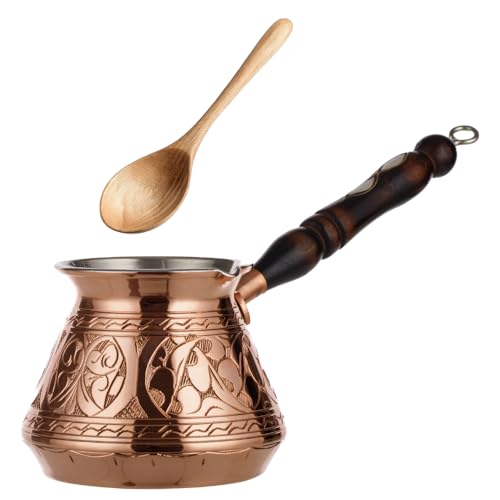
Best value copper cezve

Best stainless cezve

On induction, copper and most stainless cezves will not heat without an induction adapter disc. The other route is an electric machine.
Electric Turkish Coffee Machines
An electric Turkish coffee machine heats the coffee slowly and switches off as the foam rises, before it boils over. The Arzum Okka Minio is a well-known compact option that makes up to four cups. It is the easiest way to get consistent foam, and it solves the induction problem, at the cost of the ritual and a higher price.
Check today’s Arzum Okka Minio price on Amazon →
Common Mistakes and Fixes
| Problem | Likely cause | Fix |
|---|---|---|
| No foam or thin foam | Heat too high, coffee stale, or grind too coarse | Lower the heat, use fresh extra-fine coffee |
| Boiled over | Heat too high or cezve too small | Watch the rise closely; use a larger cezve |
| Gritty texture | Grind not fine enough | Use Turkish-grind coffee or a finer setting |
| Bitter, flat taste | Coffee boiled | Pull it off the heat at the first rise |
| Weak cup | Too little coffee or too much water | Use about 7 g per 60 to 70 ml |
Turkish Coffee vs Espresso and Moka Pot
| Turkish coffee | Espresso | Moka pot | |
|---|---|---|---|
| Grind | Powder, finest of all | Fine | Medium-fine |
| Filtered? | No, grounds settle in cup | Yes, basket | Yes, basket |
| Pressure | None | About 9 bar | About 1 to 2 bar |
| Texture | Thick, foamy, with sediment | Syrupy, with crema | Strong, clean |
| Gear cost | Very low | High | Low |
If you enjoy strong stovetop coffee, our how to use a moka pot guide covers the other classic, and moka pot vs espresso machine compares stovetop and machine coffee.
Our Verdict
Turkish coffee needs very little: a small cezve, powder-fine coffee, cold water, and patience with the heat. Start with Mehmet Efendi pre-ground coffee and a DEMMEX copper cezve. If you want to grind your own and also brew other methods, the KINGrinder K6 can reach the extra-fine range. For push-button foam, the Arzum Okka Minio does the work for you.
Start Making Turkish Coffee
A copper cezve and pre-ground Turkish coffee are all you need for your first cup.
As an Amazon Associate, CoffeeGearHub earns from qualifying purchases.
Editorial bottom line: Use powder-fine coffee, cold water, about 7 g per 60 to 70 ml, and low heat. Stir once, pull the cezve off as the foam rises, and never let it boil.
Frequently Asked Questions
What grind do you need for Turkish coffee?
The finest grind of any brew method: a powder like flour or cocoa, finer than espresso. Most electric grinders cannot go that fine. Buy pre-ground Turkish coffee, use a traditional Turkish hand mill, or use a capable hand grinder such as the KINGrinder K6 at its finest safe settings.
What is the ratio for Turkish coffee?
About 7 g of coffee, one heaped teaspoon, to 60 to 70 ml of cold water per cup. Scale it by the number of cups, and use a cezve sized for that many servings so the foam has room to rise.
Do you stir Turkish coffee while it brews?
Stir once at the start to mix the coffee and sugar into the cold water, then stop. Stirring during heating breaks up the foam, which is the mark of a well-made cup.
Should Turkish coffee boil?
No. Take the cezve off the heat as the foam rises, just before it boils. A full boil destroys the foam and makes the coffee taste flat and bitter.
Can you make Turkish coffee without a cezve?
You can use a very small saucepan, but a cezve’s narrow neck helps build and hold the foam, so the result is better. An electric machine such as the Arzum Okka Minio automates the whole process.
Can I make Turkish coffee on an induction stove?
Only with a compatible pot or an adapter. Copper cezves and many stainless ones are not magnetic, so they will not heat on induction directly. Use an induction adapter disc, an induction-ready cezve, or an electric Turkish coffee machine.
Sources and Further Reading
Preparation follows traditional Turkish coffee methods as described by Turkish coffee producers and cultural sources. UNESCO inscribed Turkish coffee culture and tradition on its Representative List of the Intangible Cultural Heritage of Humanity in 2013. KINGrinder K6 settings follow CoffeeGearHub’s K6 grind settings chart and KINGrinder’s guidance. Product details follow Amazon listings checked in November 2026. CoffeeGearHub did not test these products hands-on.
CoffeeGearHub product shortlist
Continue with related products on CoffeeGearHub
Review product categories and current verified merchant offers on CoffeeGearHub before leaving the site.