
Last Updated: February 17, 2026 | 18–24 min read
Best Coffee Makers (2026)
Most “bad coffee” isn’t your machine — it’s mismatch. The wrong brewer for your routine, the wrong grinder, a weak ratio, or a dirty machine can all make expensive equipment taste disappointing. This guide helps you choose the right coffee maker type, compares the main options across six brew methods, and routes you to the exact guides for dialing in flavor, upgrading gear, and keeping everything clean.
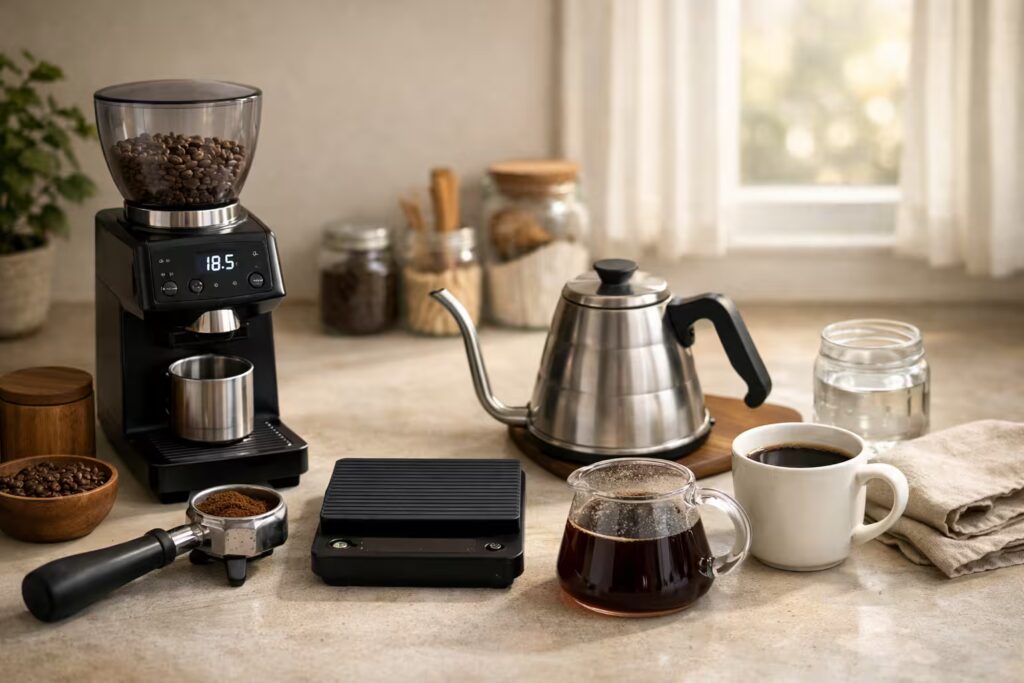
If you are brand new to home brewing, start with Coffee Brewing Foundations first — it makes every gear decision in this guide easier.
Key takeaways (save these)
- Pick the brewer you will actually use. Convenience beats “theoretical best flavor” for daily coffee.
- Grinder first. A burr grinder improves every brew method more than upgrading the machine does.
- Use a scale and a ratio for consistent sweetness and strength. Start with the Drip Coffee Ratio Guide.
- Fix taste fast with grind size. Use Grind Size Explained when coffee is sour, bitter, weak, or muddy — before changing anything else.
- Maintenance matters. Mineral scale and old coffee oils degrade flavor invisibly. A simple cleaning routine solves most “my coffee got worse” problems.
Coffee Maker Types Compared
Start with the type you will actually use most often. Flavor differences between brew methods are real — but they only matter if you are consistently using the brewer. An unused Chemex produces worse coffee than a used drip machine.
| Type | Best for | Flavor character | Effort | Common downside |
|---|---|---|---|---|
| Drip coffee maker | Daily consistency, households, easy mornings | Balanced and sweet when brewed well | Low | Cheap brewers under-extract; needs regular descaling |
| Pour-over (V60, Kalita, Chemex) | Hands-on brewing, clarity, tasting notes | Bright, aromatic, layered | Medium | Requires technique, gooseneck kettle, and a good grinder |
| French press | Full body, forgiving workflow, low gear cost | Rich, oily, bold | Low–medium | Muddy texture if grind is too fine |
| AeroPress | Fast single cups, travel, experimenting | Clean but strong; highly adjustable | Low–medium | Small capacity; not ideal for multiple cups at once |
| Moka pot | Strong stovetop coffee without an espresso machine | Intense, concentrated, slightly bitter edge | Low–medium | Requires attention to heat; burns easily |
| Cold brew | Batch brewing, smooth iced coffee, low acidity | Smooth, low acid, naturally sweet | Low (but slow — 12–24 hrs) | Requires planning ahead; not for hot coffee |
| Espresso machine | Milk drinks, café-style at home | Intense, syrupy when dialed in | High | Steep learning curve; grinder matters enormously |
| Pod / single-serve | Maximum convenience, minimal cleanup | Consistent, but limited freshness and control | Very low | Higher cost per cup; no grind control |
Which coffee maker fits your routine? (fast match)
| If you want… | Best match | Why | Next step |
|---|---|---|---|
| Push-button daily coffee for the household | Drip coffee maker | Easy, repeatable, great for multiple cups | Best coffee makers for everyday brewing |
| Clean, nuanced flavor with hands-on control | Pour-over | Highlights aromatics and tasting notes better than any other method | Pour-over brewing setup |
| Bold, full-bodied coffee with minimal gear | French press | Heavy body and oils, forgiving workflow, low entry cost | French press brew guide |
| Fast single cup, flexible recipes, travel | AeroPress | Forgiving, portable, wide grind and recipe range | AeroPress: Complete Brew Guide and Recipes |
| Strong stovetop coffee without an espresso machine | Moka pot | Concentrated, intense flavor using just a stovetop | How to use a moka pot |
| Smooth, low-acid iced coffee in batches | Cold brew | Steeping overnight produces naturally sweet, low-acid concentrate | Cold brew with a French press |
| Lattes, cappuccinos, milk drinks at home | Espresso machine | Concentrated extraction plus steam wand for milk drinks | Best espresso machines for beginners |
| Maximum convenience, zero grind decisions | Pod / single-serve | Fastest workflow with no cleanup or measuring | Best Nespresso machines or Best Keurig machines |
Choose Your Brew Method Path
Pick the method you brew most often and follow the row for gear guides, technique articles, and troubleshooting. Each row links to the best published guides on the site for that method.
Tip: If you are unsure where to start, drip is the most forgiving daily method. Once you have a burr grinder and a ratio dialed in, switching to pour-over or French press later costs almost nothing.
What to Buy First (So Your Coffee Maker Actually Tastes Great)
This order applies to every brew method — drip, pour-over, French press, and espresso. If you already have the machine, the grinder is almost always the highest-leverage upgrade available.
| Priority | Why it matters | Best next link |
|---|---|---|
| 1) Burr grinder | Controls grind consistency and extraction — the single biggest flavor upgrade for any brew method | Best coffee grinders for home brewing |
| 2) Scale + ratio | Repeatable strength and sweetness; eliminates random coffee | Drip coffee ratio guide or Best coffee scales |
| 3) Grind size understanding | Fastest troubleshooting tool for sour, bitter, weak, or muddy coffee — before changing anything else | Grind size explained or Coffee grind sizes chart |
| 4) Beans matched to your brew method | Bean origin, roast, and processing set the flavor ceiling — especially noticeable in pour-over and espresso | Coffee bean buying guide |
| 5) Maintenance routine | Prevents rancid oils and mineral scale from silently degrading flavor in an otherwise well-dialed setup | How to clean a drip coffee maker or Grinder cleaning and retention |
Three upgrades that work with any coffee maker
Before buying a new machine, these three changes consistently produce the biggest improvement in cup quality — and all three work with the brewer you already own.
Upgrade 1
Switch to a burr grinder
Consistent grind size is the number one flavor multiplier. A blade grinder produces inconsistent particles that extract unevenly — producing simultaneous sour and bitter with no adjustment capable of fixing both. A burr grinder solves this.
Upgrade 2
Use a scale and a ratio
Weighing coffee and water is the fastest path to repeatable results. Scoops vary. Tablespoons vary. Grams do not. A simple 1:15 ratio (1g coffee per 15g water) is the right starting point for drip and pour-over — adjust from there by taste.
Upgrade 3
Clean and descale regularly
Old coffee oils turn rancid within days and coat internal components with a bitter, stale residue. Mineral scale from tap water reduces brew temperature and water flow. Most “my coffee got worse over time” problems are cleaning problems, not equipment problems.
Fix Bad-Tasting Coffee (Fast Diagnosis)
Most taste problems are extraction problems. Change one variable at a time and always start with grind size — it has the fastest, most direct impact on flavor of any adjustment you can make.
If coffee tastes sour or sharp
- Grind slightly finer
- Increase brew time slightly
- Confirm your ratio is not too weak (too much water)
If coffee tastes bitter or harsh
- Grind slightly coarser
- Reduce brew time slightly
- Check for dirty equipment (old coffee oils)
If coffee tastes weak or watery
- Use more coffee (reduce your ratio — try 1:14 or 1:13)
- Grind slightly finer to slow extraction
- Confirm your brewer is reaching 195–205°F brew temperature
For a complete dial-in workflow across drip, pour-over, and espresso: How to Dial In Coffee at Home.
Coffee Maker Maintenance (So Flavor Stays Fresh)
Even a perfectly dialed-in brew routine produces poor results if the equipment is dirty or mineral-scaled. Both problems develop invisibly — flavor declines gradually over weeks rather than all at once, which is why “my coffee just doesn’t taste as good lately” is almost always a maintenance problem.
Drip coffee maker
☕ Coffee Lover Gift Guide
Looking for a thoughtful gift for a coffee enthusiast? Browse my curated Amazon gift guide featuring coffee gear, mugs, grinders, brewers, and accessories for different budgets.
Shop the Coffee Lover Gift GuideAs an Amazon Associate, I may earn from qualifying purchases.
FAQs: Beginner Coffee Guides
What type of coffee maker is best for beginners?
A drip coffee maker is usually the easiest starting point: simple workflow, consistent results for multiple cups, and easy to improve with a burr grinder and a scale. Once you have those fundamentals in place, switching to pour-over or French press later costs almost nothing. See u003ca href=u0022https://www.coffeegearhub.com/best-coffee-makers-for-everyday-brewing/u0022u003eBest Coffee Makers for Everyday Brewingu003c/au003e for specific picks.
Should I upgrade my coffee maker or my grinder first?
Upgrade your grinder first — always. A burr grinder improves extraction consistency for every brew method. Most bad coffee problems come from inconsistent or wrong grind size, not from the machine itself. See u003ca href=u0022https://www.coffeegearhub.com/best-coffee-grinders-for-home-brewing/u0022u003eBest Coffee Grinders for Home Brewingu003c/au003e.
Is pour-over better than drip coffee?
Pour-over can produce clearer, more nuanced flavor — if you are willing to do a hands-on workflow with a gooseneck kettle and a scale. A well-made drip machine brewed at the correct ratio is excellent for daily coffee with less effort. Choose based on your actual routine, not what tastes best in theory. The comparison is in u003ca href=u0022https://www.coffeegearhub.com/drip-vs-pour-over-coffee/u0022u003eDrip vs Pour-Over: Which Is Better for Home Brewing?u003c/au003e
Why does my drip coffee taste bitter or burnt?
The most common causes are grind too fine, stale or dark-roasted beans, a too-strong ratio, or coffee oils and mineral scale built up inside the machine. Start by grinding slightly coarser and checking your ratio (1:15 is a reliable baseline). If that does not help, clean and descale the machine. See u003ca href=u0022https://www.coffeegearhub.com/common-drip-coffee-mistakes/u0022u003e10 Drip Coffee Mistakesu003c/au003e for a full list.
What’s the best coffee-to-water ratio for drip coffee?
1:15 by weight — 1 gram of coffee per 15 grams of water — is the most widely recommended starting point. In practical terms, that is approximately 60g of coffee per 1 liter of water, or roughly 1 tablespoon per 6 oz of water if you are not using a scale. For stronger coffee try 1:14 or 1:13; for lighter coffee try 1:16 or 1:17. See u003ca href=u0022https://www.coffeegearhub.com/drip-coffee-ratio/u0022u003eDrip Coffee Ratio Guideu003c/au003e for exact gram tables and scaling.
Do I need a gooseneck kettle for pour-over?
It is strongly recommended for V60-style brewers where pour speed and placement affect extraction. For a Chemex or Kalita Wave, a gooseneck improves consistency significantly. For a Clever Dripper or French press, a standard kettle is fine. See u003ca href=u0022https://www.coffeegearhub.com/best-gooseneck-kettles-for-pour-over-coffee/u0022u003eBest Gooseneck Kettles for Pour-Overu003c/au003e.
Is espresso worth making at home?
Yes if you drink milk drinks regularly or want café-level espresso intensity. The investment in machine and grinder is substantial, but ongoing cost per cup is much lower than a café. The learning curve is steeper than drip or pour-over. Start with u003ca href=u0022https://www.coffeegearhub.com/best-espresso-machines-for-beginners/u0022u003eBest Espresso Machines for Beginnersu003c/au003e and u003ca href=u0022https://www.coffeegearhub.com/beginner-espresso-guide/u0022u003eBeginner Espresso Guideu003c/au003e.
How often should I clean or descale my coffee maker?
Rinse removable parts after every use. Do a full cleaning with coffee equipment cleaner monthly. Descale every 1–3 months depending on your water hardness — more often in hard water areas. Machines in hard water regions can scale significantly within 4–6 weeks of regular use. See u003ca href=u0022https://www.coffeegearhub.com/how-to-clean-a-drip-coffee-maker/u0022u003eHow to Clean a Drip Coffee Makeru003c/au003e for the full schedule.
What is the best grind size for French press?
French press requires a coarse grind — coarser than drip and significantly coarser than pour-over. Using a medium or medium-fine grind produces over-extracted, muddy, bitter coffee that seeps through the press filter. The KINGrinder K6 at 65–78 clicks is the site standard recommendation for manual grinding. See u003ca href=u0022https://www.coffeegearhub.com/french-press-grind-size/u0022u003eFrench Press Grind Size Guideu003c/au003e for full parameters.
Is AeroPress good for beginners?
AeroPress is one of the most forgiving brew methods available — it tolerates a wide range of grind sizes, water temperatures, and brew times without producing terrible results. It also produces excellent coffee when technique is refined. It is a genuinely good first brewer for someone who wants quality without a high gear investment. Start with u003ca href=u0022https://www.coffeegearhub.com/aeropress-recipes/u0022u003eAeroPress: Complete Brew Guide and Recipesu003c/au003e.